
TradeStation at a glance
TradeStation is a self-directed broker and trading-technology company built for customers who analyze and execute frequently. Its identity is not merely “commission-free trading.” The differentiators are charting, scanning, strategy development, historical testing, order automation, and a workflow that spans equities, options, and futures.
TradeStation now promotes TITAN X as its modern active-trader experience while continuing to support the established Windows Desktop platform and EasyLanguage strategies. HUB, mobile apps, TradingView connectivity, and APIs provide additional ways to manage the same brokerage relationship.
| Review question | DollarScout finding |
|---|---|
| Best for | Systematic and technically fluent active traders |
| Headline stock price | Eligible U.S. stocks and ETFs can start at $0 |
| Signature capability | EasyLanguage, backtesting, RadarScreen, and automated strategies |
| Main cost risk | Activity, routing, data, product, and service fees beyond the headline |
| Main usability risk | Powerful interfaces require setup and ongoing control |
Commissions and the complete cost
Trading Costs scores 4.0/5. TradeStation advertises U.S. exchange-listed stocks and ETFs from $0 for eligible domestic accounts. Current pricing scales by cumulative monthly volume for equities, options, and futures, with each asset class evaluated separately. A customer can therefore occupy different tiers at the same time.
The headline does not cover every trade. Executions below $1 and many OTC securities have a per-share charge and minimum. Direct routing, delegated or externally executed orders, futures options on FuturesPlus, broker assistance, exchange and regulatory charges, and some international or specialist transactions have distinct costs. The final order ticket and current fee schedule control.
TradeStation lists a $10 monthly inactivity fee that is waived when minimum activity conditions are met. Its service schedule also lists charges such as $14.95 for option exercise or assignment, $125 for an outgoing account transfer, $25 for an outgoing domestic wire, and $75 for certain risk liquidations. Legacy commission plans can have materially different account-service requirements.
This complexity is not automatically bad. High-volume traders may obtain lower tier rates, and active brokerage customers receive substantial platform capability without a separate base software charge. But “$0” is an incomplete budget.
Market data and platform expense
Basic data is available under qualifying arrangements, while exchange depth, specialist indices, international venues, professional status, and premium feeds can create recurring subscriptions. Professional subscribers generally pay much more because exchanges set different licensing terms.
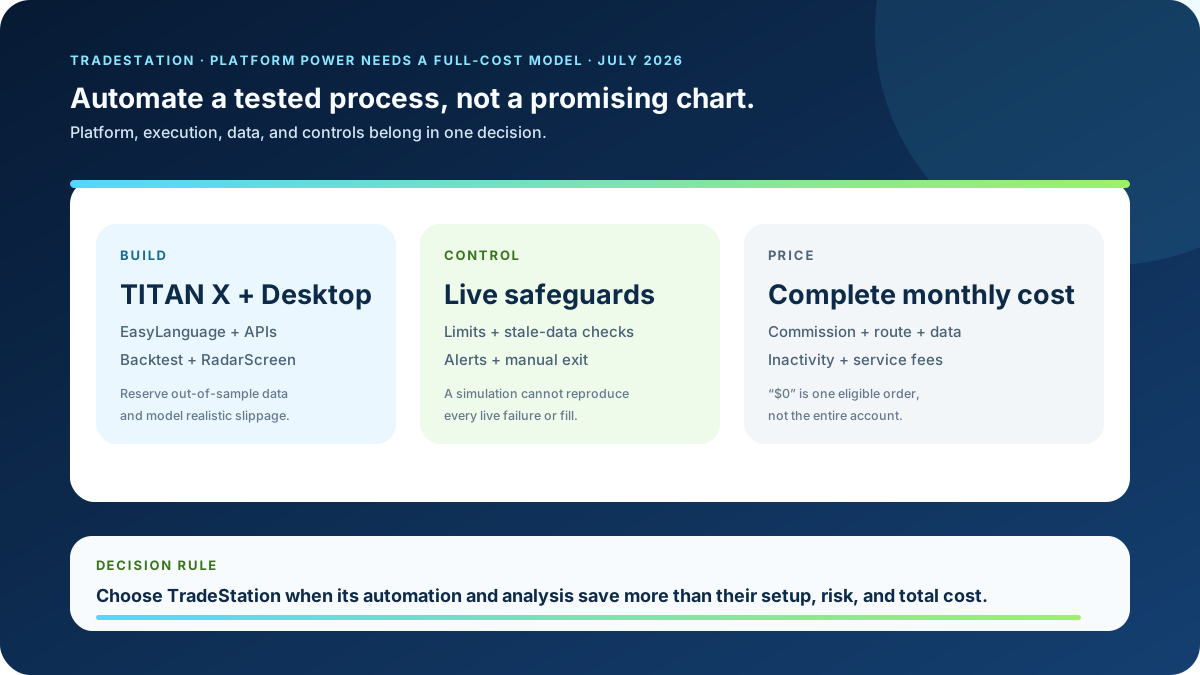
Estimate cost with four lines: expected commissions, routing and exchange pass-throughs, platform or inactivity fees, and every data subscription. Use average monthly volume rather than the customer’s best month. An occasional trader should compare that total with a mass-market broker that includes the needed data.
TradeStation Analytics is also available without a brokerage relationship, with plans advertised from $99 monthly. That is a separate analysis-software decision and should not be confused with platform access attached to a funded active brokerage account.
TITAN X and the Desktop platform
Platform scores 4.7/5. TITAN X is TradeStation’s newer desktop direction, available on Windows and Mac, with modern charting and updated multi-leg option support. TradeStation Desktop remains the deepest established environment for RadarScreen, EasyLanguage automation, Portfolio Maestro, OptionStation Pro, Matrix order entry, and extensive workspaces.
The coexistence is useful but creates a migration question. A feature or workflow in legacy Desktop may not be identical in TITAN X, web, mobile, or a third-party connection. Before moving a production strategy, verify the supported order types, alerts, indicators, data history, session templates, and automation behavior in that exact interface.
HUB provides account administration and browser access. Mobile apps cover monitoring, alerts, charts, and orders. TradingView connectivity can be convenient, but promotions and commission treatment may differ for orders sent through an outside interface.
EasyLanguage, testing, and automation
Trading Tools scores 4.8/5. EasyLanguage lowers the barrier to expressing an indicator or rule compared with a general-purpose programming stack. Chart Analysis, RadarScreen, and strategy testing can share logic, while APIs support developers who prefer their own language and infrastructure.
The disciplined workflow is: define the hypothesis, reserve out-of-sample data, include realistic costs and slippage, test multiple market regimes, size for drawdown, and paper-trade the complete operational path. Avoid optimizing dozens of parameters against one historical period.
Automation needs live supervision. The trader remains responsible for duplicate orders, rejected orders, disconnects, stale data, corporate actions, contract rolls, buying power, and kill switches. Begin with small size and a documented manual exit process.
Scanning, options, and portfolio tools
RadarScreen continuously evaluates symbols and custom calculations. OptionStation Pro supports chains, spreads, probability-oriented analysis, and position modeling. Portfolio Maestro backtests strategies across portfolios rather than a single chart. These tools are valuable to a trader with a repeatable process and largely unnecessary to someone buying a target-date fund.
Option spreads require at least $2,000 of available equity under the current margin page, while uncovered option strategies require $5,000. Approval, strategy level, and real-time buying power still govern. Model assignment, early exercise, dividends, pin risk, and the possibility that one spread leg executes without another.
TradeStation’s service schedule charges for exercise and assignment. A short option that looks inexpensive can therefore produce commissions, assignment exposure, margin changes, and a stock position. The risk graph is a model, not a promise of a clean exit.
Futures trading and leverage
TradeStation supports futures and futures options through product-specific accounts and interfaces. Brokerage commission is only one layer; exchange execution, clearing, NFA, data, routing, overnight, and delivery-related charges can apply.
Intraday margin is not the maximum possible loss. TradeStation can raise requirements, and exchange initial margin becomes relevant for overnight positions. The broker can liquidate positions when equity is insufficient, with additional fees. Physically deliverable contracts require a roll or exit before restricted dates.
Use the official contract table for tick value, session, margin, exchange fee, and delivery rule. A “micro” contract reduces notional exposure but does not make an overleveraged strategy safe.
Execution and published statistics
Execution Speed scores 4.5/5. TradeStation reported that covered equity market orders in Q1 2026 averaged 0.063 seconds, with 91.43% executed at or better than the relevant benchmark and $3.04 average price improvement per covered order. Those are provider statistics for defined order populations, not a prediction for every symbol, size, condition, or route.
Limit orders, direct routes, thin securities, futures, options, premarket sessions, and volatile markets behave differently. A faster acknowledgement is not the same as a better fill. Evaluate effective spread, price improvement, reject rate, stability, and the fill quality of the orders the customer actually sends.
TradeStation’s routing relationships and payment arrangements are described in its regulatory reports. Traders who choose routes manually should understand venue fees and rebates rather than selecting solely on displayed liquidity.
The June 2026 day-trading rule change
TradeStation states that the former fixed $25,000 pattern-day-trader equity requirement was eliminated effective June 4, 2026. That does not eliminate margin controls. The account must still meet product, strategy, maintenance, concentration, and real-time risk requirements, and the broker can restrict leverage or liquidate positions.
A lower entry threshold can increase risk by making high turnover accessible with less capital. Budget loss limits, transaction costs, and an emergency reserve before using intraday buying power. Confirm the rule implementation in the live account because broker controls can change.
Support and account operations
Customer Service scores 4.0/5. TradeStation offers phone, chat, Client Center, trade-desk, educational, and technical resources. The FAQ is unusually detailed about data, simulation, platforms, and specialized accounts.
DollarScout did not test response times, an outage, a margin call, a transfer, or a corrected tax form. Active traders should save trade-desk numbers outside the platform, retain confirmations and logs, and know how to cancel or modify an order if the primary interface fails.
Cancellation of a subscription or specialized platform can require contacting Client Services before month-end. Review the next statement after any change so an unwanted feed or platform fee does not continue.
TradeStation versus alternatives
Choose Interactive Brokers when global market breadth, multi-currency financing, professional order types, and multiple APIs matter most. Choose tastytrade when the primary workflow is visual options strategy construction with simple capped equity-option commissions.
Lightspeed can be more direct for a high-volume equities trader prioritizing hotkeys and route control, but its monthly economics are demanding. NinjaTrader is more focused for futures-only traders who want low intraday margins, simulation, and a plan-based price structure.
Who TradeStation is best for
TradeStation fits traders who:
- Will use backtesting, scanning, automation, or APIs.
- Trade equities, options, or futures often enough to justify setup.
- Can model routing, data, inactivity, and service fees.
- Maintain operational controls for automated orders.
- Want both a mature desktop environment and a modern TITAN X path.
It is weaker for passive investors, people seeking a managed portfolio, and beginners who interpret simulation or leverage as protection.
Bottom line
TradeStation earns 4.4/5. The platform and tool scores are high because few retail brokers combine EasyLanguage, RadarScreen, portfolio testing, options analysis, APIs, and multi-asset execution as coherently.
The cost score is lower because the advertised commission is only the first line of the budget. TradeStation is worth considering when its technology supports a tested process; it is not worth paying for complexity the customer will not use.


