
Lemonade at a glance
Lemonade is an app- and web-first insurance platform offering renters, homeowners, condo, car, pet health, and term life products in the United States. Its central design choice is automation: AI Maya guides quoting and policy changes, while claim intake begins in the app and straightforward cases can be processed automatically.
The digital experience is genuinely simpler than many legacy carrier flows. The product footprint is not. Each line has its own state map, underwriting structure, coverage, and claims risk. A person who can buy Lemonade renters insurance may not be able to buy Lemonade Car or homeowners at the same address.
| Review question | DollarScout finding |
|---|---|
| Best for | Straightforward renters coverage and app-first policyholders |
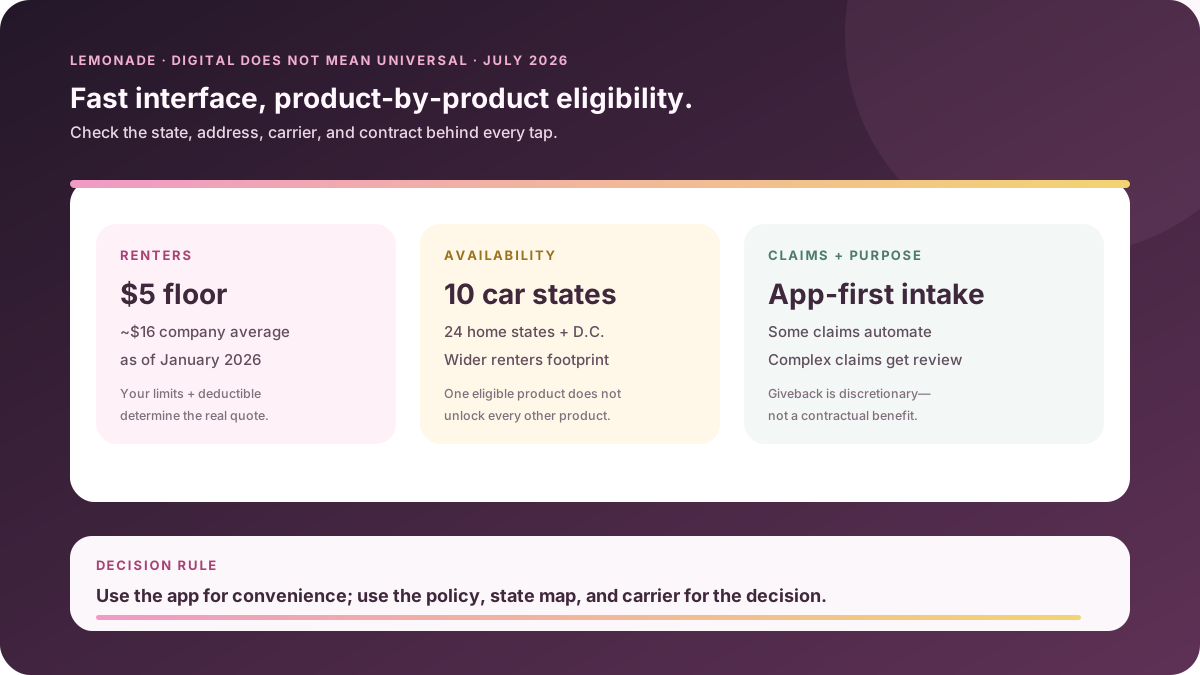
| Renters pricing claim | Starts at $5/month; company average about $16/month in January 2026 |
| Car availability | 10 states: AZ, CA, CO, IL, IN, OH, OR, TN, TX, and WA |
| Signup channel | Website or app; Lemonade says phone signup is not available |
| Main limitation | Product geography and human-service depth vary significantly |
Renters pricing: what $5 means
Price scores 4.4/5. Lemonade currently says renters insurance starts at $5 per month and reports an average around $16 per month as of January 2026. Those are company figures. The $5 amount is a marketing floor for an eligible risk and coverage combination, not a typical or guaranteed premium.
The actual quote can depend on state, address, building, protection devices, claims, selected personal-property limit, liability, loss of use, deductible, scheduled valuables, optional coverage, and permissible underwriting factors. A $5 quote with a high deductible and low property limit is not comparable with a $16 or $25 quote containing stronger protection.
Build a personal-property inventory before quoting. Add replacement values for electronics, clothing, furniture, kitchen items, bicycles, jewelry, hobby equipment, and everything stored away from immediate view. Check whether settlement is replacement cost, what sublimits apply, and whether accidental damage or scheduled-item coverage is needed.
Compare liability, medical payments, loss of use, water backup, deductible, exclusions, and annual total—not only the monthly headline. A landlord’s required minimum protects the landlord’s concern; it does not necessarily protect the renter’s full property and liability exposure.
Homeowners and condo coverage
Coverage scores 4.0/5. Lemonade’s homeowners and condo experience retains the fast digital quote and policy-management approach. Standard homeowners concepts can include dwelling, other structures, personal property, loss of use, liability, and medical payments, subject to the actual form and state.
The current availability page lists homeowners in 24 states plus Washington, D.C. That is meaningful reach but far from universal. Even in a listed state, address, construction, roof, wildfire, wind, coastal, prior-loss, occupancy, or inspection rules can prevent an offer.
Lemonade’s current Terms of Service also state that certain homeowners quotes are underwritten by member companies of Homesite. That is a crucial entity boundary. A Lemonade interface can lead to a policy whose underwriting company has sole contractual and claims responsibility. Read the quote, not the app color, to identify the carrier.
Property shoppers should inspect replacement-cost estimation, roof settlement, water backup, service line, equipment breakdown, ordinance or law, matching, valuables, home business, short-term rental, flood, earthquake, and wind or named-storm deductibles. Flood and earthquake are not made part of a standard policy by a digital signup.
Lemonade Car availability and pricing
Lemonade Car is currently listed in Arizona, California, Colorado, Illinois, Indiana, Ohio, Oregon, Tennessee, Texas, and Washington. That 10-state footprint is the main reason Coverage does not score higher.
Car uses app and location-related technology, and Lemonade’s terms contain specific location-services disclosures for enrolled drivers. Auto pricing can consider the normal driver, vehicle, use, location, history, coverage, deductible, and state factors plus telematics or mileage where applicable.
Do not assume every app-based auto program rewards only “safe driving.” Read the exact state policy and consent, including trip collection, phone permissions, driver attribution, mileage, opt-out, and renewal treatment. Lemonade’s standard car policy can exclude rideshare or delivery activity; a rideshare endorsement is currently described only in selected states. Confirm coverage before logging into a platform.
Pet and life products
Pet health and term life extend Lemonade beyond property and auto, but they follow different risk and claim structures. Pet coverage can include waiting periods, exclusions for pre-existing conditions, annual limits, deductibles, reimbursement percentages, preventive packages, and age or state rules. A low monthly quote can exclude routine care unless an optional package is added.
Term life pricing depends on age, health, term, amount, and underwriting. Life does not participate in Giveback under Lemonade’s public FAQ. Identify the issuing life company and read conversion, contestability, beneficiary, exclusion, and payment provisions.
A bundle can simplify billing or create a discount without making the products one contract. Keep the carrier, policy number, claims path, renewal date, and exclusions for each line.
Claims automation and human review
Claims Experience scores 4.2/5. Lemonade claims begin in the app. The policyholder describes the event, supplies documentation, and can record a video. Lemonade says its systems apply anti-fraud checks and that eligible instant approvals can pay quickly. Its current claims page reports that roughly 40% of claims are handled instantly and highlights a fastest recorded claim.
Those are company-wide marketing metrics, not a service-level agreement. Complex property damage, theft with verification issues, liability, injury, catastrophe, high-value items, coverage disputes, and suspicious or incomplete submissions can require human adjusters, documents, inspection, recorded statements, experts, or additional time.
Automation can reduce routine friction; it can also make missing evidence more consequential. Preserve receipts, photos, video, serial numbers, police or fire reports, mitigation records, repair estimates, pet medical records, and communications. For property damage, take reasonable emergency steps to prevent further loss without discarding evidence or authorizing permanent work before understanding the process.
If a claim is denied or underpaid, request the decision, policy language, valuation, depreciation, deductible, and appeal or supplemental process in writing. The app is a submission channel, not the final authority over state insurance rights.
Customer service and accessibility
Customer Service scores 4.0/5. The app and website make routine changes unusually easy. Lemonade says customers can change limits or deductibles, manage payment, cancel applicable policies, and submit claims digitally. Documentation and explainers are extensive.
The company’s FAQ says customers cannot sign up by phone. That is a real limitation for people who need live guidance before choosing coverage, have accessibility needs not served by the flow, or own complex risks. Human support exists for cases and service, but the platform is not designed around a dedicated local agent.
An automated quote places more responsibility on the buyer. AI Maya’s Terms of Service say insurance conclusions and selection of coverage amounts, limits, and deductibles remain the insured’s responsibility. A simple interface can still produce an underinsured policy.
Discounts and bundling
Discounts score 3.9/5. Lemonade describes automatic multi-policy savings for eligible combinations and property discounts for protective devices such as alarms, deadbolts, or smoke detectors. Exact availability and amounts vary by product and state.
The menu is less mature than the large traditional auto carriers, and limited product geography can make a desired bundle impossible. Evaluate the final combined premium, coverage, and carrier structure. A 10% bundle claim is not valuable if one component has worse protection or the household cannot buy it in the state.
Giveback, accurately stated
Lemonade presents Giveback as part of its public-benefit model. Policyholders can select a cause, and Lemonade may donate money associated with groups after claims, expenses, reinsurance, and other amounts. Its legal terms say Giveback is a policy and expression of intent, not a contractual obligation to the policyholder or cause. The company can suspend or amend it, and payment is subject to discretion, regulation, and financial considerations.
That means Giveback should not be valued as a rebate, policy benefit, or amount the customer controls. It does not increase claim limits, lower a deductible, or guarantee a donation. Choose Lemonade because the policy and service fit; view any charitable impact as discretionary and separate.
Availability and underwriting identity
Lemonade operates across many states, but not every product is available in every state. Its 2026 annual reporting says the group offers one or more products in a broad footprint; the product-specific map remains the relevant source for a household.
At checkout, identify the underwriting company and policy form. Lemonade Insurance Company, another Lemonade group company, Homesite members, or other product partners can have different obligations. Use the legal company and NAIC number for complaint and financial research.
Complaints and financial checks
NAIC Consumer Insurance Search lets consumers examine licensing, financial information, and confirmed complaints. Search the company on the actual policy, then filter by state, year, and line. Renters, homeowners, auto, pet, and life should not be combined into one complaint conclusion.
Lemonade’s FAQ cites a Demotech financial stability rating. Verify any current rating directly with the rating organization and confirm the rated legal entity. A rating evaluates claims-paying capacity, not whether an individual loss falls within the contract.
Lemonade versus alternatives
Choose State Farm when broad state reach, a local agent, and a traditional multi-policy relationship matter. Choose GEICO for a mature direct auto product, recognizing that its property agency also uses partner insurers.
Choose Progressive for deeper auto and specialty-vehicle coverage, independent agents, and comparison tools. Choose Allstate for an agent-supported home-auto bundle, Drivewise or Milewise, and a broader endorsement menu.
Who Lemonade is best for
Lemonade fits customers who:
- Need straightforward renters coverage in an eligible state.
- Prefer app and web self-service over phone or local-agent signup.
- Will build their own inventory and select coverage deliberately.
- Understand that automated claim intake can move to human review.
- Verify product availability and the underwriting company.
It is weaker for complex or high-value property, customers wanting phone-based purchase advice, drivers outside the 10 car states, or anyone treating Giveback as a contractual benefit.
Bottom line
Lemonade earns 4.1/5. Price and digital claims usability are its best attributes. The renters flow can be genuinely efficient, and routine policy management is clear. Coverage and discounts are constrained by state-by-state product reach, while the service model is less suited to buyers needing an assigned advisor.
Ignore the superficial story that Lemonade is simply “cheap AI insurance.” The correct decision checks the address-specific quote, limits, deductible, state map, carrier, and policy. Automation is valuable when it removes paperwork—not when it substitutes for coverage analysis.