Many products on this page are from partners who compensate us. This doesn't influence our ratings. Our opinions are our own.
Checking vs. Savings Accounts
By Sophie Brown, Senior Finance Editor · Updated Jul 2026 · Fact-checked Jul 18, 2026
Checking and savings accounts are both deposit accounts, but they solve different cash-management problems. Checking is built for frequent payments; savings is built to separate reserves and usually earn interest. The useful question is not which one is universally better, but what money belongs in each and what the account agreement actually allows.
Key takeaways
- Use checking for near-term transactions and savings for money that should remain separate from routine spending.
- Compare the full account agreement: fees, minimums, access methods, transfer rules, APY, and deposit availability all matter.
- The Federal Reserve removed the federal six-transfer limit in 2020, but a bank may still impose its own savings-account limits or fees.
- Checking and savings balances in the same ownership category at the same bank are combined for FDIC insurance purposes.
- A practical setup keeps a checking buffer plus labeled savings reserves and tests transfers before relying on them in an emergency.
Start with the job the money must do
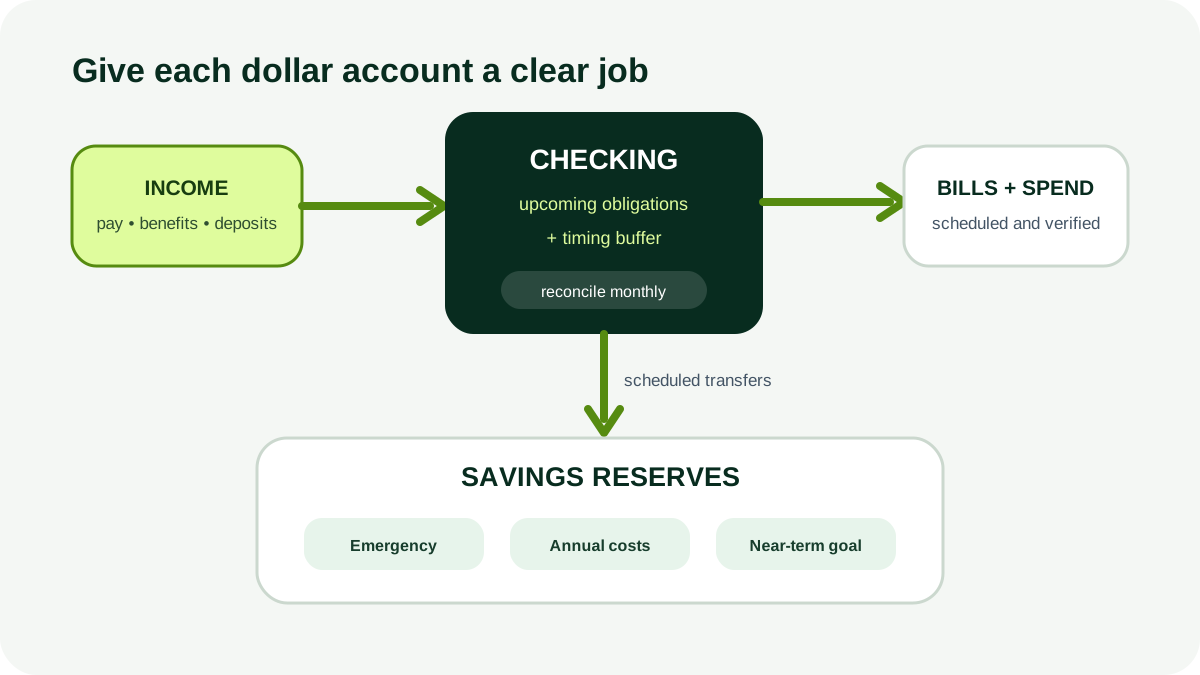
A checking account is an operating account. Paychecks arrive, card purchases settle, bills debit, checks clear, and cash moves to other accounts. A savings account is a reserve account. It creates distance between money intended for later and the balance available for ordinary spending. That separation is useful even when both accounts sit at the same institution.
Neither label guarantees a particular fee, rate, card, checkbook, or transfer speed. Those details come from the deposit agreement and fee schedule. The CFPB's account-opening checklist recommends comparing maintenance fees, minimum balances, transaction charges, ATM costs, digital access, overdraft terms, alerts, and interest. Treat the product name as a starting point and the disclosures as the actual product.
The practical differences
| Feature | Checking account | Savings account |
|---|---|---|
| Primary job | Receive income and make frequent payments | Hold reserves away from daily spending |
| Typical access | Debit card, ACH, bill pay, checks, ATM | Transfers, ATM or teller access; card access varies |
| Interest | Often none or relatively low | Commonly interest-bearing; rate can change |
| Transaction design | Built for repeated third-party payments | Institution may limit certain withdrawals or transfers |
| Main risk | Fees, overdrafts, fraud exposure, spending down the balance | Slow access, withdrawal rules, rate changes, underfunded checking |
| Useful balance | Upcoming obligations plus a buffer | Emergency fund and planned future expenses |
Checking is normally the better place for rent, payroll, utilities, loan payments, card payments, and cash needed before the next income cycle. Savings is normally better for an emergency fund, annual insurance premium, tax reserve, home repair, or another amount with a later purpose.
Do not place every dollar in whichever account advertises the higher annual percentage yield. An extra fraction of a percentage point cannot compensate for an overdraft, a missed payment, or an emergency transfer that does not arrive when expected.
Access is more than “instant” or “available”
An app may display a combined balance while the underlying accounts have different rules. Confirm how to move money, any daily or monthly limits, whether an external transfer uses ACH, and when transferred funds become available. A transfer shown as pending is not necessarily spendable. Weekends, holidays, fraud review, new-account holds, and the direction of the transfer can affect timing.
Also distinguish the account's current balance from its available balance. Pending debit-card transactions, check holds, scheduled ACH debits, and provisional credits can make those figures differ. Build the checking buffer from the amount genuinely available after known obligations, not from a headline total.
If savings is at another bank, run a small transfer in both directions before treating the setup as operational. Record how long it takes and which institution initiates the transfer. Keep another way to pay for a true emergency during the transfer window.
The six-withdrawal rule is no longer a federal requirement
Older advice often states that every savings account is limited to six convenient withdrawals per month. In April 2020, the Federal Reserve amended Regulation D to delete that numerical limit from the definition of a savings deposit. The change allows institutions to suspend the old limit; it does not require them to offer unlimited transfers.
A bank or credit union may still disclose its own withdrawal limit, fee, notice requirement, or product rule. Read the current agreement instead of assuming either “six” or “unlimited.” If the account is meant for emergencies and a few planned expenses, frequent withdrawals can also be a sign that the checking buffer or monthly budget needs adjustment.
Interest matters, but use the right comparison
For an interest-bearing account, compare APY rather than only the stated interest rate. APY incorporates the effect of compounding under the disclosed assumptions. Then check whether the APY applies to the whole balance, only a tier, or only when conditions are met. A promotional rate can expire; a variable rate can change after opening.
Estimate the dollar consequence using the balance likely to remain in the account. A one-percentage-point APY difference is roughly $10 a year per $1,000 before compounding and taxes. On a $500 working balance, convenience and fees will often dominate. On a $25,000 reserve, the rate difference is more meaningful, provided the account remains insured and accessible enough for its purpose.
Interest on a deposit account is generally taxable income. The account should solve the cash-management job first; tax reporting and rate shopping come after basic reliability.
Deposit insurance applies by ownership, bank, and category
FDIC insurance covers eligible deposits at an FDIC-insured bank, including checking and savings accounts. The standard limit is $250,000 per depositor, per insured bank, for each ownership category. Two individually owned accounts at the same bank do not each receive a separate $250,000 limit merely because one is checking and one is savings. They are added together within the single-account ownership category.
For example, $40,000 in individual checking and $230,000 in individual savings at the same insured bank total $270,000 in that ownership category. Subject to the account records and applicable rules, $250,000 would fall within the standard limit and $20,000 would exceed it. A joint account or certain retirement account may be in a different ownership category, but titles and requirements matter. Use the FDIC's EDIE estimator for a real configuration.
Federally insured credit unions use NCUA share insurance rather than FDIC insurance. The protection is comparable in purpose, but verify the institution and coverage with the correct agency.
Build a two-account operating system
Start with one month of expected transactions. List pay dates, fixed bills, variable spending, card-payment dates, and irregular costs due soon. Set a checking floor large enough to absorb normal timing errors without becoming an invitation to spend. The right buffer is personal: it may be a few hundred dollars, one pay cycle of expenses, or another tested amount.
Move money for later purposes to savings shortly after income arrives. One savings account with a written bucket ledger can work; multiple named savings buckets can make the separation clearer if the bank offers them without added fees. Avoid creating so many accounts that reconciliation becomes difficult.
Example monthly flow:
- Net pay of $4,800 arrives in checking.
- Keep $3,650 for bills, card spending, and the checking floor.
- Transfer $600 to the emergency reserve and $350 to irregular-expense savings.
- Send $200 to a separate goal only after near-term obligations are covered.
- Review checking before large discretionary purchases and reconcile both accounts monthly.
The transfer is not spending. It changes the location and purpose of cash. In a budget or net-worth tracker, exclude transfers from income and expense totals while measuring progress toward each savings goal separately.
When one account may be enough
A single checking account may be adequate when the balance is small, the account pays a competitive yield, fees are zero, and the owner can reliably avoid spending reserved money. A single savings account is rarely a complete operating account because payment tools and transaction policies may be limited.
Adding an account is useful only if the separation improves decisions or economics. If a second account creates a maintenance fee, minimum-balance problem, or missed-payment risk, the structure is working against its purpose.
Review the setup twice a year
Rates, fees, branch access, ATM networks, and product terms can change. Check the current fee schedule and APY, verify beneficiaries and contact details, test alerts, and confirm that automatic transfers still match income timing. Review whether the checking buffer prevented overdrafts without becoming unnecessarily large.
Security matters too. Turn on transaction and low-balance alerts, use unique credentials and multifactor authentication, and review statements. A savings account is not protected from unauthorized access merely because it lacks a debit card.
Bottom line
Checking and savings are complementary tools. Keep transaction money and a deliberate buffer in checking; keep emergencies and known future costs in savings. Compare disclosures rather than labels, test access before depending on it, and calculate insurance across all accounts at the same bank and in the same ownership category. The best structure is the smallest one that keeps bills reliable, reserves visible, and fees near zero.
Related content
Frequently asked questions
Sources
Related content
More from DollarScout on this topic.
