
Kraken at a glance
Kraken is a custodial cryptocurrency exchange with a beginner-oriented purchase flow and a more capable Kraken Pro trading interface. Its strongest differentiators are account-security controls, a wide asset and network catalog, transparent public Pro fee tiers, advanced orders, API access, and proof-of-reserves disclosures.
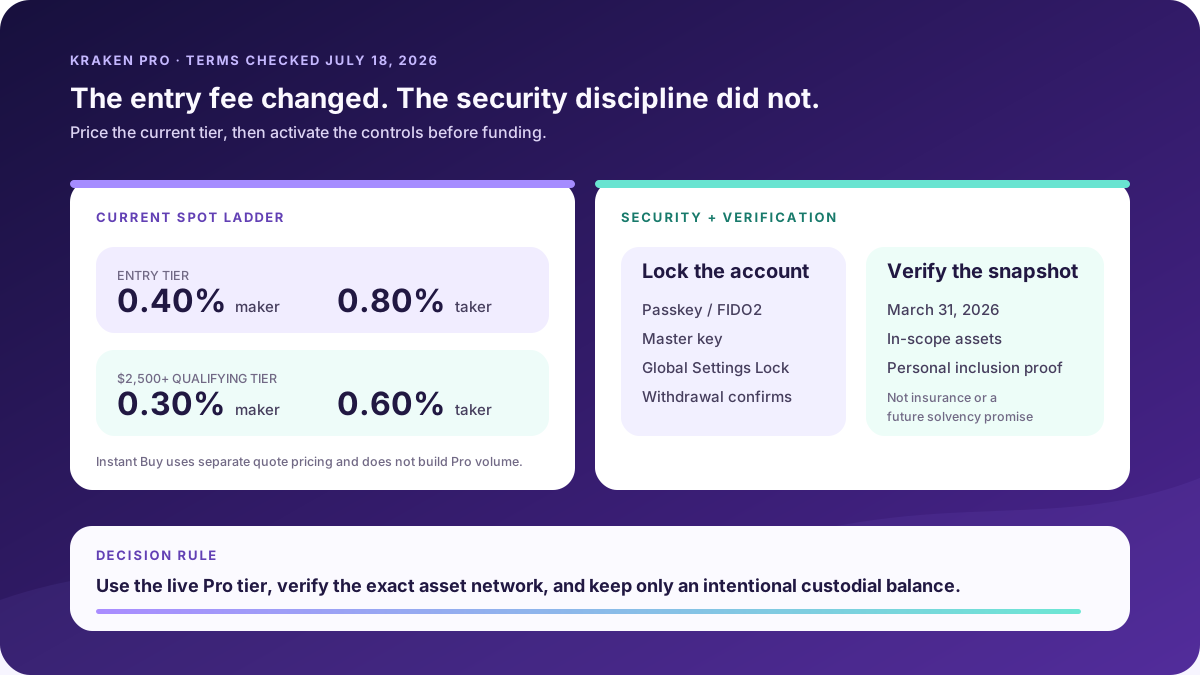
The 2026 fee table changes the cost story. Older pages often repeat a 0.25% maker / 0.40% taker starting rate. That is no longer the public entry tier. On July 18, 2026, Kraken's spot schedule showed 0.40% maker / 0.80% taker for the initial tier, followed by 0.30% / 0.60% at the next qualifying tier of $2,500 or more. Anyone comparing exchanges from an old article can understate Kraken's current low-volume cost materially.
| Review question | DollarScout finding |
|---|---|
| Best for | Security-conscious users who want Pro tools and a broad asset list |
| Entry Kraken Pro spot rate checked | 0.40% maker / 0.80% taker |
| Next published tier | 0.30% maker / 0.60% taker at $2,500+ qualifying tier |
| Main strength | Security controls plus transparent order-book and reserve documentation |
| Main limitation | Entry pricing rose and product eligibility varies by location |
Kraken Pro fees in 2026
Trading Fees scores 3.6/5. Kraken Pro uses maker/taker pricing. A maker order rests on the book and adds liquidity; a taker order executes against existing liquidity. Market orders are takers, while a limit order can be maker or taker depending on whether it crosses the book.
The published entry tier is 0.40% maker and 0.80% taker. At the next displayed tier—$2,500 or more of the qualifying metric—the rates fall to 0.30% and 0.60%. Further tiers reduce them, eventually reaching very low or zero maker rates for the largest eligible accounts. Kraken says tier qualification can reflect the applicable rolling spot volume or eligible assets held on the platform under the current program rules, and calculations update according to the schedule.
This structure changes the recommendation for a new occasional buyer. An 0.80% taker fee is not cost leadership against exchanges publishing 0.02% or less for comparable spot orders. Kraken remains competitive for users who qualify for better tiers, value the overall product, or use maker orders carefully, but the fee score must reflect what a new low-volume account actually sees.
Stablecoin, FX, margin, futures, OTC, staking, deposit, and withdrawal charges can follow separate schedules. Do not apply the headline spot table to every transaction. The order confirmation and current asset-specific funding page control.
Instant Buy is a different product
Kraken's app and Instant Buy routes prioritize speed and an all-in quote. The pricing can include a displayed Kraken fee and spread, and a payment processor or card can add cost. Kraken states that Instant Buy purchases do not count toward the volume used for Kraken Pro tiers.
That separation can surprise a recurring buyer: paying for convenience does not necessarily move the account toward a lower Pro rate. Before confirming, compare how much crypto the same dollar amount would buy through a Pro limit or market order after all fees. Also include the cost of depositing funds and withdrawing the asset.
The cheaper interface is not always the best choice for a first transaction. An unfamiliar user can make an expensive order-entry error. Learn order size, price, notional value, market versus limit behavior, and cancellation before scaling. A small controlled Pro order is a better test than assuming the interface will prevent every mistake.
Asset and network selection
Asset Selection scores 4.7/5. Kraken publishes an extensive list of supported cryptocurrencies and the deposit or withdrawal networks associated with them. The catalog was updated July 1, 2026 for this review. It spans major assets, stablecoins, long-tail tokens, and multiple networks for selected assets.
Availability is jurisdiction-specific. A coin present on the global list may not be tradable, depositable, stakeable, or withdrawable in a customer's country. The same asset can use more than one network, and some transfers require a memo or tag. Match the exact network on both platforms; a valid address format is not proof that the receiving exchange supports that route.
Kraken's selection score does not reward raw quantity alone. A broad list increases choice and operational complexity. Review liquidity, withdrawal status, project risk, contract address, custody treatment, and tax implications before buying a small token. Listing by an exchange is not an endorsement or a guarantee of continued support.
Security controls
Security scores 4.8/5. Kraken documents passkeys and FIDO2 hardware keys, sign-in two-factor authentication, separate controls for funding and trading, withdrawal email confirmation, device management, encrypted data, and a Global Settings Lock that can prevent sensitive account changes during a configurable delay.
Kraken says account recovery does not rely on phone or SMS recovery, reducing SIM-swap exposure. It also publishes ISO/IEC 27001:2022 certification and a SOC 2 Type 1 report claim. Certifications measure specified controls and scope; they do not mean that an individual account cannot be phished or that every loss is reimbursed.
A good setup enables a hardware key or passkey, creates a unique master key according to Kraken's guidance, activates Global Settings Lock after configuring addresses, secures email independently, and stores recovery material offline. Use bookmarks rather than advertisements to reach the site. Kraken support will not need a password, two-factor code, seed phrase, or remote access to the user's device.
Proof of reserves
Kraken's proof-of-reserves process lets eligible customers confirm that their balance was included in a third-party attestation snapshot without revealing the balance publicly. The page checked for this review reports a March 31, 2026 snapshot for in-scope assets. Published ratios were above 100% for the listed BTC, ETH, SOL, stablecoin, XRP, and ADA categories.
The correct conclusion is narrow: the attestation provides evidence that in-scope reserve assets met or exceeded included client liabilities at that date under the described methodology. It does not show the exchange's full financial position continuously, value every corporate liability, insure the balance, or prevent a future operational failure. A customer should verify the personal proof when available and still choose an intentional custodial balance.
Proof of reserves is nevertheless meaningful. It gives users a testable disclosure beyond “trust us” and creates a recurring accountability mechanism. DollarScout rewards that transparency while refusing to translate it into a zero-risk claim.
Custody and cash protection
Kraken is a custodian for exchange balances. The user has a contractual claim and platform account, not independent control of the keys used for pooled operational wallets. Crypto balances are not FDIC-insured bank deposits or SIPC-protected brokerage securities.
Cash treatment and banking partners depend on country and funding method. A bank transfer can be reversed, held, or delayed under the relevant rules, and the receiving bank may charge fees. Do not assume that every dollar label inside a crypto interface is an insured deposit account. Read the current U.S. funding and terms pages for the exact balance type.
Long-term holders can reduce exchange exposure by withdrawing to a tested self-custody wallet, but that introduces seed storage, inheritance, signing, malware, and network-fee risk. A diversified custody plan is not the same as scattering assets across products without recovery documentation.
Margin, futures, staking, and jurisdiction rules
Kraken supports more than spot trading, but feature availability changes by jurisdiction and investor eligibility. Kraken announced expanded U.S. retail margin availability for eligible customers in May 2026, with asset, state, collateral, and qualification rules. Futures availability follows separate restrictions and should not be inferred from access to a spot account.
Leverage can liquidate an account quickly and adds opening, rollover, borrowing, and liquidation costs beyond spot fees. A user should understand maintenance margin and test the liquidation calculation before opening a position. Access does not make leverage suitable.
Staking products can also vary by state and asset. Rewards are variable, Kraken can charge a commission, unstaking may require a protocol wait, and slashing or token-price risk can exceed the yield. Compare net rate and liquidity rather than the highest displayed annualized number.
Ease of use
Ease of Use scores 4.2/5. Kraken has improved the path from simple purchase to Pro trading, and the support center explains fees, assets, order types, funding, and security in depth. Pro gives experienced users a coherent workspace across web and mobile.
The deduction reflects complexity. A customer can encounter Kraken, Kraken Pro, Instant Buy, spot, margin, staking, OTC, and jurisdiction-specific products with different fees and rules. The platform rewards users who slow down and identify the exact product before acting. Beginners who want one simplified purchase screen may find Coinbase easier.
Customer service
Customer Service scores 4.3/5. Kraken advertises 24/7 support and provides a detailed searchable help center, security guidance, and product-status communication. The documentation is particularly strong where operational errors matter, including network support and account security.
We did not submit or time a support ticket. The rating reflects documented access, self-service quality, and escalation options rather than a promise that every locked account or transfer case resolves quickly. Keep transaction IDs, bank references, screenshots, and case numbers. Contact support only from an official page or the signed-in app.
Kraken versus alternatives
Choose Coinbase when onboarding simplicity and a beginner-first U.S. dollar experience outweigh the need for a fully public fee table. Choose Gemini for its New York custody framework and institutional orientation, while accounting for a 2026 ActiveTrader entry rate of 0.60% maker and 1.20% taker.
Binance.US has dramatically lower published Advanced spot rates but materially narrower state availability. Crypto.com advertises a very large mobile asset selection and ecosystem, but U.S. App and Exchange pricing must be separated. Kraken remains the strongest all-around choice here for someone who values security controls and product depth enough to accept the new entry fee schedule.
Bottom line
Kraken earns 4.4/5. Its security design, reserve verification, asset coverage, Pro functionality, and documentation are excellent. The rating is not higher because the entry Pro fee increased materially, the beginner and Pro routes have different economics, and location changes what the account can actually do.
Use Kraken deliberately: confirm the live tier, avoid treating Instant Buy as Pro volume, enable the stronger security controls before funding, verify the exact network, and interpret each reserve report at its stated date and scope.