State Farm at a glance
State Farm is a large mutual insurance group built around local agents, supported by online quoting, an account portal, a mobile app, and centralized claims operations. Its strongest use case is not a single cheap auto policy. It is a household that wants one relationship across auto and property coverage and values having a named agent when coverage or billing becomes complicated.
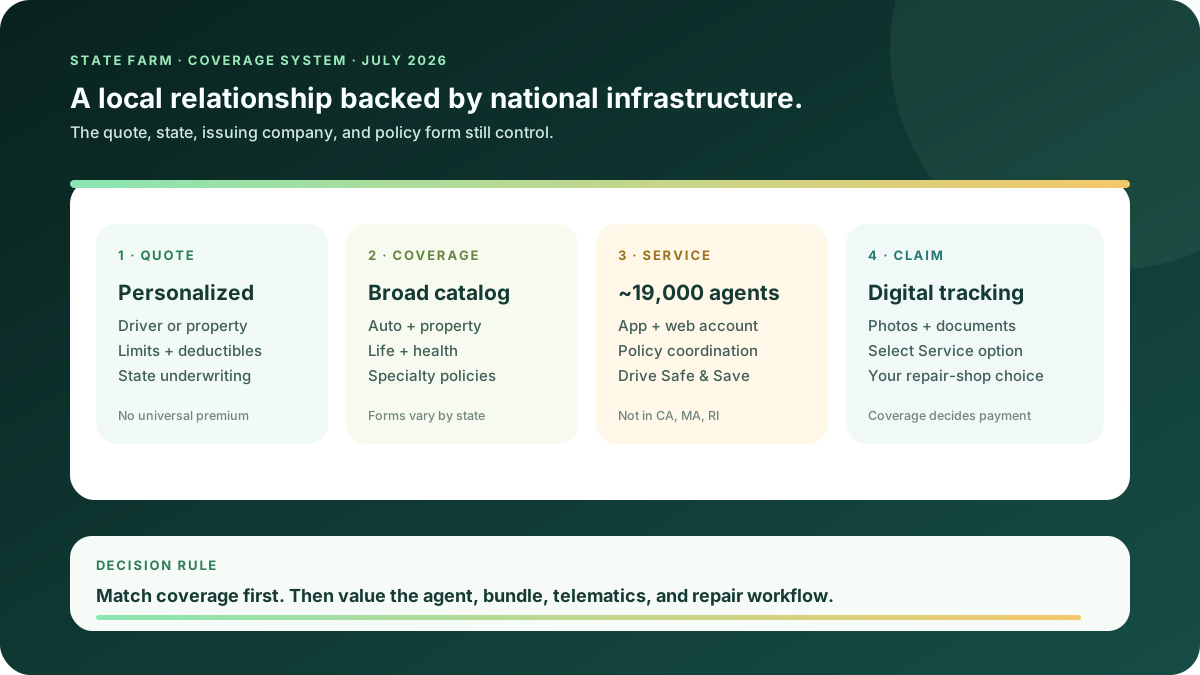
State Farm says its network includes about 19,000 agents. Its public catalog covers auto, homeowners, renters, condo, motorcycle, boat, motorhome, life, supplemental health, disability, pet medical, business, and other products. Availability, underwriting company, policy form, and discount rules still differ by state.
| Review question | DollarScout finding |
|---|---|
| Best for | Households wanting local-agent guidance and multi-policy coordination |
| Price model | Individual quote; no universal premium or reliable national “starting rate” |
| Telematics | Drive Safe & Save; unavailable in CA, MA, and RI |
| Claims channels | App, web, and phone, with optional Select Service repair networks |
| Main limitation | State-specific availability and an agent-influenced workflow |
Price and quote quality
Price scores 4.1/5. State Farm does not have one defensible national premium. Auto pricing can depend on driver age and history, household drivers, vehicle, use, garaging location, annual mileage, coverage, deductibles, prior insurance, state rules, and permissible insurance-score factors. Property pricing can add rebuild cost, roof and construction characteristics, protection class, catastrophe exposure, claims history, deductible structure, and mitigation features.
That makes a generic “State Farm costs $X per month” claim misleading. A useful comparison holds the effective date, drivers, vehicles, liability limits, uninsured-motorist treatment, comprehensive and collision deductibles, rental, roadside, and endorsements constant. For home insurance, match dwelling replacement estimate, other structures, personal property settlement basis, loss of use, liability, water backup, ordinance or law, roof settlement, and wind or named-storm deductibles.
State Farm promotes a Personal Price Plan and bundle savings, but those are quote tools and marketing estimates—not a price guarantee. A bundle can reduce premium while still costing more than separate policies elsewhere. Record each standalone quote and the combined total.
Coverage breadth
Coverage scores 4.8/5. The personal-lines catalog is one of State Farm’s clearest strengths. Auto can include state-required liability and no-fault coverages plus collision, comprehensive, uninsured or underinsured motorist, medical coverage, rental, roadside, and other options where offered. Property options span homeowners, renters, condo, and specialty vehicles, while life and supplemental products support a broader household relationship.
Breadth is not the same as automatic completeness. A homeowner should inspect replacement cost versus actual cash value, roof settlement rules, water backup, service line, equipment breakdown, ordinance or law, jewelry limits, home-business exclusions, and catastrophe deductibles. An auto buyer should verify permissive use, household-driver rules, delivery or rideshare gaps, OEM-parts treatment, rental limits, and roadside terms.
The issuing entity matters. State Farm operates through multiple companies, and products can be issued by different affiliates. Use the declarations page—not the logo—to research licensing, complaint data, and financial information.
Drive Safe & Save
Discounts score 4.5/5. Drive Safe & Save uses the State Farm app and, for many participants, a Bluetooth beacon to collect mileage and driving characteristics. State Farm currently describes a 10% initial participation discount and potential savings up to 30%, with state-specific exceptions and disclosures. The program is unavailable in California, Massachusetts, and Rhode Island; North Carolina treatment can depend on the customer’s circumstances.
State Farm says the program reviews factors such as acceleration, braking, cornering, speed, phone distraction, mileage, and trip information. The discount is recalculated at renewal, generally using up to the prior 12 months of available data. State Farm says driving behavior will not create a Drive Safe & Save surcharge, but an existing low-mileage price can change if recorded mileage shows the car is driven more than represented.
That distinction matters. “No telematics surcharge” does not mean the total policy price cannot rise. Base rates, vehicles, drivers, claims, coverage, location, inflation, and corrected mileage can all change the renewal. Before enrolling, read the state terms, decide whether every driver can maintain app permissions, and compare the initial discount with the privacy and battery tradeoff.
Other auto savings can include accident-free, good-driver, defensive-driving, good-student, student-away-at-school, multiple vehicle, passive restraint, anti-theft, and bundle discounts, subject to state eligibility. Steer Clear targets eligible newer or under-25 drivers and combines training with potential savings.
Claims and repair workflow
Claims Experience scores 4.5/5. State Farm allows claim reporting and tracking through the app, website, or phone. The digital flow can show status, accept photos and documents, support direct deposit, connect the policyholder with the claims team, and surface tasks. Those are meaningful operational capabilities; they are not proof that every disputed or catastrophe claim will be simple.
For eligible auto losses, Select Service lets the customer choose a participating repair facility for estimate and repair coordination. State Farm describes direct shop payment, a guaranteed completion date, and a shop-provided limited lifetime warranty. The customer remains free to choose another repairer. Select Service is not available in Massachusetts or Rhode Island and can be unavailable for particular locations or losses.
State Farm also describes property repair networks for mitigation, roofing, flooring, and general contracting. Participation is voluntary, geographic coverage varies, and network benefits do not replace the policy’s coverage decision. The policyholder should review the estimate, scope, depreciation, deductible, code upgrades, matching issues, supplements, and contractor contract before authorizing work.
We did not file a claim, so the score does not claim a response time or settlement outcome. Claims are evidence-heavy. Preserve scene photos, police or incident reports, inventories, receipts, mitigation records, estimates, communications, and the complete policy in force on the loss date.
Agent and digital service
Customer Service scores 4.7/5. State Farm’s roughly 19,000-agent network is a real differentiator for customers who want a local person to explain endorsements, update household risks, and coordinate multiple policies. The app and web account add ID cards, payments, policy access, roadside features, Drive Safe & Save, and claims tools.
The model can also create handoffs. The selling agent, centralized billing, underwriting, and claims representatives may own different decisions. A local agent is helpful but cannot rewrite the contract or guarantee that a claim is covered. Keep important changes in writing and verify the revised declarations and endorsements after any phone conversation.
Digital-only shoppers may find GEICO or Lemonade more direct. State Farm can still quote and service online, but some transactions route back to the assigned agent. That is a feature for a relationship-oriented customer and friction for someone who wants fully self-directed servicing.
State availability and catastrophe exposure
State Farm’s national brand does not mean every product is open for new business in every ZIP code. Insurers can restrict new property policies, require inspections, change deductibles, or nonrenew risks subject to state law and notice requirements. Catastrophe-exposed states can have especially different underwriting appetites.
Check the quote again near closing or renewal. A saved quote is not a binder, and an auto acceptance does not guarantee a homeowners offer. When property coverage is constrained, compare admitted private carriers, state residual-market options, and separate flood coverage without cancelling the current policy until replacement coverage is confirmed in writing.
Complaints and financial checks
Do not search NAIC data for “State Farm” and stop at a group-level impression. Read the company name and NAIC number on the quote or declarations, then use NAIC Consumer Insurance Search for that entity, state, year, and line of business. Complaint indexes can change with both confirmed complaints and premium volume; compare several years and peers.
Financial-strength ratings are also company- and date-specific. They address claims-paying capacity, not whether a particular claim will be covered or handled to the customer’s satisfaction. Verify the current issuing-company rating from the rating agency or state regulator when it matters to the purchase.
State Farm versus alternatives
Choose GEICO when a fast direct auto workflow and mature app matter more than a dedicated local agent. Remember that GEICO property products can be issued by partner carriers. Choose Progressive for broad vehicle types, comparison tools, and Snapshot when the customer understands that risky driving can increase the renewal in some states.
Choose Allstate for another agent-centered auto and property bundle with Drivewise, Milewise, and broad endorsements. Choose Lemonade for app-first renters coverage and straightforward digital needs in an eligible state; its product footprint and human relationship are narrower.
Who State Farm is best for
State Farm fits customers who:
- Want a local agent and will use that relationship for annual coverage reviews.
- Need auto plus home, renters, condo, life, or another household policy.
- Value established web, app, claims, and repair-network infrastructure.
- Can obtain a competitive quote with matched limits and deductibles.
- Understand state availability and verify the issuing company.
It is weaker for someone who wants the lowest possible rate without comparison, needs an entirely self-directed workflow, or lives where the desired property product is not accepting the risk.
Bottom line
State Farm earns 4.5/5. Coverage and customer service lead the score because the agent network and broad catalog solve real coordination problems. Claims and discount tools are substantial, including digital tracking, Select Service, Drive Safe & Save, and Steer Clear.
The correct buying decision still begins with the actual quote and contract. Match coverage, price the bundle and standalone policies, inspect state-specific restrictions, and research the exact issuing company. State Farm is a strong operating system for a multi-policy household—not a universal promise of the cheapest premium or identical availability nationwide.