
Interactive Brokers at a glance
Interactive Brokers, commonly IBKR, is a global multi-asset broker serving individual, professional, adviser, and institutional customers. It combines a large market network with professional order types, financing, reporting, portfolio analysis, tax-lot controls, and several APIs.
IBKR’s strength is optionality. A newer investor can use Client Portal, IBKR Desktop, or GlobalTrader; an experienced trader can use Trader Workstation; a developer can use TWS, Client Portal, Excel, or FIX interfaces. The same optionality creates a demanding setup.
| Review question | DollarScout finding |
|---|---|
| Best for | Global, multi-asset, margin-conscious, and API traders |
| U.S. stock choice | Lite at $0 for eligible exchange-listed trades or Pro fixed/tiered |
| Market reach | More than 170 markets worldwide under current platform disclosure |
| Main strength | Pricing, routing, products, tools, and financing in one account |
| Main limitation | Dense permissions, data, tax, currency, and platform decisions |
IBKR Lite versus IBKR Pro
Trading Costs scores 4.8/5. IBKR Lite offers eligible U.S. retail customers commission-free U.S. exchange-listed stocks and ETFs. Non-qualifying products, OTC securities, warrants, foreign markets, options, futures, and other assets use separate pricing.
IBKR Pro offers fixed or tiered stock pricing. The current overview lists U.S. Pro fixed at $0.005 per share with a $1 minimum and tiered base rates from $0.0005 to $0.0035 with a $0.35 minimum. Tiered pricing passes through relevant venue, regulatory, and clearing costs and potential rebates; fixed pricing incorporates many transaction costs into a predictable rate.
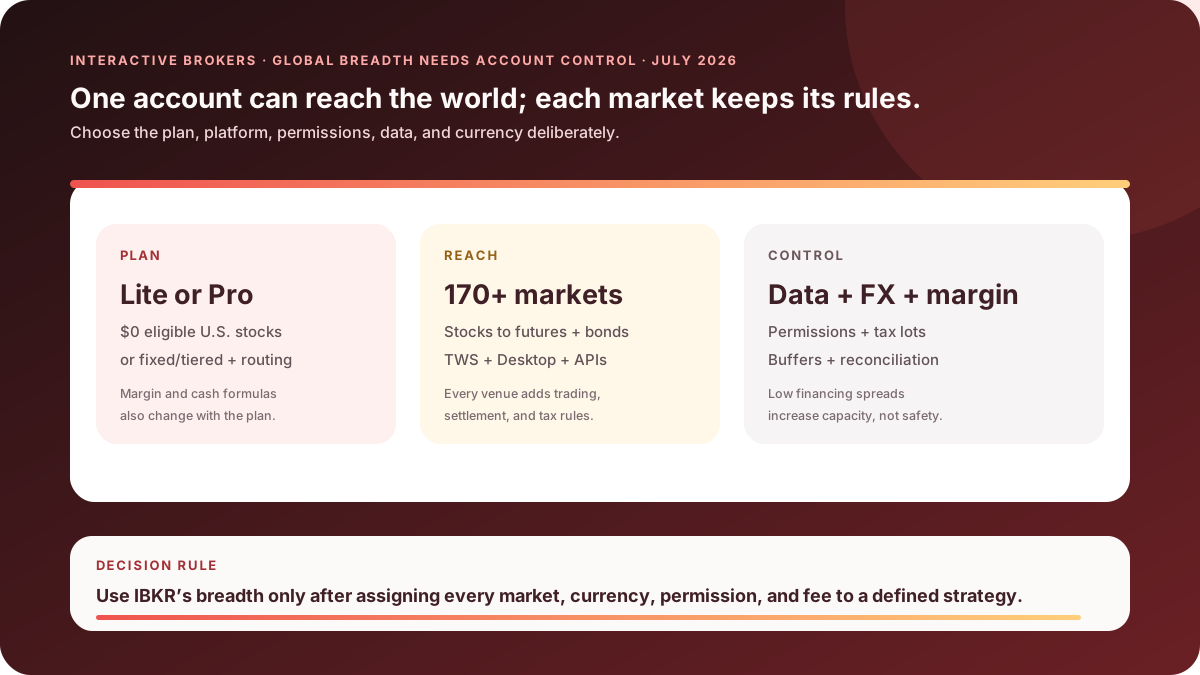
Plan choice affects more than the stock commission. Pro includes SmartRouting and generally uses lower margin spreads and a more favorable idle-cash spread. Lite is limited to eligible account types and residents. Review the comparison table rather than choosing solely from “$0.”
IBKR lists no account minimum or maintenance fee for Lite or Pro direct accounts. Market data, special services, external arrangements, withdrawals beyond free allowances, and product-specific pass-throughs can still cost money.
Options, futures, and other commissions
For U.S. options, current Pro pricing ranges from $0.15 to $0.65 per contract according to premium and monthly volume, generally with a $1 order minimum. Lite charges $0.65 for the first 1,000 U.S. option contracts in a month before applying the Pro tier model to additional volume. OCC, regulatory, transaction, exchange, or surcharge fees can apply.
U.S. futures are advertised from $0.25 to $0.85 per contract before exchange, regulatory, and carrying fees. Bonds, mutual funds, spot currencies, cryptocurrencies, metals, and international securities each have separate schedules, currencies, and minimums.
The cost advantage is strongest when the customer understands the relevant schedule. A one-contract option order can be governed by the minimum; an international stock purchase can add currency conversion and local exchange charges; a direct-routed order can price differently from SmartRouting.
Global market and product coverage
IBKR’s platform page describes access to stocks, options, futures, currencies, bonds, funds, and more on 170-plus markets worldwide. GlobalTrader advertises 90-plus stock exchanges and options on more than 30 market centers, while TWS supports the broadest mix.
Investment Selection is not a separate score in this trading methodology, but it strongly influences Platform and Tools. Customers can consolidate many exposures and currencies without maintaining a broker in every region.
Global access creates operational responsibilities. Trading hours, holidays, settlement cycles, corporate actions, short-sale rules, market data, tax withholding, product regulation, and investor protection differ by venue and legal entity. A symbol that appears familiar can settle in another currency or represent a different listing.
Before the first foreign order, record the exchange, currency, contract multiplier, settlement, minimum commission, data status, tax treatment, and local market order behavior.
Platforms for different experience levels
Platform scores 4.8/5. IBKR Desktop is the newer desktop product combining widely used TWS tools with a more approachable interface. Trader Workstation remains the flagship for multi-product traders needing advanced order types, scanners, layouts, risk tools, and flexibility.
Client Portal handles browser trading and account administration. IBKR Mobile brings a large portion of the multi-asset toolkit to phones and tablets. GlobalTrader offers a simpler mobile-first path for global stocks, options, event contracts, and supported crypto. IMPACT and Prediction Markets serve specialist workflows.
The platform comparison should be treated as a requirements matrix. Live or historical data, Level II, news, charting, complex orders, algorithms, and certain products are not identical everywhere. Use paper trading to confirm the interface before relying on it during a volatile session.
APIs and automation
Trading Tools scores 4.9/5. IBKR provides APIs from Excel and TWS to Client Portal and institutional FIX connectivity. Developers can retrieve account data, market data under subscription rules, orders, executions, and portfolios.
An API does not remove brokerage controls. Permissions, pacing, data licenses, resets, authentication, session behavior, and order status require careful handling. A production system needs idempotent order identifiers, duplicate protection, reconciliation, stale-data detection, retry limits, logs, alerts, position constraints, and a human kill switch.
Paper trading is useful for integration but cannot reproduce every live queue, fill, borrow, market-impact, or margin event. Reconcile the broker’s official statement and executions rather than treating a local database as final.
SmartRouting and execution
Execution Speed scores 4.9/5. IBKR Pro uses SmartRouting to evaluate venues and seek execution under its routing logic. The broker supports many algorithmic order types, conditional orders, combos, and professional controls.
Routing quality is more than latency. Measure effective spread, price improvement, fill rate, market impact, partial fills, and the opportunity cost of an unfilled limit. A complex global order can have exchange and currency effects a U.S. equity benchmark does not capture.
Lite and Pro can differ in routing economics and feature eligibility. Direct routing can create additional fees. Read the current routing disclosures and do not assume that the lowest displayed commission produces the lowest total execution cost.
Margin financing and cash interest
IBKR calculates margin interest from a benchmark plus a plan- and balance-dependent spread. The July 2026 comparison states that Pro begins at benchmark plus 1.5%, with lower spreads at larger balances, while Lite uses benchmark plus 2.5%. Rates are blended across tiers, accrue daily, and can change.
Idle-cash interest also differs: the comparison shows benchmark minus 0.5% for Pro and benchmark minus 1.5% for Lite. Accounts below $100,000 net asset value receive a proportionally reduced positive rate under the stated formula, and only eligible cash above thresholds may earn the full displayed rate.
These are formulas, not fixed APYs. A customer should record currency, benchmark, qualifying balance, NAV, and plan. Cash in multiple currencies can earn or owe different rates. Currency conversion can create a position rather than merely a fee.
Margin models update in real time. IBKR can raise house requirements and liquidate without waiting for a traditional margin call. Maintain a buffer larger than the displayed requirement and stress for gaps across correlated positions.
Market data and research
IBKR includes some complimentary non-consolidated U.S. equity data and sells bundles or a la carte subscriptions for additional markets and products. Exchanges determine professional versus non-professional classifications and can require separate fees.
Snapshot data, delayed data, live top-of-book, and depth are not interchangeable. The platform labels matter before placing a price-sensitive order. Data subscription cost should be assigned to the strategy that needs it.
Research, scanners, PortfolioAnalyst, Risk Navigator, options analytics, and third-party providers make the toolkit broad. Customers should simplify the workspace around decisions they actually make rather than adding every panel.
Account safety, protection, and entities
IBKR operates through regulated entities in multiple jurisdictions. The legal entity, product, and account location determine applicable protection and disclosures. U.S. brokerage SIPC protection does not cover market loss, futures, spot currency, commodity positions, or a failed strategy.
The Insured Bank Deposit Sweep and Securities Lending programs are optional structures with distinct risks and eligibility. Read the program documents before focusing on advertised rates or lending income.
Enable strong authentication, withdrawal controls, trusted contacts, and alerts. Save statements, confirmations, tax lots, corporate actions, currency conversions, and permission changes.
Customer service and learning curve
Customer Service scores 3.9/5. IBKR provides ticket, chat, phone, documentation, Campus courses, platform guides, status resources, and an extensive knowledge base. The institutional scale produces excellent documentation but can feel procedural when a customer wants a simple guided answer.
DollarScout did not contact service, dispute a fill, transfer an international position, or correct a tax document. The lower score reflects complexity and self-service burden, not evidence that a particular support interaction will fail.
Document the exact account, platform, order, timestamp, exchange, currency, and error before opening a ticket. During a live-order emergency, use the official trade-support path rather than repeatedly resubmitting.
IBKR versus alternatives
Choose TradeStation when EasyLanguage, RadarScreen, and a U.S.-focused strategy-testing workflow matter more than global breadth. Choose tastytrade when options-first visual construction and a $10 per-leg opening commission cap are more important than hundreds of markets.
Lightspeed targets direct-access U.S. equities traders willing to pay for high-velocity platforms. NinjaTrader is narrower but approachable for dedicated futures simulation and plan-based commissions.
Who Interactive Brokers is best for
IBKR fits customers who:
- Trade across countries, currencies, or asset classes.
- Need professional order types, portfolio risk, or APIs.
- Compare margin and idle-cash formulas carefully.
- Can manage permissions, data, tax, settlement, and currency.
- Want one scalable account rather than a guided beginner experience.
It is weaker for users who want a minimal feature set, an assigned adviser, or a U.S.-only interface with little configuration.
Bottom line
Interactive Brokers earns 4.7/5, the highest score in this trading batch. Fees, execution controls, global products, financing, risk tools, and APIs create exceptional capability.
Capability is not usability by default. Configure only the markets and tools the strategy requires, maintain large margin buffers, reconcile currencies and tax lots, and know which platform and pricing plan govern every order.


