Many products on this page are from partners who compensate us. This doesn't influence our ratings. Our opinions are our own.
How to Buy Bitcoin Safely
By Sophie Brown, Senior Finance Editor · Updated Jul 2026 · Fact-checked Jul 18, 2026
Buying Bitcoin safely is not just choosing a familiar app and pressing Buy. The decision includes whether the product is actual Bitcoin or price exposure, the platform’s legal and custody structure, total execution cost, account security, withdrawal testing, tax records, and a plan for loss. This guide turns those decisions into a controlled first-purchase process without recommending a provider or predicting returns.
Key takeaways
- Decide whether you want actual withdrawable Bitcoin or only investment exposure before comparing platforms.
- Verify the legal entity, available registrations, custody terms, fees, spreads, withdrawal rules, and failure protections independently.
- Secure the email and account with unique credentials and phishing-resistant multifactor authentication before funding.
- Start with a small purchase, reconcile the execution price and fees, and test a small withdrawal before increasing exposure.
- Assume Bitcoin can lose substantial value and that transfers can be irreversible; never use borrowed money or essential cash.
Define what you are trying to own
“Buying Bitcoin” can describe different products. A spot platform may credit actual Bitcoin that can be withdrawn to a blockchain address. A brokerage product may provide economic exposure without allowing withdrawal. An exchange-traded product can track Bitcoin through a security held in a brokerage account. Futures and leveraged products are contracts with different mechanics and risks.
Write the objective first:
- long-term exposure inside a familiar brokerage account;
- actual Bitcoin for self-custody or onchain use;
- a small educational purchase;
- short-term speculation.
The correct platform, tax records, custody plan, and risk limit depend on that objective. Do not assume a product named after Bitcoin gives ownership of transferable Bitcoin. Read what the customer legally owns and how it can be sold, transferred, or redeemed.
Set a loss limit before comparing apps
Bitcoin is volatile and can experience sharp declines. The CFTC warns that cash-market platforms may lack safeguards, face manipulation or cyber risk, and operate with limited regulatory oversight. Treat the purchase as a high-risk allocation that could lose most or all of its value.
Do not use rent, emergency savings, tax money, tuition, or funds needed for near-term goals. Do not borrow through a credit card, margin account, personal loan, or home equity to buy Bitcoin. Leverage can force liquidation or create debt after the asset falls.
Choose a maximum dollar exposure and a maximum percentage of investable assets. The number should come from the financial plan, not from an influencer’s price target. Decide what would trigger a pause: a job loss, inadequate emergency fund, high-interest debt, or inability to explain the product and custody arrangement.
Identify the legal platform and product
A brand name, website, and mobile app may involve several legal entities. Find the entity in the customer agreement and determine which entity executes trades, holds dollars, and controls private keys. Verify addresses and registrations through regulator databases rather than links sent by a promoter.
FINRA notes that much crypto trading occurs outside registered broker-dealers and SEC-regulated institutions, so familiar brokerage protections may not apply. A FinCEN money-services-business registration, state money-transmitter license, or other registration can be relevant, but no single listing is a government endorsement, solvency review, or guarantee that every product is lawful in every state.
Check:
- Exact legal name and jurisdiction.
- Availability in your state or territory.
- Which regulator or licensing agency covers which activity.
- Whether the entity has material enforcement actions or insolvency proceedings.
- Who holds customer dollars and Bitcoin.
- Whether customer assets are segregated, titled, lent, pledged, or pooled.
- What the agreement says happens after a hack, freeze, bankruptcy, or lost credential.
Investor.gov warns that crypto accounts generally do not receive the same FDIC, NCUA, or SIPC protections as qualifying bank deposits or protected securities at a SIPC-member broker. If a platform advertises insurance, read the policy scope, exclusions, limits, custodian, and beneficiary. “Insured” does not necessarily cover market loss, customer error, account takeover, or the full customer balance.
Compare total execution cost
The visible trading fee is only one component. Capture:
| Cost | What to verify |
|---|---|
| Deposit | ACH, wire, debit card, failed-deposit, or intermediary fee |
| Trading fee | Flat, percentage, maker/taker, subscription, or tiered pricing |
| Spread | Difference between the executable buy and sell prices at the same moment |
| Withdrawal | Platform charge plus network-related charge and any minimum |
| Conversion | Cost if dollars first become a stablecoin or another asset |
| Recurring purchase | Whether scheduled orders use the same fee and spread |
| Custody | Subscription, device, or recovery cost after withdrawal |
Use an executable quote, not a homepage price. A hypothetical market reference of $50,000 with an executable purchase price of $50,500 implies about a 1% markup before an explicit fee. On a $200 order, a $2 fee plus a $2 spread cost makes the effective acquisition cost $204. This is an illustration, not a current Bitcoin price or offer.
Compare what arrives after all costs. Avoid funding methods that treat the transaction as a cash advance or eliminate chargeback rights. Confirm deposit holds: a platform may allow trading before permitting withdrawal.
Inspect custody and withdrawal rules
If actual Bitcoin ownership is the goal, confirm withdrawals are supported for that exact asset and account. Some services allow buying but not blockchain withdrawal. Others impose account-age, identity, destination, daily, or security holds.
Read whether the platform:
- holds assets directly or through another custodian;
- combines customer assets in omnibus wallets;
- lends or pledges customer assets;
- provides proof-of-reserves information and, separately, evidence of liabilities;
- supports address allowlisting and withdrawal locks;
- pauses withdrawals under stated conditions;
- identifies the blockchain network clearly.
Proof of reserves alone does not prove solvency because it may omit liabilities, control of keys, or assets pledged elsewhere. An audit report has a defined scope and date; it is not a perpetual guarantee.
Choose between third-party custody and self-custody deliberately. Self-custody removes platform control over private keys but transfers security, backup, and recovery responsibility to the owner. It is not automatically safer for a person who cannot protect recovery material or verify a transaction.
Secure the identity layer first
Account takeover often begins with email, phone, or phishing. Before depositing:
- Use a dedicated, unique password stored in a reputable password manager.
- Secure the associated email with its own unique password.
- Prefer a hardware security key or authenticator-based MFA when supported; avoid SMS as the only factor when stronger options exist.
- Save recovery codes offline in a protected place.
- Enable login, password-change, trade, and withdrawal alerts.
- Use address allowlisting and a delay for new withdrawal addresses if available.
- Bookmark the verified domain instead of following ads or direct-message links.
Never disclose a password, MFA code, private key, or seed phrase to “support.” Legitimate support does not need a wallet recovery phrase. Treat an unsolicited call about a frozen crypto account as hostile until independently verified through the official channel.
Protect the phone carrier account with a PIN or port-out lock where available. Keep operating systems and wallet software updated from official sources. Do not install remote-access software at the request of an investment contact.
Complete identity verification through the official flow
Regulated or compliant platforms may request identity, tax, address, and source-of-funds information. Enter it only through the verified app or domain. Review the privacy policy, document retention, breach history, and account-deletion process.
Do not buy a “verified account,” use another person’s identity, or route funds through strangers. Those shortcuts can create fraud, tax, sanctions, and account-ownership problems. The name on the bank account, trading account, tax record, and wallet withdrawal review should be consistent.
Fund with a reversible, traceable test
Link the funding source through the platform’s authenticated flow. Start below the intended allocation. Confirm the deposit status, availability for trading, withdrawal hold, and any fee.
Avoid wiring to instructions received only by email or chat. Independently confirm bank details in the authenticated account. A fraudster may imitate support and replace legitimate instructions.
Keep a record of:
- legal platform entity;
- account identifier;
- deposit date, amount, and source;
- bank confirmation;
- platform fee and availability date.
If the funding method fails, resolve it before retrying repeatedly. Duplicate deposits can create an unintended position or negative bank balance.
Place and reconcile a small first order
Understand market and limit orders. A market order prioritizes execution but the final price can move, particularly during volatility or with thin liquidity. A limit order sets a maximum buy price but may fill partially or not at all. Platform labels and order behavior vary.
Before submitting, verify:
- asset ticker and network;
- dollars to spend versus Bitcoin units to receive;
- quoted price, spread, and explicit fee;
- order type and expiration;
- final total.
After execution, save the trade confirmation and calculate the effective unit cost:
Total dollars paid, including acquisition costs ÷ Bitcoin units received.
Reconcile this with the account balance. The IRS states that cash transaction costs to acquire digital assets can be included in basis under its current rules. Preserve the original data rather than relying on a dashboard that may later change.
Test withdrawal before scaling
If self-custody is part of the plan, first learn the wallet and backup process with an amount you can afford to lose. Obtain the receiving address from the wallet, verify the network, compare the beginning and ending characters on both devices, and send a small test.
Crypto transfers can be irreversible. Sending to the wrong address, wrong network, or unsupported destination can cause permanent loss. Malware can replace an address in the clipboard. Do not type an address from memory or trust a screenshot without verification.
Record the transaction ID and wait for the receiving wallet or service to show the expected status. Then test that you can view the wallet independently and understand how recovery works. Only after the test succeeds should you consider a larger transfer, preferably in controlled tranches.
Do not perform a first withdrawal while rushed, distracted, on public Wi-Fi, or following live instructions from another person. A “verification deposit” requested by a romantic interest, recruiter, trader, or government impersonator is a common fraud pattern.
Build the tax record on purchase day
Buying Bitcoin with dollars is generally an acquisition rather than a taxable disposition, but it establishes basis and records needed for a later sale, exchange, spend, or gift. Record:
- date and precise time;
- Bitcoin units;
- U.S.-dollar amount;
- acquisition fees and spread evidence;
- wallet or account;
- transaction or order ID;
- source statement.
Moving Bitcoin between wallets you own is generally not a sale, but records must prove both sides belong to you. Bitcoin used to pay a transfer fee may have separate tax treatment. Export platform CSV files and preserve transaction IDs before closing an account.
Form 1099-DA reporting does not replace personal records. The IRS says taxpayers must report relevant income, gains, and losses even when no form arrives, and early forms may omit basis in some cases.
Operate the position after purchase
Review the platform and custody plan periodically. Remove unused API keys, old devices, and unnecessary bank links. Monitor withdrawals and changes to customer terms. Reassess exposure after a major price move instead of letting volatility silently change the portfolio risk.
Ignore guaranteed-yield offers, recovery agents demanding advance payment, and requests to send Bitcoin to “unlock” a withdrawal. Real balances do not require paying taxes or insurance to a private wallet before withdrawal. Report suspected fraud promptly; blockchain transfers can move quickly and recovery is uncertain.
If using recurring purchases, review total cost and allocation regularly. Automation removes timing decisions but can also continue funding a broken plan.
A final go/no-go checklist
Proceed only if you can answer yes:
- I know whether I am buying actual withdrawable Bitcoin or another product.
- I independently verified the legal entity and relevant registrations.
- I understand custody, failure treatment, fees, spread, and withdrawal holds.
- My email and account use strong unique authentication.
- The amount can lose substantial value without harming essential goals.
- I can preserve basis and transaction records.
- If withdrawing, I have tested the wallet, backup, address, and a small transfer.
Bottom line
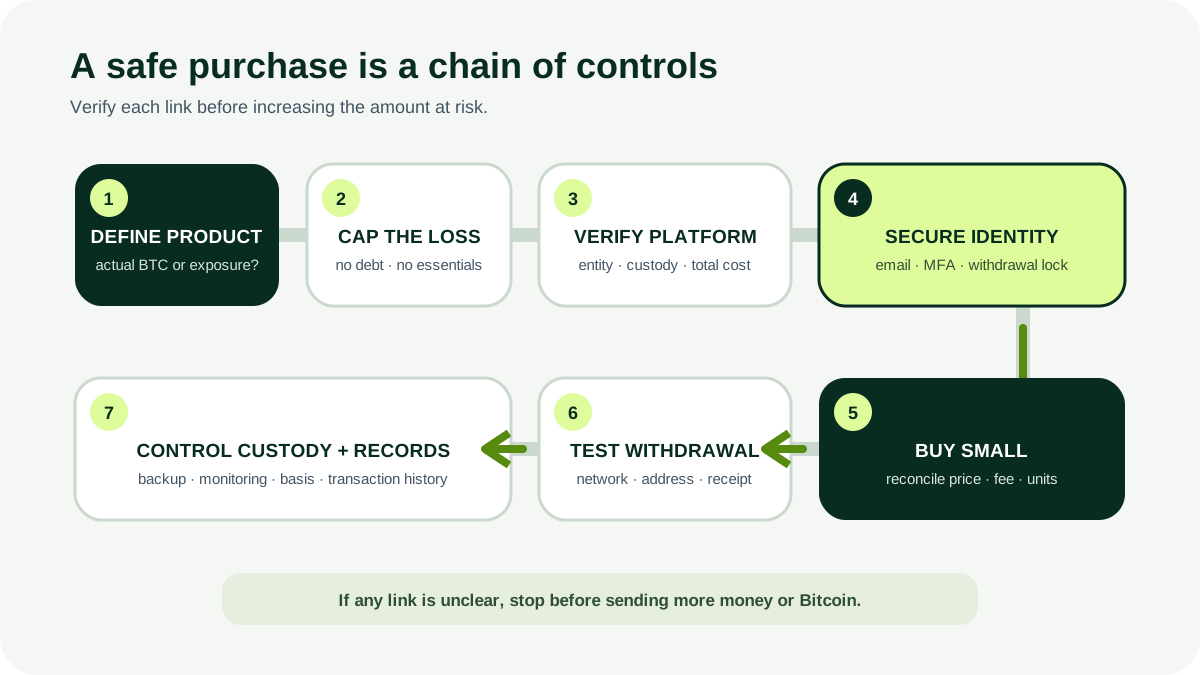
The safest way to buy Bitcoin is to slow the process down. Define the product, cap the loss, verify the legal entity and custody terms, calculate total execution cost, secure the identity layer, make a small purchase, and test withdrawal before scaling. Bitcoin’s technical design cannot protect a buyer from a fraudulent platform, exposed credential, wrong address, unaffordable position, or missing tax record.
Related content
Frequently asked questions
Sources
Related content
More from DollarScout on this topic.
