Citi Double Cash at a glance
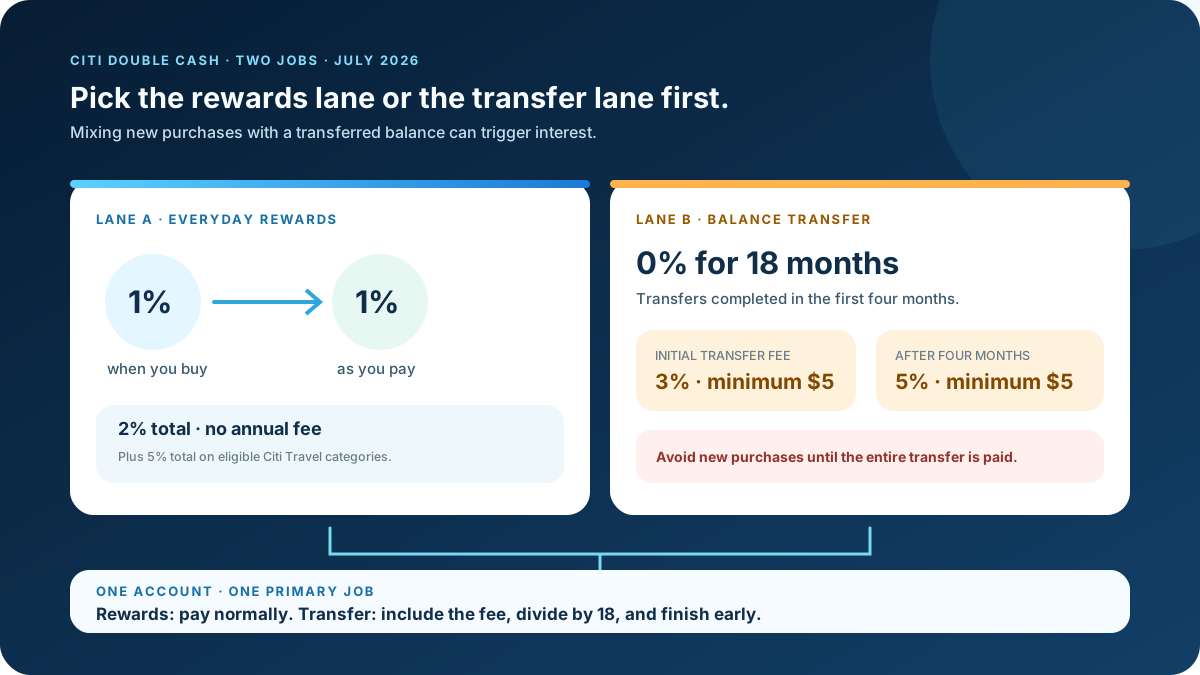
Citi Double Cash is a no-annual-fee Mastercard built around a simple two-part reward: 1% cash back when an eligible purchase is made and another 1% as that purchase is paid. Rewards are issued as ThankYou points. There is no rotating-category activation and no stated cap on the base 2% earning.
The card now has a second lane. It earns 5% total on hotels, car rentals, and attractions booked through Citi Travel. It also offers a current $200 bonus and a separate 18-month 0% balance-transfer promotion. Those additions are useful, but they introduce rules that the “Double Cash” name does not explain.
| Review question | DollarScout finding |
|---|---|
| Best for | No-fee cash-back users who pay purchases and avoid foreign transactions |
| Annual fee | $0 |
| Current purchase APR | 17.49%–27.49% variable |
| Main strength | Unlimited 2% structure with no category activation |
| Main risk | Balance transfers can remove the purchase grace-period advantage |
How the 2% reward works
Rewards scores 4.7/5. Each billing cycle, Citi awards one ThankYou point per dollar of eligible purchases and another point per dollar paid against the tracked purchase balance. The cardholder must pay at least the minimum due on time to earn under the current terms. Purchases returned for credit, balance transfers, cash advances, fees, interest, and other nonpurchase activity do not earn rewards.
The second 1% is not a reason to carry debt. Paying the full statement balance earns it while preserving the possibility of a purchase grace period. Interest at 17.49%–27.49% can exceed a 2% reward many times over. A person revolving $1,000 for a year near 25% does not come out ahead because the original purchases generated about $20 of cash back.
The structure is especially useful as a “catch-all” card in a multi-card wallet. Use category cards where they earn materially more, then Double Cash for purchases that would otherwise earn 1%. Someone seeking one card can also use it without remembering a calendar.
5% through Citi Travel
The current product earns an additional 3% on hotels, car rentals, and attractions booked through the Citi Travel portal. Combined with the 1% purchase component and 1% payment component, that reaches 5% total under the terms.
Flights are not listed in the 5% Double Cash category. A portal may sell flights, but availability in the booking site does not itself create the bonus rate. Compare the specific eligible categories before assuming every travel purchase earns 5%.
Portal booking has familiar tradeoffs: price, cancellation policy, loyalty earnings, hotel status, rental coverage, and support can differ from direct booking. Five percent of an expensive or restrictive reservation is not necessarily better than 2% on a cheaper direct reservation. Save the itinerary and know whether Citi Travel or the supplier handles a change.
Current $200 welcome offer
Citi's public cash-back-card page checked July 18, 2026 advertises $200 cash back after $1,500 in purchases during the first six months. The bonus is delivered through ThankYou points and has account-history restrictions in the offer terms, including a 48-month lookback tied to certain Double Cash bonuses or conversions.
Offers vary and dynamic pages can omit numbers when loaded outside a specific application session. The application disclosure—not this review—controls. Save a copy before applying and confirm the spending period, excluded transactions, account-standing condition, and bonus-history language.
$1,500 over six months is more accessible than many travel-card thresholds, but no bonus should change the household budget. Fees, balance transfers, cash advances, and returned purchases do not count as ordinary eligible spending.
Annual fee and foreign purchase fee
Fees scores 4.7/5 because the annual fee is $0 and base rewards have no stated cap or category enrollment. The major deduction is the 3% foreign purchase fee. A $1,000 trip charged abroad can create $30 of fees before considering merchant conversion or cash-advance costs.
That makes Double Cash a poor default outside the United States even when Mastercard acceptance is broad. Pair it with a no-foreign-transaction-fee card for overseas purchases. Decline dynamic currency conversion when the merchant's offered exchange rate is unattractive; paying in U.S. dollars at a foreign merchant may still be treated as a foreign purchase under account terms.
Cash advances cost the greater of $10 or 5% under the current pricing and begin accruing interest under the agreement. They do not earn rewards. Avoid using a credit card at an ATM except in a genuine emergency with full knowledge of the cost.
Balance-transfer offer
APR scores 4.1/5 because the card combines an 18-month 0% transfer window with a competitive disclosed standard range, but the promotion is not free. Qualifying transfers must be completed within the first four months of account opening. The introductory fee is 3% of each transfer, $5 minimum; after that it is 5%, $5 minimum.
A $6,000 transfer during the intro-fee window costs $180, creating a starting balance of $6,180 if approved within the available limit. Paying it in 18 equal months requires roughly $343.33 per month before any other charges. Minimum payments are unlikely to finish the plan, so calculate the required payment before transferring.
Citi begins processing new-account transfers after a 14-day waiting period and says transfer payment can take additional time. Continue paying the old creditor until it confirms receipt. A transfer cannot move another Citi or affiliate balance, and approval or amount is discretionary.
After the promotional period, unpaid balances and new transfers use the standard variable APR. The current disclosed purchase and post-promotion range is 17.49%–27.49%. Missing a required payment can also affect the promotion and create late or penalty consequences under the terms.
Why new purchases are risky during a transfer
Citi explicitly warns that if a cardholder transfers a balance, interest will be charged on purchases unless the entire balance—including the transfer—is paid by the due date. The CFPB gives the same general warning: carrying a promotional transfer can eliminate the grace-period treatment for new purchases even when the transferred balance itself remains at 0%.
The cleanest strategy is separation. Use Double Cash only for the transfer until it is paid, and use another card or debit for new purchases. That means giving up Double Cash rewards temporarily, but avoiding purchase interest is worth much more than 2% back.
Do not make a transfer if the required payoff amount does not fit the monthly budget. Moving debt without reducing spending can create two balances instead of one.
ThankYou point redemption
Cash back is earned as ThankYou points. Citi currently supports statement credit, direct deposit, and check redemptions, plus travel, gift cards, Shop with Points, and other options. Values and minimums can differ. The direct cash paths make the base 2% proposition understandable, but verify the exact rate shown for noncash choices.
Double Cash points may interact differently with transfer partners depending on which other Citi card accounts are held and how accounts are combined. Do not assume this no-fee card alone provides every transfer option available to a premium Citi card. Combining accounts can also affect expiration or closure consequences; read the current ThankYou terms first.
Statement-credit rewards reduce the account balance but do not replace the required minimum payment unless the issuer states otherwise. Keep automatic payment based on the statement, not on an expected reward.
Benefits and protections
Benefits scores 3.8/5. Citi provides the travel portal category, Citi Entertainment access, digital-wallet compatibility, fraud monitoring, a FICO score, and Mastercard account benefits under current terms. The product is not positioned as a premium travel-protection card and should not be assumed to include primary rental coverage, trip cancellation insurance, lounge access, or a trusted-traveler credit.
That is acceptable for a no-fee cash-back card, but users booking expensive or nonrefundable travel should compare protection terms before choosing it solely for 5%. The highest earn rate and the strongest insurance may belong to different cards.
Application and credit considerations
Citi offers a prequalification flow that can show potential offers without opening an account. Prequalification is not final approval or a guaranteed APR or credit limit. Submitting the actual application can trigger a hard inquiry and underwriting.
The credit limit matters for a transfer: the requested amount plus the fee cannot exceed the approved available limit. Opening a card also changes total available credit, account age, and utilization. Apply because the product fits, not solely to chase a temporary score effect.
Customer service
Customer Service scores 4.0/5. Citi provides mobile, web, phone, TTY or relay-service access, transfer tracking, card controls, and written help. We did not call, dispute a transaction, redeem by phone, or test a travel booking, so the score reflects access and documentation rather than measured resolution quality.
For a transfer, retain the request date, destination account, estimated amount, and confirmation. For travel, identify whether Citi Travel or the merchant controls changes. For rewards, save the Purchase Tracker and payment record when the second 1% does not post as expected.
Citi Double Cash versus alternatives
Choose Discover it Cash Back when rotating 5% categories, first-year Cashback Match, and a simultaneous introductory purchase APR are worth quarterly activation. Choose Capital One Venture when no foreign transaction fee, 2x travel miles, transfer partners, and travel benefits justify a $95 annual fee.
Double Cash is the stronger simple cash baseline. It does not require travel knowledge or category activation and can stay open without an annual fee. It is weaker for overseas spending, premium protection, and anyone who wants an uncomplicated 0% purchase-and-transfer combination.
Decision checklist
Double Cash is a strong candidate when you:
- Want unlimited 2% cash back with no annual fee or activation.
- Pay eligible purchases in full and on time.
- Need a catch-all card beside higher category cards.
- Can keep new purchases off the card during a balance transfer.
- Use another no-foreign-transaction-fee card abroad.
It is easier to skip when premium travel protections matter, foreign purchases are frequent, a single-step reward is preferred, or a transfer cannot be repaid within the promotional window.
Bottom line
Citi Double Cash earns 4.3/5. Its core remains excellent: no annual fee, unlimited 2% cash back without activation, and direct cash redemption. The current 5% portal category and $200 offer add first-year utility without changing the card's simple identity.
The balance-transfer feature needs a different mindset. Price the 3% fee, divide the full balance by 18 months, stop new spending on the account, and finish before the variable APR begins. Use Double Cash as either a paid-in-full rewards card or a transfer payoff tool—not both at once.