
Binance.US at a glance
Binance.US is a custodial exchange built specifically for U.S. customers. It is a separate legal and operating platform from Binance.com, with its own supported states, assets, pairs, custody terms, and compliance obligations. The U.S. product advertises more than 190 cryptocurrencies and combines simple purchases, Convert, Advanced spot trading, staking, APIs, and—where eligible—ACH dollar deposits and withdrawals.
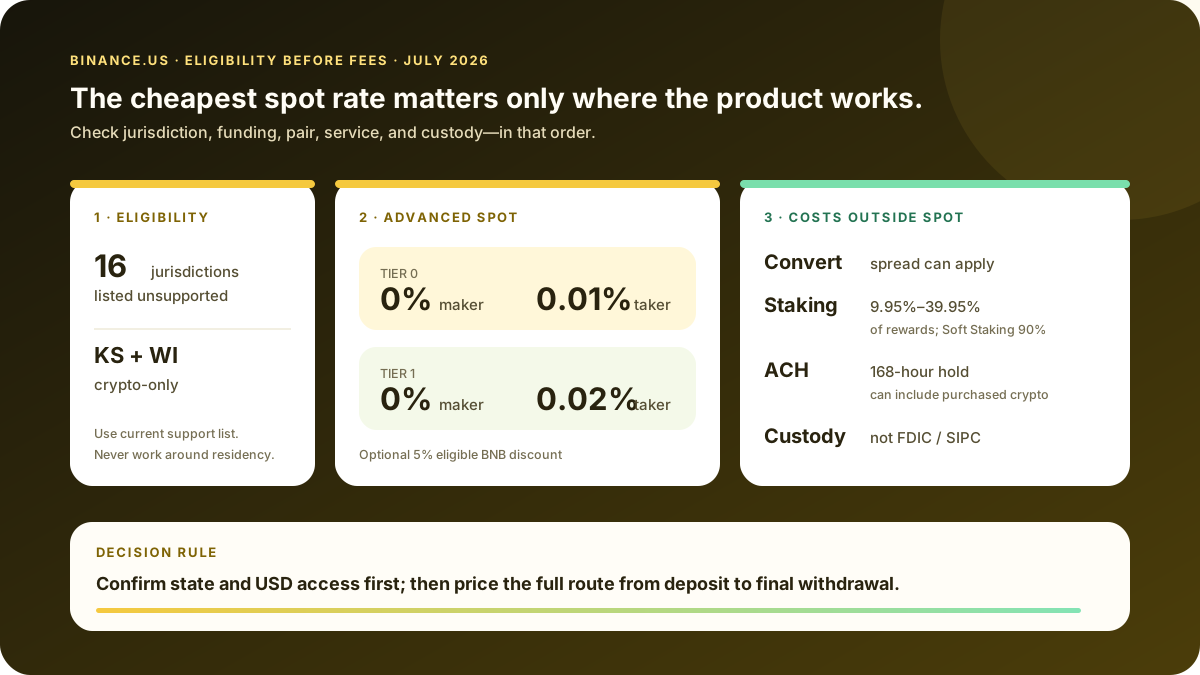
Its current Advanced fee table is exceptionally aggressive. Tier 0 pairs list 0% maker and 0.01% taker. Tier 1 pairs list 0% maker and 0.02% taker. Paying eligible fees in BNB can reduce those taker rates by 5%, to the displayed 0.0095% and 0.0190%. These are published rates without a subscription or high-volume prerequisite, but they apply to Advanced spot pairs—not automatically to every purchase, conversion, withdrawal, or staking reward.
| Review question | DollarScout finding |
|---|---|
| Best for | Fee-sensitive spot traders in a fully supported state |
| Tier 0 Advanced rate | 0% maker / 0.01% taker |
| Tier 1 Advanced rate | 0% maker / 0.02% taker |
| Main strength | Lowest published entry spot rates in this review group |
| Main limitation | Material state restrictions and separate pricing for other services |
Advanced trading fees
Trading Fees scores 4.9/5. The Advanced spot schedule separates pairs into Tier 0 and Tier 1. Makers pay 0% at both published entry tiers. Takers pay 0.01% on Tier 0 and 0.02% on Tier 1. The optional BNB payment setting applies a 5% discount to eligible fees, but using BNB introduces token-price exposure and the need to maintain a balance.
A $10,000 taker order at 0.02% produces a $2 trading fee before spread and slippage. At 0.01%, the fee is $1. Those figures are materially lower than the public entry schedules at Kraken and Gemini. A zero maker fee does not make a trade free: the bid/ask spread, price movement while waiting, funding cost, and withdrawal fee still matter.
Fee tier does not guarantee execution quality. A thin pair can have a wide spread and shallow order book. Inspect order depth, use limit prices deliberately, and calculate total dollars paid per unit. A market order can fill across several price levels even when the percentage fee is tiny.
Buy, Sell, and Convert are different
One Click Buy/Sell and Convert do not necessarily use the Advanced order-book fee table. Binance.US says Convert can advertise zero trading fees while collecting a spread between the buy and sell price. Simple purchase quotes and third-party funding routes can include other costs disclosed before confirmation.
“Zero fee” is therefore not “zero cost.” Compare the final quantity of crypto for a fixed dollar amount with the quantity from an Advanced order. For a conversion, compare the implied exchange rate with the relevant order books. The correct measure includes spread, fee, slippage, and any transfer cost.
The interface distinction also affects control. Advanced lets the user choose market, limit, stop-limit, post-only, one-cancels-the-other, and other supported instructions depending on platform. More control creates more room for order-entry mistakes. Test unfamiliar instructions with a small position.
State availability in 2026
Ease of Use scores 4.0/5, with geography as the largest deduction. Binance.US's June 3, 2026 list identified these unsupported jurisdictions: Alaska, American Samoa, Connecticut, Georgia, Guam, Maine, Northern Mariana Islands, New York, North Carolina, North Dakota, Ohio, Oregon, Texas, U.S. Virgin Islands, Vermont, and Washington.
Kansas and Wisconsin were listed as crypto-only states. Eligible customers there can use supported crypto functions but do not receive the same direct USD services as a fully supported state. Availability can change as licenses and regulatory conditions change, so a static review is not a substitute for the current help page.
A customer moving states should update the account and review the new rules before initiating funding or a trade. Holding an existing balance does not prove that every service remains available. Binance.US may restrict accounts or require action when its jurisdiction coverage changes.
USD services and ACH holds
Binance.US restored USD deposits and withdrawals for eligible customers in May 2025 after a period as a crypto-only platform. The company says ACH deposits and withdrawals carry no Binance.US fee, although banks can impose their own charges and account or transaction limits apply.
An ACH deposit can create a seven-day, or 168-hour, withdrawal hold. The hold can cover the deposited funds and crypto purchased with them. Trading may be available before external withdrawal. Someone planning to buy and immediately move assets to self-custody should account for that clock before funding.
Bank transfer availability, instant purchasing power, final settlement, and external withdrawal are different states. Do not send a second deposit because an initial one is still processing without checking the account history and bank. Preserve confirmation records for any support case.
Asset selection and networks
Asset Selection scores 4.6/5. Binance.US advertises more than 190 supported cryptocurrencies and more than 250 trading pairs on its current public site. The selection spans major assets, stablecoins, and long-tail tokens. The exact list, supported pairs, and deposit or withdrawal networks can change independently.
An asset listing is not a recommendation. Smaller tokens can have poor liquidity, high volatility, concentrated ownership, smart-contract risk, and limited withdrawal routes. Binance.US periodically adds and removes assets or pairs; users should monitor announcements for delistings and migration instructions.
Before sending crypto, open the current deposit page and match the network selected at the origin. Some assets require a memo. Sending over an unsupported network can cause permanent loss. Perform a small test and verify that withdrawals are operational before building a position that must leave the platform.
Staking economics
Binance.US markets a large U.S. staking product, but the headline reward rate is not the amount a user necessarily keeps. Its current fee schedule lists staking service fees ranging from 9.95% to 39.95% of earned rewards, depending on the asset or program. Soft Staking carries a 90% service fee on rewards under the schedule.
That distinction materially changes yield. If a protocol produces $100 of gross rewards and the service fee is 30%, the account receives $70 before tax and token-price movement. A 90% service fee would leave $10. Always open the asset-specific detail and calculate the net rate.
Staking can include unbonding periods, protocol slashing, validator risk, reward-rate changes, and restrictions by state. The token can fall more than the yield earned. Compare the convenience and custody cost with direct staking, but include the technical and smart-contract risk of alternatives.
Custody and protection
Security scores 4.2/5. The current terms describe customer crypto held beneficially for users in custodial omnibus wallets, with operational use of hot and cold storage. Users own the beneficial interest but do not control the keys used by Binance.US to process exchange withdrawals.
The terms state that crypto is not protected by FDIC or SIPC insurance. Fiat balances are also described as not FDIC-insured under the current platform terms. This differs from a bank account and from platforms that place eligible cash in a named pass-through bank program.
Binance.US publishes security and trust information including two-factor authentication, cold-storage practices, SOC 2 work, and compliance controls. Those measures reduce risk but do not eliminate platform failure, account takeover, bad transfers, or market losses. Keep only an intentional trading or staking balance on the exchange.
Account security
Enable an authenticator or stronger supported factor before depositing, use a unique password, secure email, review devices, configure address-management protections, and keep recovery material offline. SMS is better than no second factor but remains vulnerable to SIM swaps and number-porting attacks.
Phishing risk is elevated for any well-known exchange brand. Do not trust unsolicited support messages, search-result advertisements, token airdrops, or instructions to install remote-access software. Navigate with a bookmark and confirm the domain. No legitimate support agent needs a seed phrase or authentication code.
Withdrawal holds and compliance checks can frustrate users but are part of custodial controls. Keep transaction hashes, ACH references, screenshots, and case identifiers. Avoid using a crypto exchange as the only place for emergency liquidity.
Binance.US versus Binance.com
Binance.US is not the global Binance.com exchange. They have related branding and ownership history but separate legal entities, management, product access, liquidity, asset lists, terms, and regulatory coverage. A feature advertised on Binance.com does not automatically exist on Binance.US.
This distinction matters for online tutorials. Instructions for futures, leverage, cards, launch products, or deposits may refer to the global site and be unusable or inappropriate for a U.S. account. Use the .us help center and terms for every decision covered by this review.
Customer support
Customer Service scores 3.7/5. Binance.US provides a help center, chat and case routes, status information, and detailed operational articles. We did not submit a support case or measure resolution time, so the score reflects documented access and the complexity of resolving custody, ACH, or jurisdiction issues rather than a timed test.
The platform's regulatory and banking changes have made current documentation unusually important. A response copied from an older forum may no longer match available USD services or state rules. Save the dated help article used for a material transfer.
Who Binance.US fits
Binance.US is strongest for a customer who:
- Lives in a fully supported state and confirms that status regularly.
- Uses Advanced spot pairs and values very low maker/taker fees.
- Compares Convert spread and staking service fees separately.
- Accepts custodial exchange risk and maintains a withdrawal plan.
- Can tolerate an ACH hold before moving recently purchased crypto.
It is a poor fit for an unsupported jurisdiction, a Kansas or Wisconsin customer who needs direct USD access, or a user who assumes every Binance.com feature is available.
Bottom line
Binance.US earns 4.3/5. Its Advanced spot rates are the clearest fee advantage in this group, and the advertised 190+ asset selection is broad. The rating stops short of the top because eligibility is fragmented, the product has lived through substantial regulatory and banking change, and attractive headline rates do not cover Convert spread, staking deductions, or transfer costs.
Check state access first. Then compare the exact pair, order type, spread, hold, network, and custody terms. Used within those boundaries, Binance.US is an unusually inexpensive spot venue; outside them, the headline rate can be irrelevant.