Many products on this page are from partners who compensate us. This doesn't influence our ratings. Our opinions are our own.
Homeowners vs. Renters Insurance
By Sophie Brown, Senior Finance Editor · Updated Jul 2026 · Fact-checked Jul 18, 2026
Homeowners and renters insurance protect many of the same household risks, but they insure different property interests. A homeowners policy can cover the residence, other structures, belongings, loss of use, personal liability, and medical payments. A renters policy generally starts with the tenant’s belongings, loss of use, liability, and medical payments—not the landlord’s building. This guide shows how to compare the contracts, value property correctly, identify exclusions, and choose evidence-based limits.
Key takeaways
- Homeowners insurance can cover the dwelling; renters insurance generally covers the tenant’s property and liability, not the landlord’s structure.
- The landlord’s policy normally does not replace a renter’s belongings or provide the renter’s personal liability protection.
- Replacement cost, actual cash value, covered perils, sublimits, deductibles, and exclusions can matter more than the headline premium.
- Standard homeowners and renters policies generally do not cover flood, and other hazards such as earthquake or sewer backup may need separate coverage or endorsements.
- Build a home inventory, estimate rebuild or replacement costs independently, and compare written quotes using identical limits and endorsements.
Start with the property interest being insured
Insurance follows ownership and legal responsibility. A homeowner owns the building and usually the contents. A renter owns the contents but not the building. The landlord insures the landlord’s interest in the structure and rental operation; that policy generally does not insure a tenant’s furniture, clothing, electronics, temporary housing cost, or personal liability.
This is why renters insurance is not a miniature homeowners policy with a smaller price. It removes or changes the building coverage while retaining protections a tenant can still need.
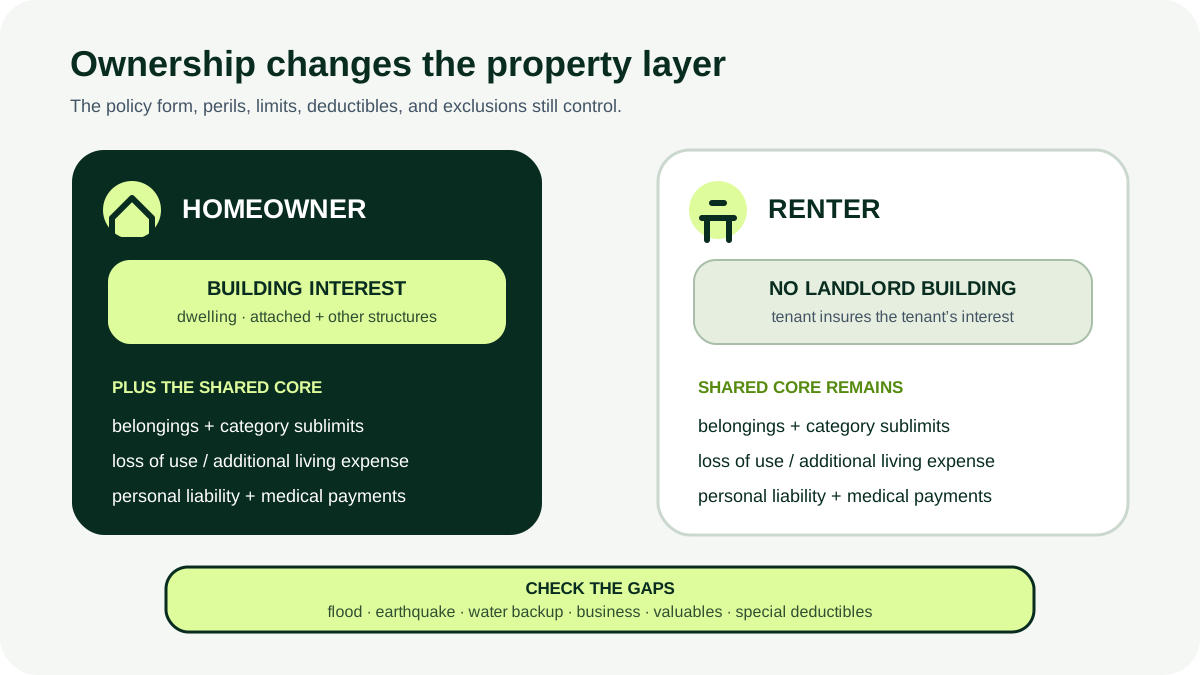
Condo and cooperative owners need another boundary. The association’s master policy may cover common areas and some building components, while the unit owner’s policy covers the interior, improvements, belongings, loss assessment, and liability according to both contracts. Obtain the master policy and bylaws rather than assuming where one policy ends.
Compare the core coverage sections
Home policies use forms and labels that vary, but the following framework is common:
| Coverage | Homeowners policy | Renters policy |
|---|---|---|
| Dwelling | Can insure the residence and attached structures | Generally not included because the tenant does not own the building |
| Other structures | May cover detached garage, fence, or shed | Generally the landlord’s property interest |
| Personal property | Can cover the household’s belongings | Can cover the tenant’s belongings |
| Loss of use / additional living expense | Can pay covered extra costs when a covered loss makes the home uninhabitable | Can pay covered extra costs when the rented home is uninhabitable after a covered loss |
| Personal liability | Can respond to covered claims for injury or property damage caused by an insured | Can provide similar personal-liability protection for the tenant |
| Medical payments to others | Limited no-fault-style payment for eligible injuries to other people | Commonly available on similar terms |
Coverage names do not prove the scope. Read the definitions of insured, residence premises, personal property, occurrence, and covered location. A roommate, domestic partner, adult child, student away at school, or short-term guest may not qualify as assumed.
Understand perils before limits
A policy pays only when the cause of loss fits its coverage and no exclusion or condition removes it. Some property coverage applies only to perils specifically named in the contract. Other forms cover direct physical loss unless a peril is excluded. Personal property can have a narrower peril basis than the dwelling even within one homeowners policy.
Fire, theft, wind, smoke, and water damage from certain sudden internal events may be covered under many forms, but wording and state-approved forms differ. Maintenance, wear, rot, insects, repeated seepage, neglect, and construction defects commonly create problems because insurance is designed for covered fortuitous losses, not routine ownership cost.
Do not describe a loss only as “water damage.” The cause matters. A pipe that suddenly bursts, rain that enters through wind damage, surface water that inundates the property, and a sewer backup can fall under different provisions.
Identify exclusions and endorsements
The NAIC and FEMA’s National Flood Insurance Program warn that most standard homeowners and renters policies do not cover flood. A separate flood policy can offer building coverage to an owner and contents-only coverage to a renter, with its own definitions, limits, deductibles, waiting periods, and exclusions.
Other gaps can include:
- earthquake, earth movement, sinkhole, or landslide;
- sewer, sump, or drain backup;
- service-line failure;
- mold or fungi beyond limited covered circumstances;
- home business property and liability;
- short-term rental or room-sharing activity;
- intentional acts and certain criminal conduct;
- watercraft, recreational vehicles, and automobiles;
- vacant or unoccupied property after a defined period;
- certain dog breeds, animal incidents, pools, or trampolines;
- cyber loss or identity restoration;
- ordinance or law cost after older construction must be upgraded.
An endorsement can add, remove, or change coverage. Record its form number and edition. “Water backup included” is incomplete without the limit, deductible, covered property, and exclusions.
Value the building separately from its market price
For homeowners insurance, the dwelling limit should reflect the covered cost to rebuild the structure, not the mortgage balance, tax assessment, purchase price, or land value. Rebuild cost depends on local labor and materials, demolition, architecture, access, debris removal, code changes, contractor demand, and the home’s dimensions and finishes.
Ask how the insurer calculated the replacement-cost estimate and correct inaccurate square footage, roof type, foundation, construction grade, additions, solar equipment, or finished space. Review after renovations and during periods of construction inflation.
Extended or guaranteed replacement-cost endorsements can provide additional protection, but names and conditions vary. Verify the percentage or formula, required insurance-to-value, reporting duties, exclusions, and whether ordinance-or-law cost is separate.
A renters policy does not need a dwelling rebuild limit, but improvements paid for by the tenant may need review. A custom built-in, upgraded fixture, or business installation might not be ordinary personal property.
Choose replacement cost or actual cash value deliberately
The NAIC explains that replacement cost value generally reflects the cost to repair or replace covered property with like kind and quality without a depreciation deduction, while actual cash value considers age, wear, and depreciation. Policy definitions and claim procedures govern.
A low contents limit with replacement-cost wording can still underinsure a household. An adequate limit with actual-cash-value settlement can still leave a large replacement gap.
Some replacement-cost claims are paid in stages. The insurer may first pay an actual-cash-value amount and release recoverable depreciation after documented repair or replacement within a stated deadline. Confirm whether this applies to the dwelling, roof, or contents and what evidence is required.
Do not infer coverage for collectible, sentimental, or antique value from “replacement cost.” Specialty property can require scheduled coverage or an agreed-value form.
Build a room-by-room personal-property limit
Walk through every room, closet, garage, storage area, and off-premises location. Record category, description, brand, model, serial number, approximate purchase date, and plausible replacement cost. Photograph wide views and important items. Save the inventory somewhere a fire, theft, or device loss will not destroy it.
Include easily overlooked property:
- clothing and shoes;
- kitchenware and small appliances;
- furniture, rugs, and window treatments;
- computers, phones, cameras, and gaming equipment;
- tools, bicycles, sports equipment, and musical instruments;
- books, hobby materials, and children’s property;
- items in a car, storage unit, dorm, or during travel, subject to policy terms.
Check category sublimits for jewelry, watches, cash, securities, firearms, silverware, collectibles, fine art, business property, trailers, and property away from the residence. A $50,000 contents limit does not mean every category receives up to $50,000.
Homeowners policies often calculate default personal-property limits as a percentage of dwelling coverage. Treat that as a starting number, not an inventory.
Measure loss-of-use coverage
Additional living expense coverage is designed for the necessary increase in living cost after a covered loss makes the residence unfit to live in, subject to limits and time periods. It does not usually pay every normal household expense or an unlimited hotel stay.
Estimate temporary housing, deposits, pet accommodation, laundry, storage, extra transportation, and the increase in food cost. Ask whether payment is limited by a dollar amount, percentage, duration, shortest repair time, or a combination. Understand how civil-authority evacuation and prohibited-use coverage works.
Keep receipts. The cause that displaced the household must generally be covered. A flood exclusion in the property section can also prevent standard loss-of-use payment after a flood; NFIP policies do not provide additional living expense.
Compare personal liability and medical payments
Personal liability can pay covered damages and legal defense when an insured is legally responsible for bodily injury or property damage. Medical payments coverage can pay limited eligible medical costs for others without requiring the same liability determination. Neither substitutes for health insurance, auto liability, professional liability, or business coverage.
Review activities and exposures: pets, pools, trampolines, firearms, household employees, volunteer roles, sports, rental property, online activity, and children away at school. Ask who is insured and where coverage applies.
The liability limit should reflect a severe plausible claim, not only the value of the belongings. Defense costs, whether paid inside or outside the stated limit, and exclusions can materially change protection. A personal umbrella policy may add limits above qualifying home, renters, and auto policies, but it requires specified underlying limits and has its own gaps.
Set deductibles that the household can actually fund
A deductible is the portion of a covered property claim borne by the policyholder. Higher deductibles can reduce premium but increase the cash needed after a loss. Liability and medical-payments sections often work differently.
Homeowners policies can have separate deductibles for wind, hail, named storms, hurricanes, earthquake, or other perils. A percentage deductible may be calculated from the dwelling limit, not the claim amount. Translate every percentage into dollars.
Renters deductibles are often flat dollar amounts, but verify. Compare the premium savings with the emergency fund and the size of loss worth claiming. A deductible above the value of likely small claims is a deliberate self-insurance decision.
Shop with an identical quote specification
Write one coverage request and give it to every insurer:
- Exact residence address, occupancy, household, and use.
- Dwelling replacement estimate and property details, if applicable.
- Personal-property limit and replacement-cost or actual-cash-value basis.
- Loss-of-use limit and duration.
- Personal-liability and medical-payments limits.
- Base and special-peril deductibles.
- Identical endorsements for water backup, ordinance or law, valuables, equipment breakdown, or other selected gaps.
- Effective date and policy term.
Compare the legal underwriting company, not only the brand or agency. Verify licensing with the state insurance department. Review complaint information, financial-strength evidence, cancellation conditions, inspection requirements, and whether the quote can change after underwriting.
Include installment fees, membership charges, and bundle effects. A bundle discount is not savings if either underlying policy is weaker or more expensive. Never cancel existing coverage until the new carrier confirms the exact policy and effective date in writing.
Special questions for renters
Confirm whether the lease requires a liability limit, lists the landlord as an interested party, or contains damage and subrogation terms. An interested party can receive notices; it is not necessarily an additional insured with rights under the policy. Ask what each designation means.
Do not assume the landlord’s requirement is a needs analysis. The required minimum may not replace your property or fund temporary housing. Conversely, a landlord-provided liability-only program may not cover belongings or loss of use.
Roommates usually need their own policies unless the contract expressly includes them. Adding an unrelated roommate informally can create ownership, claim-payment, and liability issues.
Special questions for homeowners
Mortgage companies usually require property coverage and may be named on structure-claim payments. Lender compliance does not prove adequate coverage. Review rebuilding cost, exclusions, and deductibles independently.
Tell the insurer about renovations, vacancy, a roof change, new dog, pool, home business, short-term rental, or other material change. Misstated occupancy or property facts can affect underwriting and claims.
Maintain the property. Save inspection, roof, plumbing, electrical, and renovation records. Insurance does not replace preventive maintenance, and evidence can help distinguish sudden damage from long-term deterioration.
A final comparison checklist
Before buying, answer:
- What property interest does the policy insure?
- Which causes of loss are covered for the building and contents?
- Which hazards require separate coverage or endorsements?
- Are values replacement cost, actual cash value, agreed value, or another basis?
- What category sublimits apply?
- What are all dollar and percentage deductibles?
- How much and how long can loss-of-use coverage pay?
- Who qualifies as an insured for property and liability?
- What business, pet, water, vacancy, and location exclusions matter?
- Is the insurer licensed, and is the final policy identical to the quote?
Bottom line
Homeowners and renters policies share a household-protection framework, but ownership changes the building layer. Homeowners need a defensible rebuild estimate; renters need to avoid relying on the landlord’s policy. Both need an inventory, adequate contents and loss-of-use limits, liability analysis, affordable deductibles, and a direct review of exclusions. Compare complete contracts on identical assumptions, not premiums or product names alone.
Related content
Frequently asked questions
Sources
Related content
More from DollarScout on this topic.
