Chase at a glance
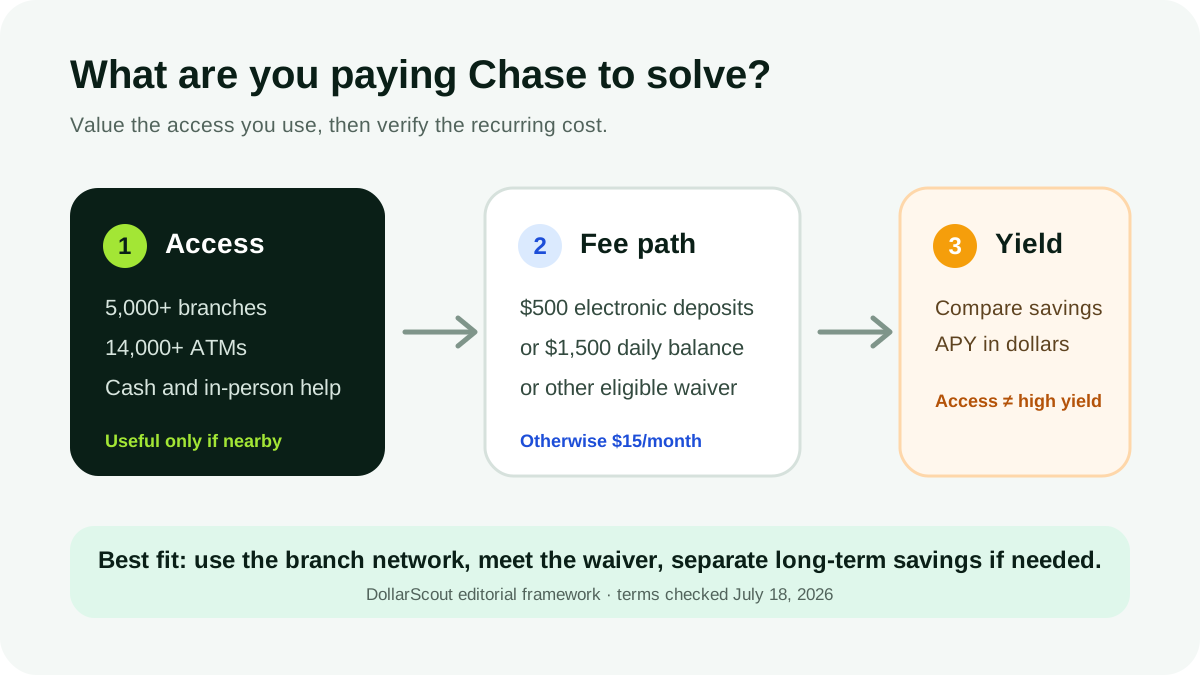
Chase is the access-first choice in this banking group. The current checking comparison page advertises more than 5,000 branches and 14,000 ATMs, while the mobile app supports transfers, bill pay, mobile check deposit, card controls, alerts, and Zelle. The bank also offers savings, certificates of deposit, credit cards, mortgages, auto loans, business banking, and J.P. Morgan investing. That breadth can reduce the number of institutions a household manages.
The tradeoff is economic. Chase Total Checking costs $15 per monthly statement period unless the customer completes one of the published waiver paths. Standard savings is designed as a convenient linked account rather than a market-leading high-yield product. A customer who never visits a branch and keeps a large emergency fund may give up substantial interest for access that goes unused.
| Review question | DollarScout finding |
|---|---|
| Best for | Customers who need branches, cash handling, and a broad financial ecosystem |
| Weakest area | Savings APY compared with online high-yield accounts |
| Core checking cost | $15 monthly or $0 when a published waiver condition is met |
| Physical reach | More than 5,000 branches and 14,000 ATMs advertised |
| Main decision | Whether access and consolidation justify fee planning and lower yield |
Chase Total Checking fees
Chase Total Checking is the most useful reference account because Chase labels it the bank’s most popular checking product. The current fee page lists a $15 Monthly Service Fee and four ways to reduce it to $0 during each statement period:
- Receive at least $500 in qualifying electronic deposits.
- Maintain at least $1,500 at the beginning of every day in the account.
- Maintain at least $5,000 in average beginning-day balances across the account and linked qualifying deposits or investments.
- Link an eligible checking account.
The definition of an electronic deposit matters. Employer and government payments arriving through ACH, RTP, FedNow, or an eligible debit-card payment facilitator can count. Cash, checks, wire transfers, interest, and Zelle transfers do not count merely because they add money. A customer relying on the $500 route should verify that the incoming transaction is coded as Chase requires.
Fees scores 3.5/5. The waiver thresholds are clearly published and attainable for many payroll customers, but the account is not inherently free. One missed requirement can turn a familiar checking account into a $180 annual expense. The $34 overdraft fee also remains relevant outside the conditions protected by Chase Overdraft Assist.
Chase Secure Banking offers a different compromise. Its published fee is $4.95 or $0 with $250 in qualifying electronic deposits or an account owner age 17–24. It does not charge overdraft fees and includes early direct deposit, but its feature set is more constrained. Comparing account names is essential; the cheapest Chase account is not automatically the closest replacement for Total Checking.
Overdraft rules and cash-flow risk
Chase Overdraft Assist can prevent a fee when an eligible checking account is overdrawn by $50 or less at the end of the business day. When the overdraft is more than $50, Chase describes a window until 11 p.m. Eastern Time on the next business day to bring the balance to no more than $50 overdrawn. It does not require enrollment for eligible accounts.
That feature is a buffer, not a credit line. Transactions can still be declined, some account types use different rules, and the deposit agreement controls posting order and availability. Customers who regularly run close to zero should use low-balance alerts, maintain a cushion, and understand when a mobile check becomes available. A visible pending deposit is not always available money.
Savings yield and the cost of convenience
APY receives 2.8/5, the lowest category score. Chase Savings and Chase Premier Savings have monthly fees with their own waiver rules, and rates depend on location, product, balance, and relationship. Chase does not market the standard account as a high-yield savings product. The important comparison is the dollars lost, not only the percentage displayed.
For example, a two-percentage-point APY gap on a $20,000 emergency fund represents roughly $400 of first-year interest before compounding and taxes. That opportunity cost can exceed checking fees. A Chase customer can still use the bank for payroll, bills, cash, and branches while keeping longer-term savings at an FDIC-insured online bank. Transfers add a delay, so enough cash should remain immediately accessible for near-term obligations.
Chase Savings can be reasonable for a small linked reserve, overdraft protection, or a customer who values instant internal transfers more than yield. It is difficult to justify as the sole destination for a large cash balance without comparing the current rate against alternatives on the same day.
Branches, ATMs, and cash access
Access & ATM Network scores 4.9/5. Chase’s footprint is the clearest reason to choose it over an online-only bank. Branches can handle cash deposits, official checks, account maintenance, document questions, and situations that are difficult to resolve through an app. The published network of more than 14,000 ATMs supports routine withdrawals across many markets.
Coverage is broad but not universal. Rural areas and some states have fewer locations, and an address search is more useful than a national total. Chase Total Checking customers may face Chase and ATM-owner charges outside the network; premium checking tiers advertise broader ATM benefits but require higher fees or balances. Map a home, workplace, and travel route before assigning full value to the network.
Cash-heavy users should also inspect deposit cutoffs, availability, and any limits applicable to an ATM or branch transaction. Chase’s advantage is that cash does not depend on a third-party retail barcode. That can be meaningful for tipped workers, small side businesses, or households that receive cash regularly.
Digital experience
Digital Experience earns 4.6/5. The app and website cover the core jobs expected from a large bank: balances, transactions, transfers, bill pay, mobile deposits, card lock, alerts, statements, Zelle, and access to other Chase products. Customers with Chase cards or J.P. Morgan accounts can see more of their financial relationship in one login.
Breadth can also create clutter. Credit-card offers, lending, investing, rewards, and bank accounts share the same ecosystem. A customer who wants only checking may see more navigation and marketing than at a focused online bank. The practical test is whether the app makes the recurring jobs—confirming a deposit, paying a bill, finding an ATM, disputing a charge—easy without requiring a branch visit.
DollarScout did not represent a public-page review as an authenticated app test. The score reflects the documented function set, established digital workflow, and integration across Chase products, with a deduction for complexity and the absence of hands-on task timing in this review cycle.
Customer service
Customer Service scores 4.4/5. The branch network gives Chase an escalation path that online-only banks cannot duplicate. The bank also publishes phone support, secure messaging, account help, appointment scheduling, and product-specific assistance. That variety is valuable when a debit card, wire, identity check, estate document, or account restriction cannot be solved by a help article.
Large scale does not guarantee a fast or favorable resolution. Support quality can vary by channel, location, issue, and time. DollarScout did not place and time test calls, so 4.4 is a documented-access score rather than a claim about average wait time. Keep confirmation numbers, save secure messages, and escalate unresolved deposit-account issues through Chase’s formal process; eligible complaints can also be submitted to the Consumer Financial Protection Bureau.
Deposit insurance and account structure
JPMorgan Chase Bank, N.A. is an FDIC-insured bank. Standard coverage is generally $250,000 per depositor, per insured bank, per ownership category—not $250,000 for every account name. Checking, savings, and CDs in the same ownership category at Chase are added together for insurance purposes. J.P. Morgan securities are not bank deposits and use a different protection framework.
Customers near the insurance limit should use the FDIC’s Electronic Deposit Insurance Estimator and include accrued interest. Adding a beneficiary or joint owner can change coverage only when FDIC ownership requirements are satisfied; it should not be done casually for yield or insurance alone.
Alternatives
Choose Capital One 360 when you want no monthly fees, a competitive savings product, and some physical access through branches, Cafés, and a large ATM network. Choose Ally Bank when savings organization, round-the-clock phone support, and an online-only account suite matter more than branches. Choose SoFi Checking and Savings when a strong qualifying APY and an all-in-one financial app fit a recurring direct-deposit workflow.
A two-bank setup can be stronger than forcing one provider to do everything. Chase can manage income, spending, cash, and branch needs while a high-yield account stores reserves. The extra transfer step is the cost of separating access from yield.
Who should choose Chase
Chase fits customers who:
- Have a Chase branch and several ATMs near their real travel routes.
- Deposit cash or need in-person service with some regularity.
- Can satisfy a fee waiver every statement period without locking up inefficient balances.
- Value one ecosystem for checking, cards, business banking, and investing.
- Prefer a mature national-bank app and broad service menu.
It is easier to skip when:
- The account would be fully digital and branches would go unused.
- A large savings balance makes APY the dominant economic consideration.
- Payroll or balances do not reliably satisfy a checking-fee waiver.
- A simpler interface and inherently fee-free account are higher priorities.
Bottom line
Chase earns 4.0/5. It is excellent at physical access, cash handling, ATM availability, and product breadth. Its digital experience is mature, and branches provide a real support advantage. Those strengths do not erase a $15 Total Checking fee without a waiver or the opportunity cost of standard savings rates.
Choose Chase deliberately for the jobs its footprint solves. Confirm the fee route using actual monthly behavior, compare savings in dollars, and consider separating everyday banking from long-term cash. A branch network is worth paying for only when the customer uses it.