The most important fact: Discover is no longer a new banking choice
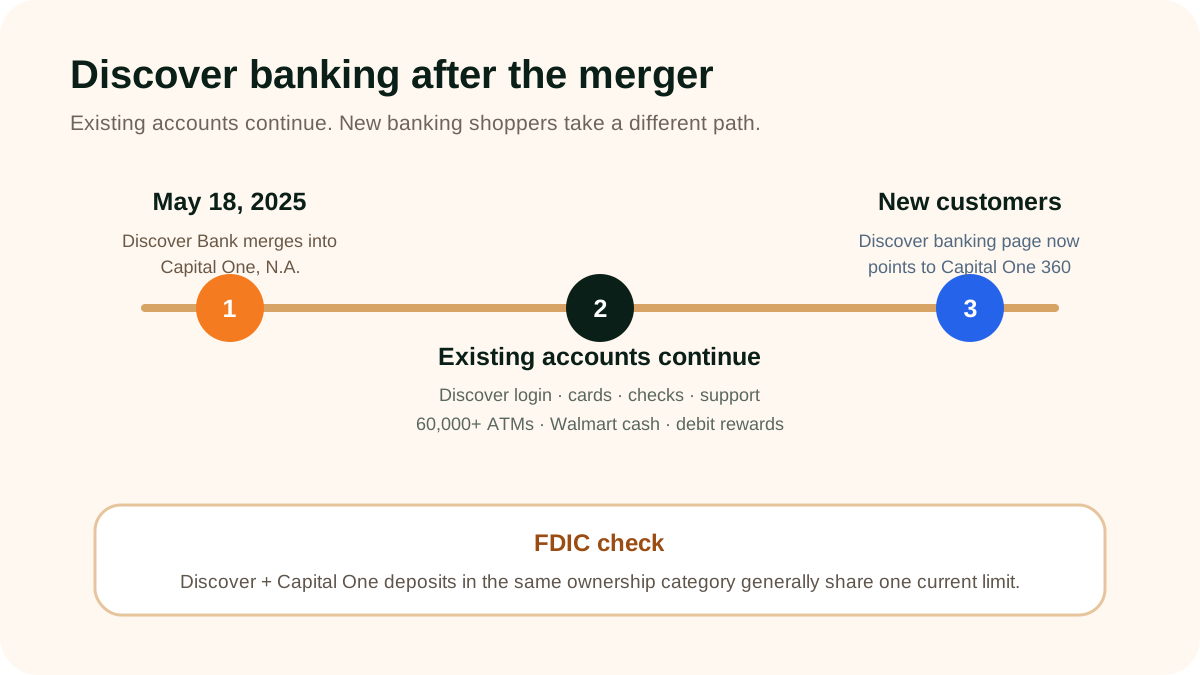
Discover Bank merged into Capital One, N.A. on May 18, 2025. Existing Discover-branded checking, savings, money market, CD, and retirement accounts remain active, and customers continue to use Discover.com, the Discover app, their existing account and routing numbers, debit cards, checks, and Discover support. The brand did not disappear from account servicing.
The acquisition changed the buying decision. Discover’s current Online Banking page is written for existing customers and directs prospective customers to Capital One checking, savings, and CD products. Old articles and comparison pages that still show an “Open an Account” path can create the impression that Discover Cashback Debit or Online Savings remains generally open to new customers. The current landing page controls: DollarScout does not recommend Discover as an account a new applicant can currently choose.
| Review question | DollarScout finding |
|---|---|
| Can a new customer apply? | The current Discover banking page directs prospects to Capital One products |
| Can an existing customer keep banking? | Yes; Discover login, account details, and servicing continue |
| Existing account fees | Discover’s merger FAQ says there are still no account fees |
| ATM and cash access | 60,000+ no-fee ATMs and Walmart cash deposits continue for eligible accounts |
| Main risk | Treating old acquisition pages as current new-account offers |
What existing customers keep
Discover’s official merger FAQ says existing customers can continue using their account, login, routing number, debit card, and checks as before. Automatic deposits, withdrawals, and bill payments continue on the existing schedule. Online savings, money market, CD, and retirement accounts continue to earn interest as shown on statements.
The same FAQ says account fees remain at $0, existing customers keep access to more than 60,000 no-fee ATMs, and eligible Cashback Debit customers continue to earn 1% cash back on up to $3,000 in debit-card purchases each month. Cash can still be added at Walmart in the United States using a contactless debit card. These are meaningful features, not a closed account waiting to disappear tomorrow.
Benefits do not cross brands automatically. Discover customers cannot currently deposit money, get account help, or use Capital One branches and Cafés as if the account were a Capital One 360 account. Capital One features do not automatically appear in Discover accounts, and Discover benefits do not transfer to Capital One accounts. The merger created one bank but not one customer interface.
Fees
Fees earns 4.8/5 for the serviced legacy account. Discover continues to state that existing deposit accounts have no account fees. Cashback Debit historically differentiated itself with debit rewards rather than an interest-bearing checking headline, and the reward remains available on eligible purchases under the merger FAQ.
Eligibility still matters. Cash back applies only to qualifying debit-card purchases and is capped at the first $3,000 of purchases per month. ATM withdrawals, money orders, person-to-person payments, loan funding, and other cash-like transactions do not become rewards purchases simply because a debit card is involved. The deposit agreement defines exclusions and can change.
The score is not 5.0 because legacy status adds nonfinancial friction. Customers have to track transition notices, distinguish Discover from Capital One support, and verify which old feature pages remain operative. A fee-free account can still create switching costs if a future migration changes workflows.
Savings APY
APY receives 4.0/5. Discover’s FAQ confirms that existing interest-bearing accounts continue earning interest, but the public new-account savings page no longer provides a reliable current offer for prospective customers. Existing customers should use their authenticated account, statement, and current notices to identify the rate applicable to their specific account.
The score recognizes that Discover Online Savings was built as a competitive online savings product and remains interest-bearing. It also deducts for opacity from a comparison shopper’s perspective and for transition uncertainty. DollarScout will not copy an old APY into a 2026 review merely because the page remains indexed.
An existing customer should compare the current statement rate with Capital One 360 Performance Savings, Ally, SoFi’s qualified and fallback rates, and other insured accounts. If the difference is material, transfer timing and FDIC aggregation matter more than loyalty to the servicing brand.
CD customers require extra care. A certificate’s fixed rate and maturity terms survive differently from a variable savings rate. Merger-related FDIC transition treatment can extend until the first qualifying maturity for some CDs. Review the maturity notice before renewing, because changing the term or amount can affect both economics and insurance treatment.
ATM and cash access
Access & ATM Network scores 4.3/5. More than 60,000 no-fee ATMs provide broad withdrawal coverage, and Walmart cash deposits make Discover more workable for occasional cash than many online banks. Existing debit cards continue to function under the published transition guidance.
There is no traditional Discover branch network. Capital One branches and Cafés do not currently service Discover deposit accounts, despite the common legal bank. A customer who needs in-person identity verification, an official check, estate support, or a complex cash transaction must use Discover’s stated remote process. That gap is why a large ATM count does not earn the same access score as a hybrid or branch bank.
Use the current locator before relying on a specific ATM. Network participants change, and some machines can display a no-fee logo after their status changes. Walmart availability also depends on store capability, debit-card status, and published transaction rules.
Digital experience
Digital Experience earns 4.2/5. Existing customers continue to manage accounts through Discover.com and the Discover app. The workflow supports balances, transfers, deposits, statements, debit rewards, bill pay, and other account functions. Discover’s Account Center agreement and mobile-deposit terms have been updated to name Capital One, showing that the legacy interface remains governed and maintained.
The deduction reflects transition rather than a claim that the current app is broken. Discover posts maintenance and migration notices, while newer educational content increasingly points to Capital One’s app and products. Customers must read notices carefully and avoid assuming that a Capital One article describes a Discover account feature.
DollarScout did not log into a private Discover deposit account. The score is based on current public servicing documentation and agreements, not an undisclosed hands-on account test. Existing users should judge the app by recurring tasks and keep contact information current so migration notices arrive.
Customer service
Customer Service scores 4.3/5. Discover instructs deposit customers to continue using Discover.com, the app, or the dedicated banking phone line at 1-800-347-7000. The merger FAQ says the same friendly service remains available by phone or online chat. A separate Capital One number handles Capital One accounts.
Clear routing is a positive, but a one-company/two-service model creates room for confusion. A Discover deposit issue should not be taken to a Capital One Café or general Capital One support unless a notice explicitly changes that process. Save any transition letter and identify the account as Discover-branded at the start of a call.
The score measures published contact paths. DollarScout did not submit or time a case, so it does not promise U.S.-based agent availability for every hour or a particular resolution outcome. Escalate unresolved deposit issues in writing and preserve case records.
FDIC insurance after the merger
The temporary six-month grace period for ordinary pre-merger deposits has ended. Discover and Capital One deposit accounts held in the same ownership category are now generally combined at Capital One, N.A. for the standard FDIC limit. Any Discover or Capital One deposit opened on or after May 18, 2025 counted together immediately.
This is the most consequential merger detail for customers with large balances. Someone with an individual Capital One savings account and an individual Discover savings account does not ordinarily receive two separate $250,000 limits today. Certain CDs can remain separately insured until a first maturity after the transition period under FDIC merger rules.
Use the FDIC estimator and include checking, savings, money market, CDs, and accrued interest under each ownership category. Moving money between Discover and Capital One may not improve insurance because both are the same insured bank.
Should an existing customer stay?
Staying can be reasonable when the current APY remains competitive, debit cash back is used, the 60,000+ ATM network fits, and the separate Discover interface is stable. There is no need to move solely because the legal merger occurred. Changing account numbers can disrupt payroll, autopay, tax refunds, and billers.
Switching becomes more attractive when the account rate lags, in-person service is needed, transition notices create too much friction, or combined Capital One and Discover balances exceed comfortable FDIC coverage. Compare a complete workflow, not a logo. The replacement should improve yield, access, service, or simplicity enough to justify moving recurring payments.
Alternatives for new customers
Choose Capital One 360 for the closest current new-account path, with no-fee checking and savings, a large ATM network, selected cash-deposit machines, and regional physical access. Choose Ally for 24/7 phone support and savings automation. Choose SoFi for a strong qualified APY and integrated mobile ecosystem when direct deposit is reliable. Choose Chase for extensive branches and cash service.
Bottom line
Discover Bank earns 4.3/5 as an existing-customer account. Its no-fee structure, debit cash back, ATM reach, Walmart cash deposits, and continuing interest remain useful. That score must not be misread as a recommendation to open an account that the current site no longer offers.
Existing customers should monitor the actual statement rate, keep transition notices, and combine Discover and Capital One balances when checking FDIC coverage. New customers should compare Capital One 360 and other currently available banks instead.