
Capital One Venture at a glance
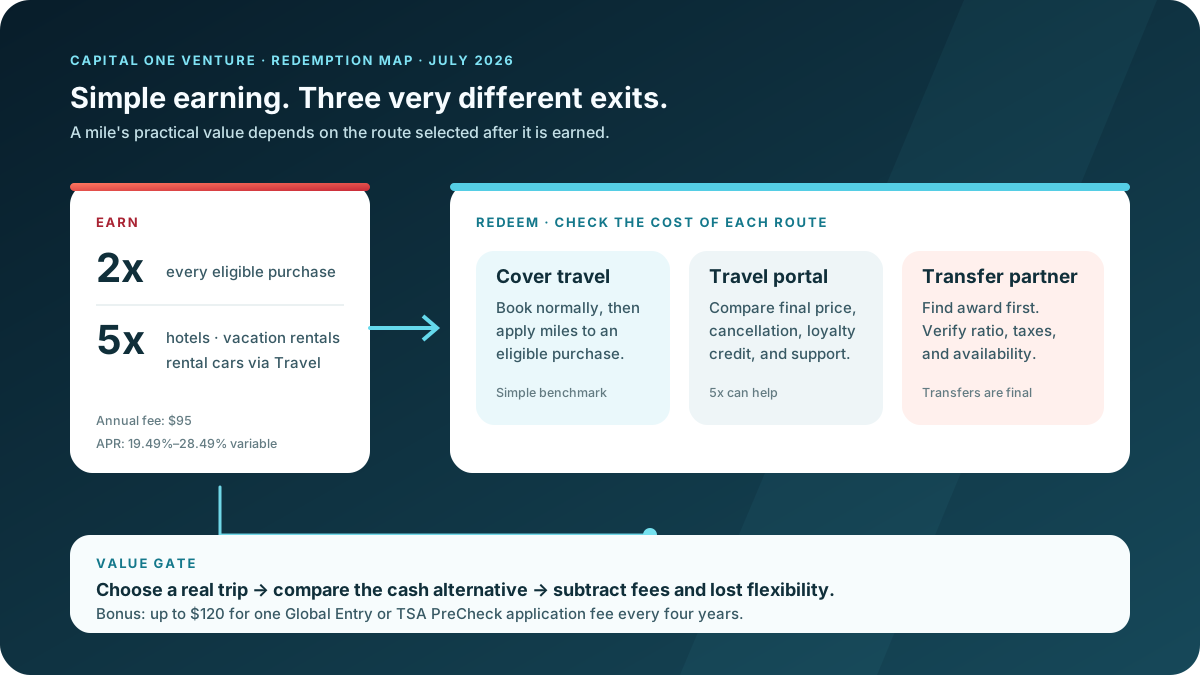
Capital One Venture Rewards is the simple middle card in Capital One's travel lineup. It charges a $95 annual fee, earns unlimited 2x miles on purchases, and increases that to 5x on hotels, vacation rentals, and rental cars booked through Capital One Travel under the current product page. The miles can be used for eligible travel, portal bookings, transfers, cash, gift cards, and other options at values that vary by redemption.
The card also includes up to $120 every four years for the first eligible Global Entry or TSA PreCheck application fee charged to the account, no foreign transaction fee, Hertz Five Star status for eligible cardholders, Lifestyle Collection benefits, and network travel protections subject to the current guide.
| Review question | DollarScout finding |
|---|---|
| Best for | Travelers who want 2x miles without tracking everyday categories |
| Annual fee | $95 |
| Current purchase APR | 19.49%–28.49% variable |
| Main strength | Flat earning plus several ways to use miles for travel |
| Main risk | Cash, travel, and transfer redemptions can produce different values |
Earning miles
Rewards scores 4.6/5. Two miles per dollar on nearly every eligible purchase removes the main maintenance burden of a category card. There is no quarterly activation, category cap, or need to choose which everyday transaction deserves the card. Capital One says miles do not expire for the life of an open account and places no stated limit on the number earned.
The 5x portal category applies to the travel types named in the current product offer. Flights generally remain at the base rate on Venture even when booked through Capital One Travel; do not import Venture X's 5x flight category into this card. Capital One's broader educational pages can describe additional portal activities, but the specific card offer and account terms control.
Returns reduce rewards, and balance transfers, cash advances, fees, or other nonpurchase transactions do not earn miles. A flat rate also cannot outperform every specialized card: a household with large dining, grocery, gas, or travel-category spend may earn more by combining cards, at the cost of more rules.
The current welcome offer
The public offer checked July 18, 2026 is 75,000 miles after $4,000 in purchases within the first three months. The offer can change and is subject to approval and account terms. Save the exact application page because direct, referral, preapproved, and third-party channels can display different terms.
The threshold should fit ordinary spending. A $4,000 target is not a reason to prepay nonrefundable travel, buy gift cards with fraud risk, or accelerate purchases that would otherwise not happen. Returns, credits, fees, cash-like transactions, and other excluded activity can reduce qualifying spend.
Treat the bonus as first-year value only. A card that works after the bonus should justify its $95 recurring fee through ongoing rewards, the trusted-traveler credit, travel use, and other benefits.
Redeeming for travel purchases
The simplest redemption is to use miles against eligible travel purchases or book through Capital One Travel under the options shown in the account. This approach can preserve the flat-rate feel: earn miles broadly, then apply them to travel rather than searching for award space.
Eligibility and value still matter. A merchant must code as qualifying travel for purchase redemption, and the account shows the rate and time window. Portal bookings have their own cancellation, change, price-match, and support flows. Compare direct prices and loyalty benefits before choosing the portal solely for 5x.
Capital One Travel advertises price prediction, price-drop features, and a price-match guarantee under stated rules. Those tools can be useful, but they do not guarantee the lowest total cost for every itinerary. Baggage, seats, resort charges, loyalty credit, insurance, cancellation rights, and package terms can make two identical-looking prices economically different.
Transfer partners
Capital One advertises more than 15 travel loyalty programs. Transfers can create higher value when a partner has useful award inventory, but ratios, minimums, timing, partners, taxes, fuel surcharges, and program rules differ. Once miles are transferred, the receiving program controls them and its expiration or change rules apply.
Do not transfer speculatively. Find the exact flight or hotel, verify that award space can be booked, compare the cash price and portal option, and leave a buffer for a transfer delay. A theoretical points valuation is not realized until an available redemption is completed.
Cash-back, gift-card, shopping, and entertainment redemptions remain available, but Capital One warns that redemption rates vary. Someone who mainly wants cash should compare the value displayed in the account with a no-fee 2% cash-back card instead of assuming the word “miles” improves the result.
Annual fee and break-even logic
Fees scores 4.3/5. The annual fee is $95 and there is no foreign transaction fee. There is no general annual travel credit equivalent to Venture X's $300 benefit. The trusted-traveler credit is available once every four years, not every year.
At a hypothetical one-cent travel redemption, 2x produces two cents per dollar. Against a no-fee 1.5% cash-back card, the extra half-cent requires about $19,000 of annual spend to recover $95 before other benefits. Against a no-fee 2% cash-back card, base earning alone does not recover the fee; Venture must win through transfer value, portal bonuses, the application-fee credit, travel benefits, or easier international use.
That comparison prevents a common error. “Unlimited 2x” sounds premium, but a fee only makes sense when the travel ecosystem adds something beyond a free flat-rate card.
Global Entry or TSA PreCheck credit
Benefits scores 4.5/5. Capital One reimburses the first eligible Global Entry or TSA PreCheck application fee charged to the account, up to $120, once every four years. The help center says the credit should arrive within two billing cycles and the account must satisfy the benefit conditions.
One credit applies per primary account, even when several authorized users have cards. Paying two application fees on the same account does not create two reimbursements. Divide the realistic value across four years: a fully used $120 benefit is approximately $30 per year, not $120 of annual recurring value.
Approval for the government program is separate. Capital One reimburses an eligible fee under the card terms; it does not influence the agency's background review, interview availability, approval, or renewal.
Lifestyle Collection and Hertz status
Eligible Venture cardholders can receive a $50 experience credit on Lifestyle Collection stays, plus property-dependent benefits such as Wi-Fi, early check-in, late checkout, or room upgrades when available. The credit is attached to an eligible booking and qualifying on-property experience, not a general $50 rebate for any hotel.
Capital One also advertises Hertz Five Star status for eligible cardholders. Status benefits depend on enrollment, Hertz program rules, location, fleet, and availability. The value is zero when Hertz is not the chosen rental company or the benefit duplicates status already held.
Use the same discipline as with the portal: compare total price, cancellation terms, taxes, status recognition, and direct-booking benefits. A curated collection can be valuable without being cheapest.
Travel protections
The current Capital One benefits material points cardholders to the applicable Visa or Mastercard Guide to Benefits. Public Venture material describes travel accident insurance, auto-rental collision damage coverage, and travel assistance for eligible transactions. Coverage depends on the network version issued and the current account guide.
Do not assume Venture's rental coverage is identical to Chase Sapphire Preferred's primary coverage. Confirm whether coverage is primary or secondary, the eligible vehicle and country, rental length, payment requirement, excluded losses, claim deadline, and documentation before declining rental-company protection.
Travel assistance coordinates help and may not pay the cost of services. A benefits logo is not a substitute for health, trip-cancellation, liability, or rental coverage selected for the actual risk.
APR and balance management
APR scores 3.5/5. The current purchase rate is 19.49%–28.49% variable, based on creditworthiness. At those rates, carrying $2,000 can generate interest far greater than the miles earned on the purchases that created it.
The CFPB explains that a purchase grace period generally lets a cardholder avoid interest by paying the full balance on time when the agreement provides one and no balance is carried. Cash advances and many balance transfers operate differently. Set automatic minimum payment as a safety net, but plan to pay the statement balance in full.
Capital One can show targeted balance-transfer offers to eligible accounts. Those transfers do not earn rewards, cannot move debt from another Capital One account—and, after Capital One's acquisition, cannot move a Discover balance—and have offer-specific fees and APRs. Read the actual offer rather than treating the product page as a financing promise.
Customer service and digital tools
Customer Service scores 4.2/5. Capital One provides web and mobile account management, virtual cards for eligible use, Eno alerts, fraud controls, phone support, travel-portal support, and help-center documentation. We did not call, dispute a transaction, request a price match, or make a protection claim, so the score is not a measured response-time rating.
Responsibility can move among Capital One, Capital One Travel, a travel supplier, a transfer partner, and a benefits administrator. Save the portal itinerary, fare rules, reward confirmation, and call reference number. A bank representative cannot make an airline release award space or override a network insurance exclusion.
Venture versus alternatives
Choose Chase Sapphire Preferred for broader bonus categories and a stronger published travel-protection package, especially when the $100 hotel credit is useful. Choose American Express Gold when restaurant and U.S. supermarket spending is large enough to justify a more complex $325 fee-and-credit system.
Choose a no-fee 2% cash-back card when cash is the main goal, transfer partners will not be used, and the $95 fee would depend on one temporary bonus. Venture wins on a simple travel workflow, not on guaranteed maximum value for every purchase.
Decision checklist
Venture is a strong candidate when you:
- Pay every statement balance in full.
- Want one card earning 2x without category tracking.
- Will redeem miles for eligible travel or researched partner transfers.
- Can use the trusted-traveler credit during the next four-year cycle.
- Value no foreign transaction fee and Capital One's travel tools.
It is easier to skip when cash back is the only desired redemption, a free 2% card is available, portal support feels undesirable, or a 0% introductory purchase offer is more important.
Bottom line
Capital One Venture earns 4.3/5. It succeeds at making travel rewards less fussy: unlimited 2x earning, flexible travel redemptions, transfer partners, 5x portal categories, a trusted-traveler credit, and no foreign transaction fee form a coherent package.
The $95 fee means simplicity is not free. Compare redemption values, direct and portal bookings, a no-fee 2% baseline, and the exact insurance guide. Venture is best for a traveler who wants a clean earning system and will still do careful work when turning miles into value.