Robinhood at a glance
Robinhood is now a multi-product investing platform rather than only the minimal stock-trading app many people remember. A self-directed account can hold U.S. exchange-listed stocks, ETFs, closed-end funds, options, ADRs, selected preferred and OTC securities, and other eligible instruments. Separate affiliated entities provide crypto, futures, event contracts, managed portfolios, and other services. Taxable, retirement, joint, and custodial account choices broaden the household use case.
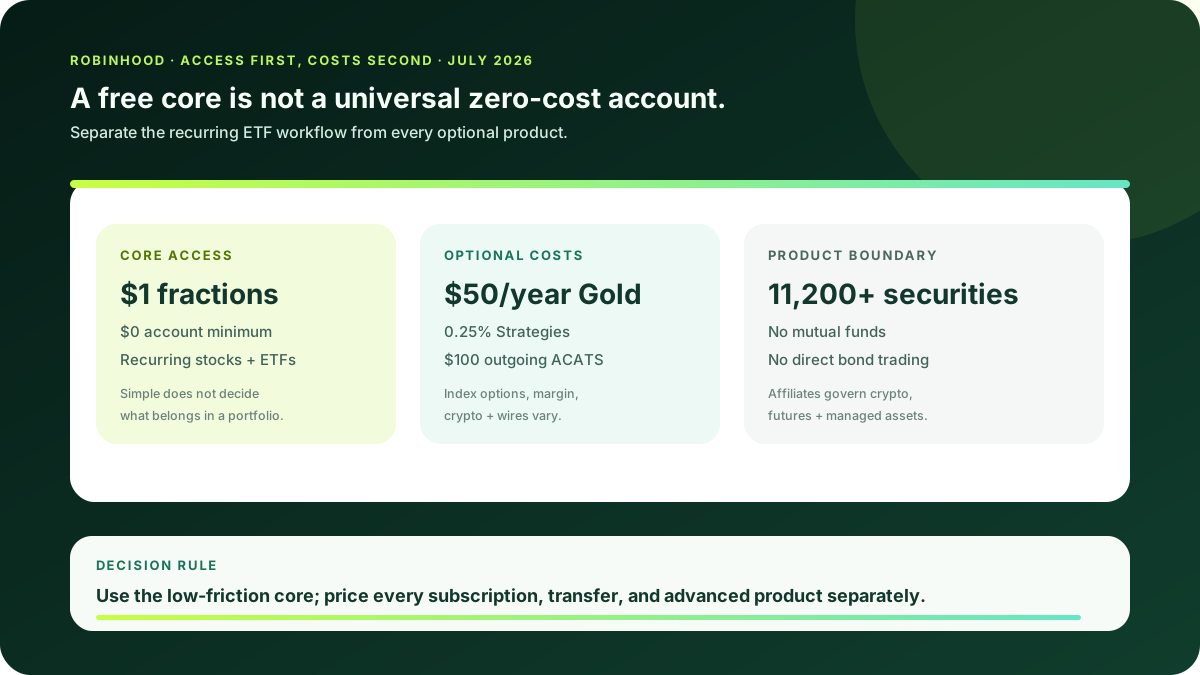
The core proposition remains simple: open without a brokerage minimum, buy eligible stocks or ETFs in dollars from $1, automate recurring purchases, and manage the account from a clean app. Robinhood says its securities catalog includes more than 11,200 investments. That is substantial, but it excludes mutual funds and direct bond or fixed-income trading. Different products also sit under different legal entities and protection regimes.
| Review question | DollarScout finding |
|---|---|
| Best for | Mobile-first investors using stocks, ETFs, fractional shares, and recurring purchases |
| Self-directed minimum | $0 to open; eligible fractional orders from $1 |
| Core stock/ETF pricing | $0 commission, with regulatory, routing, and ancillary fees still possible |
| Optional managed account | Robinhood Strategies: $50 minimum and 0.25% annual management fee |
| Main limitation | No mutual funds or direct bond trading; advanced products complicate the simple headline |
Fees and commissions
Fees & Commissions scores 4.7/5. Robinhood lists no commission for online self-directed trades in eligible U.S. exchange-listed stocks and ETFs. Stock and ETF options have no Robinhood base or per-contract commission, but regulatory charges can apply. As of the July 2026 schedule, Robinhood collects a combined regulatory amount for each options contract, so “zero per contract” should not be read literally as a zero-dollar confirmation.
Index options are different. Robinhood lists a $0.50 per-contract fee without Gold and $0.35 with Gold, before applicable exchange and regulatory charges. Exchange fees vary by symbol and contract conditions. An investor comparing SPX, SPXW, or VIX trades should model the exact contract count and all pass-through fees, not use the stock-option headline.
Robinhood Gold costs $5 monthly or $50 annually after an eligible trial. It can add research, preferred cash and margin treatment, a higher eligible IRA contribution match, and other benefits that can change. The annual price is cheaper than paying $5 for twelve months, but Gold is worthwhile only if the specific recurring benefit exceeds the subscription and any behavior it encourages.
The outgoing ACATS fee is $100. Fractional shares cannot transfer in kind and are sold in a full outgoing transfer, creating cash and potentially a taxable realization. Wire transfers, paper statements, ADRs, margin, returned payments, and other events can carry their own charges. Read the current fee schedule immediately before opening or moving an account.
Fractional and recurring investing
Ease of Use scores 4.8/5. Eligible fractional stock and ETF orders can start at $1 and can be placed in dollars or shares during supported hours. Robinhood says most NMS securities above its price and market-cap criteria qualify, but not every listed investment supports fractional trading. Fractional positions are maintained within Robinhood and generally cannot be transferred to another broker as fractions.
Recurring investments support stocks, ETFs, and crypto through the applicable Robinhood entity. Stock and ETF recurring orders are dollar-based and can create fractional positions. Robinhood groups recurring equity orders into batches and uses the batch’s weighted average execution price to calculate the shares delivered. That is automation, not a guaranteed price or a limit order.
The workflow is excellent for disciplined dollar-cost averaging, but the investor still chooses the investment and bears market risk. An automatic weekly purchase of a concentrated stock is not diversified simply because it is recurring. Review the security, amount, funding method, schedule, allocation, and tax location before turning the feature on.
Investment selection
Investment Selection scores 4.1/5. Robinhood Financial documents more than 11,200 securities, including most U.S. stocks and ETFs, many ADRs, closed-end funds, options, certain preferreds, warrants, and selected OTC equities. It also supports self-directed Traditional and Roth IRAs, with retirement matches subject to detailed holding and membership conditions.
The most important omissions are mutual funds and direct bonds or fixed-income trading. Someone building a Treasury ladder, buying individual municipal or corporate bonds, or using a specific mutual-fund share class should choose a broader broker such as E*TRADE, Fidelity, or Schwab. Bond ETFs are available, but an ETF is not a maturity-matched individual bond and its price can fluctuate indefinitely.
Crypto, futures, event contracts, and managed portfolios expand the menu through different affiliates and agreements. Crypto is not protected by SIPC. Futures and event contracts use derivative accounts and disclosures. Product availability and approval can vary by location, experience, and account type. Treat each as a separate decision rather than proof that one login is automatically a diversified portfolio.
Robinhood Strategies managed accounts
Robinhood Strategies is an optional managed service from Robinhood Asset Management. The published minimum is $50. Accounts below $500 use an ETF portfolio; accounts at $500 or more may combine ETFs and individual stocks. The annual management fee is 0.25%, accrued daily and charged monthly.
Eligible Gold members pay the management fee only on the first $100,000 in each managed account, subject to offer exclusions. Underlying fund expenses and trading-related costs remain relevant. Strategies is not the same as the self-directed brokerage and managed IRAs do not receive every self-directed IRA promotion.
The service can be useful for someone who wants a low minimum and delegated allocation. It is less attractive to an investor who can maintain a simple ETF allocation independently or wants tax, estate, and planning work from a human adviser. A 0.25% fee is modest relative to many advisers but is still a recurring percentage of assets.
IRAs and promotional matches
Robinhood advertises a 1% match for eligible self-directed IRA contributions and transfers without Gold and a 3% contribution match for eligible Gold subscribers. Promotional transfer rates can run for limited periods. The durable issue is not the headline percentage but the conditions.
IRA matches can require assets to remain in the account for five years to avoid an early-removal fee. The enhanced Gold contribution match also requires maintaining Gold for a stated period or paying a cancellation-related removal fee. Managed Robinhood Strategies IRAs are excluded from the self-directed contribution match. Tax treatment and contribution eligibility remain the customer’s responsibility.
Before transferring retirement assets, compare the bonus with five years of fund costs, account limitations, subscription charges, transfer costs, and the investments that must be liquidated. A bonus should not lock an investor into a platform that lacks the required holdings or service.
Research and tools
Research & Tools scores 4.0/5. The original app still prioritizes concise security pages and fast order entry, but Robinhood has added chart indicators, earnings and market data, recurring investments, retirement tools, watchlists, education, and Robinhood Legend, a configurable browser-based active-trading interface. Gold adds premium research and data benefits, although individual providers and availability can change.
Robinhood also offers a 24 Hour Market for selected stocks and ETFs using alternative trading systems. Overnight access is convenience, not improved liquidity. Spreads can be wider, participation can be lower, news can produce abrupt moves, and only supported order types and securities qualify. A limit order and a willingness not to trade can matter more than an extra session.
Research remains less complete than ETRADE’s broad security, mutual-fund, fixed-income, education, and Power ETRADE environment. Robinhood is good at turning an idea into an order. Investors still need a process for valuation, diversification, fund expenses, tax impact, and source verification that exists outside the trade button.
Order quality and conflicts
A zero commission does not settle execution quality. Robinhood routes orders and can receive payment connected to order flow and other platform activity. The relevant customer question is the price and execution received after spread, price improvement, speed, and fill probability—not whether an explicit ticket commission appears.
Use limit orders when price control matters, especially outside regular hours or in less liquid securities. Do not assume a displayed mark is executable. Review confirmations, compare fills with contemporaneous quotes, and understand that fractional and recurring orders can use different handling from whole-share limit orders.
Stock lending and cash programs create additional economics and disclosures. SIPC protection addresses missing cash and securities if a member brokerage fails within limits; it does not reimburse market losses. Sweep-bank FDIC eligibility applies under the sweep terms and limits, not to invested securities or crypto.
Customer service and account protection
Customer Service scores 3.9/5. Robinhood documents in-app and web support flows, callback options for eligible issues, security controls, fraud reporting, and extensive help articles. The product is designed to resolve ordinary tasks without a branch or assigned representative.
That model is efficient until a restriction, transfer, tax-document discrepancy, compromised account, option exercise, margin call, or deceased-owner process needs escalation. DollarScout did not submit and time a support case, so this score does not promise response speed. Investors who strongly prefer a branch network or a named adviser should weigh that absence before consolidating an entire household.
Enable strong unique credentials and multifactor authentication, verify every support contact inside the official app or website, and never share a verification code. Save confirmations, statements, cost-basis records, account agreements, and transfer documentation outside the account.
Robinhood versus alternatives
Choose Webull when technical charting, paper trading, desktop customization, screeners, and a more trader-oriented workspace matter more than minimalism. Choose E*TRADE when mutual funds, bonds, broad retirement and managed choices, deeper research, and Power E*TRADE justify a denser interface.
Choose M1 when the goal is a target stock-and-ETF allocation that receives deposits automatically through Pies and trading windows. Choose Public when bonds, Treasuries, direct indexing, multi-asset discovery, and AI-assisted research matter, while accepting its product-specific fees.
Who Robinhood is best for
Robinhood fits investors who:
- Want a very short path from deposit to a diversified ETF or selected stock.
- Use $1 fractional orders and recurring purchases consistently.
- Want a self-directed IRA and understand every match condition.
- Prefer mobile service with an optional web trading workspace.
- Can keep complex derivatives separate from a long-term plan.
It is weaker for mutual-fund users, individual-bond buyers, households requiring branch support, or investors likely to treat easy access to options, margin, crypto, futures, or overnight trading as a reason to take risk they do not understand.
Bottom line
Robinhood earns 4.3/5. Fees and ease lead the score because the $0-minimum, $1-fractional, recurring-investment workflow removes real friction. Selection and research have improved materially, and Robinhood Strategies adds a legitimate low-minimum managed choice.
The deductions matter: there are no mutual funds or direct bonds, the free headline has several product boundaries, and service is primarily remote. Use the simple core deliberately. Compare total cost, read match and transfer terms, verify the legal entity behind each product, and do not confuse a clean order screen with a complete investment plan.