Many products on this page are from partners who compensate us. This doesn't influence our ratings. Our opinions are our own.
Dollar-Cost Averaging Explained
By Sophie Brown, Senior Finance Editor · Updated Jul 2026 · Fact-checked Jul 18, 2026
Dollar-cost averaging means investing equal dollar amounts on a fixed schedule regardless of whether markets are rising or falling. It can turn regular income into a repeatable investing process and reduce the pressure to predict the perfect entry point. It does not guarantee a profit, prevent losses, or make an unsuitable investment safe. This guide explains the mechanics, the tradeoff with investing a lump sum immediately, and how to build a plan that survives real cash-flow and market stress.
Key takeaways
- Dollar-cost averaging fixes the dollar amount and calendar, so the number of shares purchased changes with market price.
- Regularly investing money as it is earned is different from deliberately holding an available lump sum in cash and staging it into the market.
- The strategy manages behavior and entry timing; it does not remove market, concentration, product, fee, tax, or inflation risk.
- A durable plan defines the goal, asset allocation, investment, amount, funding date, review rule, and conditions that justify a pause.
- Automation can support discipline, but statements, allocations, fees, tax lots, and failed transfers still require periodic review.
What dollar-cost averaging actually means
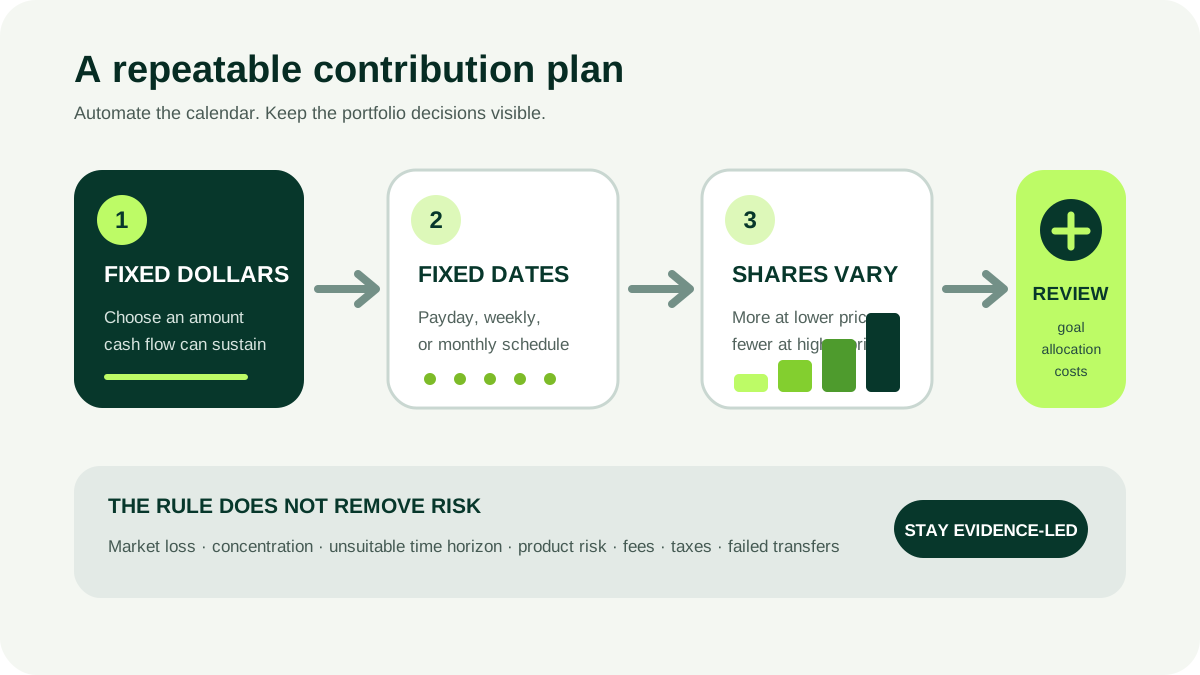
Investor.gov defines dollar-cost averaging as investing equal portions at regular intervals regardless of market ups and downs. The amount invested stays stable; the share count varies. A fixed contribution buys more shares when the price is lower and fewer when it is higher.
The definition has three essential parts:
- A predetermined dollar amount. “Whatever feels comfortable this month” is not a fixed rule.
- A predetermined interval. Weekly, every payday, or monthly can work if it matches cash flow.
- Execution independent of market forecasts. Skipping a scheduled purchase because headlines feel alarming breaks the rule.
The investment itself can be a diversified mutual fund, ETF, or another security available for recurring purchases. Dollar-cost averaging describes the purchase schedule, not the quality or diversification of the asset.
See the share math
Assume an investor contributes $600 on four scheduled dates to the same investment. Fractional shares are available and there are no transaction fees in this simplified example.
| Purchase | Price per share | Dollars invested | Shares purchased |
|---|---|---|---|
| 1 | $100 | $600 | 6 |
| 2 | $75 | $600 | 8 |
| 3 | $120 | $600 | 5 |
| 4 | $60 | $600 | 10 |
| Total | — | $2,400 | 29 |
The average purchase cost is total dollars invested divided by total shares: $2,400 ÷ 29, or about $82.76 per share. That result is below the simple average of the four quoted prices because the fixed dollars acquired more shares at lower prices.
This example does not prove that dollar-cost averaging produces a gain. If the final market price is below $82.76, the position has an unrealized loss. Prices may decline permanently, the issuer may fail, or the investment may underperform alternatives. The schedule changes when purchases occur; it does not change the economics of what is owned.
Separate paycheck investing from staging a lump sum
Two situations are often given the same label but have different decisions.
Investing from ongoing income: money becomes available each payday and is invested soon afterward. There is no earlier lump sum waiting on the sidelines. Regular retirement-plan contributions are a common example.
Staging money already available: an investor has cash today—perhaps from a bonus, sale, inheritance, or transfer—but chooses to invest it over several future dates. During that period, some money remains in cash.
FINRA notes the central tradeoff in the second case: staging a lump sum can limit the regret and short-term damage of investing immediately before a decline, but holding cash longer can forfeit gains if the market rises. Because no one knows the future path in advance, the decision is between exposures, not between a safe choice and a guaranteed winner.
| Question | Invest available lump sum now | Stage it with dollar-cost averaging |
|---|---|---|
| Market exposure | Immediate | Builds gradually |
| Risk after an immediate decline | Entire amount is exposed | Only invested portion is exposed |
| Opportunity cost in a rising market | Lower cash drag | Uninvested balance may miss gains |
| Behavioral burden | Requires accepting one entry date | Requires following multiple dates without changing the rule |
| Best fit | Investor accepts allocation and near-term volatility | Investor needs a defined transition to remain committed |
If staging is chosen, set the entire schedule in advance. An open-ended promise to “invest when conditions improve” is market timing without a rule.
Know what the strategy can and cannot do
Dollar-cost averaging can:
- automate a contribution habit;
- reduce the emotional significance of any one purchase date;
- buy more shares at lower prices and fewer at higher prices;
- align investing with recurring income;
- create a defined path for moving a lump sum into a target portfolio.
It cannot:
- guarantee a profit or a lower average cost than every alternative;
- protect against a long or permanent decline;
- diversify a concentrated fund or individual stock;
- make fees, taxes, spreads, or poor execution disappear;
- identify whether an investment is fairly valued;
- replace an emergency fund or suitable time horizon.
A repeated purchase of one speculative stock is still a concentrated bet. Consistency is useful only when attached to a suitable portfolio.
Start with the goal and time horizon
Define what the money is for, the target date, and the consequence of a loss. Money needed for near-term rent, taxes, tuition, a home purchase, or emergencies should not be forced into volatile assets merely because the purchase schedule is gradual.
Then set a target allocation among stocks, bonds, cash, and any other appropriate asset classes. The SEC’s investor education guidance distinguishes asset allocation—how the portfolio is divided among asset categories—from diversification—how risk is spread within and across those categories. A recurring contribution should support that portfolio design rather than substitute for it.
Document:
- the financial goal and target date;
- the minimum emergency reserve kept outside the plan;
- the target allocation and acceptable drift;
- the investment selected for each allocation sleeve;
- the loss or volatility the investor can realistically tolerate.
If a 25% decline would cause the plan to be abandoned, reduce the planned risk before automating it. The schedule is not a cure for an allocation that is emotionally or financially unsustainable.
Choose the investment before the frequency
Evaluate a fund or security on its own merits. For a pooled fund, read the prospectus and inspect the objective, benchmark, holdings, concentration, expense ratio, turnover, risks, and trading characteristics. For an individual stock, review SEC filings, the business, balance sheet, cash generation, valuation, dilution, and company-specific risks.
Broad funds can make diversification easier, but a fund label is not proof of diversification. Sector, thematic, leveraged, inverse, single-stock, and narrowly concentrated products may expose every recurring contribution to the same risk factor.
The contribution frequency is secondary. Weekly investing does not automatically improve returns over monthly investing. A useful frequency:
- follows the arrival of investable cash;
- clears after essential bills and reserve contributions;
- meets any platform minimum;
- avoids unnecessary transaction cost;
- is simple enough to monitor.
Build a written automation rule
A complete instruction might say:
On the first business day after each payday, transfer $350 from checking and invest it according to the 70% stock-fund / 30% bond-fund target, unless the transfer would take checking below the documented operating buffer.
That rule specifies amount, trigger, source, allocation, and a cash-safety condition. Add:
- what happens when a date falls on a holiday;
- whether the broker buys by dollars or whole shares;
- how residual cash is handled;
- whether distributions are reinvested;
- how failed transfers are reported and corrected;
- when the contribution increases after a raise;
- when the plan ends or changes.
Test the first transfer with a modest amount. Confirm the bank link, settlement, selected security, account type, and automatic-investment settings before scaling it.
Account for fees and execution
“Commission-free” is not the same as cost-free. The SEC identifies transaction charges and ongoing expenses as separate drags on returns. Depending on the product and platform, costs can include:
- fund expense ratios;
- bid-ask spreads on exchange-traded securities;
- commissions or contract fees;
- account, subscription, advisory, or inactivity fees;
- foreign transaction, currency-conversion, or transfer fees;
- cash drag from amounts too small to invest without fractional shares.
Repeated small orders can make fixed fees proportionally large. For example, a $5 charge on a $100 purchase consumes 5% before market performance. Compare the annual all-in cost of the planned schedule, not only the advertised commission.
Automatic orders can also use execution rules set by the platform. Verify when the order is submitted, whether it is a market or another order type, whether fractional orders are aggregated, and whether recurring purchases execute during regular market hours.
Direct new money and rebalance deliberately
If the portfolio has drifted from its target, new contributions can be directed toward underweight assets. This can restore balance without selling, which may reduce transaction costs and taxable gains. It is still rebalancing and should follow a rule.
Choose either:
- a calendar review, such as twice a year; or
- a drift review, triggered when an allocation moves outside a predetermined band.
Do not redefine the target simply because the recent winner feels safer. Review whether the goal, time horizon, financial situation, or risk capacity changed. Market excitement alone is not a new financial plan.
Track taxes and cost basis
In a taxable brokerage account, each recurring purchase creates a tax lot with its own date and cost basis. Dividends and capital-gain distributions can be taxable even when automatically reinvested. Sales may create gains or losses, and wash-sale rules can complicate loss harvesting when automatic purchases occur near a sale.
Retirement and other tax-advantaged accounts follow different contribution, withdrawal, and eligibility rules. Account tax treatment does not make the underlying investment less volatile.
Keep confirmations and statements, verify basis records, and understand the broker’s default tax-lot disposal method before selling. Tax rules depend on the investor’s circumstances; use current IRS guidance or a qualified tax professional for a consequential decision.
Define valid reasons to pause
“The market fell” is not, by itself, a failure of a dollar-cost averaging plan. But blind automation is not discipline. A pause or change can be justified when:
- income stops or essential cash flow becomes uncertain;
- the emergency reserve falls below its floor;
- high-cost debt or a required payment takes priority;
- the goal or time horizon materially changes;
- the investment closes, changes strategy, becomes unsuitable, or no longer tracks its stated objective;
- account security or transfer information is compromised;
- legal, tax, or plan rules require a change.
Document the condition before stress arrives. Resume according to another objective rule rather than a prediction that markets now “look safe.”
Review without turning the plan into market timing
Check each month that transfers and purchases occurred correctly. At the scheduled portfolio review, verify:
- The goal and target date are unchanged.
- Cash reserves and debt obligations remain appropriate.
- The contribution amount is affordable.
- The holdings still match the intended allocation.
- Fees, spreads, and tax effects remain reasonable.
- Beneficiaries, trusted contacts, and account security are current.
- The investment’s strategy, holdings, and risk disclosures have not materially changed.
Avoid checking performance as a referendum on every purchase. A long-term plan can be operationally correct while temporarily losing value.
Bottom line
Dollar-cost averaging is a scheduling discipline, not a return guarantee. Its strongest use is converting recurring cash flow into a diversified, low-friction plan that can continue through uncomfortable markets. When staging an existing lump sum, it exchanges some immediate market exposure for a defined transition period and possible cash drag. Write the amount, dates, investment, allocation, costs, review rule, and pause conditions before automating anything.
Related content
Frequently asked questions
Sources
Related content
More from DollarScout on this topic.
