Discover it Cash Back at a glance
Discover it Cash Back is a no-annual-fee card with three first-year value engines: rotating 5% categories, unlimited 1% on other purchases, and an automatic dollar-for-dollar match of cash back earned by a new cardmember during the first year. It also carries a current 15-month 0% offer on purchases and qualifying balance transfers.
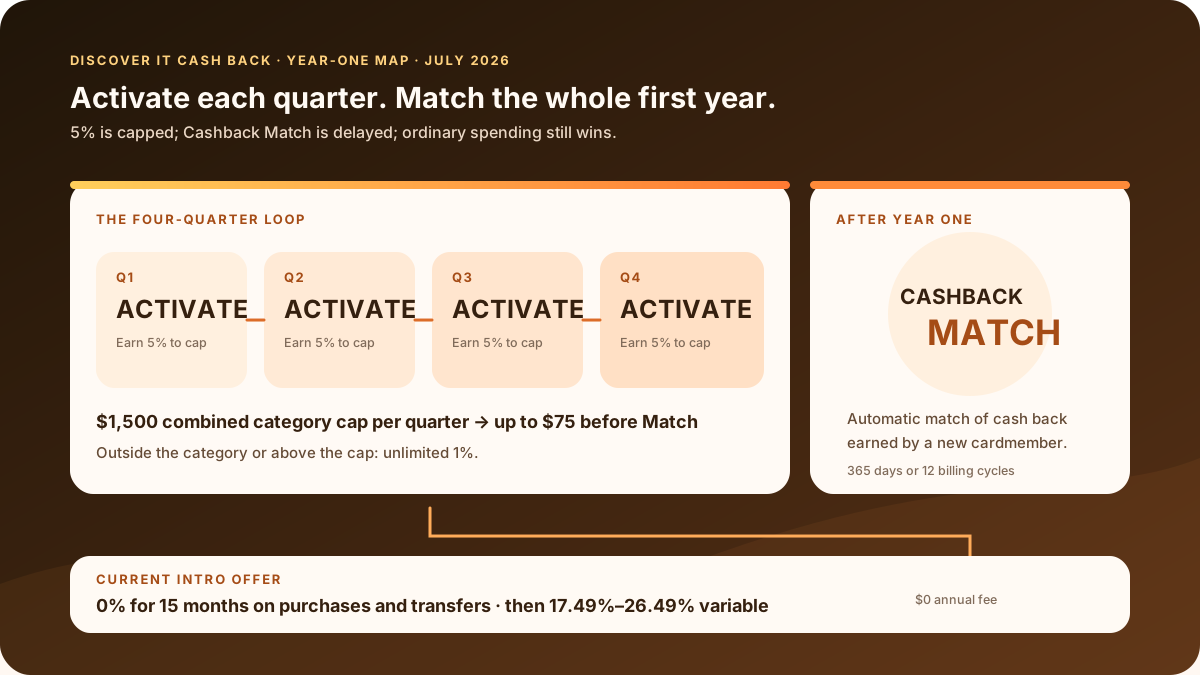
The 5% rate applies only after activation and only to the first $1,500 of eligible category purchases each quarter. That creates a maximum of $75 in category cash back per quarter before the first-year match. Spending over the cap or outside the category earns the base rate.
| Review question | DollarScout finding |
|---|---|
| Best for | No-fee users who will activate and plan around quarterly categories |
| Annual fee | $0 |
| Current intro APR | 0% for 15 months on purchases and balance transfers |
| Main strength | 5% categories plus unlimited first-year Cashback Match |
| Main risk | Activation, category definitions, and the $1,500 quarterly cap require attention |
How the rotating 5% program works
Rewards scores 4.6/5. Discover publishes a calendar of changing everyday categories such as grocery stores, restaurants, gas stations, or other merchants. The account holder must activate each quarter. Earning begins on the later of the quarter start or activation date under the applicable program terms; do not assume a late activation will credit all earlier purchases.
The cap is $1,500 in combined eligible category purchases per quarter. Five percent of $1,500 is $75. Once the cap is reached, additional category purchases earn the base rate. Across four fully used quarters, the maximum category component is $300 before counting the base rewards on other purchases and the first-year match.
Merchant category codes determine eligibility. A gas station attached to a warehouse club, a grocery counter inside a superstore, a restaurant purchased through an intermediary, or a digital wallet transaction can code differently. Read the quarter's definition and exclusions before moving recurring purchases.
Activation is free through the account, mobile app, or phone. Put a reminder a few days before each quarter and confirm the activation status instead of relying on memory.
First-year Cashback Match
Discover automatically matches all Cashback Bonus earned by a new cardmember during the match period. The period runs from account opening through the first 365 days or 12 consecutive billing cycles, whichever is longer. Discover says there is no dollar cap, no separate enrollment, and redeeming cash back during the year does not reduce the eventual match.
The match generally posts within two billing periods after the earning period ends. Rewards processed after the period may not qualify, and an account closed, revoked, bankrupt, or charged off before calculation can lose the match under the terms.
The match doubles rewards earned, not purchase amounts. A fully used 5% quarter earns $75 and contributes another $75 at match time, effectively 10% for that first-year category spend. A 1% purchase contributes another 1% at match time. This makes the first year unusually strong, but the second year returns to the ordinary 5%/1% structure.
Do not count a match until the qualifying year is complete and the account remains eligible. It is a delayed bonus, not money available for the current statement payment.
Annual fee and other fees
Fees scores 5.0/5 because the annual fee is $0, Discover advertises no foreign transaction fee for its card products, and the first late payment does not carry a late fee under current general Discover it terms. Later late payments can cost money, and missing a due date can harm credit even when a fee is waived.
No annual fee does not mean no cost. Cash advances currently cost the greater of $10 or 5%, with a 28.49% variable APR shown on the product page. Balance transfers carry a percentage fee. Interest applies after the purchase promotion or when account terms otherwise impose it.
The card can be kept long term without paying for another anniversary, which helps credit-history continuity when it remains useful and responsibly managed. Closing still affects available credit and can change utilization; it should be an account decision, not a reaction to an unused quarter.
Current 15-month 0% offer
APR scores 4.7/5. The application page checked for this review lists 0% for 15 months on purchases and balance transfers, then 17.49%–26.49% variable. The page states rates as of June 30, 2026. The promotional balance-transfer fee is 3% until the offer-specific October 10, 2026 deadline, followed by a 5% fee for future transfers.
The exact deadline advances or changes with application versions; older cached pages showed earlier dates. The disclosure presented in the applicant's session controls. Save it and verify when a transfer must be requested, when it must post, and which fee applies.
A $5,000 transfer at 3% costs $150. Paying $5,150 over 15 equal months requires about $343.34 per month. Minimum payments will not necessarily finish the balance. Schedule a payoff one statement early so processing delays do not push a residual balance into the variable APR.
Unlike Citi Double Cash, the current Discover offer also applies 0% to purchases for the same advertised period. Separate balances and payment-allocation rules still matter, and new spending increases the amount that must be cleared before the promotion ends.
Interest after the promotion
The standard purchase APR range is 17.49%–26.49% variable after the introductory period. Variable means the rate can move with the benchmark in the agreement. At those rates, carrying debt can erase rewards rapidly.
The CFPB explains that a grace period can generally avoid purchase interest when the agreement provides one and the full balance is paid by the due date. Promotional balances complicate grace-period treatment, so read the Discover disclosure and statement for how purchases and transfers are handled.
Set automatic minimum payment to reduce late risk, but calculate a full payoff schedule. A 0% period postpones interest; it does not reduce principal or make discretionary purchases affordable.
Reward redemption
Cashback Bonus can be redeemed as cash in any amount under current terms, including a statement credit or eligible deposit-account option, and for gift cards subject to availability and minimums. Rewards generally do not expire for the life of the account. Closing can trigger a check or account credit under Discover's described process, with exceptions for restricted situations.
A statement credit is not necessarily the same as making the minimum required payment. Keep the scheduled payment in place unless the statement explicitly shows otherwise. Redeeming during the first year does not reduce the Cashback Match calculation, so there is no need to hoard rewards solely for the match.
Gift cards can offer promotional value but are less flexible than cash and may have merchant restrictions. Compare the exact amount instead of assuming every noncash redemption is better.
Calendar maintenance and wallet strategy
Discover works best beside a flat-rate card. Use it for the active 5% category until the $1,500 cap, then move nonbonus spending to a card earning more than 1% if available. Keep a running quarterly total because a $75 maximum can be reached quickly in grocery, digital-wallet, or holiday-shopping quarters.
Do not buy gift cards or prepay services merely to exhaust the cap. Fraud protections, return rights, category coding, and unused balances can turn “maximization” into risk. The objective is to earn more on planned purchases, not invent purchases for rewards.
The calendar itself can have outages, as the public page did during this review. The logged-in account should be treated as the final source for the assigned quarter and activation status.
Acceptance and international use
Discover's U.S. product page says it is accepted at 99% of places that take credit cards in the United States. That does not mean every individual merchant accepts it. Acceptance abroad is more uneven even though Discover Network operates at millions of locations and the card does not advertise a foreign transaction fee.
Carry a Visa or Mastercard backup overseas and check the acceptance map for the country. Pay in local currency when the merchant's dynamic-currency-conversion offer is unfavorable. A 5% quarter may also be defined around U.S. merchant categories and should not be assumed to apply internationally.
Security and account tools
Benefits scores 4.2/5. Discover provides account freeze controls, transaction alerts, $0 fraud liability for unauthorized purchases under its policy, Social Security number monitoring enrollment, a FICO score, virtual-card access for eligible applicants, and U.S.-based service messaging. These are practical account features rather than luxury travel benefits.
The card does not center on airport lounges, transferable airline points, hotel status, or premium trip protection. That is appropriate at $0 annual fee, but a traveler booking a major nonrefundable trip may prefer to charge it to a card with stronger documented insurance even when Discover's rotating category earns more.
Preapproval and application
Discover offers a preapproval check that says it does not affect the credit score. Preapproval is not final approval, a guaranteed limit, or a guaranteed APR. Accepting and completing an application can create a hard inquiry and remains subject to underwriting.
Card designs and virtual access do not change the underlying account economics. Focus on the offer-specific rates, transfer deadline, reward calendar, and ability to pay. If the card is being opened for a 0% purchase, divide the full planned amount by 15 months before applying.
Customer service and the Capital One transition
Customer Service scores 4.4/5. Discover publishes 24/7 U.S.-based customer-service access, app and web controls, reward activation, security alerts, and extensive educational material. We did not call, report fraud, dispute a merchant category, or test the migration to Capital One, so this is not a response-time or satisfaction survey.
The merger creates an unusual transition risk. Some accounts can be managed through Capital One systems, and Discover warns that public benefit content may not apply identically. Preserve notices about login, autopay, account numbers, rewards, and benefits. Use the number on the card when public pages and the account disagree.
Discover it versus alternatives
Choose Citi Double Cash when an unlimited 2% base rate is more valuable than quarterly 5% work and the 18-month transfer period fits the debt plan. Choose Chase Sapphire Preferred when transferable travel points, stronger trip protections, and no need for quarterly activation justify a $95 fee.
Discover is the stronger first-year no-fee proposition when the categories match spending and Cashback Match will be earned. It is weaker as a one-card solution after year one because all noncategory purchases earn only 1%.
Decision checklist
Discover it Cash Back is a strong candidate when you:
- Will activate and track the 5% calendar every quarter.
- Can use the bonus category without exceeding the $1,500 cap unnecessarily.
- Want first-year Cashback Match and understand its delayed timing.
- Have a specific 15-month payoff plan for purchases or a transfer.
- Carry a backup card for merchants or countries with weaker acceptance.
It is easier to skip when category maintenance is unwelcome, a flat 2% rate is preferable, the transfer cannot be repaid in 15 months, or premium travel benefits matter.
Bottom line
Discover it Cash Back earns 4.6/5. No annual fee, up to $75 per activated 5% quarter, unlimited first-year Cashback Match, and a current 15-month 0% purchase-and-transfer offer make it one of the strongest first-year cash-back packages in this group.
The card rewards organization. Activate, read the category definition, stop at the cap, schedule the promotional payoff, and keep a second card for nonbonus or international purchases. Also watch account notices as Discover and Capital One systems converge; the logged-in account and application disclosure are the final terms.