
Crypto.com at a glance
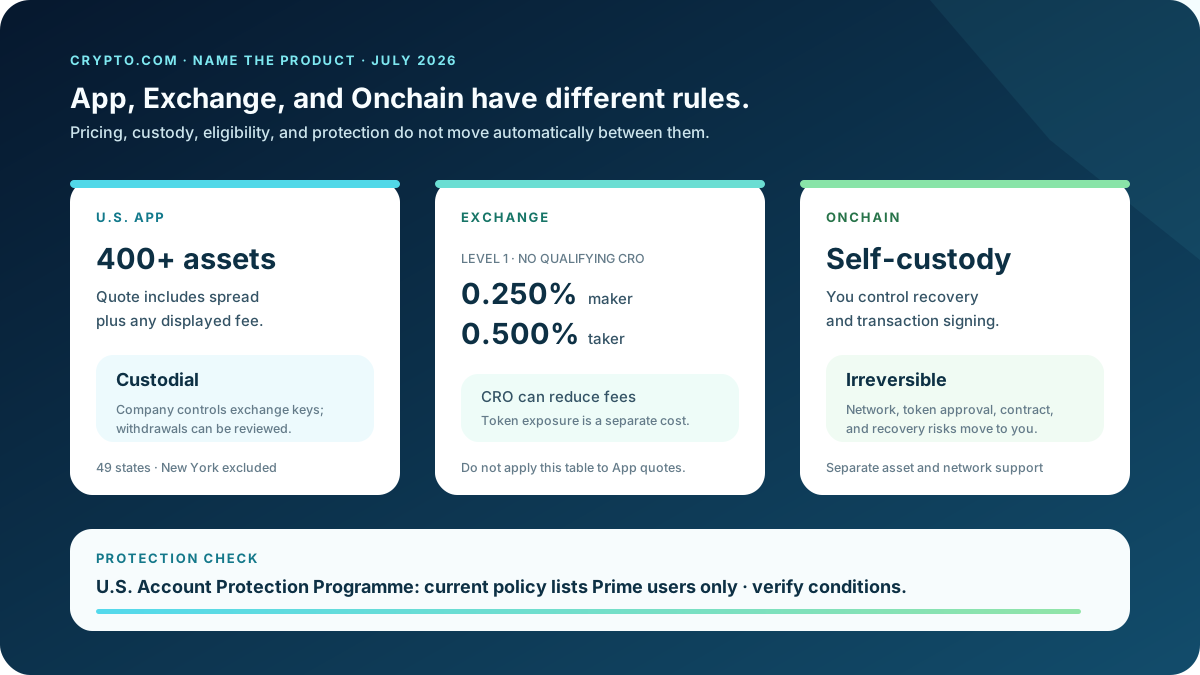
Crypto.com is not one unified price screen. For a U.S. consumer, the brand can include the custodial Crypto.com App, Crypto.com Web, a Visa card program, rewards and staking-like products, a separate Crypto.com Exchange where available, derivatives through regulated affiliates, and Crypto.com Onchain, a self-custody wallet. Each product has its own fees, eligibility, custody, and risk.
The U.S. App advertises more than 400 cryptocurrencies and availability in 49 states, excluding New York. That breadth is a meaningful advantage for mobile users. It also makes due diligence harder: an asset shown in the App may have different trading, transfer, rewards, and network availability than the Exchange or Onchain wallet.
| Review question | DollarScout finding |
|---|---|
| Best for | Mobile-first users who want a broad custodial ecosystem |
| U.S. App cost | Quote includes a markup/markdown spread plus any displayed fee |
| Exchange Level 1 checked | 0.250% maker / 0.500% taker without qualifying CRO balance |
| Main strength | 400+ advertised App assets and wide product coverage |
| Main limitation | Pricing and protection differ across App, Exchange, and Onchain |
App pricing and spread
Trading Fees scores 3.7/5. The U.S. App terms say applicable fees appear in the App or site and can change. Separate from those fees, the price at which Crypto.com buys or sells an asset includes a markup or markdown that constitutes a spread. The final confirmation is therefore the essential document for a retail trade.
The App can promote zero-fee deposits or zero-fee crypto exchange while a spread still affects execution. “Zero fee” does not mean the buy and sell price are identical to a live mid-market reference. For a purchase, divide dollars spent by units received and compare with a liquid market at the same time. For a round trip, estimate both buy and sell spread.
Spread can widen with volatility, liquidity, asset, and size. A large order should be broken into hypothetical quote checks before submission, though repeated trades can add cost and tax complexity. Capture the preview because the displayed result can change by the time an article or calculator is opened.
Crypto.com Exchange fees
The separate Exchange publishes maker/taker tiers. The July 4, 2026 table showed 0.250% maker and 0.500% taker for Level 1—less than $10,000 of 30-day volume—without a qualifying CRO balance. Higher volume reduces rates.
Holding CRO can unlock discounts under the current schedule. At a stated balance of at least 50,000 CRO, the Level 1 table displayed 0% maker and 0.4400% taker, a 12% taker discount. The tier and eligible balance can be recalculated daily. Buying a volatile token solely to save trading fees can create more market loss than the discount.
The Exchange schedule is not proof of what a U.S. App order costs or that every U.S. customer can access every Exchange pair. Product availability and legal entity matter. Confirm the site, account entity, pair, tier, CRO condition, order type, and final preview before using a rate in a comparison.
Asset selection
Asset Selection scores 4.8/5. Crypto.com's U.S. App currently advertises over 400 assets, one of the broadest retail selections in this review group. The number includes assets with very different liquidity, custody networks, transfer status, and product eligibility.
An App listing does not guarantee that the token can be withdrawn on a desired network, used with rewards, traded on Exchange order books, or sent to Onchain safely. Some tokens may be buy/sell only in a jurisdiction. Delistings, migrations, and network suspensions can require action.
Before purchasing a smaller asset, inspect the spread, order limits, withdrawal networks, minimum, fee, liquidity, project contract, and any regional restriction. Confirm that an independent destination wallet supports the same network. Use a test transfer and never select a network only because it is cheapest.
App custody versus Onchain
The Crypto.com App is custodial. Crypto.com controls the private keys used to hold and transfer customer crypto and can apply compliance, risk, or security reviews. The terms say private-key material under its control uses online and offline storage and that retrieval from offline systems can delay a transaction by 48 hours or more.
Crypto.com Onchain is a separate self-custody wallet. The user controls keys or recovery credentials and is responsible for blockchain fees, decentralized applications, token approvals, malicious contracts, and backup. Crypto.com cannot simply restore every lost recovery phrase or reverse a signed transaction.
Linking the products does not erase the boundary. A transfer from App to Onchain becomes an onchain withdrawal, subject to supported networks, address accuracy, fees, holds, and irreversible settlement. A split custody plan can reduce exchange concentration while increasing personal key-management responsibility.
Security program
Security scores 4.4/5. Crypto.com publishes information about multi-factor authentication, anti-phishing codes, withdrawal address controls, monitoring, cold storage, penetration work, and ISO and SOC certifications. It describes customer assets as held 1:1 and segregated in institutional reserve accounts under its model.
Certifications and operational controls are positive evidence, not guarantees. They do not protect a user who signs a malicious transaction, shares a one-time code, sends to the wrong network, or loses a self-custody recovery phrase. Secure the registered email and phone, use a unique password and TOTP, enable the anti-phishing code, whitelist addresses where available, and set transaction limits intentionally.
Crypto.com is a frequent phishing target. Ignore unsolicited direct messages and remote-access requests. Support does not need a seed phrase. Use the in-app route or a bookmarked official page and confirm every email domain.
Proof of reserves
Crypto.com publishes a proof-of-reserves page and wallet-address information intended to demonstrate that specified customer assets are backed 1:1. The page still references an independent verification based on balances as of December 7, 2022 for the named assets in that report.
That evidence should not be presented as a continuously current full-company audit in 2026. A reserve snapshot can support the existence and control of in-scope assets at a date, while omitting other assets, liabilities, legal claims, or later changes. Onchain address transparency helps observers monitor selected wallets, but wallet balances alone do not prove the total liability side.
DollarScout gives credit for public reserve information and security certifications while limiting the conclusion. Users should check for a newer report, confirm scope, and maintain an intentional exchange balance.
U.S. cash and deposit protection
Eligible USD may be placed with participating banking partners under the applicable program. Pass-through FDIC coverage, when available, applies to a partner bank's failure and requires records, ownership, and aggregate deposit limits. It does not protect crypto, a failed token, App spread, or general company insolvency.
Crypto balances are not FDIC- or SIPC-insured bank or brokerage deposits. Stablecoins are crypto assets even when designed to track a dollar. Their issuer, reserve, redemption, network, and market risks remain separate from a bank program used for eligible fiat.
Account Protection Programme limitations
Crypto.com's Account Protection Programme can reimburse eligible unauthorized transactions after specified controls and investigation. The April 2026 policy requires conditions such as enabled security features, timely reporting, a police report in relevant cases, truthful questionnaire completion, and cooperation.
For the United States, the policy's availability table states only for Prime users. The table describes coverage limits that can differ by user level, but a maximum should not be quoted without eligibility and exclusions. Crypto.com decides whether the event falls within the policy. Authorized scams, intentional transfers, negligence, excluded activity, or unmet security requirements may not qualify.
This narrower reading is more useful than saying “accounts are protected up to $250,000.” A regular U.S. App user should assume no general reimbursement promise unless the current account documents explicitly show eligibility.
Cards, rewards, and Level Up
Crypto.com ties parts of its ecosystem to card tiers, Level Up, subscriptions, and CRO holdings. Benefits can include rebates, rewards, yield, or fee treatment subject to plan, lockup, eligible merchant, geographic, and token-balance conditions.
Value each benefit after the subscription or opportunity cost and after CRO price risk. A rebate paid in a volatile token is not equal to cash at the moment of spending. Card rewards can have merchant-category exclusions and caps. Terms can change, so an old card-tier chart is not a durable valuation.
Rewards on deposited crypto are not bank interest. They can involve lending, staking, lockups, protocol risk, and changing rates. Read the exact product terms and understand how and when principal can be withdrawn.
Ease of use
Ease of Use scores 4.1/5. The App organizes a large number of crypto actions in a mobile-first experience and can make a first deposit or recurring purchase straightforward. The ecosystem is convenient for a person who genuinely wants several connected products.
The same breadth reduces clarity. App, Web, Exchange, Onchain, Visa, Prime, Level Up, Earn, and derivatives can look like features of one account even when they follow different entities and terms. Customer decisions improve when each transaction begins with: Which product? Who has the keys? What is the quote? What protection applies?
Customer service
Customer Service scores 3.7/5. Crypto.com provides in-app support, a help center, status information, and product-specific documentation. We did not submit or time a case, so the rating does not promise resolution speed.
Complexity raises the support burden. An App spread question, Exchange order, Onchain transaction, Visa issue, and derivatives position may need different teams and records. Save transaction hashes, order confirmations, screenshots, and case numbers. Onchain finality can leave support with no ability to reverse an error.
Crypto.com versus alternatives
Choose Coinbase when the priority is a simpler U.S. onboarding path and a clearer bridge between simple and Advanced trading. Choose Binance.US when eligible state access and the lowest published Advanced spot rate matter more than a broad lifestyle ecosystem.
Kraken provides stronger public entry-tier clarity and more mature proof-of-reserves verification, though its July 2026 entry taker fee is higher. Gemini emphasizes New York custody and institutional controls but has high entry ActiveTrader fees and fewer advertised assets.
Bottom line
Crypto.com earns 4.2/5. Its 400+ advertised U.S. App assets, mobile breadth, security program, and optional self-custody route create real utility. The deduction reflects a fragmented pricing model, product boundaries, dated reserve evidence, and protection language that is narrower in the United States than broad marketing can imply.
Name the product before valuing it. Price the App quote independently from the Exchange table, treat CRO discounts as an investment decision, and verify whether any account-protection program actually covers the specific U.S. account.