
Public at a glance
Public is a self-directed investing platform that combines an app-oriented experience with a surprisingly broad asset menu. Customers can access stocks, ETFs, OTC securities, stock and index options, corporate and government bonds, Treasuries, IRAs, margin, crypto, Direct Indexing, Investment Plans, high-yield cash, AI research, and programmatic trading tools. Different products are provided by Public Investing, Public Advisors, Jiko, Zero Hash, Apex, partner banks, and other entities.
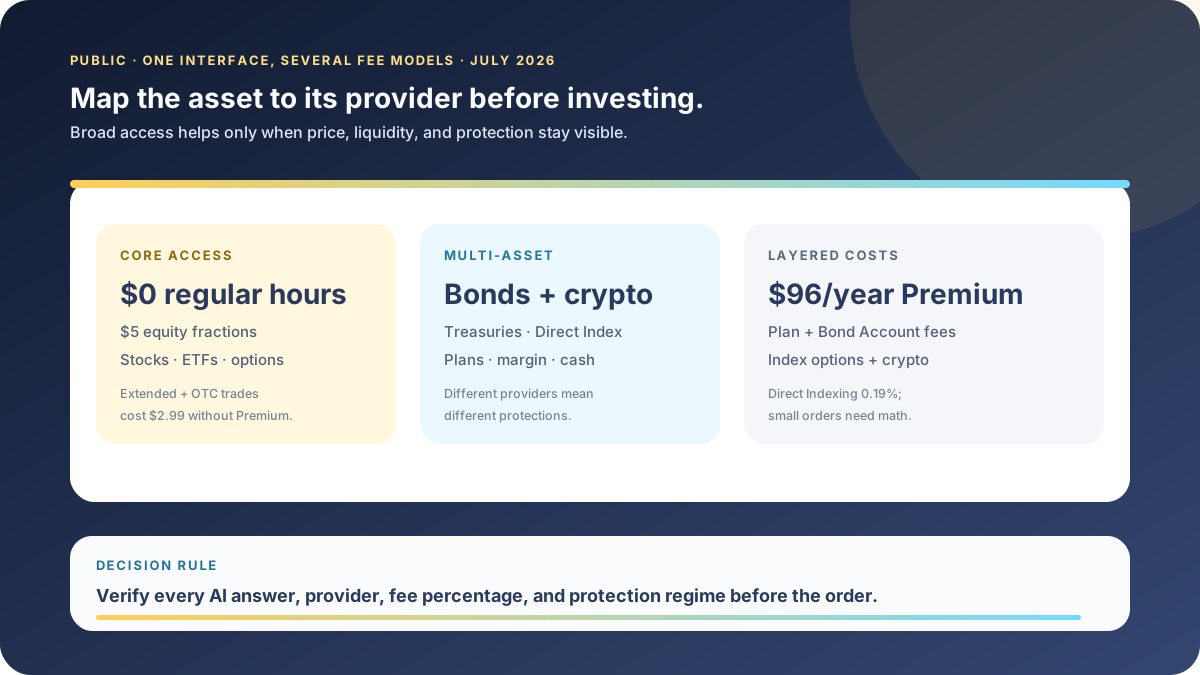
The standard brokerage has a $0 account maintenance fee and eligible U.S.-listed stock and ETF trades during regular hours have no commission. Eligible fractional stock purchases have a $5 minimum. Those core facts are competitive. The surrounding fee schedule is more layered than the clean interface suggests.
| Review question | DollarScout finding |
|---|---|
| Best for | Self-directed investors wanting stocks, bonds, options, crypto, and research in one app |
| Brokerage minimum | $0; eligible fractional stock buys from $5 |
| Regular stock/ETF price | $0 commission during regular market hours |
| Premium | $10 monthly or $96 annually; waived at a qualifying $50,000 combined balance |
| Main limitation | Product-specific Plan, bond, extended-hours, index-option, crypto, and account fees |
Stock and ETF pricing
Fees & Commissions scores 4.1/5. Public lists $0 commission for eligible U.S.-listed stock and ETF trades during regular market hours. Regulatory transaction charges and spread still apply. Customers can select certain routing methods; wholesale routing is listed at $0, while smart routing or lit-exchange-only choices can cost $0.003 per share.
Extended-hours trades are different. Public Premium members pay $0, while non-Premium members pay $2.99 per trade. The same $2.99 non-Premium charge applies to OTC trades. Extended sessions run from 4 a.m.–9:30 a.m. ET and 4 p.m.–8 p.m. ET for eligible securities, with lower liquidity and wider-spread risk.
Eligible fractional stock purchases have a $5 minimum. The sell minimum is $5 unless the customer uses “sell all” for a smaller position. Fractions improve access but can be nontransferable and subject to broker handling. A small notional order can still be uneconomical if spread or an extended-hours charge consumes a material percentage.
Public’s current schedule also lists a $3.99 monthly inactivity fee for accounts with less than $70 of total value and no activity during the prior six months. Transfer, corporate-action, restricted-account, returned-payment, paper, and other service charges can apply. Read the complete schedule rather than a headline pricing grid.
Public Premium
Public Premium costs $10 per month or $96 per year. Accounts with a qualifying combined balance of at least $50,000 receive complimentary access under the current terms. Premium adds advanced company data and insights, expanded research, fee-free extended-hours and OTC trades, fee-free stock and ETF Investment Plans, customized alerts, and a waived Bond Account monthly maintenance fee.
The annual plan saves $24 compared with twelve monthly payments. Value depends on behavior. A customer placing four non-Premium extended-hours trades in a month would otherwise pay $11.96, but avoiding those sessions entirely could be cheaper and reduce execution risk. A person using no Bond Account, Plans, or premium research may receive little economic value.
Do not deposit or retain an unsuitable $50,000 portfolio merely to waive a $96 annual charge. Subscription value should follow the portfolio plan, not drive it.
Investment Plans and automation
Investment Plans group stocks and ETFs into a recurring portfolio. Non-Premium customers pay $0.49 per recurring purchase for one to three symbols, $0.99 for four to ten, and $1.99 for eleven to twenty. Premium waives those stock-and-ETF Plan fees.
Crypto within a Plan costs 1.25% of the crypto order amount through Zero Hash. A $10 recurring crypto purchase would incur $0.125 before spread or market movement, while a small multi-symbol equity Plan can pay a high percentage of the deposit as a fixed transaction charge.
Plans can support disciplined contributions, but the customer controls securities, weights, frequency, and continuation. A recommended or thematic Plan is not automatically diversified or suitable. Review overlap, expense ratios, concentration, and taxable sales when editing.
Bonds and Treasuries
Investment Selection scores 4.7/5 partly because Public offers direct corporate and U.S. government bonds. Transaction charges are stated per $100 of par value and vary by bond type and maturity. Current Treasury charges range from $0.10 to $0.25 per $100 par; corporate bond charges range from $0.35 to $0.50 per $100 par.
Public’s Bond Account builds an allocation of ten investment-grade and high-yield bonds purchased in $100-par increments. Non-Premium members pay a $3.99 monthly maintenance fee; Premium members pay $0. Public says the account does not automatically rebalance or change allocations without customer instruction, apart from corporate-action processing.
The account can be more accessible than traditional $1,000 bond lots, but fees are significant at small balances. One $100 corporate bond can incur a $0.50 transaction charge, and $47.88 of annual maintenance equals 4.788% of a $1,000 Bond Account before default, spread, or price risk.
Treasury accounts offered through Jiko support recurring six-month Treasury bill purchases from $100 and use a 0.05% monthly management fee, equal to roughly 0.60% annually before compounding. Treasuries are obligations of the U.S. government, not FDIC-insured bank deposits; selling before maturity can produce a different price.
Options pricing
Public charges $0 commission on stock and ETF options and offers an opt-in order-flow rebate program. The current advertised rebate ranges from $0.06 to $0.18 per stock or ETF contract, based on underlying, route, current and prior monthly volume, and program terms. Regulatory and exchange charges still apply.
Index options cost $0.50 per contract for non-Premium members or $0.35 for Premium members, plus applicable exchange and regulatory fees. Index products can use cash settlement, European exercise, and different tax treatment from equity options; the exact contract disclosure controls.
A rebate does not make an option profitable. Payment connected to order flow creates an economic relationship worth understanding, and a high-volume tier can encourage excessive trading. Compare net execution, spread, assignment, exercise, and total risk—not the rebate alone.
Crypto pricing and provider
Crypto trading is provided by Zero Hash and uses a tiered transaction schedule for ordinary app orders. Current fixed fees range from $0.49 on orders up to $10 through progressively larger flat amounts, with orders above $500 charged 1.25%. First-party API crypto orders use a separate 0.60% rate under the published schedule.
Fixed fees can be expensive as a percentage of small orders. A $5 crypto buy with a $0.49 fee consumes 9.8% before spread or price movement. Crypto Plan orders use 1.25% rather than the ordinary tier table.
Crypto and crypto IRAs use providers and protections different from Public’s securities brokerage. Crypto is not FDIC or SIPC insured, can trade continuously, and can experience large price movements, custody events, or network constraints.
Direct Indexing
Public Advisors offers Direct Indexing with a $1,000 minimum and 0.19% annual management fee, accrued daily and charged monthly. The actual required minimum can be higher when a customized index contains enough positions that every smallest holding must meet the platform’s purchase threshold.
Direct Indexing can own a basket of component stocks and use tax-loss harvesting. It can also create many tax lots, tracking error, replacement-security exposure, and wash-sale interactions with holdings outside Public. The management fee is lower than many robo-advisers, but an ETF can be cheaper and simpler.
Tax-loss harvesting does not guarantee lower tax. Evaluate the entire household portfolio, future gains, tax rate, charitable plans, and administrative burden. Public Advisors does not provide personal tax advice.
Research and AI tools
Research & Tools scores 4.4/5. Public combines company metrics, analyst context, earnings-call summaries, earnings data, screeners, bond tools, income views, alerts, portfolio analysis, an AI research assistant, Agents, an API, and multi-asset discovery.
The interface is strongest when AI helps locate a primary document, compare a defined metric, or summarize material the investor then verifies. It is weakest when a broad prompt becomes a portfolio decision without constraints. AI output can sound confident while missing a filing footnote, fee, time period, or tax rule.
Public’s social roots and current AI emphasis can make the platform engaging. Engagement is not a research standard. Start with objectives and a source hierarchy: issuer filings, prospectuses, bond offering documents, account agreements, regulator records, then platform interpretation.
Ease of use
Ease of Use scores 4.5/5. Public organizes a wide product set with a modern, readable app and web experience. Fractional purchases, research, recurring Plans, bonds, options, and cash products are easier to discover than at some legacy brokers.
The hidden complexity is provider fragmentation. A stock, Jiko Treasury, Zero Hash crypto position, Direct Index account, bank-swept cash balance, and Public Investment Plan do not share one fee or protection model. A clean portfolio screen can visually combine legally distinct products.
Before enabling a new tile, read its agreement, minimum, fee, liquidity, tax reporting, withdrawal process, and support path. Ease should reduce administrative friction—not due diligence.
Customer service and protection
Customer Service scores 4.0/5. Public publishes in-app chat and support email, a detailed help center, product collections, and disclosures. Concierge access exists for qualifying larger accounts. DollarScout did not submit and time a support case, so this is not a measured response-time rating.
Public Investing is a FINRA and SIPC member for eligible securities brokerage activity. Jiko Securities is separately a FINRA/SIPC member for applicable Treasury accounts. Partner-bank cash can receive pass-through FDIC insurance under program conditions. Zero Hash crypto is outside SIPC and FDIC.
Use the provider name on each statement. SIPC does not reimburse market loss, and FDIC does not cover securities or Treasuries. Save statements, confirmations, bond documents, Plan instructions, AI prompts that generated actions, and tax records.
Public versus alternatives
Choose Robinhood for $1 fractional access, a simpler self-directed stock-and-ETF workflow, and recurring purchases without Public’s fixed Plan fee. Choose Webull for charting, paper trading, technical tools, and a trader-focused desktop platform.
Choose E*TRADE for mutual funds, deeper full-service bond and retirement infrastructure, Power E*TRADE, and broad legacy support. Choose M1 for target-allocation Pies and deposit-based Dynamic Rebalancing without a per-Plan transaction fee, while accepting windows and a possible $3 monthly platform fee.
Who Public is best for
Public fits customers who:
- Want stocks, options, bonds, Treasuries, crypto, and research in one interface.
- Will compare every product’s fee and provider.
- Value direct indexing or AI-assisted source discovery.
- Can justify Premium through recurring use, not marketing.
- Keep long-term objectives separate from social or AI prompts.
It is weaker for mutual-fund investors, branch-service customers, very small recurring Plans or Bond Accounts, and anyone who assumes every visible balance has the same protection.
Bottom line
Public earns 4.3/5. Selection, ease, and research are strong, and the platform provides unusually accessible bonds, options, and multi-asset context. The regular-hours stock and ETF core is competitively priced.
The layered schedule prevents a higher fee score. Premium, Plans, bonds, extended sessions, index options, crypto, Direct Indexing, and inactivity can each change the economics. Use Public when the broad menu solves real needs, then document the provider, protection, fee, and liquidity of every position.