Many products on this page are from partners who compensate us. This doesn't influence our ratings. Our opinions are our own.
How to Start an LLC in 2026
By Sophie Brown, Senior Finance Editor · Updated Jul 2026 · Fact-checked Jul 18, 2026
Starting an LLC is a state-law process followed by a series of tax, banking, licensing, and recordkeeping decisions. The filing itself may take minutes; building an entity that can sign contracts, receive money, document ownership, and stay compliant takes more care. This guide follows the practical sequence and flags outdated advice, including the current federal beneficial-ownership reporting rule.
Key takeaways
- Form in the state where the business actually operates unless a documented legal or economic reason supports another state.
- Confirm the name and registered agent before filing articles of organization through the official state website.
- Use an operating agreement to document ownership, authority, contributions, distributions, departures, and disputes—even for a single-member LLC.
- Treat state formation, federal tax classification, licenses, banking, and recurring compliance as separate workstreams.
- U.S.-created entities are currently exempt from federal CTA beneficial ownership reporting, but banks and states can still request ownership information.
Decide whether an LLC fits the business
An LLC is a legal entity created under state law. It can separate business obligations from an owner's personal obligations when it is properly formed and operated, but it is not a universal shield or a substitute for insurance. Personal guarantees, personal wrongdoing, payroll and tax duties, undercapitalization, and mixing personal and company money can still create personal exposure.
Compare the LLC with the alternatives before paying a filing service. A sole proprietorship is simpler but does not create a separate state-law entity. A corporation may fit a company planning institutional equity, complex ownership, or certain benefit structures. The SBA notes that legal structure affects taxes, fundraising, paperwork, and personal liability. Discuss material legal and tax consequences with qualified professionals in the relevant state.
Choose the state based on real operations
For most small businesses, the practical formation state is where the owner and business operate. Forming in Delaware, Nevada, or Wyoming does not automatically eliminate tax, privacy, or liability obligations elsewhere. If an LLC is formed in one state but conducts business in another, it may need to register as a foreign LLC in the operating state, maintain two registered agents, file two sets of reports, and pay two sets of fees.
Map the facts before choosing:
- where employees and owners perform work;
- where offices, stores, inventory, or property are located;
- where regulated services are delivered;
- where contracts are accepted and customers are served;
- whether investors or a future transaction require a particular jurisdiction.
State definitions of “doing business” differ. Get state-specific advice when operations cross borders, involve licensed professions, or hold real property. Internet claims about a universally “best” LLC state are a warning sign because they ignore registration and tax rules where the business actually operates.
Confirm the name and registered agent
Search the official state business registry before ordering a logo or signing a lease. The legal name usually must be distinguishable from existing entities and include an approved LLC designator. A trademark search and a domain search answer different questions; state name availability does not grant national trademark rights.
If the public brand differs from the legal name, the business may need an assumed-name, trade-name, or DBA filing. Confirm the rule with the state and relevant county or city.
Most states require a registered agent with a physical address in the formation state who can reliably receive legal and government documents during business hours. An owner may be allowed to serve, but the address may become public and missed service can have serious consequences. A commercial agent adds cost but can provide continuity. Verify what the service actually does; it does not replace legal counsel or automatically manage every filing.
File articles of organization through the official state channel
The formation document may be called articles of organization, a certificate of organization, or a certificate of formation. Common fields include the LLC name, principal address, registered agent, management structure, organizer, purpose, and effective date. Requirements and fees vary by state.
Use the secretary of state or other official filing office linked from the state government. Look-alike websites may charge a premium for submitting the same form. Before filing:
- Confirm the legal name character for character.
- Decide whether the LLC is member-managed or manager-managed.
- Use an address that satisfies the state's rules and can receive official mail.
- Check whether an immediate or delayed effective date is appropriate.
- Save the submitted form, receipt, stamped formation record, and state entity number.
Do not represent that the company exists before the state makes the filing effective. Contracts signed during formation should clearly identify who is signing and whether obligations will be adopted by the LLC.
Write the operating agreement and ownership record
An operating agreement is an internal governance document. The SBA says it is widely recommended even when a state does not require it. It should match the actual deal rather than a generic percentage table.
Document at least:
- each member, contribution, and ownership interest;
- who can sign contracts, borrow, hire, open accounts, and move money;
- voting thresholds and reserved decisions;
- how profits, losses, and distributions are handled;
- what happens after death, disability, divorce, bankruptcy, departure, or dispute;
- transfer restrictions, buyout methods, and admission of new members;
- recordkeeping, tax representative, amendment, and dissolution procedures.
A single-member agreement can establish authority, continuity, and separation. A multi-member agreement deserves individualized legal and tax review: a template rarely resolves deadlocks, unequal labor, vesting, intellectual property, or an owner's exit correctly.
Create a written capitalization record. Show what cash, equipment, or intellectual property each member contributed and what the LLC owns. Transfer intellectual property and important contracts with proper assignments where necessary; formation alone does not move assets into the company.
Obtain the EIN after state formation
An employer identification number is the LLC's federal tax identifier. The IRS provides EINs directly without a fee. Form the state entity first so the EIN application uses the exact legal name and effective record.
The responsible party must be a real person with ultimate control under IRS rules, not a nominee used merely to hide ownership. Save the EIN confirmation with the permanent records. Avoid paid sites that mimic the IRS or promise a special EIN that the IRS provides for free.
An EIN does not choose the LLC's federal income-tax treatment. By default, the IRS generally treats a domestic single-member LLC as disregarded for income tax and a domestic multi-member LLC as a partnership, unless an eligible election is made. Employment and certain excise-tax treatment can differ. An election to be taxed as an S corporation or C corporation is a tax classification decision, not a new state entity; deadlines, payroll, reasonable compensation, eligibility, and administrative cost matter.
Do not make a tax election solely because social media promises a fixed savings amount. Model expected profit, payroll cost, state treatment, benefits, and compliance with a tax professional.
Register for taxes, licenses, and permits
Formation approval is not permission to conduct every activity. Identify federal, state, county, and city requirements for the actual location and industry. Possible obligations include sales and use tax, payroll withholding, unemployment insurance, franchise or gross-receipts taxes, professional licenses, health or building permits, zoning, home-occupation approval, and assumed-name registration.
Create a requirements table with agency, account number, filing frequency, due date, responsible person, and source link. Treat “no activity” returns seriously: some agencies require them until an account is formally closed.
If the LLC hires workers, classify them correctly and establish payroll before the first payday. Calling a worker a contractor does not control legal classification. Obtain insurance appropriate to the work, such as general liability, professional liability, commercial auto, cyber, property, or workers' compensation.
Separate the LLC's money and records
Open an account titled to the LLC using the formation record, EIN, operating agreement or ownership documentation, and requested identification. Banks may ask about beneficial owners and controllers under customer-identification rules even though a domestic LLC is exempt from the current federal CTA reporting requirement.
Deposit member contributions with clear descriptions. Pay business expenses from the business account and personal expenses personally. If an owner pays a company expense, record it consistently as a contribution or reimbursable expense. If money moves to an owner, document whether it is payroll, a draw, a distribution, a reimbursement, interest, or loan repayment.
Set up bookkeeping from day one with a chart of accounts, receipt retention, monthly reconciliation, accounts receivable, accounts payable, and a tax reserve. Keep signed contracts, state filings, tax notices, minutes or written consents, insurance, licenses, ownership changes, and major decisions in an organized company record.
Apply the current beneficial-ownership rule correctly
Many older checklists say every new domestic LLC must submit a beneficial ownership information report to FinCEN. That is no longer current. FinCEN's March 2025 interim final rule exempted all entities created in the United States and their beneficial owners from the Corporate Transparency Act reporting requirement. Certain foreign entities registered to do business in the United States can remain reporting companies.
This exemption does not eliminate state disclosure rules, tax forms, bank due diligence, licensing disclosures, or ownership records. Because the rule changed recently and could change again, check FinCEN's official guidance rather than copying an old formation checklist.
Build a recurring compliance calendar
The LLC must remain in good standing after launch. Calendar the state's annual or biennial report, franchise or minimum tax, registered-agent renewal, licenses, income and payroll filings, estimated taxes, insurance renewals, and internal approvals. Some states impose an early initial report soon after formation.
Review the calendar after any change in address, registered agent, manager, ownership, tax classification, workers, or operating state. File amendments when required. Keep proof of submission and payment rather than relying on reminder mail, which may be a solicitation.
At least annually, verify the public state record, reconcile ownership and capital accounts, renew licenses, review insurance limits, update banking permissions, and approve major decisions in writing. If the LLC stops operating, dissolve it formally and close tax accounts; simply abandoning the entity can allow fees and returns to continue.
A practical launch checklist
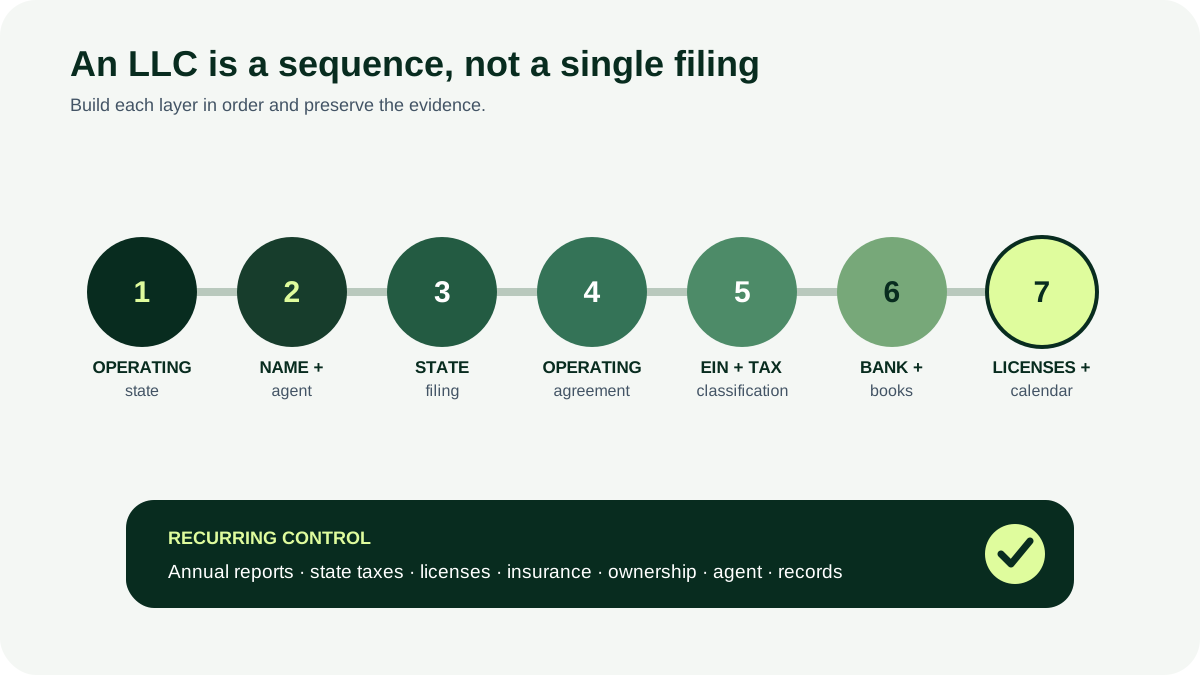
Use this order:
- Compare entity choices and confirm the operating state.
- Clear the state name and identify any DBA need.
- Select a dependable registered agent.
- File through the official state office and save proof.
- Sign the operating agreement and ownership records.
- Obtain the free IRS EIN and choose tax treatment deliberately.
- Register tax accounts, licenses, permits, payroll, and insurance.
- Open LLC banking and accounting with documented contributions.
- Verify the current FinCEN rule and any state ownership disclosure.
- Calendar every recurring filing and review the entity annually.
Bottom line
Starting an LLC is not just buying a state filing. Build the legal, tax, operational, and recordkeeping layers in the correct order. Use official government channels, document ownership and authority, separate money, confirm licenses, apply the current beneficial-ownership rule, and maintain a dated compliance calendar. That disciplined record is more valuable than a decorative formation certificate.
Related content
Frequently asked questions
Sources
Related content
More from DollarScout on this topic.
