Fundrise at a glance
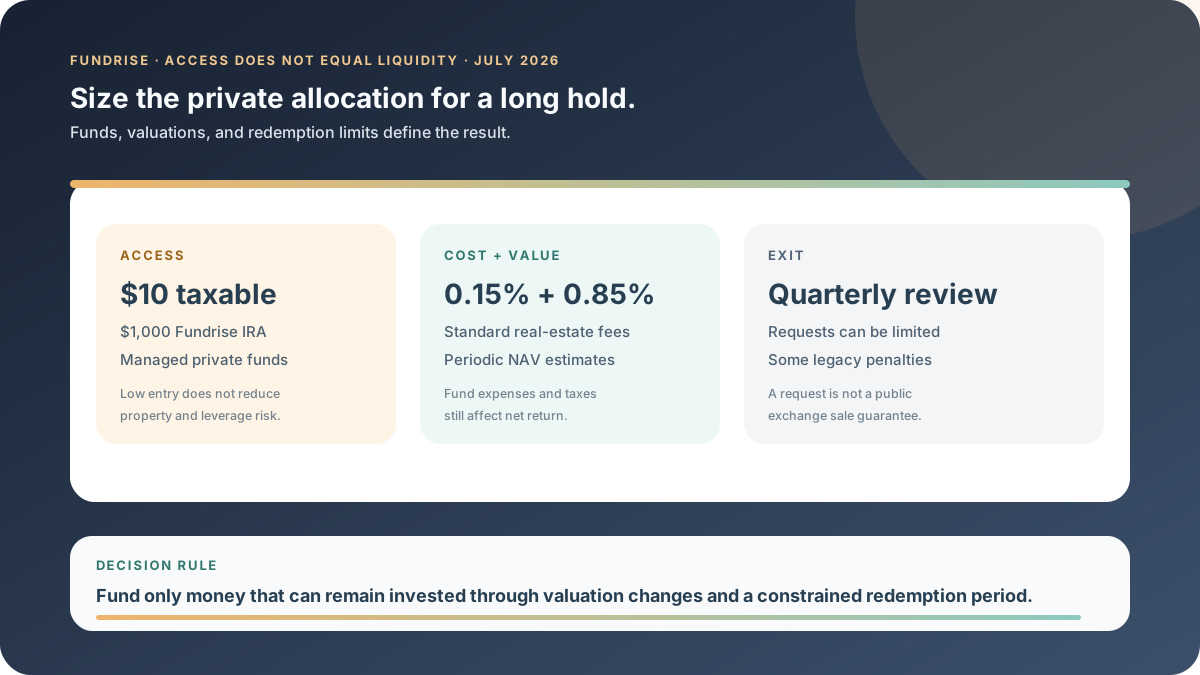
Fundrise is an online alternative-investment platform whose core product allocates customers to private real-estate funds. A taxable account can begin with $10. Investors choose Supplemental Income, Long-Term Growth, Balanced Investing, or a custom plan, then receive fund shares rather than title to an individual property.
The appeal is access: an individual can hold a diversified portfolio of apartments, industrial buildings, single-family rentals, development loans, and other real-estate exposures without underwriting or managing each asset. The tradeoff is that the shares are not continuously traded and their value depends on fund accounting, periodic valuation, and realized transactions.
| Review question | DollarScout finding |
|---|---|
| Best for | Long-term investors adding a limited private-real-estate allocation |
| Minimum | $10 taxable; $1,000 for an IRA |
| Standard real-estate cost | 0.15% advisory plus 0.85% fund management annually |
| Liquidity | Most requests reviewed quarterly and subject to fund limitations |
| Main risk | Illiquidity, valuation uncertainty, leverage, concentration, and real-estate cycles |
Minimums and account types
Fundrise says a taxable account can start with $10 and an IRA with $1,000. Supported registrations include individual, joint, entity, trust, Traditional IRA, and Roth IRA accounts. The platform does not currently offer custodial or minor accounts.
The low taxable minimum is useful for learning how the dashboard, distributions, and private-fund statements work. It should not determine allocation size. A $10 purchase is economically small, while a large allocation can create meaningful concentration and liquidity risk.
IRA ownership uses a third-party custodian and separate operational rules. Potential custody charges, contribution limits, prohibited transactions, valuation reporting, beneficiary treatment, and distribution mechanics should be reviewed before moving retirement assets. Fundrise says the IRA entry minimum is $1,000, and its custodian supplies applicable 1099-R or Form 5498 documents.
Fees and layers of cost
Fees & Commissions scores 4.0/5. Fundrise charges a 0.15% annual advisory fee. Its real-estate funds charge a 0.85% annual flat management fee. Together, the standard published rate is about 1.00% a year, or $10 per $1,000, before any additional expenses described in a specific offering circular.
Fundrise separately states that specialized products can use different pricing. The Innovation Fund historically carried a 1.85% management fee and has since transitioned to the publicly traded Public Venture Capital Fund, ticker VCX, with different trading and disclosure mechanics. Do not apply the core real-estate schedule to every vehicle on the platform.
Fund-level financial statements and offering documents can include organizational, development, financing, brokerage, property, operating, or disposition costs. Some expenses reduce NAV or project returns rather than appearing as a line-item debit in the app. The right comparison is net return after all vehicle expenses, taxes, and illiquidity—not just the advisory percentage.
An investor should record each fund held, its management fee, its leverage, and the source of return. A portfolio spread across several Fundrise funds is not automatically free of overlapping assets, managers, or macroeconomic exposure.
The three core plans
Investment Selection scores 3.9/5. The Supplemental Income plan emphasizes cash-flowing assets and lending strategies intended to support distributions. Long-Term Growth emphasizes equity positions and potential appreciation. Balanced Investing mixes income and appreciation. A custom plan can direct new money differently.
Changing the plan does not automatically rebalance existing holdings. Fundrise says the new selection affects future investments, including auto-investments and reinvested dividends. An investor can therefore own a historical mix that differs from the current plan label.
These plans are allocation frameworks, not guarantees. Income can be reduced or suspended. Growth projects can be delayed, refinanced, written down, or sold below expectations. Debt positions can default. Equity sits behind lenders and can be impaired by falling rents, higher vacancies, construction overruns, cap-rate expansion, or refinancing pressure.
Fundrise offers more direct private-real-estate exposure than a diversified stock-and-bond robo-adviser, but much less security-level control than a brokerage. Customers generally choose plans and funds, not individual buildings with a personal veto over every acquisition.
Liquidity and redemption mechanics
Liquidity is the central limitation. Fundrise says liquidation requests for most funds are reviewed quarterly. Requests generally must be submitted by the last business day of the quarter for end-of-quarter review. They remain subject to limitations and may not all be honored.
The Flagship Fund and Income Fund do not currently charge a liquidation penalty under the help-center summary. Certain eREIT shares held for less than five years may face an early-redemption penalty paid back to the fund. Each offering document controls, and rules can differ by fund and share vintage.
Fundrise uses first-in, first-out processing for applicable redemptions. A pending request can also interact with dividends or NAV distributions. Market stress is precisely when many investors may seek cash and private assets may be hardest to sell without discounts.
Compare this with a public REIT ETF, which normally trades during market hours but can show rapid price volatility. Fundrise reduces visible intraday movement by using fund valuations; it does not eliminate economic volatility or make private shares equivalent to cash.
Valuation and return reporting
Research & Tools scores 4.0/5. Fundrise publishes project updates, portfolio composition, letters, distributions, and account-level performance. Its dashboard is more transparent than many private placements because investors can inspect holdings and ongoing narratives without collecting reports from multiple sponsors.
The valuation cadence still matters. Fundrise says eREIT NAVs are generally expected to update quarterly, while certain flagship or income structures have more frequent NAV calculations. A NAV is an estimate based on appraisal, cash flow, market inputs, liabilities, and fund policies—not a guaranteed sale price.
Returns can come from cash distributions and appreciation. Reinvested dividends remain taxable in a taxable account even when no cash reaches the bank, subject to the applicable tax rules. A displayed positive return can include unrealized appreciation that will change before assets are sold.
Do not compare a smooth quarterly private-fund line with a daily public-index chart without adjusting for valuation lag, asset class, leverage, distributions, and fees. Lower observed volatility can partly reflect less frequent marking.
Taxes and documents
Fundrise says taxable investors generally receive Form 1099-DIV from a fund that generated at least $10 in aggregate distributions and Form 1099-B after applicable share liquidations. Legacy eFund ownership can create Schedule K-1 and K-3 reporting; Fundrise expects tax year 2025 to be the final K-1/K-3 year after the relevant merger.
Multiple funds can mean multiple documents and later delivery than a simple brokerage 1099. Investors should wait for the document checklist to show complete before filing and should reconcile reinvested distributions.
Tax character can differ across ordinary dividends, capital gains, return of capital, depreciation effects, and retirement accounts. Fundrise does not replace individualized tax advice.
Ease of use and automation
Ease of Use scores 4.3/5. The onboarding, low minimum, plan selector, auto-investment, dividend reinvestment, and consolidated portfolio view make private funds approachable. That is a real advantage compared with sourcing individual private deals.
The simplicity can hide structural complexity. One account may hold several legal entities, asset types, debt facilities, valuation methods, and redemption schedules. Review the actual fund allocation instead of relying only on the plan name or a single projected-return graphic.
Set a maximum portfolio percentage before enabling recurring deposits. Revisit the allocation at least annually, including the value of all personally owned real estate, REIT funds, employer exposure, and mortgages.
Customer service and governance
Customer Service scores 3.8/5. Fundrise provides an investor-relations team, help center, offering documents, and account messaging. Customers with at least $100,000 can qualify for enhanced service and other benefits under current program terms, but ordinary accounts should expect a digital-first relationship.
DollarScout did not test a live redemption, valuation dispute, tax correction, estate transfer, or support response. Save offering circulars, statements, acquisition dates, fund names, NAV history, distribution records, and every liquidation confirmation.
The Innovation Fund transition
Fundrise’s former private Innovation Fund is now the Public Venture Capital Fund (VCX) listed on the New York Stock Exchange. Existing shares are publicly traded, with transfer and lockup rules described in Fundrise’s transition materials.
That vehicle now has market-price volatility, possible premiums or discounts to NAV, and different liquidity from the private real-estate funds. It should not be used as evidence that every Fundrise position can be sold daily. Read the current VCX prospectus and brokerage mechanics separately.
Fundrise versus alternatives
Choose a low-cost public REIT ETF when intraday liquidity, broad public-market diversification, and a conventional brokerage statement matter more than private-asset access. Choose Wealthfront for a diversified stock-and-bond portfolio with automated rebalancing and taxable-account tax-loss harvesting.
Direct real-estate ownership offers control and potential tax tools but requires capital, underwriting, financing, maintenance, and concentrated property risk. Fundrise sits between a public REIT fund and direct ownership: lower entry and professional management, but limited liquidity and less control.
Who Fundrise is best for
Fundrise fits investors who:
- Have emergency savings and no near-term need for the invested cash.
- Want a limited private-real-estate allocation.
- Accept periodic valuation and redemption constraints.
- Will read fund-level offering documents and tax records.
- Can hold through a multi-year real-estate cycle.
It is weaker for short-horizon savers, active traders, liquidity-sensitive retirees, investors already concentrated in property, or anyone treating NAV as a guaranteed exit value.
Bottom line
Fundrise earns 4.0/5. The $10 entry, understandable plans, portfolio reporting, and approximately 1% standard real-estate fee make private property funds unusually accessible.
Accessibility does not remove illiquidity. Size the allocation after modeling a denied or delayed redemption, falling property values, refinancing stress, and several years of holding. Fundrise can diversify a liquid portfolio; it should not become the liquid portfolio.