Many products on this page are from partners who compensate us. This doesn't influence our ratings. Our opinions are our own.
Interactive Brokers vs TradeStation: 2026 Trading Platform Comparison
By Sophie Brown, Senior Finance Editor · Updated Jul 2026 · Fact-checked Jul 19, 2026
Interactive Brokers wins overall at 4.7/5 versus TradeStation at 4.4/5. IBKR is the stronger default for global multi-asset access, professional routing, low margin spreads, currencies, bonds, and APIs. TradeStation remains the better specialist when EasyLanguage, RadarScreen, OptionStation Pro, and a U.S.-focused strategy-development workflow are the reason for opening the account. IBKR wins Trading Costs and Execution; Platform, Trading Tools, and Customer Service are ties. Price the exact plan, product, routing method, market data, and monthly activity rather than comparing only a $0 stock headline.
Head-to-head
| Feature | Interactive Brokers | TradeStation |
|---|---|---|
| DollarScout Rating | 4.7/5 ★ | 4.4/5 ★ |
| Commissions | IBKR Lite offers eligible U.S. residents $0 U.S. exchange-listed stocks and ETFs; IBKR Pro stock pricing is fixed or tiered, and other products use separate global schedules | Eligible U.S. exchange-listed stock and ETF orders can start at $0; options, futures, sub-dollar, OTC, routed, data, and service charges follow separate tiered schedules |
| Platform Access | IBKR Desktop, Trader Workstation, Client Portal, IBKR Mobile, GlobalTrader, specialty apps, and TWS, Client Portal, Excel, and FIX APIs | TITAN X, TradeStation Desktop, web/HUB, iOS and Android apps, TradingView connectivity, and multi-asset developer APIs |
| Market Focus | Stocks, ETFs, options, futures, currencies, bonds, funds, metals, event contracts, and other products across more than 170 global markets | Active U.S. stock, ETF, option, futures, and futures-options trading with charting, scanning, backtesting, and automation |


Category-by-category breakdown
Trading Costs
Platform
Execution
Trading Tools
Customer Service
Detailed analysis
The short answer
Choose Interactive Brokers for global breadth and professional brokerage infrastructure; choose TradeStation for EasyLanguage-centered strategy development. DollarScout rates Interactive Brokers 4.7/5 and TradeStation 4.4/5. IBKR wins Trading Costs and Execution. Platform, Trading Tools, and Customer Service are ties because the better toolkit depends on the work being done.
| Decision factor | Interactive Brokers | TradeStation |
|---|---|---|
| Best fit | Global, multi-asset, margin-conscious, or API-driven traders | Active U.S. equity, option, and futures traders building or testing strategies |
| U.S. stock pricing | Lite can provide $0 eligible exchange-listed trades; Pro uses fixed or tiered schedules | Eligible stock and ETF orders can begin at $0; tier, routing, activity, and security matter |
| Options | Pro schedule varies by premium and volume; Lite has a fixed first tier | Current tiers and promotions vary; pass-through, exercise, assignment, and routing costs remain |
| Core platforms | TWS, IBKR Desktop, Client Portal, Mobile, GlobalTrader, and APIs | TITAN X, mature Desktop, HUB, Mobile, TradingView connection, and APIs |
| Distinctive strength | More than 170 markets, many currencies and products, routing and financing | EasyLanguage, RadarScreen, OptionStation Pro, Matrix, and strategy backtesting |
| Main cost trap | Product, venue, data, currency, routing, and margin schedules | Data, inactivity, service, direct-routing, platform, and specialized-order charges |
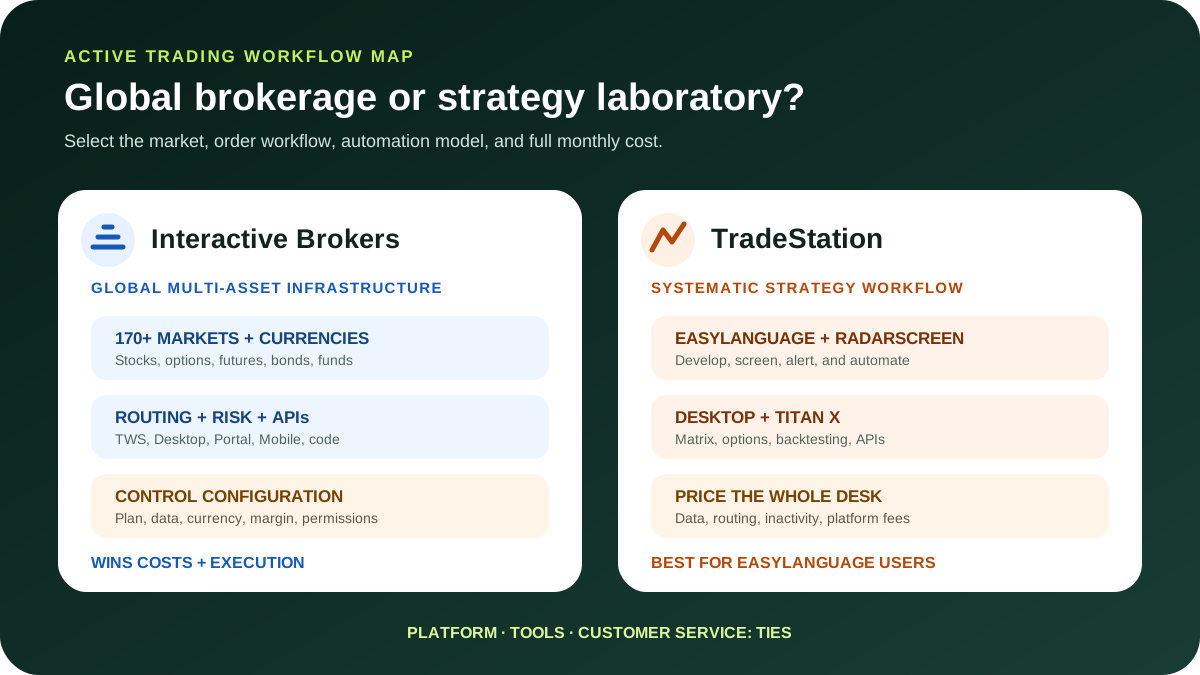
They overlap, but their centers of gravity differ
Interactive Brokers is a global brokerage infrastructure company. Its account can span stocks, ETFs, options, futures, currencies, bonds, funds, metals, event contracts, and other products across more than 170 markets under current disclosures. Platforms range from simpler mobile and browser products to Trader Workstation and institutional interfaces.
TradeStation is a U.S.-centered active-trading ecosystem. It covers stocks, ETFs, options, futures, and futures options, but its distinguishing value is the relationship between market data, charts, RadarScreen, EasyLanguage, Portfolio Maestro, strategy testing, Matrix order entry, OptionStation Pro, and brokerage execution.
The decision is therefore not “Which platform has more features?” Both have more features than most individuals will use. The question is whether the account must solve global brokerage complexity or systematic strategy-development complexity.
Trading Costs: Interactive Brokers wins
Interactive Brokers scores 4.8/5 versus TradeStation at 4.0/5. IBKR publishes separate Lite and Pro structures, extensive product schedules, margin formulas, cash-interest rules, and pass-through costs. Eligible U.S. residents can use Lite for $0 commissions on qualifying U.S. exchange-listed stocks and ETFs. Pro uses fixed or tiered pricing and is designed around SmartRouting and professional economics.
TradeStation can also begin at $0 for qualifying U.S. stock and ETF orders, and its current pricing uses volume-related tiers across assets. That headline is not the complete bill. Sub-dollar securities, OTC trades, direct routing, broker assistance, futures, options, market data, software or analytics subscriptions, and service events can follow different schedules. A $10 monthly inactivity fee can apply unless the account satisfies current activity or balance conditions.
IBKR is not universally cheaper. A one-contract order can hit a minimum; a foreign stock can create local commission and currency costs; market data and direct routing can add charges. TradeStation can be competitive for a qualifying high-volume U.S. strategy or current promotion. IBKR wins because its normal pricing and financing architecture serves more usage profiles without requiring a promotional assumption.
Trading-cost winner: Interactive Brokers. Build a 12-month worksheet using expected shares, contracts, venues, data, platform subscriptions, withdrawals, inactivity, routing, and borrowing.
U.S. stocks and ETFs
IBKR Lite's $0 commission applies to eligible U.S. exchange-listed stocks and ETFs for qualifying retail accounts. Pro stock pricing is fixed or tiered, with minimums and relevant exchange, clearing, regulatory, and routing economics. OTC, warrants, foreign listings, fractional shares, and special products should be checked separately.
TradeStation advertises $0 commission for qualifying stock and ETF trades while publishing tiered and specialized pricing. Its stock pages also publish execution statistics for defined order groups. An investor should not generalize a displayed result to every symbol, order size, time, or routing instruction.
Measure effective spread and price improvement alongside commission. A “free” market order that crosses a wide spread can cost more than a commissioned limit order. Record order type, size, time, venue eligibility, fill, midpoint at arrival, and any routing charge.
Neither platform is primarily a guided long-term-investing experience. Recurring deposits, simple fund discovery, goals, and advice are not the reason to accept either learning curve.
Options pricing and assignment economics
IBKR Pro's U.S. options commission currently varies with premium and monthly volume, generally within a published $0.15-to-$0.65 base range per contract and a stated order minimum. Lite applies its own fixed treatment to the first monthly tier. Exchange, OCC, regulatory, transaction, and other surcharges can remain.
TradeStation publishes options tiers and has promoted new-account pricing that can differ from its ordinary schedule. Its current options page shows platform and execution statistics plus tier comparisons. Do not assume an advertised $0 contract rate applies forever, to an existing account, or without pass-through charges.
For both brokers, model opening and closing commission, minimums, multi-leg treatment, exchange or index surcharges, exercise, assignment, liquidation, and market spread. A four-leg order is not one economic leg merely because it is submitted on one ticket.
TradeStation's OptionStation Pro and IBKR's OptionTrader, probability tools, risk views, combo orders, and volatility analytics can both support complex options work. The safest workflow prices the maximum loss and assignment path independently from the platform graphic.
Futures and futures options
Both brokers support futures, but their surrounding use cases differ. IBKR integrates futures into a global multi-asset account with currencies, securities, portfolio risk, and broad market access. TradeStation integrates futures with its Desktop analysis, EasyLanguage, Matrix, and strategy-testing workflow.
The broker commission is only one line. Exchange execution, clearing, NFA, data, delivery, routing, and platform charges can apply per side or per contract. Initial, maintenance, intraday, and house margin are different figures. Intraday margin can rise near the close, during volatility, or at the broker's discretion.
Physically delivered contracts require special attention to first notice, last trade, settlement, and liquidation policies. A backtest that closes at a theoretical bar price does not reproduce contract rolls, queue position, exchange fees, or a forced liquidation.
Platform: a tie
IBKR scores 4.8/5 and TradeStation 4.7/5, a difference too small to declare a general winner. IBKR offers Trader Workstation for maximum control, IBKR Desktop as a newer desktop path, Client Portal in the browser, IBKR Mobile, GlobalTrader, specialty apps, and several API routes. It is the stronger platform family when the same account must cross products, markets, and currencies.
TradeStation offers TITAN X as its modern active-trading environment while continuing to support the mature Desktop platform. Desktop remains necessary for the deepest EasyLanguage, RadarScreen, Portfolio Maestro, Scanner, Matrix, OptionStation Pro, and strategy-backtesting workflows. HUB, Mobile, TradingView connectivity, and APIs cover other contexts.
TradeStation can feel more coherent to a U.S. systematic trader because analysis and execution share the same strategy language. IBKR can feel more coherent to a global trader because the portfolio, currency, margin, permissions, and orders share one account.
Platform result: tie. Install or paper-test the exact product required. A feature on the broker's comparison page is not proof that it exists in every desktop, web, mobile, or API interface.
Trading Tools: a tie
IBKR scores 4.9/5 and TradeStation 4.8/5. IBKR provides sophisticated order types, scanners, Risk Navigator, PortfolioAnalyst, options analytics, market depth, algorithms, tax-lot tools, research, and APIs. It wins on breadth across asset classes and institutions.
TradeStation's EasyLanguage is unusually accessible for expressing indicators, alerts, screens, and strategies without building an entire brokerage stack. RadarScreen monitors many symbols with custom logic. Portfolio Maestro and backtesting connect historical rules to position and portfolio analysis. Matrix and OptionStation Pro support active execution.
The tools solve different problems, so the category is a tie. Choose IBKR when integration, global products, risk, or external code is central. Choose TradeStation when the strategy is developed inside its chart, language, scanner, and backtest ecosystem.
Tool depth can create false confidence. A strategy that fits historical bars can fail because of look-ahead bias, survivorship, corporate actions, stale constituents, spread, partial fills, latency, borrow, market impact, contract rolls, or parameter selection.
APIs and automation
IBKR provides TWS, Client Portal, Excel, and institutional FIX interfaces under different eligibility and session models. TradeStation provides REST and streaming APIs and also enables automation within EasyLanguage and Desktop.
IBKR is the better fit for developers who need global product coverage, account data, and professional brokerage controls outside a proprietary strategy language. TradeStation is the better fit for traders who want to move from a chart idea to EasyLanguage testing and platform-hosted automation.
Either production system needs idempotent client order IDs, duplicate protection, stale-data checks, position reconciliation, retry ceilings, rate-limit handling, logs, alerts, trading-hours logic, and a human kill switch. Paper fills cannot validate live queue position, borrow, auction behavior, or emergency margin changes.
Never let a strategy infer success from an HTTP response alone. Reconcile order status, execution, average price, remaining quantity, commission, position, and broker statement.
Execution: Interactive Brokers wins
IBKR scores 4.9/5 versus TradeStation at 4.5/5. IBKR Pro's SmartRouting, global venue access, algorithmic orders, direct-routing choices, and detailed execution disclosures make it the stronger general execution environment. Its advantage is control across markets, not a guarantee that every order receives price improvement.
TradeStation publishes current execution statistics for defined stock and option order populations and supports high-speed entry, Matrix, direct routing, and active-trader tools. Those capabilities are credible, especially for a U.S. workflow. The category gap reflects IBKR's broader routing infrastructure and order set.
Execution must be measured on the customer's orders. Compare effective spread, implementation shortfall, fill rate, partial fills, cancel latency, price improvement, market impact, and unfilled opportunity cost. Separate marketable orders from passive limits and ordinary sessions from auctions or news events.
Execution winner: Interactive Brokers. A documented average is context, not a promise for a particular security, size, route, or market condition.
Margin, interest, and currency
IBKR's financing architecture is a major advantage for customers who borrow, maintain cash, or trade multiple currencies. Margin interest is based on a benchmark plus plan- and balance-dependent spreads. Positive cash interest depends on currency, balance, account value, and plan. Rates are formulas that change, not fixed offers.
TradeStation publishes margin requirements and service schedules for its products. Its appeal is less about a global financing book and more about funding an active U.S. strategy within the platform ecosystem.
Lower borrowing cost does not justify more leverage. Stress a portfolio for correlated gaps, volatility expansion, currency moves, concentration, and changing house requirements. IBKR can liquidate positions in real time without waiting for a traditional margin-call conversation; TradeStation also retains risk and liquidation rights.
Currency conversion deserves an explicit order and reconciliation. A foreign security can create a cash debit, interest, withholding, and FX exposure even when its chart is displayed in familiar terms.
Market data and total platform cost
Both brokers distinguish delayed, snapshot, top-of-book, depth, and professional data. Exchange classification can change the monthly fee. News, scanners, platform modules, and specialized feeds can create additional subscriptions.
TradeStation's full Desktop workflow and analytics are valuable only if the strategy uses them. IBKR's long data menu is valuable only if the subscribed venue and product match the order. Do not buy every feed during setup.
Map each subscription to a decision: quotes for routing, depth for liquidity, news for an event process, or history for a defined test. Cancel unused feeds and record whether a fee is waived by activity, balance, or commission. A waiver condition is part of the price.
Customer Service: a tie
IBKR scores 3.9/5 versus TradeStation at 4.0/5. Both provide phone, chat or ticket channels, knowledge bases, platform training, trade desks, and operational documentation. Both also ask customers to navigate specialized teams for permissions, transfers, margin, APIs, live orders, and tax records.
IBKR's documentation is exceptional in breadth but can feel institutional. TradeStation's education is closely connected to its platform, yet a complex Desktop, data, or brokerage issue can still require precise escalation. DollarScout did not open accounts or test support response time for this comparison.
Before contacting support, record account entity, platform version, order ID, timestamp, symbol, venue, currency, error, and screenshot. During a live-order problem, use the published trade-desk procedure instead of repeatedly resubmitting.
Protection and account entity
The legal broker entity and product determine regulation and protection. SIPC protection for a U.S. securities account does not cover market loss, a poor strategy, most futures positions, spot currency exposure, or every affiliate product. Futures customer funds follow commodity rules rather than ordinary securities-account rules.
IBKR operates through multiple global entities. The customer's country, permissions, and product can determine which entity holds an account. TradeStation also provides different securities, futures, technology, and international relationships. Read the account agreement shown during onboarding rather than relying only on the group brand.
Enable strong authentication, trusted contacts, alerts, and withdrawal controls. Save confirmations, monthly statements, tax lots, corporate actions, and data or permission changes outside the trading platform.
Who should choose Interactive Brokers?
Choose Interactive Brokers if the strategy needs several countries, currencies, asset classes, professional order types, portfolio risk, APIs, or competitive margin economics. It also fits a sophisticated U.S. trader who values routing control more than a single proprietary strategy language.
Do not choose it merely because the feature list is longest. A customer who does not understand entity, currency, data, permission, and plan settings can create operational mistakes before placing a trade.
Who should choose TradeStation?
Choose TradeStation if EasyLanguage, RadarScreen, Matrix, OptionStation Pro, and Desktop backtesting are part of the actual weekly process. It is especially credible for a U.S. equity, option, or futures trader who wants research, coding, testing, monitoring, and execution inside one environment.
Do not choose it for a passive portfolio or because a temporary pricing offer looks cheaper. Model inactivity, data, routing, platform, service, and pass-through costs after the offer ends.
A practical decision test
Run the same four tasks in paper or trial access:
- Build the required watchlist or scanner and reproduce one signal.
- Enter, modify, and cancel the exact multi-leg or conditional order used live.
- Export executions, commissions, tax lots, and end-of-day positions.
- Price one full month including data, platform, borrowing, routing, and expected activity.
Then document which broker controls failure better: stale data, lost connection, partial fill, rejected order, changing margin, or an automation restart. The best normal workflow matters less than the safest abnormal workflow.
Final verdict
Interactive Brokers wins overall for pricing architecture, execution infrastructure, global markets, products, financing, and external automation. TradeStation earns a specialist recommendation for EasyLanguage and its integrated U.S. strategy-development stack. Platform, Tools, and Customer Service are ties because the appropriate winner depends on the defined workflow.
Which one is right for you?
- Best for Global markets, currencies, and multi-asset portfolios: Interactive BrokersOpen Trading Account
- Best for External APIs and professional routing controls: Interactive BrokersOpen Trading Account
- Best for EasyLanguage strategy development and automation: TradeStationOpen Trading Account
- Best for RadarScreen, Matrix, and Desktop backtesting workflow: TradeStationOpen Trading Account
Final verdict
Interactive Brokers wins 4.7/5 to 4.4/5 for global multi-asset breadth, professional routing, pricing architecture, financing, and APIs. TradeStation remains the better specialist for EasyLanguage, RadarScreen, OptionStation Pro, Matrix, and U.S.-focused strategy testing. Trading Costs and Execution go to IBKR; Platform, Trading Tools, and Customer Service are ties.
Frequently asked questions
Sources and verification
Scores and product facts come from the underlying DollarScout reviews and were checked against these primary sources.
- Interactive Brokers commissions overview
- IBKR U.S. stock commissions
- IBKR U.S. options commissions
- IBKR trading platforms
- IBKR margin rates and Lite-Pro comparison
- IBKR interest rates on cash
- IBKR other fees
- IBKR global market and product fact sheet
- TradeStation pricing
- TradeStation service fees
- TradeStation market-data pricing
- TradeStation TITAN X and Desktop continuity
- TradeStation stock trading and execution statistics
- TradeStation options tools, pricing, and execution statistics
- TradeStation futures exchange and clearing fees
Related content
More from DollarScout on this topic.
