
SoFi Checking and Savings at a glance
SoFi packages checking and savings together. Opening one automatically opens the other, and customers manage both inside a financial app that also promotes lending, credit, investing, insurance referrals, credit monitoring, and member benefits. The bank account is most compelling for someone whose paycheck already moves electronically and who wants higher savings yield without maintaining a traditional branch relationship.
The current base terms are specific. SoFi publishes 0.50% APY on checking and 3.10% APY on savings and Vaults for customers who receive eligible direct deposit or at least $5,000 in qualifying deposits during each rolling 31-calendar-day period. Customers without either activity earn 0.80% APY on savings while checking remains at 0.50%. Rates are variable and listed as current May 28, 2026.
| Review question | DollarScout finding |
|---|---|
| Best for | Mobile-first customers with recurring eligible direct deposit |
| Core fees | No monthly, minimum-balance, or standard overdraft fees |
| Qualified APY | 3.10% savings and 0.50% checking when the activity test is met |
| Nonqualified APY | 0.80% savings and 0.50% checking |
| Main complication | Qualification periods, promotions, and optional SoFi Plus rates overlap |
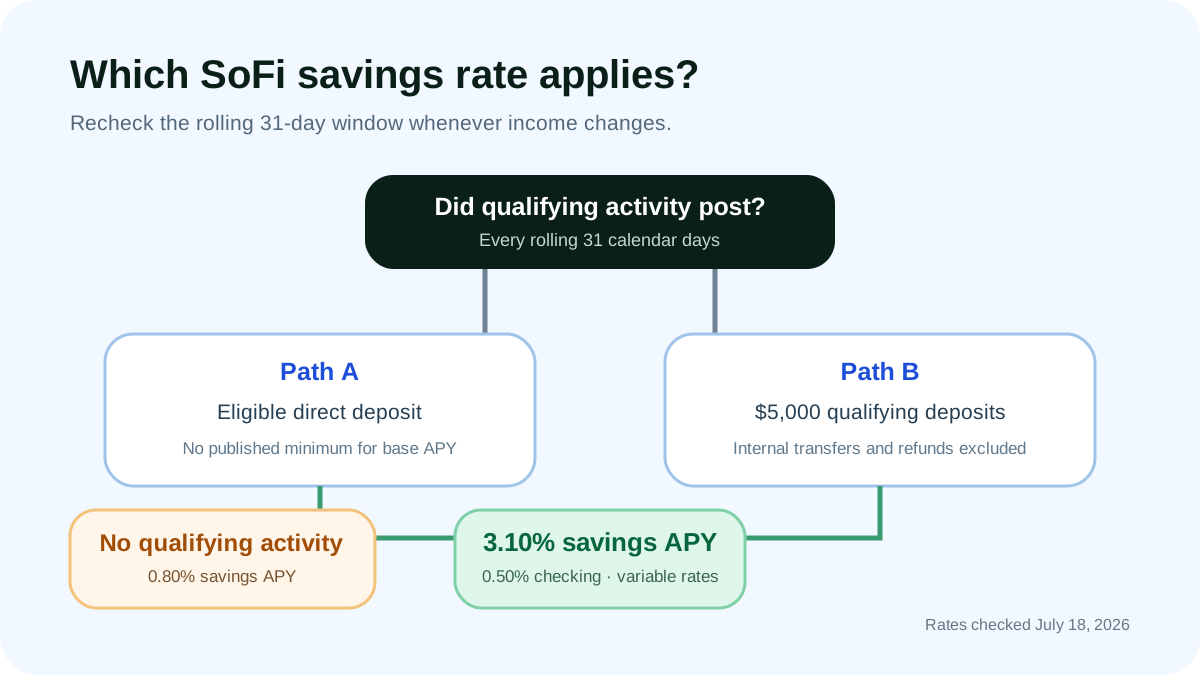
How the APY tiers work
APY scores 4.6/5 because the qualified base rate is competitive, checking itself earns interest, and the qualification can be met without a stated minimum direct-deposit amount. The alternative path—$5,000 in qualifying deposits during a rolling 31-day period—is useful for self-employed customers or households whose payroll coding is unreliable, but it requires much more monthly cash movement.
The rolling period resets when a new eligible direct deposit or qualifying $5,000 deposit threshold is recognized. Internal transfers among a customer’s SoFi accounts, interest, bonuses, merchant refunds, credits, and reversals do not count toward qualifying deposits. Incoming ACH, wires, peer-to-peer transfers, check deposits, eligible card funding, and cash deposits can count subject to SoFi’s determination and verification.
The difference between 3.10% and 0.80% is material. On a steady $20,000 balance, a 2.30-percentage-point gap is about $460 in simple first-year interest before compounding and taxes. Anyone choosing SoFi primarily for yield should confirm the APY Details screen after every change in payroll or deposit behavior.
SoFi also advertises a temporary 3.80% APY for eligible first-time Checking and Savings customers: the 3.10% base plus a 0.70% boost for up to six months when the account is opened by the stated deadline and eligible direct deposit begins within 60 days. The boost can change or end and should not be annualized beyond its term.
Paid SoFi Plus membership introduces another tier: current terms describe 4.50% on up to $20,000 in one qualifying Savings account and 3.10% above that limit. Because subscription pricing and benefits are separate decisions, this review does not award the free bank account a 4.50% continuing rate. Compare the incremental interest with the full subscription cost and other benefits before paying to raise APY.
Fees and overdraft
Fees earns 4.8/5. SoFi advertises no monthly account fee, no minimum-balance fee, and no standard overdraft fee. There is no minimum balance to earn the published APYs. Standard checks and digital transfers cover many routine needs without the waiver calculations used by large branch banks.
No-fee Overdraft Coverage can cover eligible transactions up to $50 when the customer receives at least $1,000 in eligible direct deposits during a rolling 31-day period. That is a different threshold from the savings APY rule: any amount of eligible direct deposit can unlock the qualified savings rate, while $1,000 is required for this overdraft feature. Transactions can still be declined, and a negative balance must be repaid.
Cash is the notable exception to the no-fee story. SoFi directs cash deposits to participating Green Dot retailers, not Allpoint ATMs. Green Dot partners may charge up to $4.95 per deposit at the point of sale. A customer depositing cash weekly could pay more than someone using a branch bank with a waivable monthly fee. Fees scores highly for electronic households and less impressively for cash users.
ATM and cash access
Access & ATM Network receives 4.2/5. SoFi provides more than 55,000 fee-free Allpoint ATMs, including machines inside retailers such as CVS, Walgreens, Target, Costco, and Speedway. That is broad withdrawal access, but it is not a branch network, and out-of-network ATM owners can impose charges.
Cash deposits require a participating Green Dot retail register and a SoFi debit card. Funds are typically available within 15 minutes but may take up to two hours. The fee is paid to the retailer, and cash is not accepted at an ATM. Customers should locate both an Allpoint withdrawal ATM and a Green Dot deposit counter because the networks solve different tasks.
Mobile check deposit remains available for SoFi Checking and Savings. A July 2026 help update warns that legacy SoFi Money accounts lose mobile check deposit on August 4, 2026 unless upgraded; that notice does not mean the current Checking and Savings product loses the feature. Account names matter when reading support articles.
Digital experience and Vaults
Digital Experience scores 4.6/5. SoFi supports account opening, transfers, mobile deposits, bill payment, debit-card controls, direct-deposit setup, APY tracking, ATM search, Vaults, and broader financial products from one app. Vaults label money for individual goals inside Savings, similar to sub-buckets rather than separate insured accounts.
The integrated model works well for customers who intentionally use several SoFi services. It can feel promotional to someone who wants only checking and savings. Loan, investing, credit, rewards, and membership offers add choices but also compete for attention. The strongest setup pins the Banking screen, configures relevant alerts, and ignores products that are not part of a written financial plan.
DollarScout did not claim authenticated app testing. The score reflects the documented end-to-end workflow and range of self-service tools, with deductions for qualification complexity and cross-selling. A prospective customer should use the app during the first month to confirm that deposits are classified correctly and that the displayed APY matches expectations.
Direct deposit benefits and bonus
Eligible direct deposit can unlock early paycheck access, qualified savings APY, and overdraft coverage. SoFi also advertises a limited $50 or $400 bonus for new eligible direct deposit activity. The current terms require at least $1,000 in eligible direct deposits for the lower bonus and at least $5,000 during the 25-day measurement period for the $400 tier.
A bonus is temporary and can be taxable. It should not justify moving an account that fails on recurring fees, access, support, or yield. Save the offer date, funding window, eligible-payment definition, and payout schedule at enrollment. Payroll providers sometimes fail to code an incoming payment as direct deposit; SoFi instructs affected customers to contact support for validation.
Customer support
Customer Service scores 4.2/5. SoFi publishes a detailed help center, secure account support, and product-specific contact channels. The APY Details page gives customers an unusually useful self-service view of the qualification period. The company also provides articles explaining deposits, withdrawals, account closure, checks, wires, and agreements.
The score stops below the online-bank leader because SoFi has no branches and DollarScout did not time a case. A complex fraud, identity, estate, or transfer issue must be resolved remotely. The wide product ecosystem can also make routing more important: a bank-deposit question belongs with SoFi Bank support, not lending or investing support.
FDIC coverage
SoFi Bank, N.A. is an FDIC member. Standard eligible deposits are insured within FDIC limits. SoFi also offers an optional sweep program that can distribute eligible savings balances among participating banks and advertises access to additional FDIC coverage up to $3 million. Coverage depends on opt-in status, participating-bank capacity, ownership, and any money the customer already holds at a receiving bank.
The $3 million headline is not automatic insurance on every dollar in every SoFi product. Checking and non-swept deposits remain subject to SoFi Bank limits, and SoFi Invest securities are not FDIC-insured. Review the participating-bank list and exclude any bank where existing deposits would reduce available coverage.
Alternatives
Choose Ally Bank for savings buckets, 75,000+ fee-free ATMs, limited domestic ATM reimbursement, free Walmart cash deposits, and 24/7 phone support without an APY activity test. Choose Capital One 360 when some physical locations and eligible cash-deposit ATMs matter. Choose Chase when extensive branches and full-service cash handling justify fee planning and lower savings yield.
SoFi is best evaluated against the customer’s continuing rate. If direct deposit is stable, the product competes near the top of this set. If qualification is uncertain, compare the 0.80% fallback with no-condition high-yield accounts rather than assuming the 3.10% headline.
Who should use SoFi Bank
SoFi fits customers who:
- Receive qualifying income electronically every month.
- Want checking, savings, goals, and other financial products in one mobile app.
- Can use Allpoint ATMs and rarely deposit cash.
- Will monitor the rolling 31-day APY qualification window.
- Value interest on both checking and savings.
It is easier to skip when:
- Payroll does not arrive as eligible direct deposit and $5,000 monthly funding is unrealistic.
- Cash deposits are frequent enough for Green Dot fees to add up.
- A branch is important for complex service or documents.
- Cross-selling inside a broad financial app creates distraction.
Bottom line
SoFi Checking and Savings earns 4.5/5. It offers excellent fee economics, a competitive qualified savings rate, interest-bearing checking, a strong mobile workflow, and a large withdrawal network. The main work falls on the customer: satisfy and monitor the APY test, separate a temporary 3.80% promotion from the continuing 3.10% base, and understand that cash deposits can cost up to $4.95.
For a direct-deposit household that banks digitally, those conditions are manageable. For someone who will earn the 0.80% fallback or deposit cash frequently, an account with a no-condition yield or free cash route can be the better value.