Many products on this page are from partners who compensate us. This doesn't influence our ratings. Our opinions are our own.
How to Invest in Stocks
By Sophie Brown, Senior Finance Editor · Updated Jul 2026 · Fact-checked Jul 18, 2026
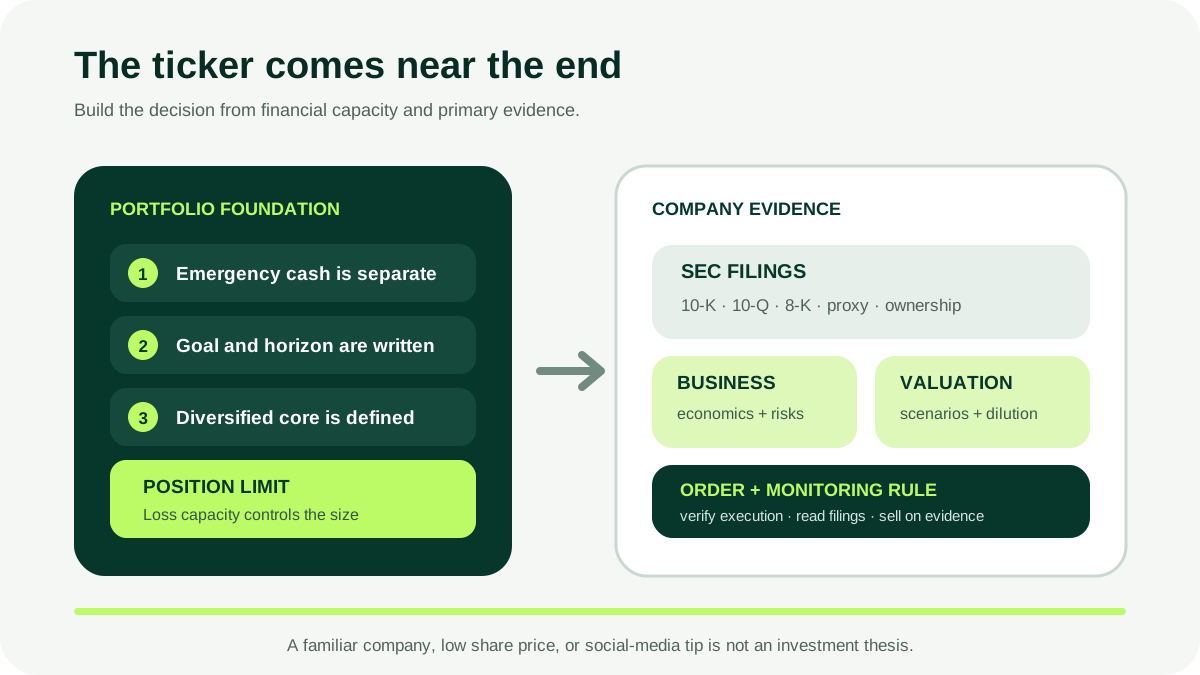
Buying a stock takes seconds; deciding whether it belongs in your financial plan takes much longer. A share represents ownership in a company, and its price can rise, fall, or become worthless. A sound process begins with the goal, time horizon, account, diversification, and costs before it reaches a ticker symbol. This guide covers the complete path from financial readiness and SEC filings to position size, order entry, taxes, monitoring, and sell rules.
Key takeaways
- Do not invest emergency cash or money needed for a near-term obligation in volatile stocks.
- A diversified fund can serve as the core of a stock allocation; owning a few familiar companies is not broad diversification.
- For an individual stock, research the business, financial statements, risks, valuation, management incentives, and competitors using primary filings.
- A market order prioritizes execution but not price; a limit order controls the worst acceptable price but might not execute.
- Write position-size, monitoring, and sell rules before buying so a headline or price swing does not become the strategy.
Understand what a stock gives you
A stock is an ownership interest in a company. Common shareholders may vote on certain corporate matters and may receive dividends if the board declares them. They also stand behind creditors in the capital structure. If a company fails, the common stock can lose most or all of its value.
Returns can come from a higher market price and cash distributions, but neither is promised. A profitable company can be a poor investment if the purchase price assumes even better results. A struggling company can rise temporarily on speculation. Separate the company, the security, and the price paid.
Make the balance sheet ready before the brokerage account
Stock prices can fall sharply and remain depressed for years. Before investing, protect the money that cannot tolerate that path.
Confirm:
- recurring bills and minimum debt payments are covered;
- an accessible emergency reserve reflects job, health, household, and insurance risks;
- high-cost debt has a deliberate repayment plan;
- near-term taxes, tuition, housing, and major purchases are funded separately;
- employer retirement matches or other valuable benefits have been evaluated;
- the invested amount can remain invested through a severe decline.
Risk tolerance is the willingness to accept loss. Risk capacity is the financial ability to absorb it. An investor can feel calm about volatility and still have low capacity because the money is needed next year.
Define the goal, horizon, and stock allocation
Name the goal and date. “Build wealth” is too vague to determine risk. Retirement in 30 years, a home deposit in three years, and next semester’s tuition require different portfolios.
Set the allocation among stocks, bonds, cash, and other appropriate assets before choosing securities. Stocks can support long-term growth, but a 100% stock portfolio is not automatically suitable. The mix should reflect the goal, horizon, need for liquidity, and ability to withstand loss.
Then decide how the stock allocation will be diversified:
- U.S. and, if appropriate, international markets;
- large, medium, and small companies;
- multiple industries and business models;
- broad funds and any individual-stock sleeve;
- exposures already present in retirement accounts, employer stock, and compensation.
FINRA warns that concentration can hide across accounts. Owning a technology fund, a broad index dominated by large technology companies, employer shares, and several individual technology stocks can create one large correlated exposure even though the account lists many positions.
Choose a diversified core or individual stocks deliberately
Broad mutual funds and ETFs can provide exposure to hundreds or thousands of companies in one holding. They can simplify diversification and reduce the impact of one company’s failure. They still carry market risk, fund expenses, tracking differences, and possible concentration.
Individual stocks demand more research and monitoring. They add company-specific risks such as product failure, fraud, litigation, financing stress, customer loss, dilution, regulation, or poor capital allocation.
A practical structure is:
- a diversified core designed to carry the long-term allocation; and
- a smaller, capped individual-stock sleeve for researched convictions.
That is a framework, not a universal prescription. The important point is to assign each position a portfolio role and maximum size. Do not let an experimental trade silently become the retirement plan.
Select the account before the investment
A taxable brokerage account offers flexibility but can create taxable dividends, distributions, and realized gains. Traditional and Roth retirement accounts can offer tax advantages while imposing eligibility, contribution, withdrawal, and distribution rules. Workplace plans, health savings accounts, education accounts, custodial accounts, trusts, and joint accounts each change ownership, taxes, access, and administration.
Ask:
- Who legally owns the assets?
- When will the money be needed?
- What tax treatment applies to contributions, income, trades, and withdrawals?
- Are the desired investments available?
- Do contribution or withdrawal rules conflict with the goal?
Do not open a margin account simply because the application defaults to it. Margin is a loan secured by account assets. It can magnify losses, trigger a demand for more collateral, and allow the broker to sell securities without waiting for the investor’s preferred time.
Research the company with primary filings
Public U.S. companies file information through the SEC’s EDGAR system. Investor.gov describes several core documents:
| Filing | What it can show |
|---|---|
| Form 10-K | Audited annual financial statements, business description, material risks, management discussion, controls, and legal matters |
| Form 10-Q | Unaudited quarterly statements, updated risks, and management discussion |
| Form 8-K | Material events disclosed between scheduled reports |
| Proxy statement | Board elections, executive compensation, ownership, related-party matters, and shareholder proposals |
| Forms 3, 4, and 5 | Certain insider ownership and transaction disclosures |
Start with the business section. Explain in plain language what the company sells, who pays, why customers choose it, and what could make them leave. Identify major products, geographies, suppliers, distribution channels, regulation, and customer concentration.
Read the risk factors for specificity and change. Boilerplate is less useful than a newly added risk, a dependency on one supplier, a debt covenant, a government investigation, or a material cybersecurity event. Compare the current filing with the prior year rather than reading it in isolation.
Connect the three financial statements
The income statement reports revenue, expenses, and profit over a period. The balance sheet reports assets, liabilities, and equity at a date. The cash-flow statement reconciles accounting profit with cash from operations, investing, and financing.
Track a small, consistent set of questions:
- Is revenue growing organically, through acquisitions, or both?
- Are gross and operating margins improving or deteriorating?
- Does operating cash flow broadly support reported earnings over time?
- How much is spent on capital assets and acquisitions?
- Are debt and interest obligations manageable under weaker results?
- Is the share count rising because of stock compensation or financing?
- Are receivables, inventory, deferred revenue, or other working-capital items changing unusually?
- Does management report a non-GAAP metric that excludes recurring costs?
One quarter rarely proves a thesis. Use multiple years and compare the company with direct competitors that have different incentives and accounting choices.
Evaluate management and capital allocation
Management decides how to deploy cash among operations, research, acquisitions, debt repayment, dividends, and share repurchases. Compare promises with outcomes.
Review:
- long-term targets and whether they were met or quietly changed;
- acquisition price, strategic logic, and later impairments;
- repurchases relative to stock-based compensation and valuation;
- dividend coverage and financial flexibility;
- executive incentives in the proxy statement;
- related-party transactions and governance structure;
- auditor changes, control weaknesses, and restatements.
An attractive narrative does not replace evidence. Treat investor presentations as management’s case and filings as a place to test it.
Distinguish price from valuation
A $10 share is not necessarily cheaper than a $500 share. Share price depends on how the company divided its equity. Market capitalization—share price multiplied by shares outstanding—is a better starting measure of the equity value, but even that excludes debt and excess cash.
Common valuation measures include price-to-earnings, price-to-sales, free-cash-flow yield, and enterprise-value ratios. Each can mislead when the denominator is cyclical, negative, adjusted, or temporarily elevated. Compare:
- the company’s valuation across its own history;
- peers with similar economics and growth;
- a range of plausible operating outcomes;
- the return implied if growth slows;
- dilution, debt, and required reinvestment.
Write a base, optimistic, and adverse case. A valuation is not one precise target price; it is a set of assumptions that should be visible enough to challenge.
Set position size before submitting an order
Position size controls how much one mistake can damage the portfolio. Work backward from an adverse outcome. If the stock fell 50%, what dollar and portfolio loss would result? Would that loss threaten the goal or trigger a panic sale?
Document:
- initial maximum weight;
- absolute maximum after appreciation;
- whether additions are allowed and under what evidence;
- exposure to the same company through funds or employment;
- total sector and thematic limits;
- prohibited leverage, options, or shorting if outside the plan.
“I will average down if it falls” is not a risk rule. A lower price can reflect a broken thesis. Require updated evidence before adding.
Understand the order before pressing buy
The SEC explains that order types trade price certainty against execution certainty.
- A market order seeks prompt execution at the best available price, but the execution price is not guaranteed.
- A limit order specifies a maximum purchase price or minimum sale price. It controls price but may receive no fill or only a partial fill.
- A stop order becomes a market order when its trigger is reached; the eventual execution can differ substantially in a fast market.
- A stop-limit order becomes a limit order after the trigger; it controls price but may not execute.
For a purchase, review the ticker, security name, share or dollar amount, order type, limit price if used, time in force, estimated total, and account. Similar tickers and multiple share classes create avoidable errors.
Avoid treating extended-hours quotes as equivalent to regular trading. Liquidity can be lower, spreads wider, and prices more volatile. Read the broker’s routing, fractional-share, and extended-hours disclosures.
Confirm execution and settlement
An order confirmation screen is not proof of a completed trade. Check whether the order is open, partially filled, filled, canceled, or rejected. Review the average execution price and fees.
Most U.S. stock trades now generally settle one business day after the trade date, but the broker’s rules and the security matter. In a cash account, selling before a purchase is properly paid can create violations and restrictions. Keep enough settled cash and learn the platform’s settled-funds display.
Save trade confirmations and compare them with the monthly statement. Report an incorrect or unauthorized transaction promptly in writing.
Include every layer of cost and tax
Zero-dollar commissions do not eliminate:
- bid-ask spreads and price impact;
- fund expenses for any pooled holdings;
- advisory, subscription, data, transfer, or account fees;
- margin interest;
- foreign taxes or currency conversion;
- taxes on dividends and realized gains in a taxable account.
The IRS distinguishes ordinary and qualified dividends and requires reporting of capital gains and losses. Cost basis, holding period, wash sales, corporate actions, and reinvested dividends affect the record. Tax rules change and individual facts matter; use current IRS material or professional advice rather than a social-media summary.
Monitor the thesis, not every price tick
Create a one-page investment record at purchase:
- why the company can compound value;
- the evidence supporting that view;
- important operating metrics;
- valuation assumptions;
- principal risks;
- the expected review schedule;
- facts that would invalidate the thesis;
- maximum position size.
Review new 10-Q, 10-K, 8-K, and proxy filings. Track the business drivers selected before purchase. A falling price is not automatically a sell signal, and a rising price is not proof that the analysis was right.
Potential sell reasons include a broken thesis, unreliable reporting, a materially better opportunity after tax and cost, excessive portfolio concentration, a changed financial goal, or a valuation that no longer supports plausible returns. “Everyone online is selling” and “I want to get back to my purchase price” are not research conclusions.
Reject social-media urgency
The SEC warned again in 2026 that social-media stock recommendations can be part of scams. Impersonation, group chats, guaranteed returns, sudden pressure, and a request to move to an unfamiliar platform are red flags.
Never rely solely on a tip, screenshot, influencer, celebrity image, or claimed insider. Verify the security through EDGAR, the professional through BrokerCheck or the SEC’s adviser database, and the firm through official contact information obtained independently. Do not send money or credentials to a person who initiated an unsolicited investment conversation.
Bottom line
Investing in stocks is a portfolio process, not an order-entry exercise. Protect near-term cash, define the goal and allocation, choose the right account, diversify the core, and cap company-specific risk. For each individual stock, read primary filings, connect the statements, test valuation assumptions, and write the sell rules before buying. Then verify execution, taxes, costs, and the continuing thesis with the same care used for the first purchase.
Related content
Frequently asked questions
Sources
Related content
More from DollarScout on this topic.
