
Coinbase at a glance
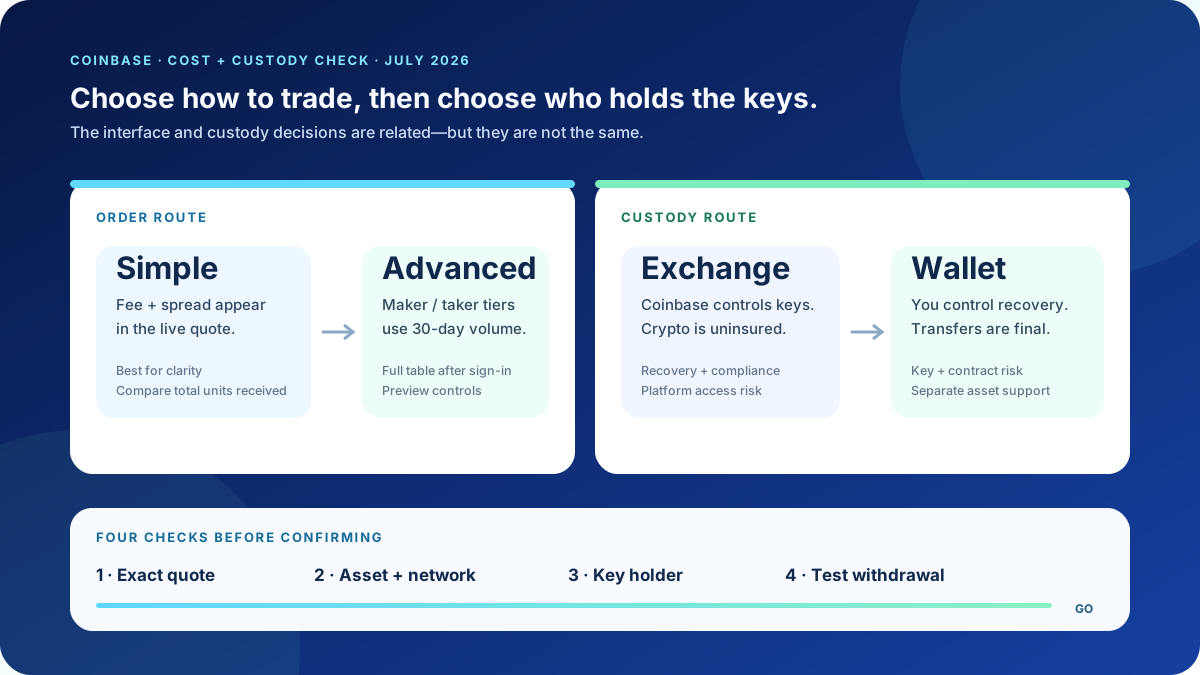
Coinbase is a U.S.-based custodial cryptocurrency platform with two retail trading experiences in the same account. The simple interface prioritizes an understandable quote and a short path from dollars to crypto. Coinbase Advanced adds order books, maker/taker pricing, charting, limit and stop orders, and a fee tier tied to trading volume. Separate Base app and legacy Coinbase Wallet products provide self-custody; they should not be confused with assets held in a Coinbase exchange account.
That product split explains both Coinbase's appeal and its most common pricing mistake. A beginner can buy an asset without learning an order book, but convenience pricing can include both a transaction fee and a spread. An Advanced order follows a different schedule. A review that gives Coinbase one permanent percentage without naming the interface, order type, volume tier, and quote date is incomplete.
| Review question | DollarScout finding |
|---|---|
| Best for | U.S. beginners who want an easy fiat on-ramp and a path to advanced orders |
| Main strength | Excellent onboarding and a broad connected product surface |
| Main weakness | Simple and Advanced pricing require different comparisons |
| Custody | Exchange assets are custodial; wallet products are separate self-custody tools |
| Core protection limit | Crypto is not a bank deposit and is not FDIC- or SIPC-insured |
How Coinbase pricing works
Trading Fees scores 3.4/5. Coinbase's simple buy, sell, and convert flows calculate pricing in the order preview. The quote can include a Coinbase fee and a spread between the market reference and the execution price. Payment method, order size, market conditions, asset, and jurisdiction can affect the result. The correct cost is therefore the difference between dollars committed and crypto received—or dollars received after a sale—not a remembered marketing rate.
Coinbase Advanced uses maker/taker pricing. A maker order rests on the order book and adds liquidity; an immediately matched order is a taker. A limit order can still pay taker pricing if it crosses the spread immediately, and a partially matched order can have both treatments. Coinbase says the fee tier at the time the order is placed controls and that tiers update hourly using total USD-equivalent volume across order books during the trailing 30 days.
The public help page does not expose the entire current retail tier table. It directs customers to sign in to the Advanced fees page, and Coinbase states that the applicable fee appears before confirmation. DollarScout therefore does not print a supposedly universal beginner maker/taker rate. Before trading, capture the actual preview and divide the fee by notional value. For a fair competitor comparison, add funding costs, spread, trading fee, and the network fee required to move the asset to its final destination.
Simple versus Advanced
Ease of Use scores 4.8/5 because the simple interface makes funding, buying, selling, recurring purchases, and portfolio monitoring understandable. It can be a reasonable training route for a first small purchase. The convenience becomes expensive when someone repeats large market purchases without comparing Advanced.
Advanced is not a different exchange account. Eligible balances can be used with an order-book interface, and the account can support multiple Advanced portfolios under Coinbase's rules. Limit orders offer price control, but they do not guarantee execution. Market orders prioritize execution and accept available liquidity. Anyone unfamiliar with slippage should test with a small order and inspect the estimated fill, fee, and total before submitting.
Recurring purchases are useful for enforcing a schedule, not for guaranteeing a good price or low cost. Compare the recurring quote with the cost of making the same purchase manually through Advanced. Automation can reduce behavioral friction while quietly increasing transaction costs.
Asset and network selection
Asset Selection scores 4.6/5. Coinbase supports a broad set of assets and trading pairs, but there is no single count that applies to every U.S. customer and every product. Availability depends on location, regulatory restrictions, account eligibility, the chosen interface, and whether Coinbase supports the specific blockchain network for deposits and withdrawals.
The network distinction is more important than the token symbol. USDC, ETH, or another asset may exist on several networks. A Coinbase account can support the asset but not the network used by the sender. Coinbase warns that unsupported deposits can be lost and that recovery is limited to eligible assets and networks. Never infer support from a wallet product: Base app or Coinbase Wallet may display thousands of tokens that the custodial exchange does not list or accept.
Use the live Explore page filtered to tradable assets, then open the asset's deposit or withdrawal instructions. Match the network at both ends, note whether a memo or destination tag is required, and verify minimums and temporary holds. A small test is worth the extra network fee when the operational risk is material.
Exchange custody versus self-custody
On Coinbase exchange, Coinbase controls the private keys and processes withdrawals according to account controls, compliance reviews, and platform availability. That design makes password recovery and fiat trading possible, but it creates counterparty and access risk. Users do not independently sign an onchain transaction from the exchange wallet.
Base app and legacy Coinbase Wallet are separate self-custody experiences. In self-custody, the user controls the recovery phrase or passkey-based recovery arrangement described by that product. Coinbase cannot simply reverse a blockchain transfer or restore a lost secret in every configuration. Self-custody removes some exchange risk while adding personal key-management, smart-contract, phishing, and network-selection risk.
The right answer can be split custody. A user may keep a modest trading balance on the exchange and move longer-term holdings to a carefully tested wallet. The decision should consider transaction frequency, technical competence, recovery planning, tax records, withdrawal fees, and the consequence of either an exchange interruption or a lost key.
Cash, insurance, and what is not protected
Security scores 4.6/5. Coinbase says eligible U.S. dollar cash can be held at participating FDIC-insured banks or in other permissible liquid investments. Pass-through insurance is conditional: it concerns the failure of a partner bank, requires records and ownership conditions, and is aggregated with the customer's other deposits at that bank. It does not insure a bad crypto trade, a declining stablecoin, or a Coinbase failure.
Crypto is not covered by FDIC deposit insurance or SIPC securities protection. Coinbase describes a crime insurance policy covering a portion of digital assets against certain losses from covered cybersecurity or employee-theft events. That policy is not individual account insurance, has limits and exclusions, and does not cover a user who gives credentials to a scammer or allows an attacker into the account.
This boundary deserves prominent treatment. “Coinbase is insured” is too broad. Eligible cash may have conditional pass-through bank protection; a limited company policy may respond to specified events; the customer's crypto balance does not become an insured bank deposit.
Account security
Coinbase supports passkeys and security keys as stronger authentication choices than SMS. A security-conscious setup uses a unique password stored in a password manager, a hardware security key or passkey, withdrawal allowlisting when appropriate, device and session review, and locked-down email and mobile accounts. Recovery codes should be stored offline and separately from the device used to trade.
Phishing remains a user-level risk. Do not install remote-access software at the request of an unsolicited caller, move assets to a “safe wallet,” or share a two-factor code. Reach support through the signed-in app or a manually typed official domain. An attacker who controls email, phone, and a weak second factor can defeat otherwise strong exchange infrastructure.
Coinbase may delay withdrawals or request information for fraud, security, or compliance review. That can be frustrating but is part of custodial risk control. Keep identity information current and avoid treating an exchange balance as emergency cash that must be available instantly.
Staking and rewards
Coinbase offers staking or rewards for eligible assets and jurisdictions. The displayed reward rate is variable, Coinbase can charge a commission from protocol rewards, unstaking can take time, and the market value of the token can fall more than the yield earned. Some protocols impose slashing or unbonding risk.
Compare net estimated rewards after Coinbase's commission with direct staking and liquid-staking alternatives, but include technical and smart-contract risk. A simple percentage is not equivalent to bank interest. Rewards may be taxable when received and later price movements may create additional gains or losses; users should preserve transaction records and consult current tax guidance.
Customer support and recovery
Customer Service scores 3.8/5. Coinbase provides a large help center, signed-in support routes, automated account locking, and recovery workflows. Documentation on fees, unsupported networks, cash treatment, and security is detailed. We did not open and time support cases, so the score does not claim a measured response time or resolution rate.
The most difficult cases—account takeover, disputed access, a compliance hold, or an unsupported deposit—may require identity review and cannot always be solved in one chat. Save transaction hashes, screenshots, case numbers, timestamps, and the exact destination details. Never use a social-media reply or search advertisement as proof that a support contact is genuine.
Coinbase versus alternatives
Choose Kraken when public Pro fee tiers, advanced order tools, proof-of-reserves disclosures, and security controls matter more than the simplest first-purchase flow. Choose Gemini when a New York fiduciary and institutional custody framework is a priority, while accepting high 2026 entry-level ActiveTrader fees and a narrower asset list.
Binance.US publishes much lower Advanced spot rates but is unavailable in several states and limits USD access in others. Crypto.com offers a larger advertised mobile asset selection but divides U.S. App, Exchange, card, and Onchain products into separate pricing and eligibility systems. No competitor removes market, custody, transfer, or regulatory risk.
Who Coinbase is best for
Coinbase is strongest for:
- A first-time U.S. buyer who values understandable funding and order previews.
- A user who wants to graduate from simple purchases to an order book without opening another account.
- Someone who will verify every supported asset and network before transferring.
- A household that separates eligible cash treatment from uninsured crypto custody.
It is weaker for a high-volume trader unwilling to sign in and compare the current tier, a fee-sensitive buyer who always uses simple orders, or a self-custody user expecting the exchange and wallet asset lists to be identical.
Bottom line
Coinbase earns 4.3/5. Its accessible interface, broad product coverage, mature documentation, and strong account-security options make it a practical U.S. starting point. The Advanced path also prevents the platform from being only a beginner app.
The decision depends on disciplined execution. Inspect the quote, use Advanced when appropriate, distinguish token support from network support, and understand that exchange crypto is uninsured custodial property. Coinbase makes the first purchase easy; the user still has to make custody, cost, and transfer risk explicit.