
Acorns at a glance
Acorns is a subscription investing app built around reducing behavioral friction. It recommends a diversified ETF portfolio, accepts one-time and recurring deposits, and can aggregate the spare change from linked-card purchases through Round-Ups. The product is designed to make contributing feel routine rather than to provide a full brokerage workstation.
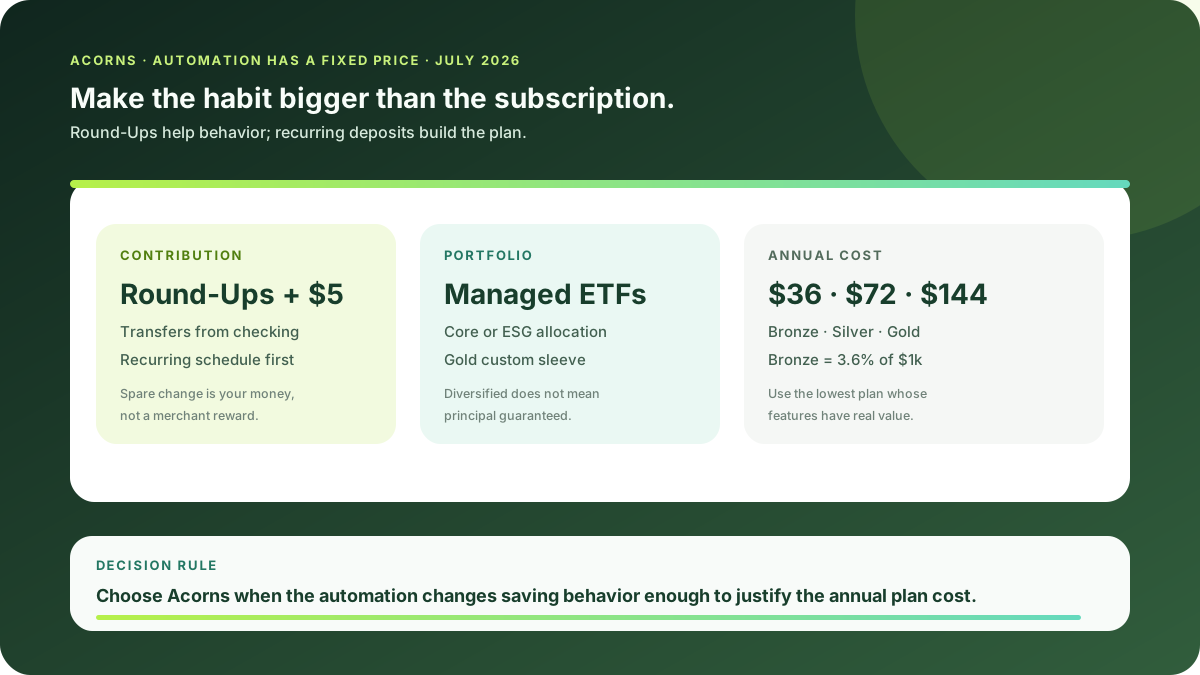
The standard plans are Bronze at $3 per month, Silver at $6, and Gold at $12. All three include an Acorns Invest base portfolio, Round-Ups, Acorns Later retirement access, and checking. Silver and Gold add benefits whose value depends on whether the customer actually uses them.
| Review question | DollarScout finding |
|---|---|
| Best for | Beginners who need contribution automation more than investment choice |
| Entry requirement | No account minimum; $5 to start investing |
| Standard price | $3, $6, or $12 per month, plus underlying investment expenses |
| Portfolio | Expert-built core or ESG ETF allocation; Gold can add a custom sleeve |
| Main limitation | Flat subscription can consume a large percentage of a small balance |
Subscription cost and effective fee
Fees & Commissions scores 3.8/5. Bronze is $36 a year, Silver is $72, and Gold is $144. Acorns’ Form CRS says the subscription includes its program and advisory components and that it does not charge a separate transaction-based fee when Acorns Securities facilitates an investment. The ETFs inside the portfolio still have expense ratios, and banking, ATM, transfer, IRA, or other product terms can create additional costs in specific circumstances.
A flat dollar price behaves differently from an assets-under-management fee. Bronze at $36 annually equals 36% of a $100 balance, 7.2% of $500, 3.6% of $1,000, 0.72% of $5,000, and 0.36% of $10,000. Those percentages exclude fund expenses and market movement. The same plan becomes proportionally cheaper as the balance grows.
This arithmetic is more useful than asking whether $3 “sounds cheap.” A customer who leaves $75 invested for a year could pay almost half that balance in subscription charges. A customer who actively uses Invest, Later, checking, and Round-Ups while building several thousand dollars can receive more practical value.
Use Silver or Gold only when the incremental features have measurable value. An IRA match, emergency savings, custom portfolio, family account, insurance, or tax-filing benefit can be worthwhile, but unused features do not reduce the subscription charge.
Minimum and funding workflow
Acorns advertises no account minimum and says a customer can begin investing with $5. Round-Ups from linked spending cards accumulate and transfer from the designated checking account once they reach at least $5. Purchases on an Acorns debit card can use Real-Time Round-Ups under applicable plan and account rules.
The distinction matters. Acorns does not take the rounding amount from the credit card used for a purchase; the linked checking account supplies the investment. If five cards are linked, their rounding amounts can still draw from one primary checking source.
Recurring investments can be scheduled independently of Round-Ups. That is usually the more reliable wealth-building engine because the amount and date are known. Round-Ups are a behavioral supplement, not a substitute for an emergency fund, workplace retirement contribution, or deliberate savings rate.
Portfolio construction
Investment Selection scores 3.6/5. The base portfolio uses ETFs representing thousands of stocks and bonds and is mapped to a recommended risk profile. Customers can choose between a core and an ESG-oriented path where available. Acorns handles purchases, reinvestment, and rebalancing within the managed program.
This is adequate for a beginner who wants a diversified allocation and does not want to select funds. It is intentionally narrower than a full brokerage. There is no mutual-fund marketplace, individual-bond desk, options chain, futures access, or unrestricted stock-trading account inside the standard managed portfolio.
Gold customers can create a Custom Portfolio sleeve with selected stocks and ETFs. Acorns says this sleeve can make up as much as 50% of the total Invest portfolio, with the base portfolio remaining the diversified foundation. That adds control but also concentration and overlap risk. A customer can unknowingly own the same company directly and through several ETFs.
Fund expense ratios, bid-ask spreads, taxes, and allocation risk still exist even when Acorns does not charge a ticket commission. Review the underlying ETF prospectuses and the actual target weights before funding.
Ease of use and behavioral design
Ease of Use scores 4.8/5, the strongest category. The product integrates onboarding, a recommended portfolio, recurring contributions, Round-Ups, retirement, and banking in one mobile workflow. That can help a first-time investor move from intention to an automated deposit.
The best use is to define a fixed recurring contribution first, then treat Round-Ups as variable extra funding. Set a checking buffer and monitor transfers during the first two statement cycles. An interface that makes investing feel invisible can also make the subscription and contribution total easy to ignore.
Acorns’ projection tools use hypothetical assumptions. They can illustrate compounding but cannot forecast market returns. A smooth app does not make a portfolio low-risk, and “spare change” invested in securities can fall in value.
Later IRA and match rules
Acorns Later supports Traditional, Roth, and SEP IRA structures under the program documents. Silver advertises a 1% match and Gold a 3% match on eligible new contributions during the first subscription year, subject to enrollment, contribution limits, good-standing requirements, and detailed terms.
The match is not immediately unconditional. Acorns’ current terms include a four-year holding period and potential recapture after a downgrade or disqualifying withdrawal. Rollovers, transfers, rewards, wires, and failed deposits may not count as eligible contributions. The applicable match also has an annual cap tied to the statutory contribution limit.
Do not choose an IRA only for the headline match. Compare the subscription for the entire holding period, portfolio expense, beneficiary and distribution process, tax treatment, and whether a lower-cost IRA elsewhere offers the investments you want. An IRA contribution or rollover should fit a retirement plan, not a promotion.
Banking and protection boundaries
Acorns Checking is provided through partner banks, while investment accounts are offered by Acorns Advisers and Acorns Securities. Eligible checking deposits can receive FDIC pass-through treatment under the banking disclosures. Invest, Later, and Early securities can receive SIPC protection under SIPC rules.
FDIC and SIPC are not return guarantees. FDIC applies to eligible deposits at insured banks if a bank fails. SIPC addresses missing cash and securities at a failed brokerage within legal limits. Neither reimburses an ETF, stock, or bond allocation for market losses.
Gold and Silver features can involve additional providers and eligibility. Read the specific agreement for insurance, tax filing, kids’ accounts, emergency savings, debit cards, ATM access, and bonus investments instead of assuming one protection regime applies to the whole app.
Research and tools
Research & Tools scores 3.4/5. Acorns provides education, goal projections, portfolio explanations, transaction history, and in-app guidance. Those tools are useful for learning contribution habits and understanding a managed allocation.
It is not a research platform for comparing securities. There are no professional chart packages, options analytics, bond ladders, broad screeners, analyst-estimate workstations, or portfolio tax-lot controls comparable with a full broker. Gold’s custom sleeve adds selection without turning the app into a deep research terminal.
An investor using individual stocks or niche ETFs should research them independently and inspect overlap with the core portfolio. The absence of a trading-oriented feed can reduce impulsive behavior, but it also means decisions may depend on external tools.
Customer service and records
Customer Service scores 3.9/5. Acorns publishes a support center, account disclosures, and remote contact channels. DollarScout did not time responses or resolve a live transfer, IRA, fraud, or tax-document case.
Save subscription confirmations, portfolio weights, ETF prospectuses, statements, tax forms, Round-Up settings, and match records. If closing or transferring an account, verify subscription timing, fractional-share treatment, IRA custody fees, match recapture, and whether positions can move in kind.
Acorns versus alternatives
Choose Wealthfront for asset-based automated management, daily tax-loss harvesting in eligible taxable accounts, broader portfolio customization, and a $500 minimum. Choose M1 Finance when you want to define stock and ETF targets yourself and accept scheduled trade windows.
A no-subscription brokerage can be cheaper for an investor who already knows how to automate a recurring ETF purchase. Acorns earns its place when the combined behavior, banking, IRA, and Round-Ups workflow causes someone to invest consistently who otherwise would not.
Who Acorns is best for
Acorns fits customers who:
- Need an automated prompt to begin and continue investing.
- Will fund enough that the flat subscription is economically reasonable.
- Prefer a managed ETF portfolio over choosing funds.
- Understand that Round-Ups draw from checking.
- Will use the plan features they pay for.
It is weaker for tiny dormant balances, experienced DIY investors, active traders, direct-bond buyers, or customers seeking advanced research and tax-lot control.
Bottom line
Acorns earns 3.9/5. Its contribution design is excellent and its pricing is transparent in dollars. The central tradeoff is that the same flat price that feels simple can be punitive on a small account.
Calculate annual cost, select the lowest plan that meets a real need, set a deliberate recurring contribution, and keep Round-Ups as a controlled extra. The app is valuable when it changes behavior—not merely when it rounds a purchase.