
Lightspeed at a glance
Lightspeed is a direct-access broker for active equity and options traders. It emphasizes hotkeys, configurable routes, rapid order entry, market scanners, specialized desktop software, and a trade desk instead of free passive investing, retirement planning, or beginner guidance.
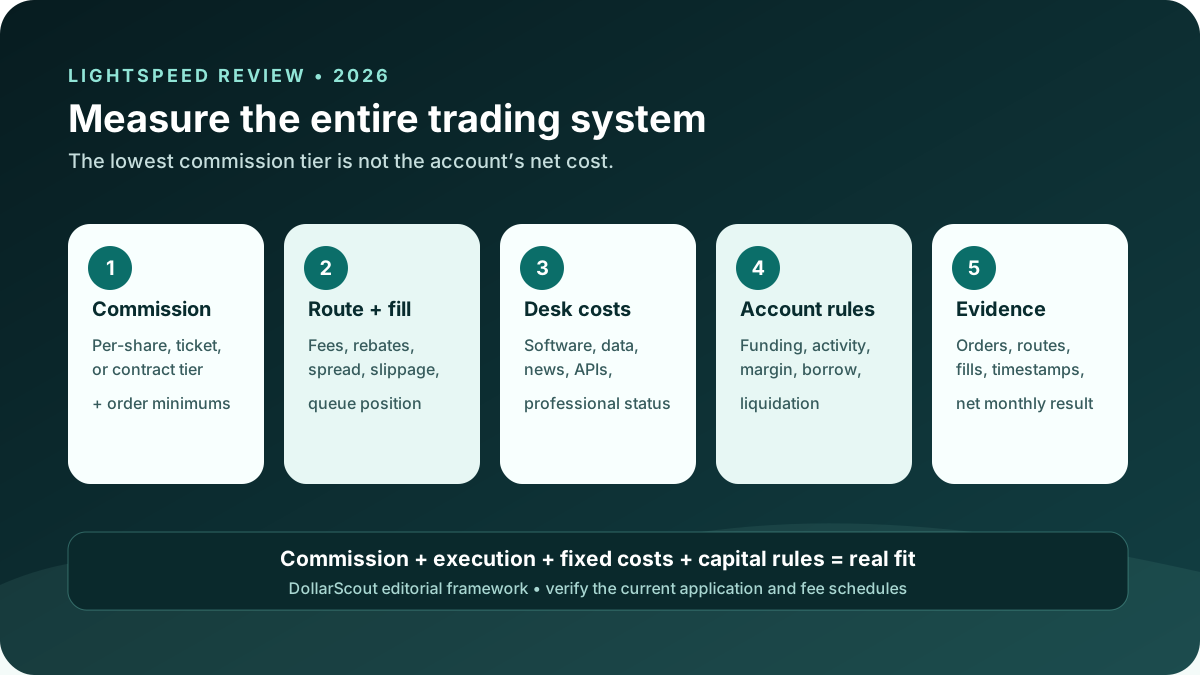
Its name does not guarantee a better fill. Execution quality depends on order type, route, liquidity, queue position, market conditions, technology, and the customer’s process. The useful question is whether Lightspeed’s control improves net results after every recurring and transaction cost.
| Review question | DollarScout finding |
|---|---|
| Best for | Experienced, high-volume U.S. equity and options traders |
| Headline pricing | From $0.001/share, $2/trade, or $0.20/options contract at qualifying tiers |
| Core platform | Lightspeed Trader Pro with hotkeys, routes, scanners, charts, and API access |
| Important recurring cost | Up to $130 monthly software charge, plus selected data, less eligible commissions |
| Main limitation | Low-volume customers can pay meaningful platform and activity costs |
Commission schedules
Trading Costs scores 3.6/5. Lightspeed advertises equity commissions as low as $0.001 per share with a $0.25 minimum at the highest volume tier, or $2 per trade at the highest ticket tier. Options can fall to $0.20 per contract. Those figures describe the deepest published tiers, not the default price for every customer.
The stock per-share schedule steps down as monthly share volume rises, while the per-trade schedule steps down with trade count. The options schedule uses monthly contract volume. Active Trader rates are not applied automatically and do not automatically change each month; the customer must contact Lightspeed, remain eligible, and request a rate adjustment. Past activity is not rebated.
Small orders can have platform-specific minimum commissions. Web & Mobile does not offer per-share equity pricing and applies a $1 minimum to options orders. Eze EMS, Sterling, and other specialist products have their own minimums and software arrangements.
Compare at least three scenarios: a typical month, a quiet month, and a high-volume month. Include partial fills, multiple routes, cancel-replace behavior, options legs, and any tier that must be requested manually.
Routing and regulatory charges
Direct routing is one reason to choose Lightspeed, but it makes cost modeling more complicated. Per-share customers can pay or receive route-specific fees and rebates depending on venue, order type, liquidity, and current schedule. Regulatory and transaction assessments remain separate.
A rebate does not prove best execution. Routing to earn a rebate can lose more through a worse price or delayed fill. The economic comparison is net execution: market at submission, fill, fees, rebates, slippage, and adverse price movement after the fill.
Use limit orders where appropriate, understand whether an order adds or removes liquidity, and retain route and execution reports. A strategy that depends on fractions of a cent needs more rigorous records than a long-term market order.
Software, data, and activity costs
Lightspeed’s FAQ lists Lightspeed Trader Pro at up to $130 per month, reduced by eligible monthly commissions. If a customer generates $100 in qualifying commissions, the example software charge is $30. This is a rebate structure, not a promise that every trading-related charge offsets software.
The same FAQ lists a $25 stock-data package and another $10 for options, with additional feeds available. The detailed data page separates nonprofessional and professional classifications and sells depth, venue, index, news, and Greeks products à la carte. Professional data can cost substantially more.
Lightspeed says Web & Mobile has no monthly software charge and no market-data charge for nonprofessional subscribers. That lower fixed-cost path is important, but it does not provide every desktop route, hotkey, API, or data workflow.
Accounts below $15,000 are subject to a $25 monthly minimum commission, reduced by actual commissions from the prior month. An account generating $10 would owe the remaining $15; an inactive qualifying account would owe $25. This makes Lightspeed particularly weak for buy-and-hold use.
Account minimums and platform conflicts
Lightspeed’s current legal disclosure lists a $2,500 minimum for new accounts using Lightspeed Trader Pro or Web & Mobile. It lists $25,000 for Sterling Trader Pro and Eze EMS, $30,000 for Lightspeed Connect, $50,000 for DAS, and $175,000 for portfolio margin.
Some marketing and comparison pages still show $5,000 for Lightspeed Trader Pro and Web & Mobile. The legal disclosure is the more appropriate baseline for this review, but the binding application controls. Ask Lightspeed to confirm the platform, account type, minimum funding, minimum ongoing equity, and day-trading treatment in writing.
The end of the former blanket $25,000 pattern-day-trader framework does not make day trading low risk. Margin approval, house rules, buying power, maintenance requirements, concentration, short-stock availability, and risk liquidation still apply. Specialist products can maintain higher eligibility thresholds.
Lightspeed Trader Pro
Platform scores 4.5/5. Lightspeed Trader Pro is designed for active equities and options. It supports configurable windows, charts, scanners, watchlists, baskets, conditional orders, customizable routes, hotkeys, hot buttons, and API-assisted order entry.
Hotkeys can reduce manual steps but also accelerate mistakes. A wrong share size, route, price offset, short-sale flag, or cancel-all instruction can affect multiple positions quickly. Begin with conservative defaults, confirmation rules where practical, hard buying-power limits, and a documented kill procedure.
The platform now advertises 24/5 access to eligible U.S. markets. Overnight sessions can have thinner liquidity, wider spreads, different venues, and limited order types. Do not transfer assumptions from the regular session without testing them.
Web, mobile, and specialist platforms
Lightspeed Web & Mobile offers browser and phone access, watchlists, charts, scanners, research data, and order management without the nonprofessional software and market-data subscriptions. It is the more approachable cost structure, but per-share equity pricing and direct-routing features differ.
Sterling Trader Pro, Eze EMS, DAS Trader Pro, Lightspeed Connect, and options-specialist platforms target professional or institutional workflows with higher minimums and separate charges. A platform name on Lightspeed’s site does not mean every customer receives the same clearing, routing, data, or support arrangement.
Choose the smallest platform that actually supports the strategy. Paying for a professional terminal before a process needs it adds fixed cost and operational complexity.
Execution and routing control
Execution Speed scores 4.9/5, the strongest category. Lightspeed documents multiple routing destinations, hotkey order entry, direct-access controls, real-time market data, rapid order-management tools, and active-trader support. Those capabilities provide unusually granular control.
DollarScout did not benchmark latency or compare fill quality. “Fast” can refer to interface response, order transmission, exchange acknowledgement, or fill time; they are different measurements. A marketable order may fill quickly at an unfavorable price, while a passive order may wait by design.
Track order-entry timestamp, acknowledgement, route, fill timestamp, displayed spread, fill price, fees, rebates, and post-fill movement. Compare like order types at similar liquidity. Marketing speed is not a substitute for customer-specific execution data.
Tools and workflow
Trading Tools scores 4.5/5. Scanners, charts, Level 2 and depth subscriptions, historical options data, hotkeys, baskets, conditional orders, APIs, and window linking support an active desk. Lightspeed’s strength is workflow integration rather than fundamental investment research.
Third-party news, data, and specialist platforms can extend the environment. Every integration creates another dependency: permissions, billing, credentials, data entitlement, support ownership, and failure handling should be documented.
Back up layouts and hotkeys. Maintain an alternate order-entry path and the trade-desk number outside the platform. Test connectivity and updates before the market opens, not during a fast move.
Margin, short selling, and liquidation
Lightspeed publishes margin rates by debit balance and notes that rates can change. The December 12, 2025 comparison ranges from 11% for smaller balances to 8.50% above $1 million. Interest accrues independently of whether a trade is profitable.
Short selling adds borrow availability, borrow fees, recall, buy-in, dividend, and theoretically unlimited loss risk. A symbol shown as available can become hard to borrow or be recalled. Ask how locate fees and overnight borrow are displayed and recorded.
Risk liquidation can carry a separate fee in addition to the market loss. Maintain cash above the minimum, know the broker’s house margin, and size positions so one ordinary adverse move does not consume the buffer.
Research and long-term investing
Lightspeed provides charts, news, scanners, and platform research, but it is not designed around retirement projections, mutual-fund selection, adviser access, tax planning, or automated portfolio construction. The monthly minimum commission below $15,000 further weakens passive use.
A long-term investor can find commission-free, no-inactivity-fee brokers with deeper planning tools. Lightspeed becomes rational when routing control, hotkeys, and active support measurably matter to the strategy.
Keep long-term assets separate from active trading capital. That reduces the chance that intraday margin needs, platform incentives, or a large loss changes the household investment plan.
Customer service
Customer Service scores 4.3/5. Lightspeed publishes general, trading, account, and software support paths, and its specialist positioning includes access to knowledgeable trade support. The FAQ answers detailed billing, transfer, platform, and operational questions.
DollarScout did not call support or resolve a live-order incident. Save the trade-desk number, account identifier, platform version, order IDs, timestamps, screenshots, logs, and written responses. For a live risk problem, use the broker’s designated trade channel rather than social media or a generic sales form.
Lightspeed versus alternatives
Choose Interactive Brokers for broader global markets, stronger portfolio analytics, more asset classes, and a larger API ecosystem. Choose TradeStation for EasyLanguage, strategy testing, and a more mature retail systematic-trading workflow.
Choose tastytrade for an options-first interface and capped equity-option opening commissions. A mainstream commission-free broker is usually better for occasional equity trades, funds, and household investing.
Who Lightspeed is best for
Lightspeed fits customers who:
- Trade enough to justify fixed software, data, and activity costs.
- Need specific routes, hotkeys, scanners, and a direct-access workflow.
- Measure execution rather than assuming the fastest-looking screen wins.
- Maintain margin buffers and documented operational controls.
- Can request and monitor the correct volume schedule.
It is weaker for beginners, passive investors, small occasional accounts, and anyone unwilling to reconcile a multi-layer fee statement.
Bottom line
Lightspeed earns 4.4/5. Its execution workflow is excellent and its platform is purpose-built for serious active traders. Costs receive the lowest category score because the headline tier tells only part of the story.
Before opening, obtain the exact platform, funding requirement, commission tier, order minimum, routing schedule, software rebate, market-data classification, and activity rule. Then compare the all-in monthly result with actual execution data. That is the standard a professional-style platform deserves.


