
Farmers Insurance at a glance
Farmers is a large U.S. insurance organization that combines local agents, independent distribution, direct channels, online accounts, a mobile app, and a national claims operation. The familiar Farmers brand does not identify one legal insurer for every customer. Farmers says its three primary exchanges—Farmers Insurance Exchange, Fire Insurance Exchange, and Truck Insurance Exchange—are reciprocal insurers owned by their policyholders. Those exchanges, subsidiaries, and affiliates can issue coverage, and each company is financially responsible for its own policies.
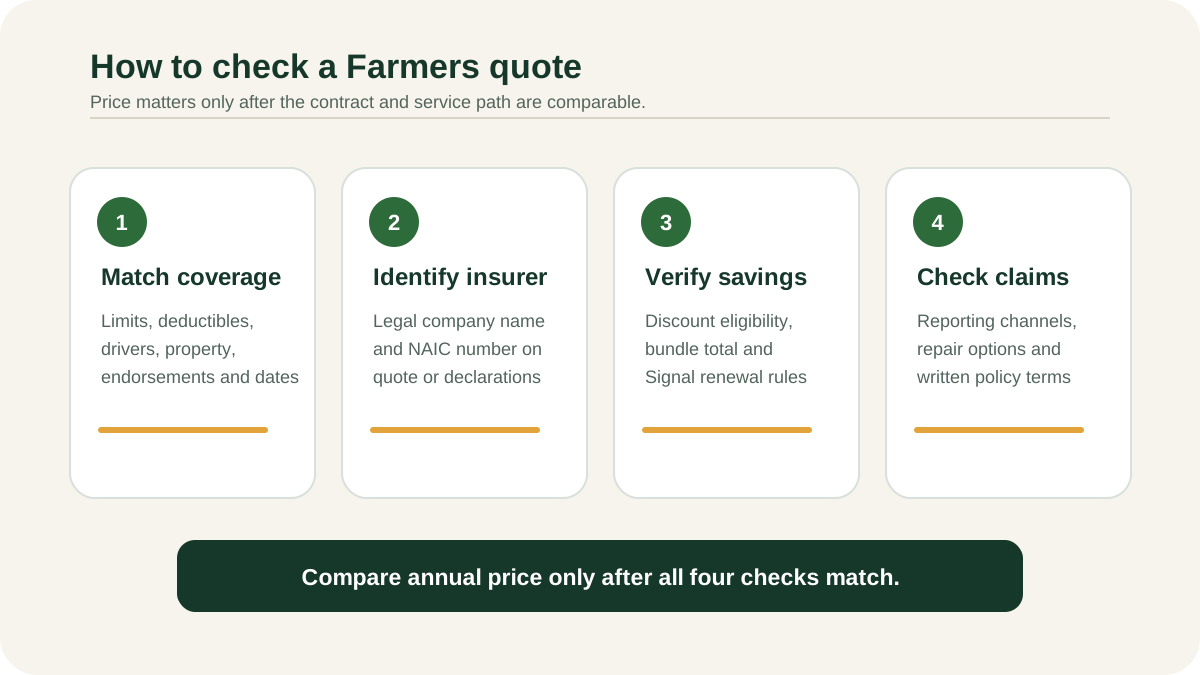
That structure makes the declarations page important. A shopper should record the exact company name and NAIC number shown on the quote, not just “Farmers.” The issuing entity controls the contract, licensing footprint, filed rates, complaint record, and claims-paying obligation.
| Review question | DollarScout finding |
|---|---|
| Best for | Households wanting an agent-supported auto and property relationship |
| Price model | Individual quote; no universal Farmers premium |
| Main product strengths | Auto, homeowners, renters, discounts, bundling, and claims tools |
| Telematics | Signal; riskier driving can raise renewal premium |
| Main limitation | State, company, product, discount, and underwriting variation |
What Farmers is—and why the company name matters
Farmers describes an organization serving households and businesses through several brands, companies, and channels. It has Farmers exclusive agencies, independent agents, online and call-center sales, Farmers GroupSelect for participating employer and affinity groups, Foremost for standard and specialty risks, Bristol West for nonstandard auto, 21st Century for direct California auto, and other entities. A customer entering through Farmers.com may therefore see a different company, policy form, or servicing path depending on location and risk.
This is not inherently a drawback. Multi-company groups can serve a wider range of customers. The problem arises when a shopper assumes that brand familiarity makes every quote identical. Farmers’ own disclosures say that not every insurer is authorized in every state, not every product or discount is available everywhere, and each insurer has sole financial responsibility for its policies.
Before purchase, save the quote and locate the underwriting-company disclosure. Confirm that the company is licensed in the state, then use the same entity—not the group name—to research complaints and financial information. NAIC Consumer Insurance Search and the state insurance department are better tools for this job than an unfiltered web review.
Price and quote quality
Price scores 4.0/5. Farmers provides online quote entry points, agent support, state pages, and detailed explanations of factors that can affect premium. The final price still depends on the drivers or property, ZIP code, coverage, limits, deductibles, history, discounts, underwriting rules, company, and factors allowed by state law.
Farmers currently advertises an average $530 annual saving among surveyed new customers who switched auto coverage during a stated 2024–2025 period and reported savings. The disclosure excludes certain states and Farmers GroupSelect and says potential savings vary. That is marketing evidence about a selected group of switchers—not a rate a new applicant should place in a budget. People who did not save are not represented by a “customers who switched and realized savings” figure.
The renters page says coverage can cost as little as $14 per month. “As little as” is a floor, not an average or guaranteed offer. Home and auto bundle pages similarly advertise percentages or survey-based dollar savings under stated conditions. A shopper should treat each headline as a prompt to quote, never as a substitute for the returned premium.
The correct test is to obtain at least three quotes with the same drivers, vehicles, address, effective date, liability limits, uninsured-motorist choices, property limits, valuation, deductibles, endorsements, and payment schedule. Compare the annual total and all installment fees. For a bundle, also price the best standalone combination; a discount can coexist with a higher combined bill.
Auto insurance coverage
Coverage scores 4.7/5 across the reviewed product family. Farmers’ auto material covers the standard building blocks: bodily-injury and property-damage liability, collision, comprehensive, uninsured and underinsured motorist protection, medical payments or personal-injury protection where applicable, rental, towing or roadside assistance, and state-specific options.
The broader catalog also includes rideshare, collectible vehicles, motorcycles, recreational vehicles, boats, umbrella coverage, and group products. Optional features and eligibility vary. Farmers describes accident forgiveness on certain Farmers Smart Plan and Flex Personal policies, generally for one qualifying accident every three years, while noting that it is unavailable in California, Hawaii, North Carolina, New York, and South Carolina. A shopper should verify the exact policy rather than assuming a national feature list applies.
“Full coverage” should not be used as a specification. Ask for the actual liability limits, physical-damage deductibles, rental amount and duration, roadside terms, loan or lease protection, custom-equipment treatment, OEM or aftermarket parts language, rideshare gap, permissive-use rules, and household-driver requirements. A low premium built on state-minimum liability and a large deductible is not comparable with stronger protection.
Farmers earns a high coverage score because it can serve straightforward and more complex personal-lines households. The score stops short of 5 because contract details and availability vary by company and state, and the public product catalog cannot tell a specific applicant what will be offered.
Signal telematics and auto discounts
Discounts scores 4.7/5. Farmers advertises more than 20 auto discount options and allows eligible discounts to be combined. The current menu includes multi-policy, multiple vehicle, safe driver, accident-free, good student, distant student, youthful-driver continuity, paperless, automatic payment, paid in full, anti-theft, homeowner, professional or affinity, and other state-specific opportunities.
Signal deserves separate treatment because its downside is material. The smartphone app can monitor driving behavior such as braking and phone use. Farmers says enrollment can produce an initial discount and safer driving can produce a renewal discount. It also states plainly that riskier driving behavior could increase the premium at renewal. This is different from programs that promise driving behavior will not create a surcharge.
Farmers’ current auto disclosure says Signal is unavailable in Florida, Hawaii, New York, and South Carolina, and the Signal discount is unavailable in California. Product eligibility also varies. Anyone considering Signal should read the current consent, confirm every household driver and vehicle requirement, understand how trips are identified and corrected, review data collection and retention, and compare the expected discount with the privacy and renewal-pricing tradeoff.
Do not enroll only because the quote screen displays an initial saving. Ask what happens if the app is disabled, a driver does not carry the phone, trips are misclassified, driving is limited, or participation ends. Save the terms in force at enrollment and review the renewal calculation.
Homeowners insurance
Farmers is especially competitive for homeowners who want agent help tailoring coverage. Its public materials describe dwelling, other structures, personal property, loss of use, personal liability, and medical payments, plus options that can address higher rebuild costs, water backup, valuables, umbrella liability, flood, earthquake, and other property risks.
Extended Replacement Cost can add a stated percentage above the dwelling limit after a covered loss, subject to the policy. Farmers also describes an optional Guaranteed Replacement Cost feature that can pay the full covered rebuild cost even above the stated limit. Neither label removes the need for an accurate replacement-cost estimate, required insurance-to-value updates, ordinance or law coverage, a suitable deductible, and compliance with policy conditions.
Property insurance is highly local. Roof age and settlement method, wildfire or wind exposure, water losses, electrical or plumbing systems, prior claims, inspection findings, protective devices, occupancy, pets, pools, short-term rental use, home business, and renovations can alter eligibility or terms. Flood and earthquake are generally separate decisions. A standard homeowners quote should not be treated as complete until these exposures and exclusions are reviewed.
Farmers’ online home quote can show how estimated premium changes when limits change, after which an agent can discuss options. That is useful, but the quote is still not a binder. Confirm the legal company, effective date, mortgagee, forms, endorsements, catastrophe deductibles, and replacement-cost terms before cancelling existing coverage or closing on a property.
Renters insurance
Farmers renters coverage is a meaningful product, not merely a thin bundle add-on. The company describes protection for personal property, personal liability, additional living expenses or loss of use, and other policy components. Its coverage page distinguishes named-perils coverage from an open-perils option and notes common exclusions such as flood, earthquake, and pests.
The quote should begin with an inventory. Add clothing, electronics, furniture, kitchenware, tools, bicycles, hobbies, stored property, and belongings carried away from home. Then compare replacement-cost versus actual-cash-value settlement, property sublimits, scheduled valuables, deductible, loss-of-use limit, liability, guest medical payments, water backup, identity or cyber options, and flood or earthquake needs.
Farmers can be especially attractive for a renter who already has or is shopping for auto coverage and wants an agent to coordinate both. The bundle still needs a total-cost comparison. Confirm whether an unrelated roommate is insured, how pets and home business are treated, and whether the landlord requires a certificate of insurance rather than a declarations page.
Claims and repair experience
Claims Experience scores 4.4/5. Farmers allows online claim filing and status tracking, document and receipt uploads, and access to claim information around the clock. Its site says a new claim can be started in under five minutes with a policy number and basic details. Auto, homeowners, business, roadside, glass, and catastrophe paths are separated so the customer can reach the relevant workflow.
For auto claims, Farmers presents three repair paths: a network facility, an outside shop with photo and estimate coordination, or other options based on the loss. It says repairs completed through its network are guaranteed for as long as the customer owns the vehicle. That guarantee is useful, but a customer should still read who provides it, what work and parts it covers, and how supplements, calibrations, rental limits, and disagreements are handled.
A digital portal cannot establish whether a loss is covered. Preserve photos, video, police or incident reports, inventories, receipts, mitigation records, estimates, communications, and the complete policy. For property claims, ask the adjuster to explain the covered cause, deductible, depreciation, replacement-cost holdback, code upgrades, matching, additional living expense, and payment calculation in writing.
We did not file a claim or measure response time, so 4.4 reflects documented access, network options, catastrophe resources, and service design. It is not a prediction that every claim will be fast or undisputed.
Agent and customer service model
Customer Service scores 4.5/5. Farmers’ local-agent model is useful when a household needs to coordinate multiple cars, a house, a rental property, an umbrella policy, valuables, a teen driver, or business use. The agent can help gather information, explain options, and update policies, while the website and app support documents, payments, claims, and other self-service tasks.
The model can also create handoffs. The agent, underwriting company, billing operation, claims representative, repair facility, and third-party provider may each own a different part of the experience. An agent does not decide coverage after a loss and cannot override the policy. Important requests should be confirmed in writing and checked against revised declarations and endorsements.
Digital-only shoppers may prefer a carrier with fewer agent touchpoints. Farmers is strongest when the customer actually values advice and periodic coverage review rather than treating the agent channel as an extra step in a commodity purchase.
Farmers versus State Farm, Allstate, Progressive, GEICO, and Lemonade
Choose State Farm when a very large captive-agent network and its particular auto-property ecosystem are the priority. Choose Allstate for another agent-supported bundle with Drivewise, Milewise, and broad property endorsements. The Farmers decision should come down to the actual matched quote, company, coverage, and relationship—not which legacy brand is most familiar.
Choose Progressive when direct comparison tools, specialty vehicles, or a direct-plus-independent-agent model matter. Choose GEICO for a more direct auto experience, while remembering that some GEICO property quotes are placed with partner insurers. Choose Lemonade for an app-first renters or homeowners workflow in an eligible state when the risk is straightforward and a local agent is not desired.
Who Farmers is best for
Farmers is strongest for customers who:
- Want to compare auto, homeowners, or renters coverage through one relationship.
- Value a local agent but also want online claims and account tools.
- Need property endorsements or help reviewing replacement cost and liability.
- Can use several verified discounts without reducing coverage.
- Will compare the returned premium and issuing company with alternatives.
It is weaker for someone who expects an advertised saving to be guaranteed, wants a fully self-directed purchase, objects to telematics data collection, or cannot obtain the desired product in the relevant ZIP code.
Quote checklist
Before buying Farmers insurance:
- Match limits, deductibles, endorsements, drivers, property facts, and effective dates across quotes.
- Record the legal issuing company and NAIC number.
- Price bundled and standalone combinations in annual dollars.
- Verify every discount and what is required to keep it.
- Read Signal consent and renewal-pricing terms before enrollment.
- Review property valuation, exclusions, sublimits, and catastrophe deductibles.
- Confirm the policy is bound before cancelling current coverage.
- Save the application, quote, binder, declarations, forms, and communications.
Bottom line
Farmers earns 4.4/5. Its broad auto and property catalog, agent support, discount menu, customizable homeowners options, renters coverage, Signal program, and claims tools make it a serious multi-policy contender. Coverage and discounts are the strongest categories.
The buying decision must remain quote-specific. Farmers is a group brand used by multiple insurers, the cheapest offer cannot be inferred from a switcher survey, and Signal has real renewal downside for riskier recorded driving. Compare matched contracts, verify the issuing company, and choose Farmers only when the actual price, coverage, and service model fit the household.