
tastytrade at a glance
tastytrade is a self-directed broker designed around active derivatives trading. The platform language, order ticket, visual analysis, strategy templates, and educational ecosystem all emphasize options probability, volatility, risk, and position management.
The product has expanded beyond its original options identity. Customers can access stocks, ETFs, futures, futures options, cryptocurrency, forex, fixed income, and prediction markets under applicable approvals and rules. Options remain the clearest reason to choose it.
| Review question | DollarScout finding |
|---|---|
| Best for | Active, self-directed options and futures traders |
| Equity-option price | $1 per contract to open, $10 cap per leg, $0 to close |
| Signature tools | Strategy Builder, risk analysis, backtesting, order chains, tastylive |
| Main strength | Pricing and interface use the same options-first mental model |
| Main limitation | Traditional research, planning, and passive-fund breadth are secondary |
Commission structure
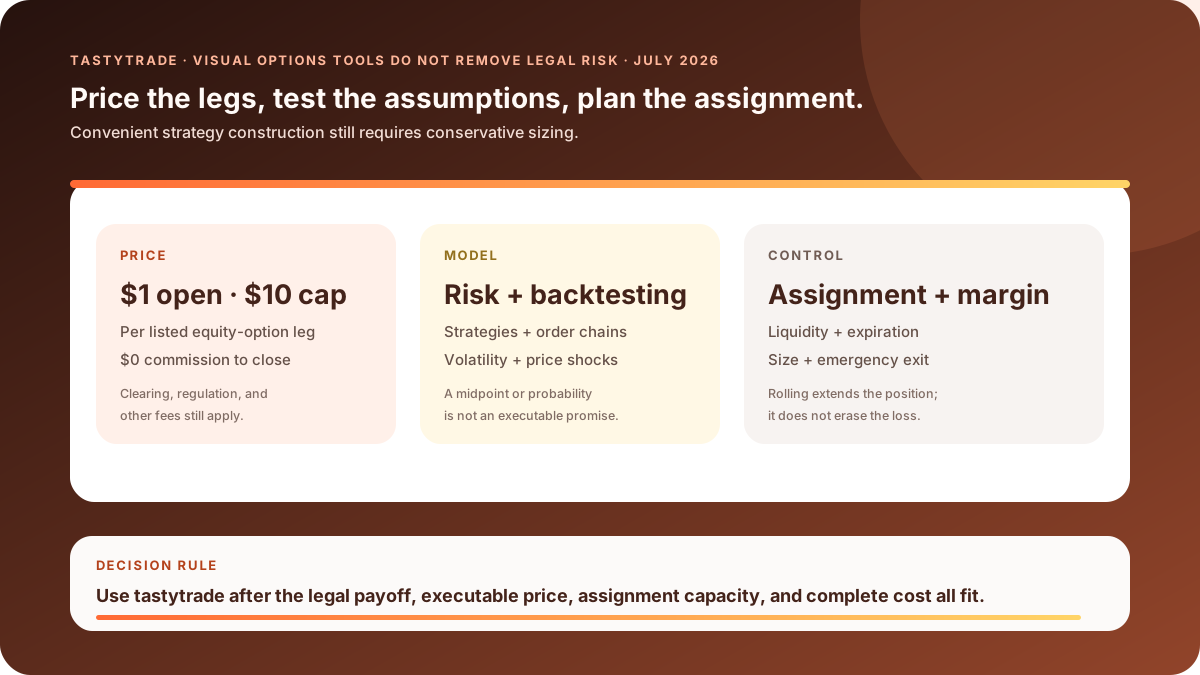
Trading Costs scores 4.5/5. tastytrade lists stock and ETF commissions at $0 to open and close. Listed stock and ETF options cost $1 per contract to open, capped at $10 per leg, and $0 per contract to close. The cap applies by leg, so a four-leg structure can have four separate caps.
Broad-based index options also list $1 per contract to open and $0 to close, without the same stated equity-option leg cap. Futures cost $1 per contract on both opening and closing; Micro futures cost $0.75 each way. Options on standard futures are $1.25 per contract each way and Micro futures options $0.75.
Exchange, clearing, regulatory, transaction, and product-specific fees remain. A $0 closing commission does not mean closing is free. Multi-leg orders, exercises, assignments, crypto, forex, fixed income, transfers, margin, and special services can have separate charges.
The $10 cap benefits larger equity-option legs. One contract still costs $1 to open, while 25 contracts on the same leg remain capped at $10 before pass-through fees. Compare round-trip dollars, not only the opening headline.
Account minimums and permissions
tastytrade states that most brokerage account types have no minimum to open, though margin privileges and products have funding, equity, suitability, or permission requirements. Account types include individual, joint, traditional and Roth IRA, entity, and certain international structures.
Cash, standard margin, and portfolio margin permit different strategies and buying power. Portfolio margin can provide much greater leverage for eligible diversified positions and requires approval and sufficient equity. Greater buying power magnifies losses and liquidation risk.
Options, futures, and forex permissions are not automatic. The customer’s financial profile, experience, objectives, and account structure matter. An approved strategy can still be unsuitable for the customer.
Desktop platform
Platform scores 4.7/5. The desktop application is designed for speed and dense active-trader workflows. A customizable ladder supports futures and equities. The analysis tab evaluates risk factors, probability estimates, and volatility shifts. Advanced charts and order entry sit near position management.
Strategy Builder offers preset multi-leg structures and lets a trader adjust strikes and expirations. Order-chain tracking connects rolls and multi-leg activity from entry through exit. Visual Risk Analysis can stress queued orders and positions for price, implied volatility, and expiration changes.
These features make complex trades easier to inspect, not easy to profit from. Always read the actual order legs, debit or credit, buying-power effect, maximum contractual gain and loss, break-evens, exercise style, and expiration.
Web and mobile platforms
The web platform adds browser-based charting, analysis, options backtesting, ladder trading, AI-assisted symbol search, and an unlimited journal that can link notes to trades. It also advertises access to T-bills and other fixed-income investments.
The mobile app supports stocks, options, futures, and crypto with position management, quotes, charts, financials, and news. A mobile workflow is useful for monitoring and emergency action but should not be the first place a trader tries to understand a complicated spread.
Features, layouts, and order controls can differ by interface. Rehearse adjustments and exits in the exact platform used during live trading. Keep biometric security, strong authentication, and notification privacy configured.
Options backtesting and visual analysis
Trading Tools scores 4.8/5. tastytrade advertises options backtesting using more than ten years of data, alongside risk analysis and strategy templates. This can help compare expirations, strikes, entry rules, and historical conditions.
Historical option data contains modeling challenges. Wide bid-ask spreads, stale quotes, survivorship, early exercise, dividends, assignment, margin changes, and incomplete intraday liquidity can make a theoretical fill unrealistic. A backtest that always trades the midpoint is especially suspect.
Reserve an out-of-sample period, use conservative fills and fees, test multiple volatility regimes, and review the worst sequence—not only average return. Paper trading cannot replicate real assignment or emotional pressure.
Probability, Greeks, and position management
tastytrade presents probability of profit, delta, theta, volatility, and payoff curves prominently. These are useful summaries of a model at a point in time. They are not independent guarantees.
Rolling an option closes one position and opens another. It can realize a loss, extend risk, add commissions and pass-through fees, and increase total capital exposure. Order-chain tracking helps document the sequence, but the economic result must include every debit, credit, assignment, and underlying position.
Percent-of-profit limit orders and Quick Roll make management faster. Automation of a management rule still requires a decision about liquidity, fill quality, and whether the original thesis remains valid.
Execution and order quality
Execution Speed scores 4.4/5. The platform offers fast order construction, ladder entry, quick adjustments, multi-leg support, and active position controls. DollarScout did not measure network latency or fills.
Options execution should be evaluated across the full package. A complex order can fill as a package or, depending on order design, create leg risk. The natural market may be wide, and a theoretical midprice may not be available. Use patient limit orders where appropriate and understand the consequences of replacing an order repeatedly.
Commission caps do not compensate for a poor fill. Record the displayed market, submitted limit, execution price, and later underlying movement to evaluate process fairly.
Futures and crypto
tastytrade supports futures and futures options with per-contract charges on entry and exit. Futures accounts have different protection and segregation rules from securities accounts and are not covered by SIPC. Exchange margin, house margin, contract multipliers, settlement, and delivery rules govern risk.
Crypto transactions currently advertise a $0 crypto commission on the pricing page, but spreads, custody structure, asset availability, withdrawal rules, and product terms matter. Crypto is not protected like a bank deposit or a standard SIPC-covered security position.
Avoid assuming that access from one screen gives every product identical legal treatment. Read the disclosure and statement section for the specific account and clearing arrangement.
Education through tastylive
tastylive programming and tastytrade courses use the same volatility, probability, and strategy vocabulary as the platform. In-platform video and follow feeds reduce the gap between learning a concept and locating the relevant tool.
Education is not individualized advice. A live host’s capital, portfolio, timing, tax situation, risk limit, and ability to adjust can differ completely from the viewer’s. Recreate a trade from first principles instead of copying it.
Courses covering platform operation, stocks, options, futures, and strategy families are useful for mechanics. Regulatory documents such as the Characteristics and Risks of Standardized Options remain required reading.
Research and long-term investing
tastytrade has improved charts, company financials, news, fixed-income access, AI search, and research-oriented tools. It still does not center its experience on mutual-fund selection, retirement projections, goals-based allocation, tax planning, or a human adviser.
A long-term investor can hold stocks and ETFs at $0 commission, but a simpler broker or automated adviser may provide a clearer contribution, allocation, and planning workflow. The platform’s energy can encourage unnecessary activity.
Use a written investment policy and separate long-term holdings from speculative capital. Options should not become the default merely because the interface makes them convenient.
Customer service
Customer Service scores 4.3/5. tastytrade publishes phone and email contacts for general support, accounts, banking, trade desk, overnight futures, and technology. Courses and the Help Center provide platform-specific guidance.
DollarScout did not call the trade desk, resolve an assignment, transfer an account, or correct a tax form. Save order IDs, timestamps, statements, confirmations, chat or email records, and screenshots. Use the emergency trade path for live orders rather than general education questions.
tastytrade versus alternatives
Choose Interactive Brokers for global market breadth, currency financing, institutional order types, and a wider API stack. Choose TradeStation for EasyLanguage, RadarScreen, portfolio testing, and a mature systematic-trading desktop environment.
NinjaTrader is more focused for futures simulation, order flow, and plan-based commissions. A full-service broker is better for advice, mutual funds, and household planning.
Who tastytrade is best for
tastytrade fits customers who:
- Trade listed options often enough to benefit from the per-leg cap.
- Want visual strategy construction and risk analysis.
- Will verify legal payoff, liquidity, assignment, and margin.
- Learn through tastylive but make independent decisions.
- Prefer a focused active-trading interface over traditional planning.
It is weaker for advice seekers, passive-only investors, and anyone who interprets modeled probability as protection.
Bottom line
tastytrade earns 4.6/5. Its pricing, tools, order workflow, and education form one of the most coherent options ecosystems available to self-directed retail traders.
The platform reduces friction; it does not reduce the underlying risk automatically. Use conservative size, limit orders, a complete round-trip cost, and a plan for assignment and margin before entering any derivatives position.


