Wealthfront at a glance
Wealthfront is a digital investment adviser whose core Automated Index Investing account builds and manages a diversified ETF portfolio. The customer answers a risk questionnaire, reviews the proposed assets and target weights, and can adjust the risk score or customize the portfolio within the available fund universe.
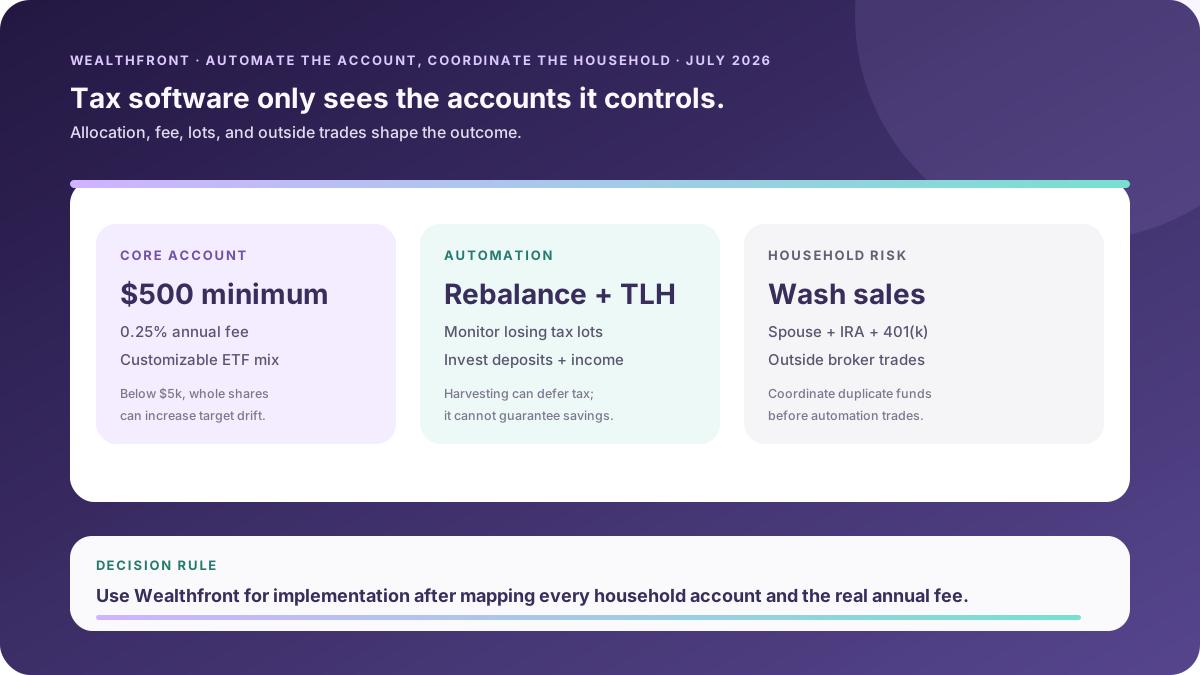
The minimum is $500 and the annual advisory fee is 0.25%, deducted monthly. The service includes automatic investing, rebalancing, dividend reinvestment, and daily tax-loss harvesting for eligible taxable accounts at no incremental advisory charge.
| Review question | DollarScout finding |
|---|---|
| Best for | Hands-off taxable investors who value automated tax management |
| Core minimum | $500 |
| Core advisory fee | 0.25% annually, plus underlying fund expenses |
| Key tool | Daily tax-loss harvesting in eligible taxable accounts |
| Main limitation | Digital service without a traditional assigned-adviser relationship |
Core fee and what it covers
Fees & Commissions scores 4.2/5. The Automated Index Investing account charges 0.25% annually on managed assets. A $10,000 average balance costs about $25 a year; $100,000 costs about $250. The fee is deducted monthly. ETF expense ratios, market spreads, taxes, and any optional or specialized product expenses remain separate.
Wealthfront says it does not charge account-opening, withdrawal, closing, trading-commission, or account-transfer fees. Its published schedule lists different advisory rates for other products: 0.25% for the Automated Bond Portfolio, 0.15% for the Automated Bond Ladder, 0.09% for S&P 500 Direct, and 0.12% for Nasdaq-100 Direct. Stock Investing has no Wealthfront account or commission fee and does not accept payment for order flow under the current disclosure.
The core price is competitive for an automated adviser but more expensive than owning the same broad ETFs directly at a commission-free brokerage. The value has to come from allocation, rebalancing, harvesting, automation, and reduced behavioral error—not from exclusive access to the ETFs.
At higher balances, compare the dollar fee with a flat-fee planner, self-directed implementation, and services that include human planning. At lower balances, 0.25% avoids the disproportionate impact of a flat monthly subscription.
Minimums and small-account behavior
The Automated Investing minimum is $500. Wealthfront’s Form ADV also lists $500 for its Automated Bond Portfolio and Automated Bond Ladder, and $5,000 for standalone S&P 500 Direct and Nasdaq-100 Direct accounts. The separate Stock Investing and Cash Accounts can begin with $1 under current rules.
Wealthfront explains that automated accounts between $500 and $5,000 can deviate more from the target portfolio. Because it generally buys whole ETF shares in that program, the software selects a combination intended to balance target tracking and uninvested cash. More asset classes can be added as the account grows.
That is not necessarily harmful, but a new customer should inspect actual holdings after the first deposit. A recommended nine-fund allocation might initially hold fewer positions because one full share is too expensive relative to the account.
The $500 threshold is an operational minimum, not a statement that the portfolio is sufficient for a goal. Keep emergency cash outside market investments and define the contribution required to reach the goal.
Portfolio construction and customization
Investment Selection scores 4.1/5. The questionnaire produces a risk score, tax level, target mix, and explanation of the recommended portfolio. Wealthfront uses ETFs across U.S. and foreign equities, bonds, real estate, and other asset classes depending on the selected model and account type.
Customers can edit available investments and relative weights. This is more flexible than a fixed robo portfolio, but Wealthfront retains trading authority within the advisory account and implements its rebalancing and tax logic. It is not the same as placing unrestricted market, limit, option, bond, or futures orders.
Customization can undermine the original model. Removing an asset class, concentrating a thematic fund, or holding a similar security elsewhere can change expected risk and tax behavior. Record the intended allocation before editing and compare the weighted expense ratio.
Wealthfront also offers a Stock Investing Account with fractional shares, curated collections, no advisory fee, and a $1 entry point. That account is self-directed and economically distinct from the managed portfolio. Holding the same stocks in both can complicate tax-loss harvesting.
Rebalancing and deposits
Ease of Use scores 4.7/5. Deposits, dividends, and withdrawals give Wealthfront opportunities to move the portfolio toward its targets. The software also trades when drift reaches its internal criteria, while considering taxes in taxable accounts.
This is well suited to recurring investment. The customer does not need to calculate which ETF is underweight after each transfer. Planning tools can link outside accounts and show projected net worth and goals, though linked data can be delayed or incomplete.
Automation should be audited. Review target versus actual weights, cash, realized gains and losses, advisory fees, and transfers at least quarterly. Save the investment plan before and after major customization.
Tax-loss harvesting
Research & Tools scores 4.2/5. Wealthfront monitors taxable Automated Index Investing accounts for ETF lots trading below cost. When its model finds an expected net benefit, it can sell the position and purchase an alternative ETF intended to maintain similar exposure while observing its wash-sale controls.
Harvested losses can offset capital gains and, under current federal rules, up to $3,000 of ordinary income after netting, with unused losses generally carried forward. Selling the replacement later can realize a gain because its tax basis is lower. The benefit depends on tax rate, future transactions, holding period, donations, withdrawals, and the eventual disposition.
Wealthfront’s April 2026 white paper estimates material historical benefits for many clients. That is research from the provider, not a guarantee for an individual. High turnover introduces spreads, tracking differences, possible unqualified dividends, and execution costs.
Tax-loss harvesting applies only where losses matter. It is generally irrelevant inside tax-deferred IRAs. A customer trading the same funds in a 401(k), IRA, spouse account, or outside brokerage must coordinate to reduce wash-sale risk.
Direct indexing and specialized products
Taxable Automated Index Investing accounts with at least $100,000 can qualify for U.S. Direct Indexing, which replaces part of the broad U.S. ETF exposure with individual stocks plus a completion fund. Smart Beta begins at $500,000 under current thresholds.
The standalone S&P 500 Direct account starts at $5,000 and charges 0.09%; Nasdaq-100 Direct also starts at $5,000 and charges 0.12% according to the fee schedule. These accounts have different index, concentration, turnover, and transfer mechanics from the diversified automated portfolio.
Direct indexing can harvest more individual-stock losses but creates many tax lots and tracking differences. The value is highest when taxable gains, tax rate, account size, contribution pattern, and charitable or estate strategy support it. It should not be selected solely because the fee is lower.
Cash Account and protection
The Wealthfront Cash Account is a brokerage cash-sweep product, not a bank account issued by Wealthfront. It sweeps eligible funds to program banks where deposits can receive FDIC pass-through coverage, subject to arrival, ownership category, program terms, and the customer’s deposits at the same banks.
As of Wealthfront’s March 2026 support article, the representative APY was 3.30%, with a $1 minimum and no account, overdraft, transfer, or minimum-balance fee. The rate is variable and can change at any time. Individual and Joint Cash Accounts have checking-style features; Trust Cash does not offer every checking feature.
Wealthfront advertises eligibility for up to $8 million of FDIC coverage for individual ownership and $16 million for joint ownership through multiple program banks. Those are maximum program capacities, not automatic coverage for every dollar. Customers must monitor deposits held directly at the same partner banks.
Securities in brokerage accounts receive SIPC treatment under SIPC rules. SIPC and FDIC do not protect market value, tax outcomes, or an investment strategy from losses.
Human advice and customer service
Customer Service scores 4.0/5. Wealthfront provides digital support, published help documentation, phone and messaging paths, and regulatory disclosures. The core service is not a traditional advisory relationship with an assigned professional who knows the household.
Someone needing Social Security coordination, employee-equity planning, estate work, insurance analysis, business-sale planning, or behavioral coaching may need a separate fiduciary professional. Software can implement a portfolio while leaving the broader planning question unanswered.
DollarScout did not time support, dispute a transaction, transfer a concentrated position, or correct a tax form. Save statements, trade confirmations, realized-gain reports, fee records, account agreements, and the portfolio plan.
Wealthfront versus alternatives
Choose Acorns when contribution behavior, Round-Ups, banking, and a simple subscription bundle matter more than sophisticated tax tools. Choose M1 Finance when you want to define stock and ETF target weights yourself and accept scheduled trade windows.
A full-service brokerage is better for mutual funds, individual bonds, options, precise tax-lot orders, or a dedicated adviser. Wealthfront is strongest when the task is to automate a diversified liquid portfolio and the customer wants the software to make routine allocation decisions.
Who Wealthfront is best for
Wealthfront fits customers who:
- Want a managed ETF portfolio with a percentage fee.
- Hold meaningful taxable investments that can use harvesting.
- Will coordinate transactions across the entire household.
- Prefer software over frequent adviser meetings.
- Understand that direct indexing and cash are separate products.
It is weaker for investors seeking an assigned planner, unrestricted trading, direct bonds and options, or complete control of every tax lot and execution.
Bottom line
Wealthfront earns 4.3/5. Its 0.25% core fee, $500 minimum, portfolio customization, rebalancing, and tax-loss harvesting form one of the most complete digital-adviser packages.
The service is not fully automatic at the household level. Coordinate outside trades, read the actual portfolio, monitor cash and fees, and obtain human advice for planning decisions the algorithm does not cover.