
Gemini at a glance
Gemini is a custodial cryptocurrency exchange and institutional custody provider founded around a regulation- and security-first operating model. For U.S. retail customers, it offers Gemini Mode for simple purchases and ActiveTrader for order-book trading. Institutional clients can use separate custody, execution, and related services under their own terms.
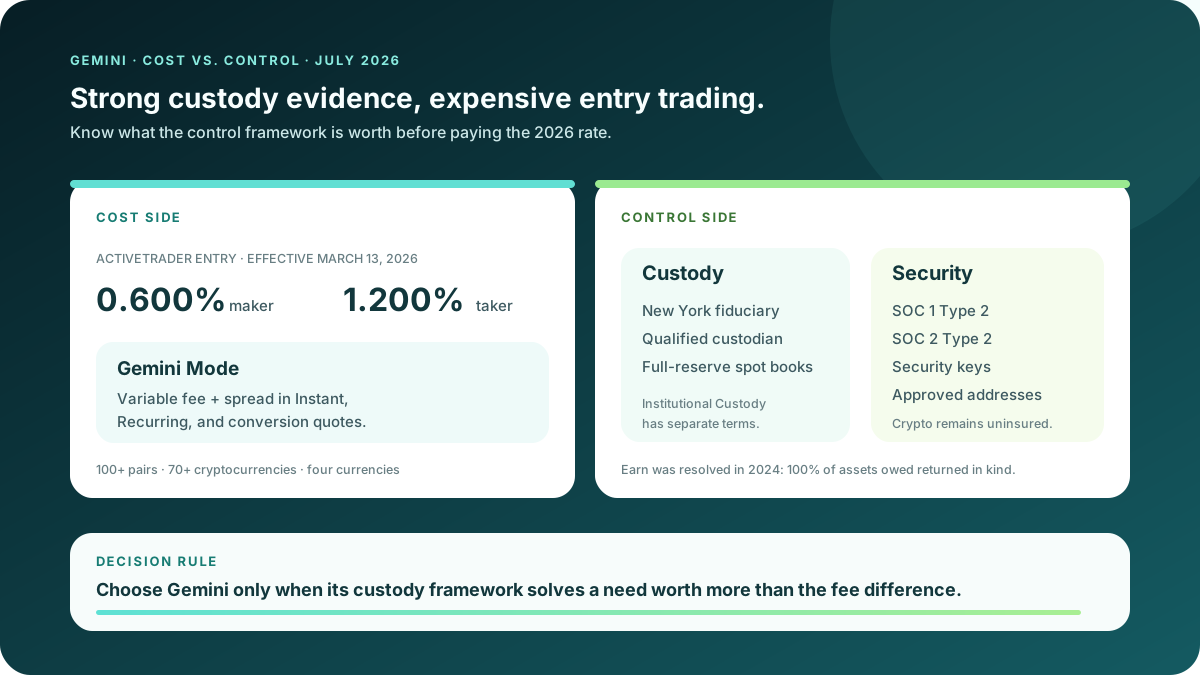
The 2026 fee schedule materially changes Gemini's competitive position. The public ActiveTrader table dated July 9, 2026 lists 0.600% maker and 1.200% taker at the entry tier. A $10,000 taker order at 1.20% produces a $120 trading fee before spread or slippage. That is substantially more than Kraken's current entry taker rate and dramatically more than Binance.US Advanced pairs.
| Review question | DollarScout finding |
|---|---|
| Best for | Users prioritizing New York custody and control documentation over price |
| ActiveTrader entry rate | 0.600% maker / 1.200% taker |
| Advertised ActiveTrader selection | 100+ pairs across 70+ cryptocurrencies and four currencies |
| Main strength | Fiduciary custody framework and mature security controls |
| Main limitation | Very high 2026 entry-level trading fees |
ActiveTrader fees in 2026
Trading Fees scores 2.8/5. The ActiveTrader schedule uses maker/taker pricing and can qualify tiers using trailing 30-day notional volume or, at selected levels, assets held on platform. The entry tier of $0 or more lists 0.600% maker and 1.200% taker.
The next major public breakpoint shown at $10,000 of qualifying volume or $1 million of eligible assets reduces pricing to 0.400% maker and 0.800% taker. At $25,000 of volume or $5 million of assets, the table lists 0.250% and 0.500%. Rates continue to fall at larger tiers. Specific stablecoin pairs can follow separate maker/taker treatment.
The balance-based alternative illustrates a poor fit for ordinary retail customers: holding $1 million merely to reach a lower tier is not a reasonable fee strategy for most people. A low-volume user should compare the 0.60%/1.20% entry rate directly with competitors before trading.
Maker status does not guarantee a cheaper total result. A resting limit order can miss execution while the market moves. A taker order prioritizes immediacy and can experience slippage. Calculate fee, spread, depth, and price movement together.
Gemini Mode pricing
Gemini Mode—the web and mobile simple experience—uses a different fee schedule. Gemini says the transaction fee is calculated for the specific order and can be influenced by payment method, size, market conditions, jurisdiction, asset, and facilitation costs. The fee appears in the trade review screen.
Instant and Recurring orders include a spread in the quoted price. Crypto-to-crypto conversions also include spread in the exchange rate. Gemini says it may retain excess spread and can test fee or spread variations across users or transaction categories.
That means a review should not paste the ActiveTrader rate next to a Gemini Mode screenshot. Compare a fixed dollar order in both interfaces at nearly the same time. Record units received, transaction fee, implied spread, funding fee, and later withdrawal cost. Recurring automation can be useful, but repetition magnifies any convenience premium.
Funding and transfer fees
Gemini's January 20, 2026 transfer table lists ACH deposits and withdrawals as free from Gemini. Wire deposits are free from Gemini, while a same-day USD wire withdrawal is $25. Debit-card purchases carry 3.49% of the purchase amount and PayPal deposits carry 2.50%, before the trade economics.
Crypto deposits are free from Gemini, while external crypto withdrawals use a dynamic network fee shown before initiation. Gemini says the dynamic fee is intended to correspond to network cost and is not retained as revenue. Network fees can change immediately.
Moving assets between Gemini Exchange and the separate Gemini Custody product has asymmetrical pricing: Exchange to Custody is listed as free, while Custody to Exchange is $125 per withdrawal. Institutional clients should include that operational cost and the custody minimums in workflow design.
Asset and pair selection
Asset Selection scores 3.9/5. ActiveTrader advertises more than 100 pairs across 70+ cryptocurrencies and four currencies. That covers major U.S. retail assets and several smaller tokens, but it is narrower than Coinbase, Kraken, Binance.US, or Crypto.com's advertised breadth.
Selection quality is more important than the raw count. Gemini publishes a marketplace page with active order books and rules. The platform follows price-time priority for limit orders and states that the marketplace is full reserve: orders must be fully funded rather than relying on uncovered positions within the spot book.
Asset availability can differ by jurisdiction, product, and transfer network. An asset may trade in Gemini Mode but not in every ActiveTrader pair, or a network may be unavailable for withdrawals. Confirm contract, network, memo, minimum, and status before depositing. A test transfer is appropriate when an error would be costly.
Security and custody
Security scores 4.6/5. Gemini Trust Company is a New York trust company and describes itself as a fiduciary and qualified custodian under New York banking law. It publishes SOC 1 Type 2 and SOC 2 Type 2 reporting claims, security controls, hardware-key support, approved-address restrictions, and institutional cold-storage processes.
The fiduciary and audit framework is meaningful evidence about control design and custody obligations. It is not a guarantee against business failure, cyberattack, court proceedings, or individual account compromise. Audit reports have scope and time periods; users should obtain current reports when relying on them for institutional due diligence.
Retail users should enable a passkey or hardware security key where supported, use a unique password, protect email, review devices, and configure approved addresses. Gemini's default security may include withdrawal holds after certain account changes. Do not bypass a hold through an unknown “support” contact.
Cash and crypto insurance
Gemini says eligible U.S. dollars can qualify for pass-through FDIC insurance when held through its bank arrangements and when ownership and recordkeeping conditions are satisfied. The coverage aggregates with the customer's other deposits at the same bank and concerns a bank failure.
Crypto is not FDIC-insured and is not protected by SIPC. Gemini describes commercial crime insurance for certain losses of digital assets held in its online hot wallet, subject to limits and exclusions. It does not insure the customer's crypto market value and can exclude account takeover caused by compromised credentials or other user-level events.
Institutional cold-storage custody follows separate terms and pricing. The product page describes a minimum of $30 per month per asset, among other charges or negotiated arrangements. A retail exchange account should not be described as identical to an institutional custody contract.
The Earn history, accurately stated
Gemini Earn was a lending program in which customer assets were transferred to third-party borrower Genesis under program agreements. Withdrawals were paused in November 2022 after Genesis halted redemptions, and Genesis later entered bankruptcy. That event demonstrated that a familiar exchange interface can expose users to a separate counterparty.
The outcome is important and should be current. In May and June 2024, Gemini announced final distributions that returned 100% of the digital assets owed to Earn users in kind, plus certain appreciation because repayment was in the original assets rather than a frozen dollar value. It is inaccurate in 2026 to describe the Earn loss as unresolved.
The lesson remains. Read who receives title or control, whether assets are lent, what collateral exists, and which entity owes repayment. A strong custodian can distribute a separate product whose risk depends on another company. Product-level terms matter more than the parent brand.
Ease of use
Ease of Use scores 4.2/5. Gemini Mode is clean and approachable, while ActiveTrader provides order books, charting, multiple order types, and APIs without requiring a separate institution. Funding and withdrawal documentation is concise.
The deduction reflects pricing complexity and the gap between retail simplicity and institutional branding. A new user can assume a simple order inherits ActiveTrader pricing or that “Gemini custody” means every product has the same insurance and cold-storage agreement. The interface should be paired with careful reading of the exact product schedule.
Customer service
Customer Service scores 3.7/5. Gemini provides a help center, support request process, status information, and detailed trust, marketplace, fee, and insurance documentation. We did not open or time a support case, so this is not a response-time score.
Custodial cases can require identity checks and investigation. Preserve order IDs, transaction hashes, bank references, screenshots, and support numbers. Gemini warns about impersonation; no legitimate agent needs a seed phrase, remote device access, or a transfer to a new “safe” wallet.
Gemini versus alternatives
Choose Coinbase when ease, asset selection, and a path from simple to Advanced trading matter more than a New York trust-company emphasis. Choose Kraken when stronger public entry pricing, a broader asset list, proof-of-reserves verification, and Pro controls are the priorities.
Binance.US publishes much lower spot rates but has substantial state restrictions. Crypto.com advertises far more assets and a larger lifestyle ecosystem, but pricing and protection are fragmented across products. Gemini's best case is a user willing to pay more for its particular control, custody, and regulatory profile.
Who Gemini is best for
Gemini fits a user who:
- Values the New York trust-company and fiduciary custody framework.
- Uses security keys and approved withdrawal addresses.
- Trades infrequently enough that the higher fee is acceptable or qualifies for a lower tier.
- Needs a supported major asset rather than the broadest long-tail catalog.
- Separates retail exchange custody from institutional Custody and former Earn lending risk.
It is weak for a cost-sensitive beginner using market orders, a frequent low-volume trader, or a user seeking the widest asset list.
Bottom line
Gemini earns 3.9/5. Its security controls, custody framework, audits, full-reserve marketplace, and documentation are serious strengths. The former Earn issue is resolved in assets, though it remains relevant to product-level counterparty analysis.
The decisive weakness is current price. A 1.20% entry taker rate can consume a meaningful portion of every trade, and Gemini Mode adds variable fee and spread economics. Choose Gemini because its custody and controls solve a specific need—not because an old review describes it as competitively priced.