
Ally Bank at a glance
Ally is an online bank built around deposit accounts rather than a branch network. Its current lineup includes a Spending Account, Savings Account, Money Market Account, certificates of deposit, IRA deposit products, mortgages, auto financing, and investing services. For everyday banking, the central pairing is Spending plus Savings: money can move internally, Spending provides debit-card and payment access, and Savings provides buckets and automation.
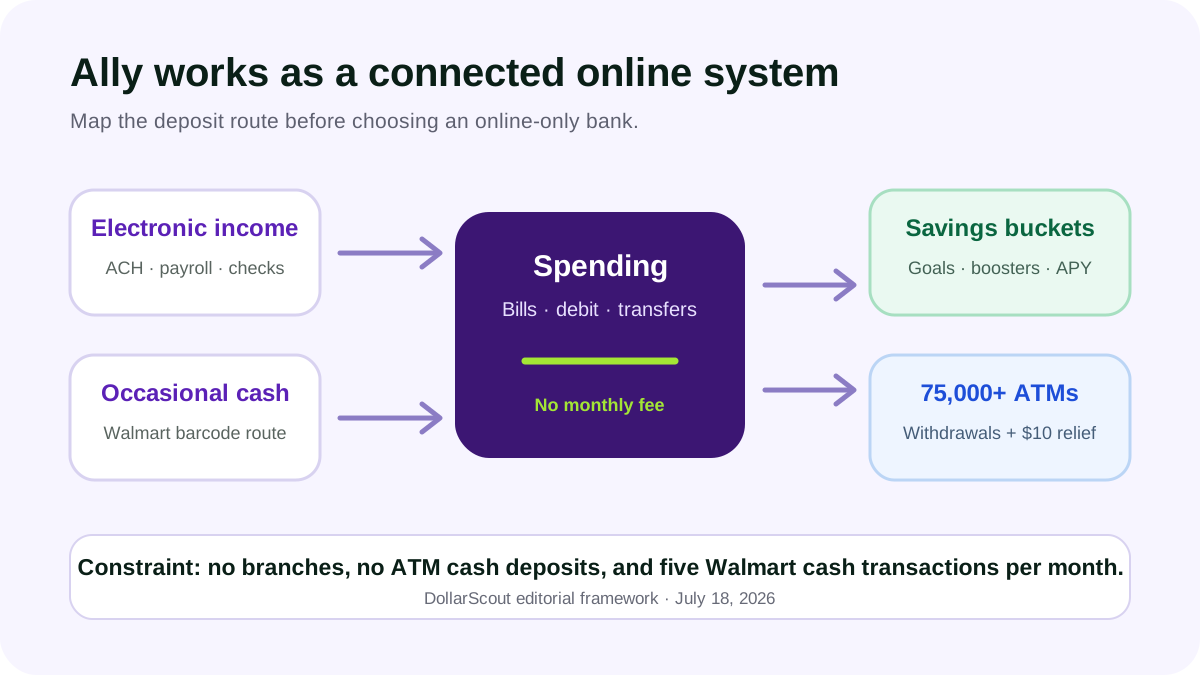
The headline terms are unusually clean. Ally Savings lists no monthly maintenance fee, no minimum opening deposit, and no minimum balance to earn the published variable APY. Spending uses the Allpoint and MoneyPass networks and Ally says more than 75,000 fee-free ATMs are available in the United States. Domestic fees charged by other ATMs can be reimbursed up to $10 per statement cycle.
| Review question | DollarScout finding |
|---|---|
| Best for | Online-first households that want savings organization and broad ATM access |
| Monthly maintenance fee | $0 on the core Spending and Savings accounts |
| Savings requirement | No minimum to open or earn the live APY |
| Cash deposits | Free at Walmart for Spending through an app-generated barcode; not at ATMs |
| Main limitation | No branches for in-person service or complex cash needs |
:::note Ally publishes its current APY dynamically and can change it after an account is opened. DollarScout links the live rate rather than freezing a number that may become stale. Confirm the APY immediately before moving money. :::
Savings rate and buckets
APY scores 4.5/5. Ally describes the Savings Account rate as competitive and variable and currently makes the same APY available across its three disclosed balance tiers: below $5,000, $5,000–$24,999.99, and $25,000 or more. The account compounds interest daily. No minimum balance is required to open the account or earn the published APY.
The rate is only one part of the product. Savings buckets divide one account into labeled goals without creating separate account numbers. A customer can reserve money for taxes, travel, repairs, or an emergency fund while the full balance remains in one deposit account. Boosters and recurring transfers can automate contributions. Buckets are planning labels; they do not create separate FDIC coverage or legally restrict the money.
A rate can be competitive without being the highest available. Smaller banks and credit unions periodically lead the market, and promotional accounts may pay more for a limited period. Ally earns a high score because the rate sits inside a useful no-fee account with automation and broad support, not because DollarScout assumes it will always rank first.
Customers should compare APY in dollars and check transfer timing. The best rate is less helpful if an emergency withdrawal requires an external transfer that arrives after a bill is due. Keeping a working balance in Spending and using Savings for reserves can preserve access without abandoning yield.
Fees and overdraft handling
Fees earns 4.9/5. Ally does not charge monthly maintenance fees on its core deposit accounts, and the Savings Account has no opening minimum. The bank also documents fee-free overdraft tools for eligible Spending accounts: Overdraft Transfer Service can move money in $100 increments from a linked Ally savings or money market account, while CoverDraft may provide up to $100 of temporary coverage for qualifying customers.
“No monthly fee” does not mean every service is free. International ATM transactions can incur up to a 1% international transaction fee, outgoing wires and expedited services are governed by the current agreement, and an ATM operator outside the supported network can impose a surcharge before Ally’s limited domestic reimbursement. Read the fee schedule for uncommon transactions rather than assuming the headline applies everywhere.
CoverDraft is not an invitation to spend beyond the available balance. Eligibility and coverage can change, repayment is required, and transactions may still be declined. Low-balance alerts and an intentional cushion are safer than treating overdraft coverage as part of monthly income.
ATM network and cash deposits
Access & ATM Network earns 4.5/5. Ally’s more than 75,000 Allpoint and MoneyPass ATMs compare well with national banks for withdrawals. Ally does not charge a domestic ATM fee, and it reimburses up to $10 per statement cycle in fees charged by other U.S. ATM owners. The locator should still be checked around home, work, and travel routes; a large total does not guarantee a convenient machine in every town.
Cash access changed materially. Ally’s current help center says customers can add cash to a Spending Account for free at a Walmart Money Center or customer service desk. The customer generates a single-use barcode in the Ally app, presents identification, and hands the cash to the associate. Published limits are $20–$999 per transaction, up to $1,000 per day, and five transactions per month. Cash cannot be added at an ATM, by mail, or directly to Savings, Money Market, or CD accounts.
That option corrects the outdated claim that Ally never accepts cash, but it is not equivalent to a branch. It depends on the app, location services, Walmart department hours, identification, and a retail counter. A household receiving cash every day may find the monthly transaction count too restrictive. Occasional cash users now have a workable path; cash-heavy businesses do not.
Mobile check deposit, mailed checks, ACH transfers, wires, and direct deposit cover the other funding routes. Ally lists mobile check limits of $50,000 per business day and $250,000 per 30 calendar days, with availability delays possible for new customers, large checks, or risk review.
Digital experience
Digital Experience scores 4.6/5. Ally’s account model is coherent: the app and website support balances, transfers, bill pay, Zelle, mobile check deposit, ATM search, debit-card controls, savings buckets, recurring rules, and secure support. The same login can expose other Ally products, although availability and interfaces differ by product.
Online-only design reduces branch-related complexity, but it makes authentication and device access more important. A lost phone, locked profile, ownership change, trust account, or large time-sensitive transfer cannot be solved by walking into a lobby. Customers should maintain current contact information, store the support number separately, and understand the identity documents needed for account recovery.
The score is not a claim that DollarScout completed private app tasks in a temporary account. It reflects the documented workflows, the breadth of online self-service, and the consistency of Savings and Spending tools. The deduction recognizes that some exceptions still move to phone, mail, or manual review.
Support and branch tradeoff
Customer Service receives 4.5/5. Ally advertises customer care associates available by phone 24 hours a day, seven days a week, publishes a broad help center, and supports secure messages inside online banking. Round-the-clock phone availability is a meaningful advantage over online banks that limit live help to business hours.
There is no physical branch. That matters for notarized documents, urgent official checks, complex estates, cash, identity disputes, and customers who communicate better face to face. Ally can mail or arrange some items, but timing differs from leaving a branch with the document in hand. The right service model depends on the exceptions a household actually encounters.
DollarScout did not call with a test case or measure resolution time. The score evaluates documented reach and self-service depth, not a promise about the quality of every interaction. Preserve case numbers and written messages for any material dispute.
FDIC insurance
Ally Bank is an FDIC member. Eligible deposits are generally insured up to $250,000 per depositor, per insured bank, per ownership category. Buckets inside one Savings Account do not multiply coverage. Spending, Savings, Money Market, and CDs owned in the same category at Ally are added together, including accrued interest.
Ally Financial also offers non-deposit products. Securities, vehicle financing, and other products are not Ally Bank deposits merely because they share a brand and login. Confirm the legal entity and protection framework for each account.
Alternatives
Choose Capital One 360 when some branch or Café access, cash-deposit ATMs, and an online savings account are more useful than Ally’s savings tools. Choose SoFi when a direct-deposit workflow, integrated investing and lending, and a qualifying tiered APY fit the household. Choose Chase when true branch depth and complex in-person service outweigh monthly fee planning and lower savings yield.
Ally is particularly compelling as the high-yield half of a two-bank setup. A local checking account can handle branches and cash while Ally organizes reserves. The cost is transfer delay and an additional login; the benefit is separating rare physical needs from recurring savings.
Who should use Ally
Ally is a strong fit for customers who:
- Are comfortable completing routine banking online or by phone.
- Want savings buckets and recurring automation inside one account.
- Value no monthly maintenance fee and no minimum balance.
- Have convenient Allpoint, MoneyPass, or Walmart locations nearby.
- Prefer 24/7 phone availability over branch service.
It is easier to skip when:
- Cash deposits occur more than five times per month or routinely exceed the limits.
- A nearby branch is essential for documents, identity issues, or financial guidance.
- The current Ally APY materially trails another insured account that meets the same needs.
- International ATM use is frequent enough that foreign fees dominate.
Bottom line
Ally earns 4.6/5. It combines clean fees, competitive savings, thoughtful automation, a very large fee-free ATM network, limited reimbursement outside that network, a new Walmart cash route, and 24/7 phone support. The product is no longer accurately described as having no cash-deposit option at all.
The limits remain clear: no branches, no ATM cash deposits, a five-transaction monthly cash cap, and a variable rate that may not always lead. For an online-first household that uses electronic deposits and wants one place to organize savings, Ally is one of the most complete choices.