Many products on this page are from partners who compensate us. This doesn't influence our ratings. Our opinions are our own.
Balance Transfer Cards Explained
By Sophie Brown, Senior Finance Editor · Updated Jul 2026 · Fact-checked Jul 18, 2026
A balance transfer moves eligible credit-card debt to another account, usually in exchange for an upfront fee and a temporary promotional APR. It can reduce interest only when the approved limit, fee, timing, payment allocation, and payoff schedule work together. This guide shows how to model the transfer before applying and how to operate it without creating a second debt problem.
Key takeaways
- A balance transfer moves debt; it does not forgive it, guarantee approval, or necessarily transfer the full requested amount.
- Calculate the transfer fee, approved amount, promotional end date, monthly payoff target, and post-promotion APR before acting.
- Keep paying the old card until the transfer has posted and the issuer confirms the remaining balance.
- Avoid new purchases on the transfer card unless the agreement clearly preserves a purchase grace period and the budget supports them.
- Schedule payoff before the promotion expires and compare the plan with a lower-rate loan, hardship program, or accelerated payments on the existing card.
What a balance transfer actually does
A balance transfer uses credit on one account to pay debt on another. The receiving issuer may offer a low or 0% promotional annual percentage rate for a stated period. The CFPB notes that transfers sometimes carry a percentage or fixed fee and that the promotional rate lasts only for a limited time. After it ends, the account's regular transfer APR can apply to any remaining promotional balance.
The transfer is not debt consolidation by itself. You still owe the principal, plus any fee, and the old card may remain open with available credit. A good plan creates one controlled payoff path. A poor plan creates new room to borrow while the original debt merely changes addresses.
Read the offer as a set of separate terms
Do not summarize an offer as “0% for 18 months.” Capture every field from the application disclosure and cardholder agreement:
| Term | Question to answer |
|---|---|
| Promotional transfer APR | Is it truly 0%, or a low rate? |
| Promotional duration | When does it begin and on what exact date does it end? |
| Transfer deadline | Must the transfer be requested within a set number of days after opening? |
| Transfer fee | What percentage or minimum fee applies? Does it change after an initial window? |
| Regular transfer APR | What rate applies after the promotion? Is it variable? |
| Credit limit | How much is available after the fee and any other transactions? |
| Eligible debt | Are transfers from affiliated issuers, loans, or other debt excluded? |
| Purchase APR and grace period | How are new purchases treated while a transfer balance exists? |
| Minimum payment | How is it calculated and how are payments allocated? |
| Late-payment consequences | Could the promotional terms or other pricing change? |
The CFPB's credit-card agreement database contains general terms and pricing submitted by issuers, but your account-specific disclosure controls. Request the current agreement from the issuer when any term is unclear.
Calculate whether the transfer saves money
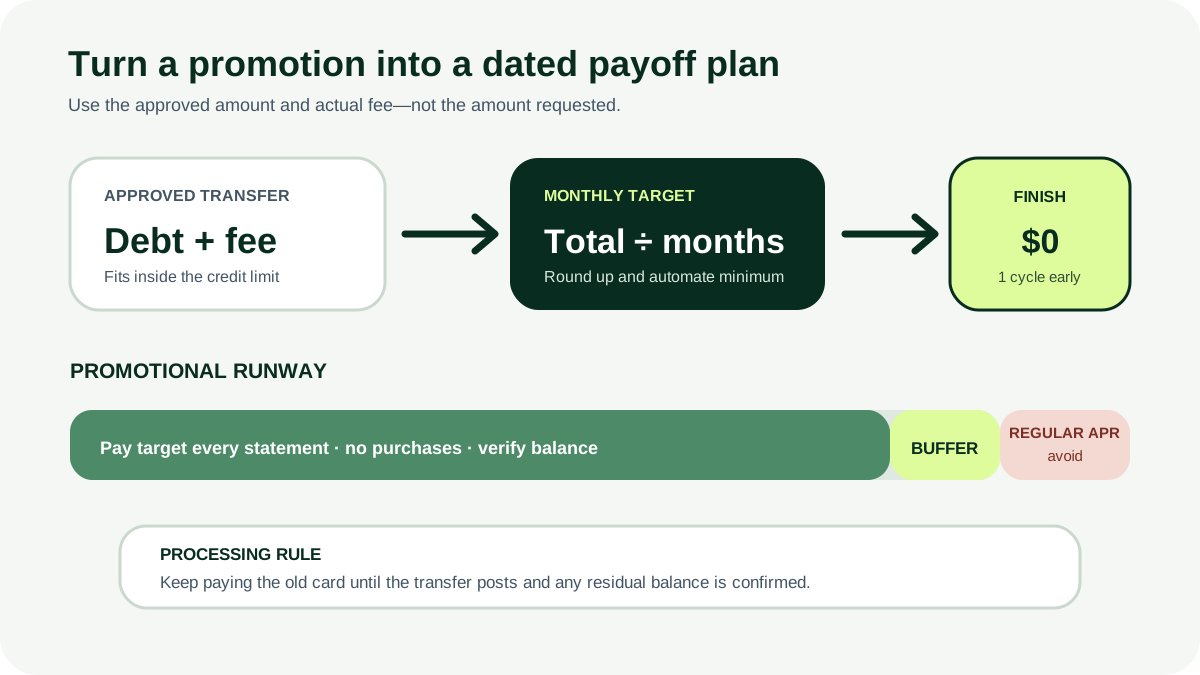
Start with the amount likely to be approved, not the desired amount. The new credit limit can be lower than requested, and the fee may consume part of it.
For a hypothetical $6,000 transfer with a 4% fee:
- transfer fee = $6,000 × 0.04 = $240;
- starting promotional balance = $6,240;
- if the promotion has 15 usable payment months, an even target is $416 per month;
- with a one-month safety buffer, divide by 14 instead: about $446 per month.
This example is arithmetic, not a current offer. Use the actual disclosure and round the payment up. If the resulting monthly target is not affordable, a transfer may delay interest without solving cash flow.
Compare the transfer with the status quo. Estimate interest on the existing card using its balance, APR, payment schedule, and the issuer's calculation method. Credit-card interest commonly uses a daily periodic rate and average daily balance, so a simplistic annual estimate may not match the statement. Also compare personal-loan origination cost and rate, a nonprofit credit counselor's debt-management proposal, an issuer hardship program, and directing the same monthly amount to the current card without opening new credit.
Build the payoff calendar before applying
List the expected opening date, transfer-request deadline, expected posting window, first due date, promotional end date, and the date your final promotional payment must arrive. “18 months” may not mean 18 full billing cycles available after the transfer posts.
Create three payment numbers:
- Required minimum: the issuer's minimum due. Paying only this is unlikely to finish the plan.
- Scheduled target: transferred principal plus fee divided by usable months, rounded up.
- Recovery target: the higher amount needed after a missed or reduced month.
Automate at least the minimum to protect the due date, then schedule or manually pay the target. Keep a cash buffer in the bank so automation does not cause an overdraft. Review each statement because the due date, balance, or terms may differ from the model.
Protect the transfer while it is processing
Submitting a transfer request does not instantly pay the old issuer. Processing can take time, a request can be reduced or rejected, and trailing interest or new charges can remain. Continue making at least the required payment to the old card until the transfer is posted there and you verify the remaining balance from a fresh statement or account view.
After posting:
- save confirmation of the amount, fee, and date;
- reconcile the debit on the new card with the credit on the old card;
- pay any residual balance or interest on the old account;
- redirect recurring charges that would otherwise rebuild the old balance;
- confirm the promotional end date in the new account.
Never pay a fee to a person who claims they can “erase” the balance through a transfer. Use the issuer's authenticated application and account channels.
Keep purchases away from the payoff plan
A 0% balance-transfer APR does not necessarily mean a 0% purchase APR. It also does not guarantee a grace period on purchases. The CFPB explains that issuers generally are not required to offer a grace period and that, when one exists, carrying a balance can cause interest on new purchases from the transaction date.
The safest operating rule is to make no new purchases on the transfer card. Use the card as a closed payoff lane. If an offer includes both a purchase and transfer promotion, still model each balance and expiration date separately. Promotional periods may end on different dates.
Do not use a cash advance. Cash-advance APRs and fees are commonly separate, and interest may begin immediately. A payment strategy designed around a 0% transfer can be undermined by one unrelated transaction type.
Understand how payments are allocated
Federal Regulation Z generally requires amounts paid above the minimum to be allocated first to the balance with the highest APR. The issuer has more discretion over the minimum-payment portion. There are special rules near the expiration of deferred-interest offers.
This matters when one card holds a promotional transfer, regular-rate purchases, and a cash advance. Your intuitive instruction—“apply everything to the transfer”—may not match the legal allocation order. The cleaner solution is not to mix transaction types.
Also distinguish a genuine 0% APR promotion from deferred interest. With a 0% APR, interest does not accrue at the promotional rate during the period; after expiration, the regular APR generally applies prospectively to the remaining balance. A deferred-interest offer can impose previously deferred interest if the qualifying balance is not fully paid by its deadline. Read the exact language and do not treat the two structures as interchangeable.
Prepare for an approved limit below the requested amount
Suppose you request $10,000 but receive a limit that supports only a $6,000 transfer after fees. Decide in advance which balance or portion to transfer. Compare APRs, minimums, and remaining promotional eligibility. A partial transfer creates two payment obligations, so budget both due dates.
Avoid applying repeatedly after a small approval. Additional applications can add inquiries and new accounts without creating enough capacity. Rework the payoff plan using the actual result and stop if another application would not materially improve it.
Decide what to do with the old card
Do not close the old card automatically and do not automatically keep it forever. Closing can reduce total available credit and increase utilization; keeping it can tempt new spending, retain an annual fee, or expose an unused account to fraud.
Review:
- annual fee and product-change options;
- age of account and total available credit;
- whether recurring bills remain;
- the ability to lock the card or reduce access;
- the behavioral risk of seeing an open limit.
If the card remains open, remove it from wallets and stored checkouts, turn on alerts, and monitor statements. If you close it, obtain confirmation and continue monitoring for residual interest, refunds, or recurring charges.
Use checkpoints, not hope
At every statement, record opening balance, target payment, actual payment, closing balance, and months remaining. At the halfway point, compare the actual balance with the planned balance. If behind, calculate the recovery target immediately.
When income falls, contact issuers before missing payments. A hardship plan, due-date adjustment, or nonprofit credit counseling may be more useful than trying to preserve a promotion at all costs. Do not divert rent, food, utilities, insurance, or required tax payments merely to hit an aggressive transfer target.
Three months before expiration, verify the exact deadline and remaining balance. Aim to reach zero one statement early. That buffer absorbs processing delays, calculation differences, or an unexpected lower-payment month.
A go/no-go test
Proceed only when all are true:
- the estimated interest saved exceeds the fee and other costs;
- the transfer is eligible and the likely limit is useful;
- the required monthly target fits the budget with a buffer;
- there is a plan to stop new card debt;
- the promotion, regular APR, deadline, grace period, and payment allocation are understood;
- existing payments will continue until the transfer is confirmed.
If any condition fails, improve the cash-flow plan or compare alternatives before applying.
Bottom line
A balance transfer is a financing tool, not a reset button. The useful version exchanges a known fee for a measurable reduction in interest and a dated payoff plan. Read the full agreement, model the approved amount, isolate the card from purchases, keep the old account current during processing, and finish early. The plan succeeds when the balance reaches zero—not when the application is approved.
Related content
Frequently asked questions
Sources
Related content
More from DollarScout on this topic.
