
Capital One 360 at a glance
Capital One 360 occupies the middle ground between an online bank and a national branch bank. The core deposit pair—360 Checking and 360 Performance Savings—uses online-bank economics, while Capital One also operates bank branches and Cafés in selected markets. Checking customers can withdraw at more than 70,000 fee-free Capital One, MoneyPass, and Allpoint ATMs, and eligible locations accept cash deposits.
The flagship accounts list no monthly maintenance fee and no minimum balance. 360 Performance Savings pays one variable APY across the full balance, compounds interest monthly, and does not require direct deposit. The rate is competitive, but Capital One’s page loads the exact number dynamically; DollarScout links the live disclosure instead of hard-coding a figure that can change.
| Review question | DollarScout finding |
|---|---|
| Best for | Customers who want online-bank fees with selected physical access |
| Monthly fee | $0 on 360 Checking and 360 Performance Savings |
| Savings requirement | No minimum; one variable APY across all balances |
| ATM network | 70,000+ fee-free Capital One, MoneyPass, and Allpoint ATMs |
| Main limitation | Branch and Café service is not nationally distributed |
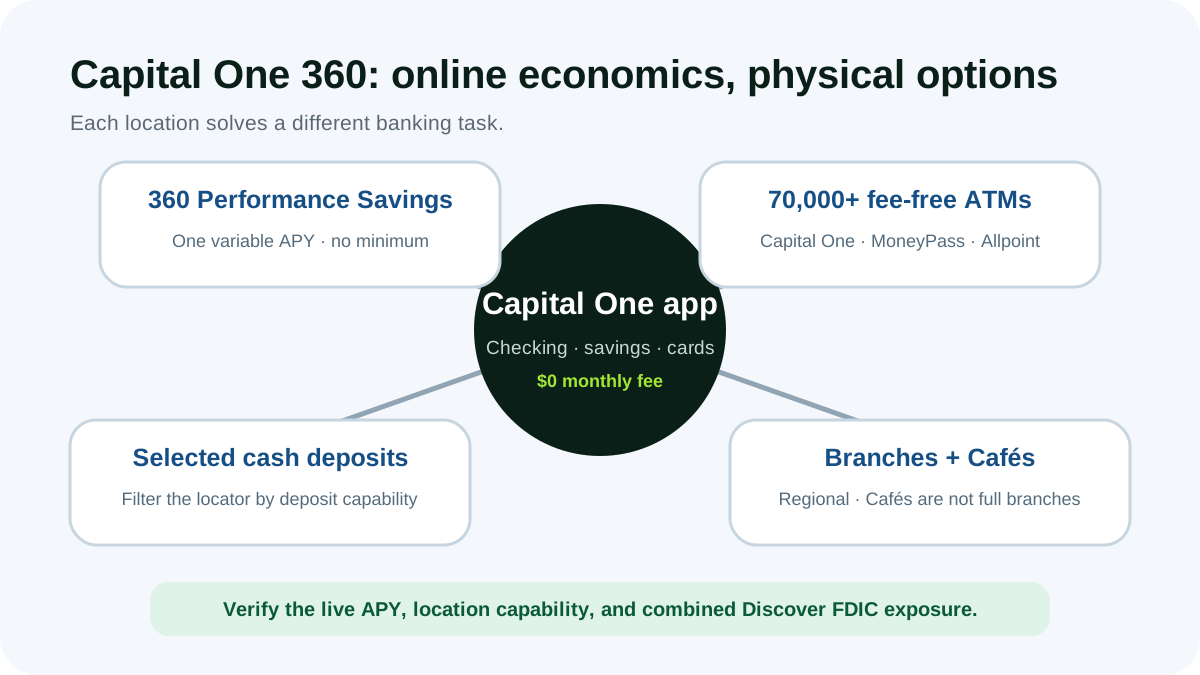
:::note Capital One Cafés are not full bank branches. They include ATMs and Ambassadors who can help with some banking questions, but customers should use the location finder and service details before assuming a Café can complete a specific transaction. :::
360 Performance Savings
APY earns 4.3/5. Capital One describes 360 Performance Savings as a high-yield account and applies the same variable APY to every balance. There is no minimum opening deposit, minimum ongoing balance, monthly cycle service charge, or recurring activity test. That simplicity is valuable: a customer does not lose the stated rate because payroll changes or a monthly deposit threshold is missed.
The score stops below the leaders because “competitive” does not mean “highest.” Savings rates change across the market, and Capital One may lag a smaller online bank or temporary promotion. Compare the live APY on the day money moves and calculate the dollar gap. A 0.50-percentage-point difference on $30,000 is roughly $150 in first-year simple interest before tax.
Capital One compounds and credits interest monthly. AutoSave and recurring transfers can move money into the account, while goal and spending tools help organize the plan. Unlike Ally’s named buckets, Capital One’s core proposition is straightforward rate and access rather than a dense savings-goal system.
The current disclosure mentions a six-transfer-per-cycle limitation but says Capital One is not enforcing it and will notify customers if that changes. ATM and teller transactions use separate rules. Customers who move savings frequently should read the live disclosure instead of assuming a pandemic-era suspension is permanent.
360 Checking fees and overdraft choices
Fees scores 4.8/5. 360 Checking has no monthly cycle service charge and no minimum opening deposit. Capital One’s May 2026 disclosure describes three overdraft settings: Auto-Decline, Free Savings Transfer, and No-Fee Overdraft. The bank does not charge an overdraft fee under those options, although it can decline transactions or require a negative balance to be repaid.
The customer should choose the setting intentionally. Auto-Decline reduces the risk of spending unavailable money but cannot prevent every negative balance, such as an offline or delayed transaction. Free Savings Transfer can move funds from an eligible linked account, which may weaken a savings plan if used repeatedly. No-Fee Overdraft is subject to eligibility and bank discretion.
Less common services still have costs and limits. Cashier’s checks, outgoing wires, international transactions, and non-network services follow the current disclosure. “No fee” on the product page means no monthly maintenance fee; it is not a universal promise that every banking service costs zero.
ATMs, cash deposits, branches, and Cafés
Access & ATM Network scores 4.8/5. Capital One says checking customers can use more than 70,000 Capital One, MoneyPass, and Allpoint ATMs without a Capital One fee. Its August 2025 network disclosure counted 1,260 Capital One ATMs, 35,000 MoneyPass ATMs, and 40,000 Allpoint ATMs. Networks and individual machines can change, so the locator is more reliable than a saved list.
Eligible 360 Checking customers can deposit cash at Capital One ATMs and selected Allpoint ATMs. Availability depends on location and account type. The help page says eligible ATM cash deposits have no hold and become available and begin accruing interest the same business day. Customers should filter specifically for a cash-deposit machine; most fee-free withdrawal ATMs do not automatically accept deposits.
Branches add full-service capacity in selected regions. Cafés combine self-service banking with Ambassadors but do not perform every branch task. This physical footprint is far smaller and less evenly distributed than Chase’s. Capital One is a hybrid only where a useful location exists. Elsewhere, it behaves primarily as an online bank with an excellent ATM network.
Digital experience
Digital Experience receives 4.7/5. Capital One’s app combines deposits, cards, payments, transfers, mobile check deposit, debit controls, alerts, credit monitoring, and location search. The bank cites strong current App Store and Google Play ratings, but DollarScout treats provider-reported store scores as context rather than a substitute for task testing.
Customers with Capital One credit cards benefit from one login and a consistent security model. The breadth is more focused than SoFi’s full financial marketplace but broader than a savings-only app. Common jobs—checking a deposit, transferring to savings, locking a card, finding a cash-capable ATM—fit a coherent journey.
The score is based on public documentation, not a newly opened DollarScout account. Account approval, deposit limits, fraud review, and feature eligibility vary by customer. A smooth demo cannot prove how the app handles an unusual identity or dispute case.
Security controls also belong in the usability assessment. Customers can configure alerts, lock an eligible card, review transactions, and use Capital One’s account-recovery process, but they remain responsible for protecting credentials and checking payee details before sending money. Zelle and other instant-payment tools should be treated like cash: a polished confirmation screen cannot recover an authorized payment merely because the recipient was a scammer. Keep a separate support number, enable transaction notifications, and review linked external accounts periodically.
Customer support
Customer Service scores 4.3/5. Capital One publishes phone help for bank customers seven days a week, generally 8 a.m. to 11 p.m. Eastern Time, plus online help, secure account service, branches in selected regions, and Café assistance for appropriate questions. Multiple channels are better than an app-only model.
The score is lower than Ally’s because the bank does not advertise 24/7 general deposit support and physical coverage is regional. DollarScout did not place and time a case, so the rating reflects documented availability and escalation paths. For a material dispute, keep the case number, copies of messages, and the relevant account disclosure.
Discover integration and FDIC insurance
Discover Bank merged into Capital One, N.A. on May 18, 2025. The temporary six-month period during which some pre-merger deposits could remain separately insured has elapsed for ordinary non-CD deposits. Current Capital One and Discover deposit balances held in the same ownership category generally count together at Capital One, N.A. for FDIC coverage. Certain CDs can have transition rules tied to maturity.
This matters to customers who use both brands. A $250,000 individual savings balance at Capital One and another $250,000 individual balance in a Discover-branded deposit account do not ordinarily create $500,000 of current coverage at two banks. Use the FDIC estimator and include accrued interest. Capital One credit cards and securities are not deposits.
Alternatives
Choose Ally Bank for savings buckets, 24/7 phone support, 75,000+ fee-free ATMs, and free but limited Walmart cash deposits. Choose SoFi for interest-bearing checking and a higher qualified savings rate when recurring direct deposit is reliable. Choose Chase for far more branches and complex in-person service, accepting monthly fee planning and lower standard savings yield.
Customers who already have Discover-branded deposits should evaluate that legacy account separately. New visitors to Discover’s banking page are now directed toward Capital One products, so opening a new Capital One 360 account can consolidate FDIC exposure rather than diversify it.
Who should choose Capital One 360
Capital One 360 fits customers who:
- Want no monthly fees without a direct-deposit or balance test.
- Have a useful Capital One branch, Café, or cash-deposit ATM nearby.
- Value a broad fee-free ATM network and a polished combined app.
- Want one savings APY across the full balance.
- Already use Capital One credit cards and prefer one login.
It is easier to skip when:
- The closest physical location cannot perform the needed transactions.
- The live savings APY materially trails a comparable insured account.
- 24/7 general phone support is essential.
- Existing Discover and Capital One balances approach FDIC limits.
Bottom line
Capital One 360 earns 4.6/5. It pairs excellent fee economics and a clear savings structure with ATM reach, cash-deposit options, a mature app, and some in-person access. Few competitors balance those elements as well.
The qualification is geographic. A Café is not a full branch, cash deposits work only at eligible machines, and physical coverage is regional. Verify the live APY, map the services you will actually use, and combine Discover-branded deposits when checking FDIC coverage. If those details fit, Capital One 360 is the most versatile hybrid option in this set.