Many products on this page are from partners who compensate us. This doesn't influence our ratings. Our opinions are our own.
Trading · Rankings
Best Platforms for Day Trading in 2026
By Sophie Brown, Senior Finance Editor
Updated Jul 19, 2026
Fact-checked Jul 19, 2026
12 min read
Lightspeed ranks first among the five attached platforms for equity and options day trading because its order-entry speed, configurable hotkeys, route control, locate workflow, and trader-focused support are designed around repeated intraday decisions. Interactive Brokers ranks second for lower-cost global multi-asset access, advanced order types, APIs, and portfolio risk. TradeStation is third for charting, scanners, backtesting, and automation. NinjaTrader is fourth and would rank first for a futures-only day trader. tastytrade is fifth because its options workflow is strong but its routing, paper-trading, and high-frequency equities controls are narrower.
The ranking is deliberately about operational fit, not advertised profitability. DollarScout reviewed current official platform, commission, market-data, margin, simulation, disclosure, and regulatory sources on July 19, 2026. We did not fund accounts, compare fills through a synchronized colocated test, request stock locates, trade a volatile open, trigger a liquidation, or test support during an outage. Day trading can create rapid losses, and a platform can only enforce a process—it cannot manufacture an edge.
Volume schedules advertise stocks from $0.001 per share or $2 per trade and options from $0.20 per contract; minimums, routing, regulatory, platform, and data fees can apply
IBKR Lite offers eligible U.S. residents $0 U.S. exchange-listed stocks and ETFs; IBKR Pro stock pricing is fixed or tiered, and other products use separate global schedules
Eligible U.S. exchange-listed stock and ETF orders can start at $0; options, futures, sub-dollar, OTC, routed, data, and service charges follow separate tiered schedules
Free: $0/month and $0.39 Micro/$1.29 Standard per side; Monthly: $99 and $0.29/$0.99; Lifetime: $1,499 once and $0.09/$0.59, before exchange, clearing, and NFA fees
$0 stocks and ETFs; listed stock and ETF options $1 per contract to open with a $10 per-leg cap and $0 to close; futures and futures options use per-contract opening and closing charges
Platform Access
Lightspeed Trader Pro, browser and mobile access, plus higher-minimum specialist platforms; Lightspeed Trader Pro lists a $130 monthly software charge reduced by eligible commissions
IBKR Desktop, Trader Workstation, Client Portal, IBKR Mobile, GlobalTrader, specialty apps, and TWS, Client Portal, Excel, and FIX APIs
TITAN X, TradeStation Desktop, web/HUB, iOS and Android apps, TradingView connectivity, and multi-asset developer APIs
NinjaTrader Desktop, Web, and iOS/Android Mobile with simulation, charts, order entry, SuperDOM, and futures-focused analysis; desktop provides the deepest automation and customization
Native desktop, browser, and iOS/Android platforms plus an API, with options analysis, charting, ladder trading, backtesting, and integrated education
Market Focus
Direct-access U.S. stocks and options for experienced high-volume traders; selected specialist platforms also support futures and professional workflows under separate terms
Stocks, ETFs, options, futures, currencies, bonds, funds, metals, event contracts, and other products across more than 170 global markets
Active U.S. stock, ETF, option, futures, and futures-options trading with charting, scanning, backtesting, and automation
More than 100 futures contracts across CME Group, Eurex, ICE, and Coinbase Derivatives, with contract-specific permissions, margins, fees, and availability
Options, stocks, ETFs, futures, futures options, cryptocurrency, forex, fixed-income access, and prediction markets under product-specific rules
Standout feature
Configurable hotkeys, order types, routes, and direct-access workflow
Global multi-asset trading, APIs, and professional order types
Deep charts, scanners, EasyLanguage, APIs, and historical testing
Futures-specific charts, execution, automation, and custom studies
Excellent multi-leg options construction and visual risk workflow
Detailed reviews
In-depth look at every product on our list.
Best Overall · Editor's Choice
1
Ranked #1
Lightspeed
★★★★⯨4.4/54.4
DollarScout rating
LIG
Lightspeed
Best direct-access equity and options day trading
Lightspeed ranks first for a high-activity U.S. equity or options trader who needs configurable hotkeys, routes, locates, Level II context, extended-hours access, and trader-focused support. Its value depends on volume: platform, data, routing, locate, regulatory, account, and minimum-commission economics can make it a poor and expensive fit for casual users.
Volume schedules advertise stocks from $0.001 per share or $2 per trade and options from $0.20 per contract; minimums, routing, regulatory, platform, and data fees can apply
Platform Access
Lightspeed Trader Pro, browser and mobile access, plus higher-minimum specialist platforms; Lightspeed Trader Pro lists a $130 monthly software charge reduced by eligible commissions
Market Focus
Direct-access U.S. stocks and options for experienced high-volume traders; selected specialist platforms also support futures and professional workflows under separate terms
Standout features
Configurable hotkeys, order types, routes, and direct-access workflow
Multiple locate sources and extended-hours equity controls
Active-trader platform, reporting, and specialist support focus
DollarScout's take
Lightspeed ranks first for a high-activity U.S. equity or options trader who needs configurable hotkeys, routes, locates, Level II context, extended-hours access, and trader-focused support. Its value depends on volume: platform, data, routing, locate, regulatory, account, and minimum-commission economics can make it a poor and expensive fit for casual users.
Pros
✓Configurable hotkeys, order types, routes, and direct-access workflow
✓Multiple locate sources and extended-hours equity controls
✓Active-trader platform, reporting, and specialist support focus
Cons
✗All-in platform, data, route, locate, and activity cost is complex
✗Demo does not reproduce live price/time priority, size, or P&L
Interactive Brokers ranks second for global market access, competitive Pro pricing, advanced order types, scanners, portfolio risk, margin views, APIs, and a configurable PaperTrader account. It can beat Lightspeed for systematic or cross-asset work, but the broader TWS and account configuration adds learning and operational risk to a discretionary direct-access equities workflow.
IBKR Lite offers eligible U.S. residents $0 U.S. exchange-listed stocks and ETFs; IBKR Pro stock pricing is fixed or tiered, and other products use separate global schedules
Platform Access
IBKR Desktop, Trader Workstation, Client Portal, IBKR Mobile, GlobalTrader, specialty apps, and TWS, Client Portal, Excel, and FIX APIs
Market Focus
Stocks, ETFs, options, futures, currencies, bonds, funds, metals, event contracts, and other products across more than 170 global markets
Standout features
Global multi-asset trading, APIs, and professional order types
Competitive per-share, contract, margin, and currency pricing
PaperTrader, portfolio risk, scanners, and consolidated records
DollarScout's take
Interactive Brokers ranks second for global market access, competitive Pro pricing, advanced order types, scanners, portfolio risk, margin views, APIs, and a configurable PaperTrader account. It can beat Lightspeed for systematic or cross-asset work, but the broader TWS and account configuration adds learning and operational risk to a discretionary direct-access equities workflow.
Pros
✓Global multi-asset trading, APIs, and professional order types
✓Competitive per-share, contract, margin, and currency pricing
✓PaperTrader, portfolio risk, scanners, and consolidated records
Cons
✗Steep TWS and account-configuration learning curve
✗Venue, data, borrow, interest, and fixed-versus-tiered costs require modeling
Our pick for best charts, scanners, and automation
3
Ranked #3
TradeStation
★★★★⯨4.4/54.4
DollarScout rating
TRA
TradeStation
Best charts, scanners, and automation
TradeStation ranks third because RadarScreen, Matrix, EasyLanguage, OptionStation Pro, APIs, historical testing, and a multi-asset simulator create a strong hypothesis-to-order workflow. It is less globally broad than Interactive Brokers, and activity tiers, routes, promotions, data, assignment, exercise, and exchange fees must be priced after the strategy is defined.
Eligible U.S. exchange-listed stock and ETF orders can start at $0; options, futures, sub-dollar, OTC, routed, data, and service charges follow separate tiered schedules
Platform Access
TITAN X, TradeStation Desktop, web/HUB, iOS and Android apps, TradingView connectivity, and multi-asset developer APIs
Market Focus
Active U.S. stock, ETF, option, futures, and futures-options trading with charting, scanning, backtesting, and automation
Standout features
Deep charts, scanners, EasyLanguage, APIs, and historical testing
Stocks, options, and futures simulation in the platform ecosystem
Strong bridge from systematic research to monitored execution
DollarScout's take
TradeStation ranks third because RadarScreen, Matrix, EasyLanguage, OptionStation Pro, APIs, historical testing, and a multi-asset simulator create a strong hypothesis-to-order workflow. It is less globally broad than Interactive Brokers, and activity tiers, routes, promotions, data, assignment, exercise, and exchange fees must be priced after the strategy is defined.
Pros
✓Deep charts, scanners, EasyLanguage, APIs, and historical testing
✓Stocks, options, and futures simulation in the platform ecosystem
✓Strong bridge from systematic research to monitored execution
Cons
✗Pricing tiers and promotional rates complicate long-run comparisons
✗Desktop depth can create unnecessary complexity for simple manual trades
NinjaTrader ranks fourth only because this is a cross-product list. Futures day traders get purpose-built charting, DOM and order entry, automation, live-data simulation, a controllable feed, and historical Market Replay. Its published rates are per side and exclude exchange, clearing, NFA, data, and other charges, while intraday margin is never a maximum-loss limit.
Free: $0/month and $0.39 Micro/$1.29 Standard per side; Monthly: $99 and $0.29/$0.99; Lifetime: $1,499 once and $0.09/$0.59, before exchange, clearing, and NFA fees
Platform Access
NinjaTrader Desktop, Web, and iOS/Android Mobile with simulation, charts, order entry, SuperDOM, and futures-focused analysis; desktop provides the deepest automation and customization
Market Focus
More than 100 futures contracts across CME Group, Eurex, ICE, and Coinbase Derivatives, with contract-specific permissions, margins, fees, and availability
Standout features
Futures-specific charts, execution, automation, and custom studies
Live simulation, synthetic data, and accelerated Market Replay
Transparent Free, Monthly, and Lifetime plan comparisons
DollarScout's take
NinjaTrader ranks fourth only because this is a cross-product list. Futures day traders get purpose-built charting, DOM and order entry, automation, live-data simulation, a controllable feed, and historical Market Replay. Its published rates are per side and exclude exchange, clearing, NFA, data, and other charges, while intraday margin is never a maximum-loss limit.
Pros
✓Futures-specific charts, execution, automation, and custom studies
✓Live simulation, synthetic data, and accelerated Market Replay
✓Transparent Free, Monthly, and Lifetime plan comparisons
Cons
✗Futures focus does not serve a broad equity or options portfolio
✗Per-side commissions, data, exchange, clearing, and add-ons accumulate
tastytrade ranks fifth for general day trading but remains strong for deliberate options orders. Multi-leg construction, visual risk, order-chain tracking, education, and the $10 opening commission cap per stock-option leg are useful. Direct routing, international markets, full forward paper trading, and high-frequency equity controls are narrower than the alternatives.
$0 stocks and ETFs; listed stock and ETF options $1 per contract to open with a $10 per-leg cap and $0 to close; futures and futures options use per-contract opening and closing charges
Platform Access
Native desktop, browser, and iOS/Android platforms plus an API, with options analysis, charting, ladder trading, backtesting, and integrated education
Market Focus
Options, stocks, ETFs, futures, futures options, cryptocurrency, forex, fixed-income access, and prediction markets under product-specific rules
Standout features
Excellent multi-leg options construction and visual risk workflow
$1 opening commission capped at $10 per stock-option leg
Integrated education, historical backtesting, and order management
DollarScout's take
tastytrade ranks fifth for general day trading but remains strong for deliberate options orders. Multi-leg construction, visual risk, order-chain tracking, education, and the $10 opening commission cap per stock-option leg are useful. Direct routing, international markets, full forward paper trading, and high-frequency equity controls are narrower than the alternatives.
Pros
✓Excellent multi-leg options construction and visual risk workflow
✓$1 opening commission capped at $10 per stock-option leg
✓Integrated education, historical backtesting, and order management
Cons
✗No equivalent full consumer forward paper-trading account
✗Narrower routing, market, and equity day-trading controls
Prices, methodology, tradeoffs, and the workflow each service actually supports.
How we ranked day-trading platforms
The model weights Order Entry and Execution Control at 30%, Intraday Risk Controls at 20%, Strategy-Specific Total Cost at 20%, Market Data and Scanning at 15%, Shorting and Product Access at 10%, and Reliability, Support, and Records at 5%. We separate equities and options from futures because they use different regulators, margin systems, contract mechanics, and platform strengths.
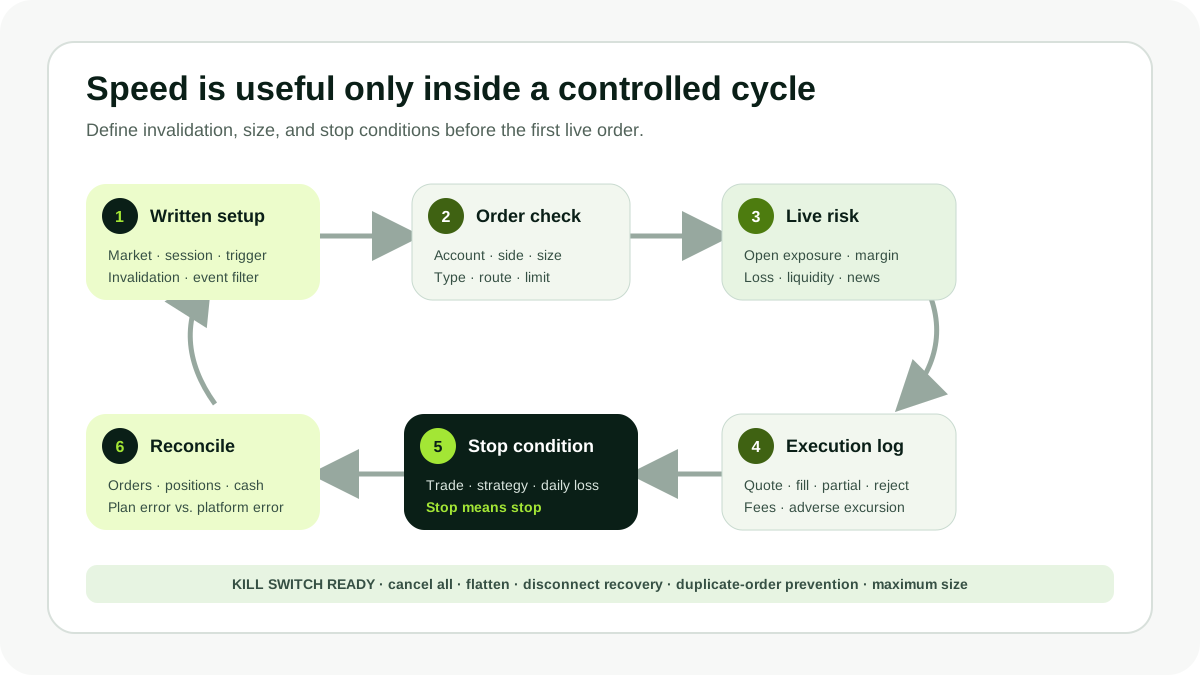
The useful speed is a short, controlled decision cycle. Every order needs a pre-defined invalidation point, position limit, and stop condition before the hotkey is pressed.
1. Lightspeed — best for direct-access equity and options day trading
Lightspeed ranks first because its core workflow is built around the tasks an active equity or options trader repeats: monitor Level II and time-and-sales, configure hotkeys, choose a route or algorithm, manage locates, enter or cancel rapidly, and inspect intraday positions and P&L. Lightspeed Trader Pro also promotes multiple locate sources, extended-hours access, configurable risk views, news, and multi-screen layouts.
The advantage is not a universal latency number. A fill depends on the user's network and location, route, order type, limit price, market, queue position, available size, volatility, and venue. DollarScout did not run a controlled execution study. Lightspeed earns the position because the platform exposes the relevant controls and because its product, support, and reporting are organized around active traders.
Costs require a full model. Current stock schedules publish lower per-share or per-trade rates at high monthly volume, but active-trader rates are not automatically applied; customers must request changes. Routing fees or rebates, regulatory fees, options contract charges, short locates, platform fees, market data, professional status, and account minimums can matter more than the headline. Official disclosures say accounts below $15,000 face a $25 monthly minimum commission charge minus actual commissions. The current main site advertises a $2,500 U.S. minimum for Lightspeed Trader Pro, while other products and account types require more.
The demo is for configuration and platform learning. Lightspeed says it fills orders in full at the last traded price and does not simulate live price/time priority or available size. It may approximate order-entry and market-order response but is not a valid speed, slippage, or P&L test. Stop behavior and marginability also differ from live mode.
Lightspeed is the best attached choice when the strategy generates enough U.S. equity or options activity to justify the fixed and variable costs. It is a poor fit for casual trading, long-term portfolio management, or a user who wants global multi-asset breadth from one account.
2. Interactive Brokers — best for multi-asset cost and control
Interactive Brokers ranks second because Trader Workstation combines global market access, advanced orders, scanners, charting, portfolio risk, margin views, APIs, and a configurable paper account. An intraday strategy that trades multiple countries, currencies, securities, options, or futures can monitor exposure in one account instead of treating each position in isolation.
IBKR Pro's current U.S. stock schedule lists tiered rates from $0.0005 to $0.0035 per share or $0.005 fixed, while U.S. options range from $0.15 to $0.65 per contract. Futures pricing is separate. Lite offers $0 commissions on eligible U.S.-listed stocks and ETFs for eligible U.S. residents but uses a different routing and payment model. Market-data subscriptions, exchange and regulatory charges, interest, borrow fees, and minimums within the fixed or tiered schedule still apply.
The strongest differentiator is order and risk depth. TWS supports many order types and algorithms, conditional logic, baskets, APIs, market scanners, and portfolio analytics. Those tools can reduce manual repetition, but they also create configuration risk. A complex order that a trader does not understand is not a safety feature.
PaperTrader inherits many live account settings and can help verify API messages, order states, and daily statements. IBKR discloses that some order types are unsupported and that simulated orders neither execute nor clear. Fill logic based on market prices and sizes cannot reproduce queue position or market impact. Use it to test instructions and reconciliation, then introduce live size slowly if the strategy and risk budget justify it.
Interactive Brokers ranks behind Lightspeed for a discretionary U.S. direct-access workflow because its breadth and TWS learning curve add friction. It can be the better choice for systematic, international, or cross-asset day trading.
3. TradeStation — best for charting, scanning, and automation
TradeStation ranks third for the trader whose process starts with a scanner, indicator, or coded rule. RadarScreen, Matrix, EasyLanguage, strategy testing, OptionStation Pro, APIs, and historical data support a continuous path from hypothesis to alert, simulation, and order. TITAN X and mobile provide newer interfaces, but the desktop ecosystem remains the reason to choose it.
Simulation covers stocks, options, and futures and can use real-time data for qualifying non-professional users after the account requirements are met. Balance resets and a shared platform help rehearse a complete session. Backtesting and forward simulation answer different questions: historical tests explore a rule under selected past data; paper trading checks live decision and software behavior. Neither includes the emotional, liquidity, market-impact, or fill conditions of real risk.
Current pricing uses activity tiers and distinguishes equities, single-leg and multi-leg options, index options, direct routing, assignment or exercise, futures, and other services. A temporary new-account offer is not the long-run cost. Model the post-promotion tier, exchange pass-throughs, market data, platform access, and the exact mix of routes and products.
TradeStation loses points when the trader wants broad international markets or a simpler manual ticket. It is third because excellent research and automation tools do not by themselves establish execution quality; they must be paired with explicit risk limits and representative cost data.
4. NinjaTrader — best for futures day trading
NinjaTrader ranks fourth only because the page covers day trading generally. For exchange-listed futures, it is the top attached specialist. The platform offers charts, DOM and order-entry tools, automation, custom indicators, web and mobile access, backtesting, live-data simulation, a controllable simulated feed, and Market Replay up to 1,000× speed.
The current U.S. plan structure lists per-side commissions. Free is $0.39 per micro and $1.29 per standard contract; Monthly costs $99 with lower rates; Lifetime costs $1,499 with the lowest published rates. Exchange, clearing, NFA, market-data, inactivity, and other account charges are additional. Round trips double per-side commissions, and a strategy that scales in and out multiplies contract charges again.
Intraday margins are performance bonds, not maximum losses. The broker or exchange can raise them, and holding near a session boundary can trigger a higher requirement. Futures can move quickly enough to lose more than the deposited margin. The CFTC advises customers to understand contract obligations, risk disclosures, and how much they can lose beyond the initial investment.
NinjaTrader is not a substitute for a broad securities broker. It ranks below the top three for an equity/options query but should lead a futures-specific shortlist.
5. tastytrade — best for deliberate options day trades
tastytrade ranks fifth because it is designed around options strategy construction and management rather than direct-access equity routing. The strategy builder, curve and table views, order-chain tracking, visual risk, and education are excellent for understanding a spread before sending it. That can be more valuable than raw interface speed for a trader who places a small number of deliberate multi-leg orders.
Stock and ETF options currently cost $1 per contract to open, capped at $10 per leg, and $0 to close, plus applicable third-party fees. Index options have a separate schedule. The cap is useful for larger single legs; multi-leg and high-turnover strategies still accumulate exchange, regulatory, assignment, exercise, and other charges.
tastytrade does not provide the same consumer forward paper-trading account as TradeStation, IBKR, or NinjaTrader. Its options backtester uses historical data to simulate potential strategies, while its developer sandbox resets daily and uses delayed quotes. Those are useful development tools but do not reproduce a complete live session or direct-access order book.
It ranks fifth for a general day trader but can be the right attached platform for options specialists who value construction and risk visualization over routing breadth.
What each platform is actually best at
Platform
Best intraday use
Rehearsal tool
Important cost layer
Key limitation
Lightspeed
Direct-access U.S. equities and options
Short platform demo
Platform, data, route, locate, activity
Demo fills do not model live queue or size
Interactive Brokers
Global, multi-asset, API-driven
PaperTrader
Plan, route, data, interest, borrow
Configuration complexity
TradeStation
Scanner-, chart-, and rule-driven
Multi-asset simulator and backtest
Tier, route, data, assignment, exchange
Less global breadth
NinjaTrader
Futures day trading
Live sim, synthetic feed, Market Replay
Per-side plan rate, data, exchange, clearing
Futures specialization
tastytrade
Deliberate multi-leg options
Historical backtester; developer sandbox
Per-leg contracts and third-party fees
No equivalent full consumer paper account
Do not rely on an outdated $25,000 summary
The regulatory transition changed in 2026. The SEC approved FINRA's proposal to replace the old pattern-day-trader framework—including its $25,000 minimum—with intraday margin standards. The approved plan calls for an effective date after a FINRA Regulatory Notice and permits firms to phase implementation over 18 months. During that window, firms can use different implementation timing and can impose house requirements stricter than the regulatory floor.
Ask the broker which framework applies to the account now, how equity, cash, options, futures, and portfolio-margin activity are treated, when intraday exposure is recalculated, what creates a deficiency, and when the firm can restrict or liquidate. Futures and futures options are governed through a different margin and regulatory structure; do not apply a securities-account slogan to them.
Run a safe platform trial
Write the strategy before evaluating software: market, session, setup, entry, invalidation, exit, maximum size, maximum loss per trade, daily stop, maximum open risk, event exclusions, and overnight policy. Configure the simulator with realistic commissions and deliberately conservative slippage. Reject any platform that cannot represent the actual product, order type, and data needed.
Track at least order-submission time, decision quote, route, limit, fill, partial fills, rejects, cancel/replace events, fees, maximum adverse excursion, maximum favorable excursion, and whether the trade followed the plan. Separate strategy error, execution error, platform error, and discipline error. A green simulated P&L without an audit trail is not evidence.
Before live use, test kill-switch behavior: cancel all, flatten, disconnect recovery, duplicate-order prevention, maximum order size, hotkey confirmation, and account-mode visibility. Reduce live size far below the simulated size. Set a loss point that stops the session even if the platform remains available.
Frequently asked questions
Which platform ranks first for equity day trading?
Lightspeed ranks first for an attached high-activity equity or options trader who needs hotkeys, routes, locates, and direct-access workflow and can justify the costs. Interactive Brokers is the stronger global or API-driven alternative.
Which platform is best for futures day trading?
NinjaTrader is the attached futures specialist. Its simulation and Market Replay are particularly useful, but intraday margin is not a loss limit and per-side commissions plus exchange, clearing, NFA, and data charges must be modeled.
Does paper trading prove a day-trading strategy works?
No. Simulators omit or simplify queue priority, liquidity, market impact, borrow availability, partial fills, emotions, and liquidation. They validate process and software behavior, then live risk must be introduced cautiously.
Has the pattern day trader rule disappeared everywhere?
No single answer applies during the approved transition. FINRA's new standards replace the old framework, but implementation can be phased and brokers can apply house rules. Confirm the live account's current treatment in writing.
What is the most important day-trading platform feature?
The ability to enforce the user's risk policy: correct account, product, quantity, order type, price, maximum exposure, daily stop, and reliable records. Speed without those controls makes an error arrive faster.
Bottom line
Lightspeed is the best attached direct-access choice, Interactive Brokers is the best multi-asset and API alternative, TradeStation is the best integrated analysis-and-automation environment, NinjaTrader is the futures specialist, and tastytrade is the deliberate options workflow. The final decision should follow a written strategy, a representative-month cost model, and a documented simulation—not a leaderboard or testimonial.
Our methodology
How we scored every product on this list
Weighted Order Entry/Execution Control 30%, Intraday Risk 20%, Strategy Total Cost 20%, Data/Scanning 15%, Shorting/Product Access 10%, and Reliability/Support/Records 5%. Official materials reviewed; no funded accounts, live-order comparisons, locates, volatility trades, or liquidation tests.
This review cycle used official product documentation, published methodology, current plan terms, and regulatory sources. Any hands-on or support-response testing is stated explicitly when performed. Read our fullmethodologyfor the complete scoring rubric.
DollarScout uses a privacy-friendly, cookie-less analytics script (Ahrefs) to understand traffic in aggregate. We don't sell your personal information and don't run ad trackers. You can review our Privacy Policy or opt out of data sharing any time.