Many products on this page are from partners who compensate us. This doesn't influence our ratings. Our opinions are our own.
Lightspeed vs NinjaTrader: 2026 Active Trading Comparison
By Sophie Brown, Senior Finance Editor · Updated Jul 2026 · Fact-checked Jul 19, 2026
NinjaTrader wins narrowly at 4.5/5 versus Lightspeed at 4.4/5, but these platforms serve different primary markets. Choose Lightspeed for high-volume U.S. equity and listed-options trading that genuinely needs direct routing, hotkeys, scanners, and a specialist trade desk. Choose NinjaTrader for futures charting, SuperDOM, simulation, replay, order flow, and strategy development across Free, Monthly, or Lifetime plans. NinjaTrader wins Trading Costs, Platform, and Trading Tools; Lightspeed wins Execution; Customer Service is a tie. Do not compare a stock commission with a futures commission without modeling the entire strategy.
Head-to-head
| Feature | Lightspeed | NinjaTrader |
|---|---|---|
| DollarScout Rating | 4.4/5 ★ | 4.5/5 ★ |
| Commissions | Volume schedules advertise stocks from $0.001 per share or $2 per trade and options from $0.20 per contract; minimums, routing, regulatory, platform, and data fees can apply | Free: $0/month and $0.39 Micro/$1.29 Standard per side; Monthly: $99 and $0.29/$0.99; Lifetime: $1,499 once and $0.09/$0.59, before exchange, clearing, and NFA fees |
| Platform Access | Lightspeed Trader Pro, browser and mobile access, plus higher-minimum specialist platforms; Lightspeed Trader Pro lists a $130 monthly software charge reduced by eligible commissions | NinjaTrader Desktop, Web, and iOS/Android Mobile with simulation, charts, order entry, SuperDOM, and futures-focused analysis; desktop provides the deepest automation and customization |
| Market Focus | Direct-access U.S. stocks and options for experienced high-volume traders; selected specialist platforms also support futures and professional workflows under separate terms | More than 100 futures contracts across CME Group, Eurex, ICE, and Coinbase Derivatives, with contract-specific permissions, margins, fees, and availability |


Category-by-category breakdown
Trading Costs
Platform
Execution
Trading Tools
Customer Service
Detailed analysis
The short answer
Lightspeed is a direct-access U.S. equity and options broker; NinjaTrader is a futures brokerage and platform specialist. DollarScout rates NinjaTrader 4.5/5 and Lightspeed 4.4/5. NinjaTrader wins Trading Costs, Platform, and Trading Tools. Lightspeed wins Execution. Customer Service is a tie.
| Decision factor | Lightspeed | NinjaTrader |
|---|---|---|
| Best fit | High-volume U.S. equity and options traders | Futures traders using charts, ladders, simulation, replay, or automation |
| Pricing model | Per-share, per-trade, or per-contract tiers plus routing, software, data, and activity rules | Free, $99 Monthly, or $1,499 Lifetime plan plus exchange, clearing, NFA, data, and account fees |
| Main platform | Lightspeed Trader Pro; Web & Mobile and specialist platforms also available | NinjaTrader Desktop, Web, and Mobile |
| Distinctive strength | Direct routes, hotkeys, scanners, rapid order management, active trade desk | SuperDOM, futures charting, Market Replay, Order Flow+, NinjaScript, simulation |
| Market focus | U.S. listed stocks and options, with specialist active-trading arrangements | More than 100 futures contracts across supported exchanges |
| Main risk | Fixed costs and volume incentives can make a marginal strategy worse | Low intraday margin can encourage severe overleverage |
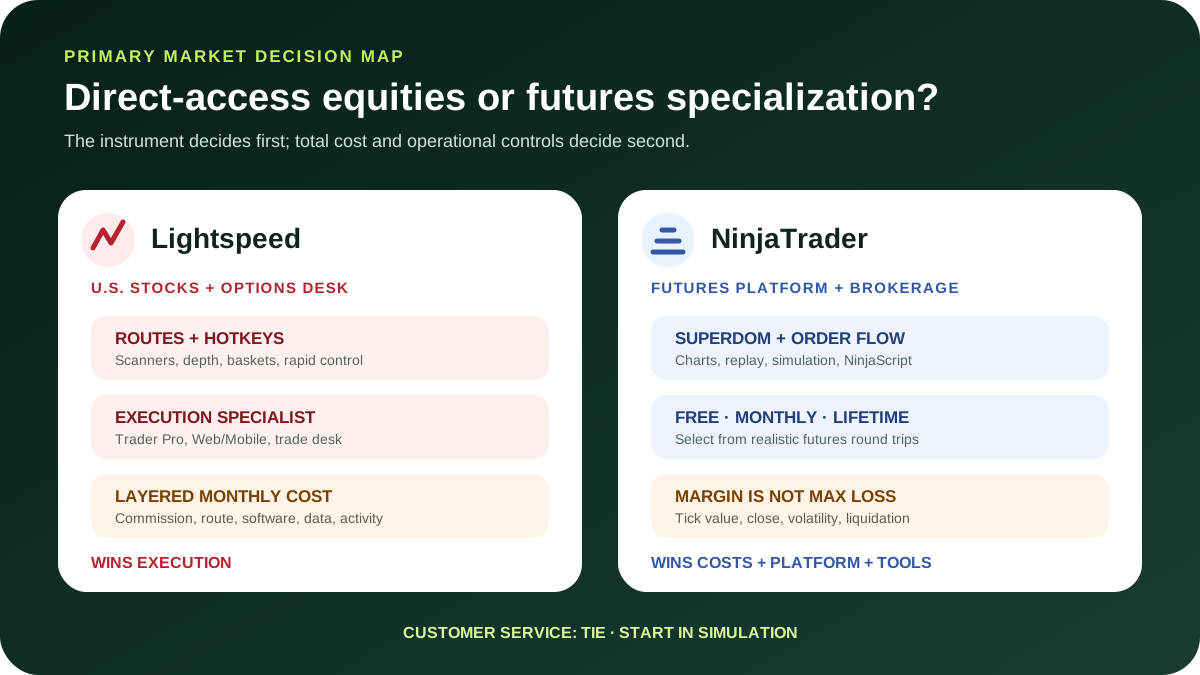
First choose the market, then the broker
Lightspeed and NinjaTrader appear together because both target serious active traders. They are not interchangeable brokerage accounts. Lightspeed centers on U.S. stocks and listed options with direct-access routing, configurable desktop tools, hotkeys, scanners, and specialist support. NinjaTrader centers on futures with charts, depth ladders, simulation, replay, order flow, and strategy development.
A trader whose process requires locating and routing a U.S. equity order has no reason to choose NinjaTrader for that task. A trader whose process depends on replaying a Micro E-mini session has no reason to pay Lightspeed's equity-platform costs. Define the tradable instruments, venues, holding period, order type, and overnight policy before comparing scores.
The overall rating favors NinjaTrader by one tenth because its specialist futures workflow has a clearer low-fixed-cost entry and deeper native practice tools. Lightspeed remains the winner for its narrower direct-access execution use case.
Trading Costs: NinjaTrader wins
NinjaTrader scores 4.0/5 versus Lightspeed at 3.6/5. Its Free plan removes a monthly platform license, while the current $99 Monthly and $1,499 Lifetime plans reduce the platform commission per side. The customer can calculate whether expected round trips justify a paid plan.
The displayed commission is not all-in. Exchange, clearing, NFA, market-data, activity, liquidation, transfer, and other fees can remain. A futures round trip pays both sides. Each contract has its own exchange charge, multiplier, and margin.
Lightspeed publishes per-share, per-trade, and options-contract schedules. Its lowest advertised figures require very high volume, are not applied automatically, and can be subject to order minimums. Per-share customers can also pay or receive route-specific charges or rebates. Regulatory assessments remain separate.
Lightspeed Trader Pro can cost up to $130 per month, reduced by eligible commissions under current documentation. Data packages and professional classifications add costs. Accounts below $15,000 can face a $25 monthly minimum commission, reduced by qualifying commission generated in the prior month. Web & Mobile removes some nonprofessional software and data charges but has a different feature and commission model.
Trading-cost winner: NinjaTrader. That result reflects plan transparency and a credible no-license entry, not cheap futures risk. Lightspeed can be economically superior for a truly high-volume equity trader whose routing control improves net execution.
Calculate the NinjaTrader plan break-even
NinjaTrader currently lists the Free plan at $0 per month, Monthly at $99, and Lifetime at $1,499 once. Published platform commissions differ for Micro and Standard contracts by plan. Exchange and other fees do not disappear when the plan changes.
Use expected round trips, not aspirational activity. Calculate the saving per round trip between Free and Monthly, divide $99 by that saving, and repeat for each contract mix. Use quiet, normal, and active months. A customer should not place additional trades merely to justify the subscription.
Lifetime requires a longer-horizon test. Discount future savings, allow for breaks from trading, strategy failure, broker switching, product changes, and plan revisions. The purchase is sunk if the workflow changes.
The appropriate NinjaTrader plan can therefore be Free even for a serious trader with low frequency, while Monthly or Lifetime can make sense for stable, verified volume. The smallest commission is not automatically the lowest total cost.
Model Lightspeed as a complete desk
Lightspeed's price is a combination of the commission schedule, order minimums, route fees or rebates, regulatory charges, platform, market data, account equity, activity, borrowing, and service events. A customer must obtain the exact schedule associated with the selected platform.
Lightspeed Trader Pro supports the deepest direct-access workflow and can carry a monthly software charge. Web & Mobile can remove software and nonprofessional data subscriptions but does not simply reproduce every desktop route, hotkey, API, or per-share pricing feature. Sterling, Eze EMS, DAS, and other specialist platforms have separate minimums and economics.
The current legal disclosure lists $2,500 for new Lightspeed Trader Pro and Web & Mobile accounts while higher specialist platforms have higher minimums. Other marketing pages can show different numbers. The application and legal agreement control; confirm the platform, funding, ongoing equity, margin, and activity rule in writing.
Model partial fills, cancel-replace sequences, multi-leg option orders, quiet months, and the exact route. A schedule that looks inexpensive at the top tier can be expensive when normal activity never reaches it.
Platform: NinjaTrader wins
NinjaTrader scores 4.7/5 versus Lightspeed at 4.5/5. NinjaTrader Desktop provides advanced charts, more than 100 indicators, SuperDOM, Market Analyzer, backtesting, simulation, replay, strategy development, and an add-on ecosystem. Web and Mobile extend charts, depth, order entry, positions, and account access.
Lightspeed Trader Pro is excellent for active stocks and options. Configurable windows, hotkeys, hot buttons, baskets, scanners, charts, conditional orders, routes, and API-assisted entry support a professional-style desk. Web & Mobile supplies a lower-fixed-cost alternative; specialist third-party platforms cover other desks.
NinjaTrader wins because Desktop, Web, Mobile, simulation, and Market Replay create the more complete native specialist environment. Lightspeed's platform is exceptionally effective once direct routing is required, but more of its surrounding capability can depend on subscriptions, platform selection, or third parties.
Platform winner: NinjaTrader. It is not the winner for stocks and options; it is the stronger product within the market it actually serves.
Execution: Lightspeed wins
Lightspeed scores 4.9/5 versus NinjaTrader at 4.5/5. Its product is built around rapid U.S. equity and option order entry, direct route selection, hotkeys, market depth, cancel-replace control, and an active-trader trade desk. Those controls are the clearest reason to pay its layered costs.
NinjaTrader supplies fast futures order entry through SuperDOM, charts, ATM strategy templates, brackets, Web, Mobile, and Desktop. The broker and exchange infrastructure is credible, but the comparison rewards Lightspeed's unusually granular route-level workflow.
Neither score guarantees a fill. Measure acknowledgement time, effective spread, slippage, price improvement, queue position, partial fills, cancellations, route charges, and post-fill movement. A marketable order can fill quickly at a poor price; a passive order may wait because that is its purpose.
Execution winner: Lightspeed. DollarScout did not benchmark latency. The win reflects documented routing and order-management control, not a universal speed claim across unrelated products.
Hotkeys versus SuperDOM
Lightspeed hotkeys can combine symbol, size, order type, price offset, route, time in force, and other instructions. That reduces manual steps during a fast equity session. It also turns a configuration mistake into a fast live mistake.
NinjaTrader's SuperDOM provides a depth ladder for placing and managing futures orders around current price. ATM templates can attach targets and protective orders. Order Flow+ and related tools can add volume, delta, VWAP, and depth-oriented analysis depending on plan and entitlement.
Both interfaces should begin with conservative size and confirmation behavior. Test buy versus sell, open versus close, stop versus stop-limit, cancel-all scope, bracket replacement, and what happens after disconnection. Keep the broker trade-desk number outside the computer.
Displayed depth is not promised liquidity. Orders can be canceled, hidden interest may exist, and the market can trade through levels during fast movement. A ladder or Level II window is evidence about the present book, not a prediction.
Trading Tools: NinjaTrader wins
NinjaTrader scores 4.8/5 versus Lightspeed at 4.5/5. Its free charting, backtesting, simulation, Market Replay, strategy tools, SuperDOM, order-flow features, and NinjaScript ecosystem cover research, rehearsal, development, and execution in one futures-specific environment.
Lightspeed offers strong scanners, charts, baskets, conditional orders, hotkeys, APIs, depth, historical options data, and third-party news or specialist integrations. Its tools optimize a live active desk more than a research or practice laboratory.
NinjaTrader wins because simulation and replay materially improve platform training and process testing. Lightspeed users can paper-test and use analytical tools, but its distinctive value is live routing control.
No simulation validates profitability. Conservative tests must include commission, exchange fees, slippage, contract rolls, session templates, delayed entries, different volatility regimes, and out-of-sample periods.
Simulation, replay, and false confidence
NinjaTrader makes it easy to practice without live capital. Use that environment to learn order mechanics, rehearse a daily routine, test a connection failure, and review whether a rule was followed. Market Replay can recreate historical sessions for deliberate practice.
Simulation cannot reproduce every queue position, partial fill, spread change, emotion, outage, liquidation, or margin response. A fill engine may assume execution when a real passive order would wait. Historical data can use adjusted or merged contract series that were not directly tradable.
Lightspeed users need an equally explicit testing protocol even if the platform's core appeal is live. Paper-test every hotkey, route, basket, multi-leg ticket, and cancel command. A direct-access workflow should not be learned with full production size.
Graduation from simulation should depend on operational consistency, not simulated profit alone. Begin with the smallest viable size and predetermined maximum daily loss.
Margin means different things in each account
NinjaTrader advertises intraday futures margins from $50 for some Micro contracts and $500 for popular Standard contracts. Those figures are minimum equity requirements during eligible periods, not contract value or maximum loss. Initial margin can apply near the session close, and house requirements can rise around volatility or news.
Lightspeed equity margin depends on account rules, security eligibility, concentration, short availability, and house requirements. Borrowing adds interest. Short selling adds locate or borrow fees, recall, buy-in, dividends, and theoretically unlimited loss. Portfolio-margin and specialist accounts have materially higher qualifications.
Do not compare a $50 futures intraday margin with a stock account minimum as if both represent risk. Convert each position to dollar movement per point or share, stress a gap, include correlated positions, and maintain capital far above the broker's liquidation threshold.
Risk liquidation can add a fee on top of the market loss at either broker. Document the exact time and event that changes the margin regime.
Product scope and contract lifecycle
Lightspeed's core instruments are U.S. listed equities and options. Its direct-access model can suit day traders, liquidity-sensitive strategies, and desks managing many rapid orders. It is not intended as a diversified household account with mutual-fund research, retirement projections, or advice.
NinjaTrader advertises more than 100 futures across CME Group, Eurex, ICE, and Coinbase Derivatives under current availability. Every contract has a multiplier, tick value, hours, expiration, price-limit rules, settlement, margin, and exchange fee.
Some futures are physically delivered. Traders must know first notice, last trade, broker liquidation, and roll timing. A continuous historical chart may be back-adjusted while live orders must name an actual expiring contract.
The narrow scope of both products is useful: it prevents pretending that one active-trading tool should also hold emergency savings or a retirement plan.
Data, connectivity, and third-party dependencies
Lightspeed sells bundled and à-la-carte market data with different nonprofessional and professional rates. NinjaTrader also depends on exchange data entitlements, connection state, and the selected contract. Delayed, top-of-book, and depth data are not interchangeable.
Third-party platforms, indicators, strategies, news, or data add vendor, licensing, security, billing, update, and support dependencies. Availability in a marketplace is not evidence that an add-on is profitable or safe.
Back up layouts, hotkeys, templates, and code. Test software updates outside market hours. Maintain an alternate connection and order path. Know which protective orders reside at an exchange or broker and which depend on a local platform remaining online.
Customer Service: a tie
Lightspeed scores 4.3/5 and NinjaTrader 4.4/5, treated as a tie. Lightspeed publishes general, account, software, and trading-support paths for its active clientele. NinjaTrader advertises futures-specific 24/5 support, platform training, documentation, forums, and an emergency trade desk.
DollarScout did not open accounts, call either desk, or resolve a live-order emergency. The tie reflects specialist documentation and access, not a claim about response time in every incident.
Save account ID, platform version, order IDs, timestamps, route or contract, connection status, screenshots, and logs. Use the designated trade desk for an open-order risk event rather than a generic sales channel.
Support can explain account or platform mechanics. It cannot decide that a leveraged strategy is suitable or guarantee that a stop fills at its trigger.
Regulation and protection
Lightspeed securities accounts and NinjaTrader futures accounts do not have identical legal protection. SIPC protection can apply to customer securities and cash at a member broker if the firm fails, subject to rules and limits; it does not cover market losses or a failed trading strategy.
Futures customer funds follow Commodity Exchange Act segregation and FCM rules. They are not ordinary SIPC securities positions or FDIC-insured bank deposits. Review the legal entity, FCM, introducing relationship, disclosures, and applicable regulator shown in the account agreement.
Enable strong authentication and withdrawal controls. Keep statements and trade confirmations outside the platform. Separate active risk capital from household cash and long-term investments.
Who should choose Lightspeed?
Choose Lightspeed if the verified strategy trades enough U.S. stocks or options to justify desktop, data, routing, and activity costs—and if specific routes, hotkeys, scanners, API entry, or a specialist trade desk materially improve execution.
Do not choose it for passive investing or because the lowest commission tier looks attractive. The rate may require exceptional volume and manual qualification. Model normal and quiet months using the exact platform agreement.
Who should choose NinjaTrader?
Choose NinjaTrader if the process is futures-specific and benefits from Desktop charting, SuperDOM, Market Replay, simulation, order flow, or NinjaScript. Select Free, Monthly, or Lifetime using realistic round trips after all exchange and account costs.
Do not choose it because intraday margin makes a contract appear affordable. Margin is the broker's minimum, not a safe account size. Understand tick value, expiration, session changes, and liquidation before funding.
A practical comparison test
The most useful test is not the same trade because the instruments differ. Test the same operational standard:
- Configure the smallest live-like workspace and remove unused tools.
- Submit, modify, cancel, and flatten a representative order in simulation.
- Disconnect the primary interface and recover from the secondary path.
- Reconcile the fill, fees, position, and statement.
- Price a quiet month and an active month with every fixed and variable cost.
The winning platform is the one that safely supports the required instrument after total cost—not the one with the most colorful depth display.
Final verdict
NinjaTrader wins overall by a narrow margin because its futures-specialist platform, plan choices, native simulation, replay, and strategy tools create a coherent system. Lightspeed remains the clear specialist for direct-access U.S. stock and option execution. The two brokers should rarely be chosen for the same primary strategy.
Which one is right for you?
- Best for Direct-routed U.S. equity and options trading: LightspeedRequest an Account
- Best for Hotkeys, scanners, and specialist trade-desk workflow: LightspeedRequest an Account
- Best for Futures charting, SuperDOM, and order flow: NinjaTraderOpen Futures Account
- Best for Simulation, Market Replay, and futures automation: NinjaTraderOpen Futures Account
Final verdict
NinjaTrader wins 4.5/5 to 4.4/5 for a coherent futures workflow spanning Free, Monthly, and Lifetime plans, Desktop, Web, Mobile, SuperDOM, simulation, replay, and strategy tools. Lightspeed is the better direct-access specialist for high-volume U.S. stocks and options and wins Execution. NinjaTrader wins Trading Costs, Platform, and Trading Tools; Customer Service is a tie.
Frequently asked questions
Sources and verification
Scores and product facts come from the underlying DollarScout reviews and were checked against these primary sources.
- Lightspeed commissions and pricing
- Lightspeed brokerage and activity fees
- Lightspeed order-routing fees and rebates
- Lightspeed market-data pricing
- Lightspeed platform comparison
- Lightspeed Trader Pro
- Lightspeed Web and Mobile
- Lightspeed legal disclosures and account minimums
- NinjaTrader pricing plans
- NinjaTrader futures brokerage overview
- NinjaTrader account fees
- NinjaTrader futures margins
- NinjaTrader intraday margin guide
- NinjaTrader Desktop platform
- NinjaTrader platform training and simulation
Related content
More from DollarScout on this topic.
