Many products on this page are from partners who compensate us. This doesn't influence our ratings. Our opinions are our own.
tastytrade vs Interactive Brokers: 2026 Broker Comparison
By Sophie Brown, Senior Finance Editor · Updated Jul 2026 · Fact-checked Jul 19, 2026
Interactive Brokers wins overall at 4.7/5 versus tastytrade at 4.6/5 because its Lite and Pro pricing, professional routing, more than 170 markets, global products, currencies, margin economics, portfolio risk, and APIs serve a wider set of advanced traders. tastytrade is the better specialist for a coherent listed-options workflow with $1 opening commission per stock or ETF option contract, a $10 cap per leg, $0 closing commission, visual strategy tools, backtesting, and integrated education before pass-through fees. IBKR wins Trading Costs and Execution; tastytrade wins Customer Service; Platform and Trading Tools are ties.
Head-to-head
| Feature | tastytrade | Interactive Brokers |
|---|---|---|
| DollarScout Rating | 4.6/5 ★ | 4.7/5 ★ |
| Commissions | $0 stocks and ETFs; listed stock and ETF options $1 per contract to open with a $10 per-leg cap and $0 to close; futures and futures options use per-contract opening and closing charges | IBKR Lite offers eligible U.S. residents $0 U.S. exchange-listed stocks and ETFs; IBKR Pro stock pricing is fixed or tiered, and other products use separate global schedules |
| Platform Access | Native desktop, browser, and iOS/Android platforms plus an API, with options analysis, charting, ladder trading, backtesting, and integrated education | IBKR Desktop, Trader Workstation, Client Portal, IBKR Mobile, GlobalTrader, specialty apps, and TWS, Client Portal, Excel, and FIX APIs |
| Market Focus | Options, stocks, ETFs, futures, futures options, cryptocurrency, forex, fixed-income access, and prediction markets under product-specific rules | Stocks, ETFs, options, futures, currencies, bonds, funds, metals, event contracts, and other products across more than 170 global markets |


Category-by-category breakdown
Trading Costs
Platform
Execution
Trading Tools
Customer Service
Detailed analysis
The short answer
Choose Interactive Brokers for global multi-asset infrastructure; choose tastytrade for an options-first workflow that is easier to learn and repeat. DollarScout rates Interactive Brokers 4.7/5 and tastytrade 4.6/5. IBKR wins Trading Costs and Execution. tastytrade wins Customer Service. Platform and Trading Tools are ties.
| Decision factor | tastytrade | Interactive Brokers |
|---|---|---|
| Best fit | Self-directed listed-options and futures traders using visual strategy tools | Global, multi-asset, margin-conscious, professional, or API traders |
| U.S. stocks and ETFs | $0 commission to open and close before relevant fees | Lite can provide $0 eligible exchange-listed trades; Pro uses fixed or tiered pricing |
| Stock and ETF options | $1 per contract to open, capped at $10 per leg; $0 to close | Pro base varies by premium and volume; Lite has a fixed first monthly tier; minimums and pass-throughs apply |
| Platform approach | Desktop, Web, and Mobile share an options-centered vocabulary | TWS, IBKR Desktop, Client Portal, Mobile, GlobalTrader, specialty apps, and APIs |
| Distinctive strength | Visual risk, strategy templates, more than ten years of backtesting, tastylive education | More than 170 markets, broad products, advanced orders, routing, currencies, financing, and risk |
| Main limitation | Less suited to mutual-fund, advice, planning, and broad global research needs | Steeper learning curve across plans, platforms, data, currencies, permissions, and entities |
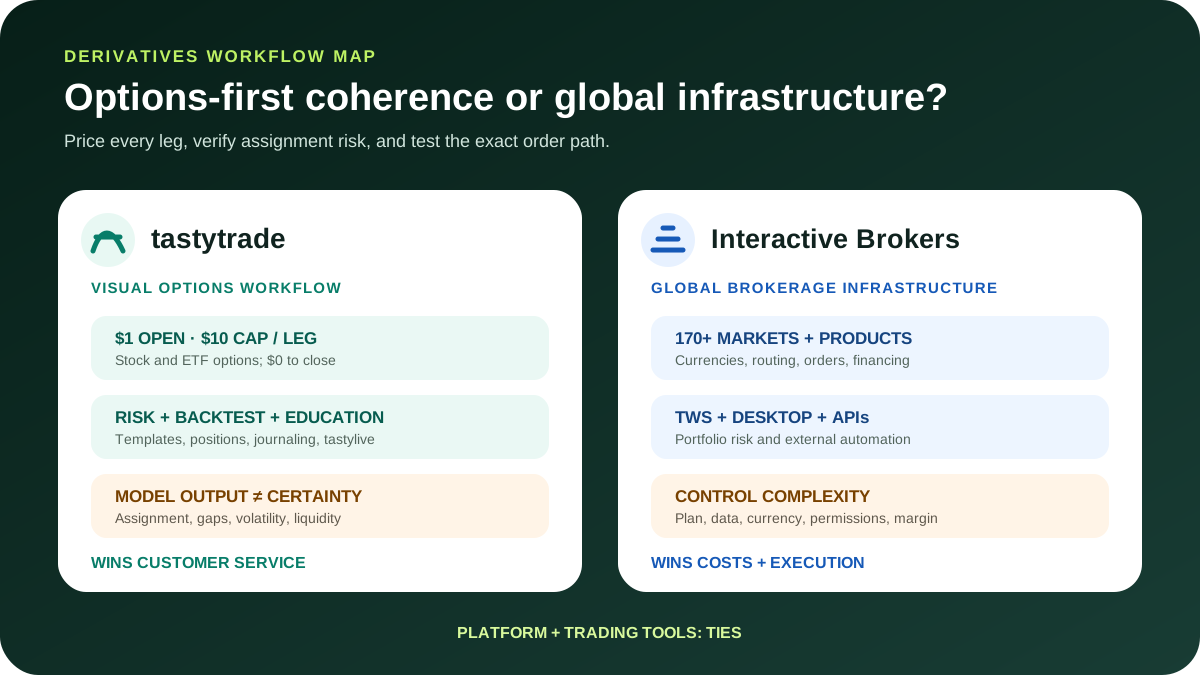
The products start from different questions
tastytrade asks how an active derivatives trader can build, visualize, place, and manage an options or futures strategy efficiently. Its platform, pricing, educational media, templates, risk curves, backtesting, follow features, and position tools use a consistent options vocabulary.
Interactive Brokers asks how a customer can access many products, markets, currencies, entities, order types, risk systems, and APIs from one brokerage relationship. An options trade is one part of a much larger global infrastructure.
That distinction explains the narrow overall result. IBKR wins because it can solve more advanced brokerage problems. tastytrade remains the stronger choice when the actual problem is learning and executing a repeatable listed-options workflow without configuring an institutional-style workstation.
Trading Costs: Interactive Brokers wins
IBKR scores 4.8/5 versus tastytrade at 4.5/5. Eligible U.S. customers can use IBKR Lite for $0 commission on qualifying exchange-listed stocks and ETFs. IBKR Pro provides fixed or tiered stock schedules, SmartRouting, and professional-style economics. U.S. Pro options base commissions vary with premium and volume, generally within a published range, while Lite applies a fixed first monthly tier.
tastytrade charges $0 commission for stocks and ETFs. Listed stock and ETF options cost $1 per contract to open, capped at $10 per leg, and $0 per contract to close. Broad-based index options, futures, Micro futures, and futures options follow their own opening and closing schedules. Exchange, clearing, regulatory, exercise, assignment, and other fees can remain.
tastytrade's cap is valuable for larger equity-option orders, but it applies per leg. A four-leg position can encounter four opening caps. The cap does not eliminate spread, slippage, closing fees on products outside the $0-close schedule, or assignment economics.
IBKR's lower contract rate can favor small and moderate orders, high volume, and customers already using Pro. Its minimum can matter on a one-contract order, and venue or product surcharges remain. There is no universal cheapest broker.
Trading-cost winner: Interactive Brokers. tastytrade's pricing is easier to explain; IBKR's broader schedules and financing are stronger across more realistic account profiles.
Compare an options order correctly
For each representative strategy, calculate commission per contract, per-leg cap, order minimum, exchange or index surcharge, clearing, regulatory fees, exercise, assignment, liquidation, and the expected closing path. Model both the intended exit and the position being assigned.
A ten-contract single-leg stock option order reaches tastytrade's $10 opening cap. A two-contract order does not. IBKR's base depends on the applicable plan, premium, and monthly volume. A low-premium contract can price differently from a high-premium one, and an order minimum can dominate very small tickets.
Spread is often larger than commission. Record the bid, ask, midpoint, order type, limit changes, fill, and market movement. A broker that saves a few dollars in commission but creates worse execution is not cheaper.
Do not optimize by adding contracts to “use” a cap. Position size must follow maximum loss and portfolio exposure, never the commission schedule.
Stocks, ETFs, and long-term holdings
Both brokers support $0-commission paths for ordinary U.S. stocks and ETFs under qualifying conditions. tastytrade lists $0 commissions to open and close. IBKR Lite offers eligible U.S. residents $0 on qualifying exchange-listed trades, while Pro uses fixed or tiered pricing.
IBKR is stronger for international stocks, multiple currencies, bonds, mutual funds, broader account structures, portfolio analytics, and consolidated multi-asset work. tastytrade can hold long stock and ETF positions, but planning, adviser access, traditional mutual-fund research, and goals-based allocation are not the product center.
Fractional eligibility, OTC securities, warrants, corporate actions, direct routing, foreign listings, and special account arrangements should be checked separately. “$0 stock commission” does not describe every security that resembles a stock in the search box.
Neither platform should replace a written asset-allocation and tax plan. A sophisticated order ticket is not a retirement recommendation.
Futures and futures options
tastytrade supports futures, Micro futures, options on futures, and options on Micro futures at published per-contract opening and closing commissions. Its Active Trader interface and shared derivatives vocabulary can make the transition from equity options more coherent.
IBKR offers futures and futures options across a broader global market network and integrates them with securities, currencies, bonds, risk, and APIs. This is the stronger environment for a multi-market portfolio or institutional-style strategy.
At either broker, add exchange, clearing, regulatory, data, and carrying costs. Understand multiplier, tick value, session, expiration, price limits, delivery, first notice, and margin. Futures positions are not ordinary SIPC-covered securities, and intraday margin is not maximum loss.
tastytrade wins ease of learning across derivatives; IBKR wins breadth. The better futures broker depends on whether the account needs one coherent retail derivatives process or many global products and venues.
Platform: a tie
tastytrade scores 4.7/5 and IBKR 4.8/5, treated as a tie. tastytrade's Desktop, Web, and Mobile platforms emphasize watchlists, option chains, strategy selection, payoff and probability views, positions, working orders, charts, futures ladders, and educational content. The interfaces share a recognizable workflow.
IBKR offers Trader Workstation for the deepest control, IBKR Desktop as a newer desktop experience, Client Portal in the browser, IBKR Mobile, GlobalTrader, specialty apps, and API routes. It supports far more product and market contexts but requires more choices.
tastytrade is easier when the trader repeatedly builds verticals, iron condors, strangles, covered calls, or futures positions. IBKR is better when the same workstation must manage an international stock, currency hedge, bond, option combo, futures position, and algorithmic order.
Platform result: tie. Coherence and breadth are different forms of quality. Paper-test the exact order and account-administration path, not a marketing screenshot.
Visual options workflow
tastytrade makes option-chain liquidity, expiration, strike, delta, probability, buying-power effect, and payoff shape prominent. Strategy templates can preselect common structures. Position views and order chains help connect opening and management actions.
Those graphics are model outputs. Implied volatility changes, skew, dividends, borrow, interest, early exercise, assignment, pin risk, and discontinuous price moves can change the result. A probability displayed at entry is not an audited forecast and does not update the trader's behavioral discipline.
IBKR provides powerful OptionTrader, Strategy Builder, volatility, probability, risk, and portfolio tools inside a larger professional platform. It can express more order logic and cross-product hedging, but the learning path is less singular.
tastytrade is the better options teaching interface. IBKR is the better options infrastructure when the strategy already has a rigorous process.
Trading Tools: a tie
tastytrade scores 4.8/5 and IBKR 4.9/5. tastytrade offers strategy templates, visual risk, options backtesting with more than ten years of data, charting, Active Trader ladders, order-chain tracking, journaling, watchlists, and integrated tastylive media. The tools reinforce one style of decision-making.
IBKR provides scanners, Risk Navigator, PortfolioAnalyst, options analytics, professional order types, algorithms, market depth, research, tax-lot control, global data, and multiple APIs. Its toolkit spans far more instruments and account types.
The category is a tie because the additional breadth does not help an options trader who needs a fast repeatable workflow, while tastytrade's specialization cannot replace IBKR's portfolio and market scope.
Both can encourage false precision. Backtests require point-in-time data, realistic spreads, commissions, assignment, expiration, survivorship controls, and out-of-sample periods. A payoff curve is a scenario, not a distribution of every real outcome.
Backtesting and simulation
tastytrade advertises options backtesting across more than ten years of data. A trader can compare structures, entry conditions, expirations, deltas, and management rules without building a complete options-data engine. This is a meaningful usability advantage.
IBKR provides paper accounts, API testing, historical data under entitlements, and sophisticated analytical tools. Developers can construct broader tests, but they must define the model, data licenses, corporate actions, fills, and option lifecycle themselves.
Neither environment can reproduce every live fill, early assignment, borrow event, volatility surface, margin change, or outage. Use conservative bid-ask assumptions and test losing regimes. Record parameters before viewing the result to reduce selection bias.
Paper trading should validate order and failure mechanics as well as a strategy. Test rejection, partial fill, lost connection, cancel-replace, expiration, and an emergency flatten procedure.
APIs and automation
IBKR is the stronger automation broker. TWS, Client Portal, Excel, and FIX interfaces cover retail-to-institutional use cases under different eligibility, authentication, session, pacing, and data rules. The global product network makes one integration useful across many strategies.
tastytrade provides an API and platform-integrated tools for active traders. It can support account data, market data, orders, and strategy workflows under current documentation and permissions, but it does not match IBKR's breadth or institutional connectivity.
An API response is not proof that an order is safely complete. Use idempotent client IDs, duplicate protection, stale-data checks, rate-limit handling, retry ceilings, reconciliation, position and buying-power caps, logs, alerts, and a human kill switch.
Automation should reduce repeated manual work, not remove supervision. Assignment, corporate actions, session changes, and broker risk controls can create state the strategy did not predict.
Execution: Interactive Brokers wins
IBKR scores 4.9/5 versus tastytrade at 4.4/5. IBKR Pro's SmartRouting, direct-routing choices, algorithmic orders, broad venue access, combo handling, and execution disclosures create a more powerful general execution environment.
tastytrade provides effective order entry for its options and futures audience, including multi-leg tickets, visual price controls, chart and ladder workflows, and active position management. Its execution tools are good; the category gap reflects IBKR's routing infrastructure and professional control.
Execution winner: Interactive Brokers. DollarScout did not benchmark either broker. Measure the customer's effective spread, fill rate, price improvement, partial fills, cancel latency, market impact, and unfilled opportunity cost.
Commission and execution are one economic decision. Routing or modifying an order to save a visible fee can lose more through price and delay.
Margin and buying power
tastytrade shows buying-power effect alongside options strategies, which helps compare capital use. It publishes margin education and account requirements for cash, margin, portfolio margin, futures, and options permissions. Displayed buying power is not a recommendation to consume it.
IBKR's margin economics and real-time risk system are stronger for qualified customers. Rates are benchmark-based formulas that vary by plan, balance, and currency. IBKR can liquidate positions without waiting for a traditional margin-call conversation.
Portfolio margin can reduce requirements for modeled offsets while increasing sensitivity to changing scenarios and concentration. Short options can expand in requirement as volatility rises or offsets break. A low requirement is capacity, not low risk.
Maintain cash above both the current requirement and a stressed requirement. Model gaps, correlated positions, early assignment, currency moves, and a volatility shock. Know which positions the broker can liquidate first.
Education and Customer Service: tastytrade wins
tastytrade scores 4.3/5 versus IBKR at 3.9/5. tastytrade courses, tastylive programming, Help Center, and specialist contact routes use the same terminology as the platform. That alignment reduces the gap between learning a concept and finding the corresponding tool.
IBKR Campus, documentation, webinars, knowledge resources, tickets, chat, and phone channels are extensive. The challenge is scale: global entities, permissions, transfers, products, data, APIs, margin, and taxes can make support procedural and self-directed.
Customer Service winner: tastytrade. This is not a measured response-time guarantee. DollarScout did not open accounts, call a trade desk, dispute a fill, or test an international transfer.
Support cannot determine whether a trade is appropriate. During an operational incident, provide platform, account entity, order ID, timestamp, symbol, venue, currency, error, and screenshots.
Research and education are not signals
tastylive and tastytrade courses can teach volatility, probability, strategy construction, trade management, and platform use. Their proximity to the broker creates a coherent learning environment and a potential activity incentive. Education should not become a reason to trade more often.
IBKR integrates research, scanners, news, analyst services, fundamentals, risk, and portfolio analytics from multiple providers. It covers more asset classes and geographies, but the interface asks the user to select and organize the relevant data.
Separate education, research, and decision rules. A video segment, scanner result, analyst opinion, or platform idea is a prompt for analysis—not permission to enter. Document maximum risk, thesis, liquidity, event calendar, exit, and portfolio exposure before sending the order.
Global markets and account entity
IBKR's defining advantage is access to more than 170 markets and a wide set of products and currencies under current disclosures. Account availability depends on country, legal entity, permissions, regulation, and product. Protection and tax treatment can differ across entities.
tastytrade supports U.S. and certain international customers and offers several account types, but its global market breadth is much narrower. It should be selected for its derivatives workflow, not as a substitute for a broad international brokerage.
SIPC does not protect against market loss and does not cover every futures, currency, crypto, or affiliate product. Cryptocurrency arrangements can involve a separate provider and pricing mechanism. Read the exact agreement for the legal entity holding each asset.
Enable strong authentication, withdrawal restrictions, and trusted contacts. Save statements, confirmations, tax lots, assignments, exercises, and currency transactions outside the app.
Who should choose tastytrade?
Choose tastytrade if the primary work is building and managing listed-options or futures strategies and the customer values a consistent Desktop, Web, Mobile, visual-risk, backtesting, journaling, and educational ecosystem. Its capped stock and ETF option opening commission is particularly relevant to larger single-leg or multi-contract orders.
Do not choose it because a probability or buying-power figure makes a risky strategy look controlled. Understand assignment, exercise, spread, liquidity, margin, and maximum loss independently.
Who should choose Interactive Brokers?
Choose Interactive Brokers if the account must cross markets, currencies, asset classes, professional order types, portfolio risk, margin, or external APIs. It is the better default for an experienced trader whose options positions sit inside a wider global portfolio.
Do not choose it solely for the lowest displayed contract rate. Configure the correct Lite or Pro plan, platform, market data, permissions, account entity, currency, and order route before trading.
A practical decision test
Paper-test the same representative options position at both brokers:
- Build the strategy and verify every leg, multiplier, expiration, and assignment path.
- Submit a nonmarketable limit, modify it once, and document the fill logic.
- Roll or close one leg without accidentally changing total exposure.
- Reconcile commission, pass-through fees, buying power, position, and statement.
- Simulate a platform disconnect while protective and working orders remain.
Then test the broker-specific reason to switch: a global product and API workflow at IBKR, or a backtest and visual management workflow at tastytrade. If that distinctive task is not useful, switching may add complexity without value.
Final verdict
Interactive Brokers wins overall because pricing, routing, markets, products, financing, risk systems, and APIs solve more advanced brokerage problems. tastytrade nearly matches it by offering one of the most coherent retail options environments available. The correct choice follows the scope of the account, not the overall score alone.
Which one is right for you?
- Best for Visual listed-options construction and management: tastytradeOpen Trading Account
- Best for Integrated options backtesting and education: tastytradeOpen Trading Account
- Best for Global multi-asset markets and currencies: Interactive BrokersOpen Trading Account
- Best for Professional routing, portfolio risk, and APIs: Interactive BrokersOpen Trading Account
Final verdict
Interactive Brokers wins 4.7/5 to 4.6/5 for global multi-asset breadth, Lite and Pro pricing, professional routing, financing, risk tools, and APIs. tastytrade is the better listed-options specialist for visual strategy construction, capped stock and ETF option opening commissions, backtesting, and integrated education. IBKR wins Trading Costs and Execution; tastytrade wins Customer Service; Platform and Trading Tools are ties.
Frequently asked questions
Sources and verification
Scores and product facts come from the underlying DollarScout reviews and were checked against these primary sources.
- tastytrade commissions and pricing
- tastytrade product and platform overview
- tastytrade desktop platform and options tools
- tastytrade web platform
- tastytrade mobile platform
- tastytrade account types
- tastytrade margin education
- tastytrade courses and support contacts
- Interactive Brokers commissions overview
- IBKR U.S. stock commissions
- IBKR U.S. options commissions
- IBKR trading platforms
- IBKR margin rates and Lite-Pro comparison
- IBKR global options access
- Interactive Brokers global market fact sheet
Related content
More from DollarScout on this topic.
