Splash Financial at a glance
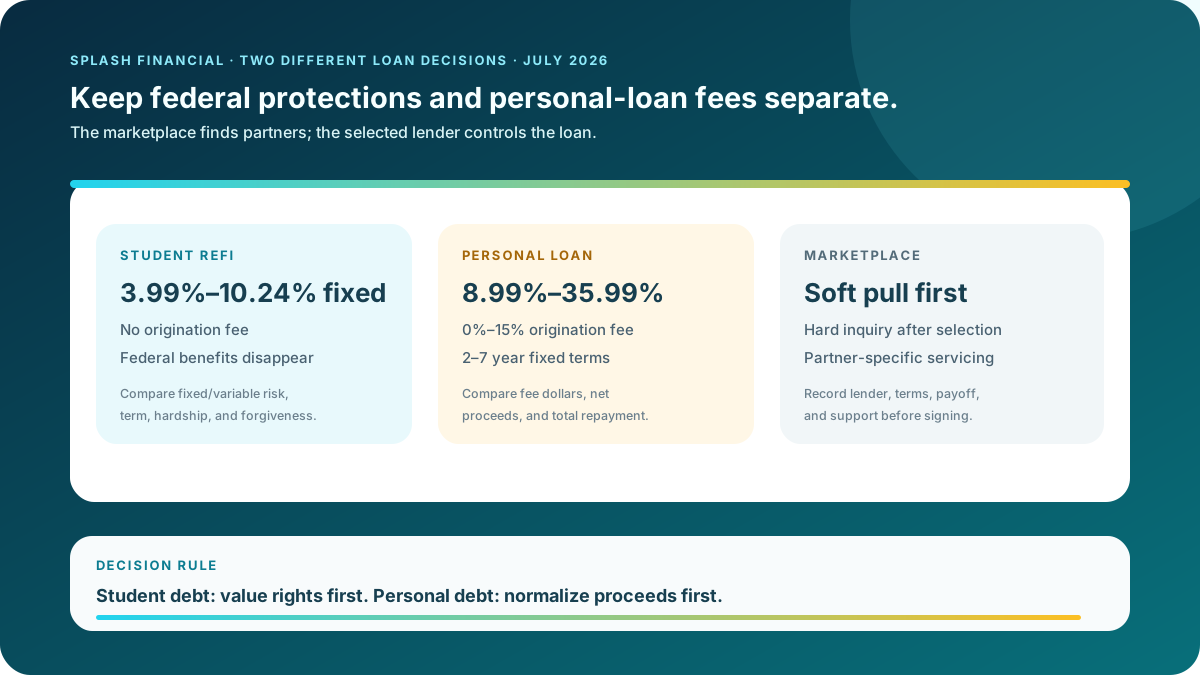
Splash Financial is a loan marketplace, not one uniform lender. It collects information, performs or facilitates a soft credit check, and matches eligible users with banks, credit unions, and other partners. The selected institution makes the final credit decision and can become the lender or servicer.
Two product families sit under the same brand. Student-loan refinancing currently advertises 3.99% to 10.24% fixed APR and 4.74% to 10.24% variable APR. Personal-loan marketplace offers advertise 8.99% to 35.99% fixed APR. Their fees, amounts, terms, risks, and permissible uses are not interchangeable.
| Review question | DollarScout finding |
|---|---|
| Best for | Qualified borrowers comparing several student-refinance or personal-loan partners |
| Rate check | Soft inquiry at prequalification; final application uses a hard inquiry |
| Student-refinance fees | No application, origination, or prepayment fee |
| Personal-loan fees | Partner fee can range from 0% to 15% and reduce proceeds |
| Main risk | Losing federal protections or confusing marketplace terms with a guaranteed offer |
Student-loan refinance APR
APR scores 4.2/5. Splash's disclosures dated June 24, 2026 list fixed student-refinance APRs from 3.99% to 10.24% and variable APRs from 4.74% to 10.24%. The lowest rate can include a 0.25-point AutoPay discount and the shortest term. Actual options depend on credit, income, degree, term, partner, state, and the loans refinanced.
Fixed student-refinance terms run from five to 20 years in the general disclosure. Variable terms can extend to 25 years. A fixed rate stays stable. A variable rate adds a margin to a 30-day average SOFR-based index and can move up or down.
A lower payment can result from a longer payoff date instead of a lower cost. Compare monthly payment, total interest, payoff date, fixed-versus-variable risk, and the value of benefits surrendered. For a variable offer, model payment at today's index and at a meaningfully higher rate.
Student-refinance fees and amounts
Splash states there is no application or origination fee and no prepayment penalty on student-loan refinance. Late or returned-payment charges can still arise under the partner agreement.
Amount rules vary. Many medical-refinance partners use a $5,000 minimum with no set maximum, while special resident products can impose different minimums and caps. Ordinary refinance availability depends on the partner, degree, state, balance, income, and school or program criteria.
Confirm every loan included in the payoff. Keep paying old servicers until each reports a zero balance. Splash says old servicers often need three to 14 business days to receive and apply payoff funds.
Federal loans require a separate decision
Federal Student Aid warns that a private refinance can remove rights not normally offered by private lenders: income-driven repayment, approved deferment or forbearance, subsidized-interest treatment in qualifying periods, Public Service Loan Forgiveness, teacher forgiveness, total-and-permanent-disability discharge, borrower defense, and other federal relief.
Value those protections before comparing rate. A borrower pursuing PSLF or using an income-driven plan can lose far more than the apparent interest saving. Federal Direct Consolidation is different from private refinancing and can have its own effects on interest and qualifying-payment credit.
Private student loans do not carry those federal rights, so refinancing a private balance can be a cleaner rate decision. Still compare cosigner release, death or disability discharge, hardship, variable-rate caps, and servicing reputation.
Personal-loan APR and fees
Splash's personal-loan marketplace is a separate product. Current disclosures show 8.99% to 35.99% fixed APR and terms of two to seven years. The lowest rate can require AutoPay, the shortest term, and direct payment of existing debt.
Partners can charge a 0% to 15% origination fee, deducted from proceeds. Splash illustrates a $10,000, 36-month loan at 17.98% APR with a 5% fee: the borrower receives $9,500 and pays about $343.33 monthly.
Personal loans generally range from $1,000 to $50,000; some partners offer up to $100,000 to qualified borrowers. Current disclosures identify higher minimums in Georgia, Massachusetts, New Mexico, and Ohio.
Fees scores 4.6/5 because the student-refinance path is clean and personal-loan fees are prominently disclosed, but the possible 15% deduction is substantial. Score the actual product selected, not the best feature from the other path.
Personal-loan use restrictions
Personal loans are for personal, family, or household purposes. Splash says they cannot purchase or refinance real estate, securities or other investments, finance post-secondary education, support a business, provide short-term bridge financing, or fund illegal activity.
Use the truthful purpose. If the need is tuition, a personal loan can lack education-loan protections and violate the stated restrictions. If the need is a home project, compare an unsecured loan with a HELOC only after considering collateral and closing costs.
Soft prequalification and final application
Splash performs a soft credit pull to estimate prequalified rates. The initial check does not affect the score. After an offer is selected, Splash or the partner obtains a full credit report, producing a hard inquiry.
Prequalified rates are estimates and can update until the application and verification are complete. Partners can request income, identity, payoff, degree, residency, or credit-union membership documents. Splash does not work with every lender and does not guarantee an offer or approval.
Capture the lender name, APR, rate type, term, amount, fee, net proceeds, payment, total of payments, AutoPay condition, and servicer before continuing. A marketplace logo is not the creditor identity.
Approval and funding speed
Funding Speed scores 4.4/5. A rate check can take about three minutes, and a qualified user can compare partner options without separate soft applications. Verification and partner underwriting determine final timing.
For personal loans, Splash says approved and signed funds typically arrive in one to two business days, though some cases can take up to two weeks. For student refinancing, payoff delivery and old-servicer posting can take three to 14 business days.
Those clocks solve different tasks. Personal-loan cash availability is not a student-loan payoff date. Continue all existing payments until the bank and old servicer confirm completion.
Partner servicing and hardship
Customer Service scores 4.0/5. Splash publishes weekday phone hours, email, rate-check FAQs, product FAQs, and guidance for old-loan payoff. After funding, the partner or designated servicer can control payments, hardship, deferment, forbearance, complaints, and payoff.
Splash says deferment or forbearance may be available depending on the lender and will appear in the credit agreement. That is not equivalent to a federal entitlement. Obtain the conditions, interest treatment, duration, credit reporting, and effect on term in writing.
DollarScout did not contact Splash, a partner, or a servicer. The score evaluates documented access and marketplace help rather than a uniform service promise across institutions.
Fixed and variable refinance stress test
A fixed rate keeps the contract rate stable, while a variable rate moves with its stated index and margin. The lowest variable quote can look attractive on the application date but expose a long-term borrower to payment increases. Read the rate cap, adjustment frequency, index definition, and notice procedure in the note.
Model at least three cases: the initial rate, a two-percentage-point increase, and the highest rate permitted by the disclosure. Compare both the payment and total interest. A variable loan that fits only at today's index is not a resilient refinance.
Term selection can matter more than a small rate difference. Stretching repayment from 10 to 20 years may lower the monthly payment while substantially increasing interest and delaying the debt-free date. Choose the shortest payment that remains sustainable after a realistic income interruption; do not choose a fragile term merely to capture the advertised floor.
Cosigners and release terms
A cosigner can improve eligibility or pricing but becomes legally responsible. Compare whether a partner permits release, the required number of on-time payments, income and credit requalification, and whether release is discretionary.
Refinancing can also remove an existing cosigner or replace several obligations with one, subject to approval. Do not assume a death or disability policy transfers from the old loan. Read the final note and preserve it.
The cosigner should receive and retain the note, servicing contact, payment schedule, and release rules. Both parties should agree who monitors statements and how a missed or changed payment will be handled. A refinance can affect both credit files even when only one person uses the proceeds.
Splash versus applying directly
The marketplace can reduce repeated data entry and expose several partners through one soft-pull workflow. Applying directly can reveal a lender not in Splash's network, a loyalty discount, or different terms. Splash explicitly says it does not work with all lenders.
For student refinance, compare Splash with direct offers and a federal-loan “do nothing” baseline. For personal loans, compare SoFi, LightStream, Upstart, Happen, and a credit union on equal proceeds and term.
The goal is not the largest number of offers. It is a short list with fully comparable disclosures and a documented reason to replace the existing debt.
Who Splash Financial is best for
Splash fits borrowers who:
- Have private student loans and strong enough credit to improve cost.
- Have valued every federal benefit before considering private refinance.
- Want one soft-pull intake across several partners.
- Understand that the final lender and servicer control the loan.
- Will compare personal-loan fee dollars and net proceeds.
It is weaker for federal borrowers pursuing forgiveness or income-driven relief, applicants expecting guaranteed coverage of every lender, or anyone using a student-refinance rate to judge a personal-loan offer.
Bottom line
Splash Financial earns 4.3/5. Its partner comparison, soft prequalification, current student-refinance range, no student-refinance origination fee, and broad personal-loan marketplace create useful shopping efficiency.
The two products require different safeguards. Preserve federal protections unless the private refinance is clearly worth the permanent exchange; on a personal loan, compare the actual partner's APR, fee, proceeds, and servicing terms before signing.