
The essential answer
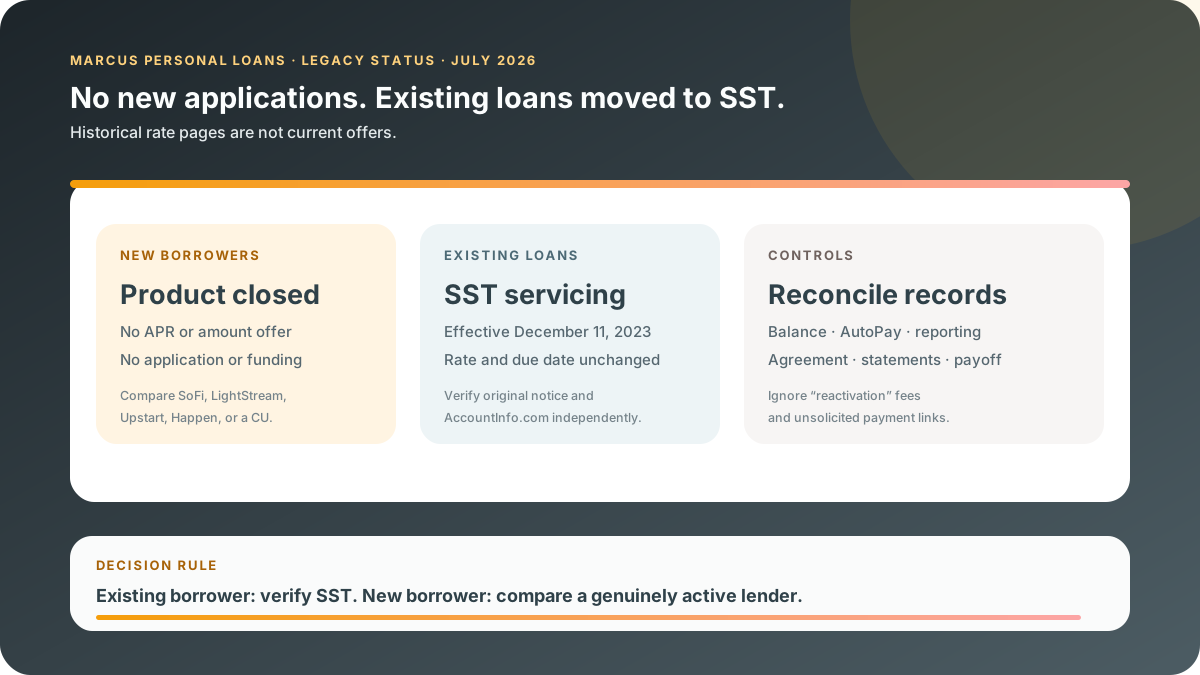
Marcus by Goldman Sachs does not accept new personal-loan applications. Goldman Sachs stated in its first-quarter 2023 Form 10-Q that it had started a process to cease offering new Marcus unsecured consumer loans. Later filings say the firm sold substantially all of the Marcus loan portfolio in 2023.
Existing Marcus Personal Loan and MarcusPay servicing transferred to Systems & Services Technologies, Inc. (SST) effective December 11, 2023. SST maintains its customer portal at AccountInfo.com and identifies itself as a loan servicer with NMLS 950746.
| Review question | DollarScout finding |
|---|---|
| Can a new borrower apply? | No |
| Current APR or amount range | None published for new applications |
| Existing-loan servicer | SST, effective December 11, 2023 |
| Did the transfer change the rate? | Marcus says no |
| Correct CTA | Compare active lenders—not Apply or Check Rate |
Why the product closed
Goldman Sachs launched Marcus personal loans in 2016 as fixed-rate, no-fee unsecured credit. That history explains why older articles still display attractive amount ranges, APR tables, and a “no fees” proposition.
The business changed materially in 2023. Goldman Sachs described a strategic narrowing of consumer activities, began ceasing new unsecured-loan originations, sold substantially all of the Marcus loan portfolio, and moved remaining servicing administration. Those actions make old application terms unsuitable for a 2026 comparison.
A discontinued product can remain visible in search results long after its application disappears. DollarScout retains the page to prevent a worse outcome: a user relying on stale rates, clicking an impostor, or confusing Marcus deposit products with an active personal loan.
How an unavailable product is scored
APR scores 1.5/5, Loan Amounts 1.0/5, and Funding Speed 1.0/5 because there is no current offer to evaluate. These are minimum availability scores, not claims that an existing borrower's contractual APR or original funding experience was poor.
Fees scores 3.0/5 to recognize the historical no-fee structure without treating it as a current application benefit. Existing fees and payment consequences come from the signed note and SST account, not a legacy marketing page.
Customer Service scores 2.6/5 because Marcus publishes a detailed transfer FAQ and SST provides a servicing portal, while the handoff creates extra verification and contact complexity. DollarScout did not test either support channel.
The weighted result is 1.9/5. A product unavailable to new applicants cannot rank beside active lenders on rates or approval speed, even if its historic design was competitive.
What the servicing transfer changed
Marcus says the transfer did not change the interest rate, due date, or core terms and conditions of the loan. It changed administrative elements such as the servicer, account number, portal, and payment destination.
After the effective date, SST became responsible for payments and ongoing credit-bureau reporting. Existing AutoPay instructions were expected to continue, while borrowers received a new account number and portal setup instructions.
A servicing transfer does not erase the debt or authorize a new party to rewrite the signed economics without the contract and applicable law. It does require the borrower to update records and confirm where payments are credited.
Existing-borrower verification checklist
Start with the written transfer notice received from Marcus or SST. Compare the borrower name, former account, effective date, new account number, official contact details, payment address, and website. Then reach the portal independently rather than clicking a message link.
Inside the authenticated account, verify:
- Remaining principal and accrued interest.
- Fixed interest rate and original maturity.
- Next due date and AutoPay status.
- Recent payment history and allocation.
- Contact address, email, and phone.
- Payoff quote process and any pending disputes.
Save the transfer letter, original agreement, final Marcus statement, first SST statement, and confirmation of every payment around the transition. Those records resolve most questions faster than a screenshot of an old product page.
Payment and AutoPay controls
Marcus stopped accepting ordinary payments immediately before the December 2023 servicing transfer. Current payments belong with SST or an identified collection agency if the borrower received valid written notice of that relationship.
Do not send a second payment merely because the portal display lags. First confirm the bank debit, transaction identifier, effective date, and SST history. If a payment is missing, contact the servicer promptly and provide proof without exposing full bank credentials.
If AutoPay is active, maintain enough cash and confirm the next debit after any bank-account change. A manual payment may not cancel the scheduled debit. If the borrower wants to pay extra principal or obtain a payoff, request written allocation instructions.
Credit reporting after the transfer
Marcus says it reported account information until transfer and SST reports afterward. The transfer itself did not create a hard inquiry. A tradeline can change the servicer name while representing the same underlying obligation.
Review reports from the three national bureaus at the federally authorized AnnualCreditReport.com. Check balance, status, payment history, opened date, and whether an old Marcus entry is duplicated rather than transferred.
Dispute an error with both the reporting bureau and the company furnishing the data, including the relevant statements and payment proof. Do not dispute an accurate balance merely because the servicer changed.
If a payment problem or hardship occurs
Contact SST before the due date. Ask what assistance is available, whether interest continues, whether the payment changes, how long relief lasts, whether the maturity extends, and how the account will be reported. Obtain the answer in a durable message or letter.
Do not assume the historical Marcus “on-time payment reward” or any old deferral description remains available without confirmation for the individual agreement. Account-specific rights control.
If the servicer does not resolve an error, document dates, representatives, confirmation numbers, letters, and bank records. The Consumer Financial Protection Bureau accepts complaints about consumer loans and servicing after the company has had a reasonable opportunity to respond.
How to document and escalate a servicing dispute
Create a timeline containing the due date, amount, bank confirmation, statement entry, calls, messages, and names or reference numbers. Use the written-notice address and procedure in the current statement or agreement. Send copies of evidence rather than originals and retain delivery confirmation.
For a credit-reporting error, dispute with both the bureau and the furnisher. Identify the exact month, balance, status, or duplicate account that is wrong. General complaints without the relevant statement and payment proof can be harder to investigate.
If the documented issue remains unresolved, a borrower can submit a CFPB complaint identifying the current servicer and attaching the chronology. That process does not automatically suspend payments, interest, collection activity, or contractual deadlines. Continue paying undisputed amounts when possible and obtain legal help for litigation, active collection, or limitations questions.
Scam and impersonation risk
A discontinued brand is attractive to impostors because people remember the name but do not know the current process. Red flags include a new-loan approval from Marcus, an upfront “release” fee, gift-card or crypto payment, a request for a one-time code, remote screen access, or a threat to pay immediately through a shortened link.
Neither the old Marcus brand nor the SST logo proves authenticity. Verify the domain, certificate, account number, and notice. Type AccountInfo.com independently or use a saved verified bookmark. Keep email and phone multifactor authentication secure.
New borrowers should never pay a third party to “reopen” or “reactivate” a Marcus application. There is no active application to unlock.
If an unexpected collector claims the loan, request validation and verify the transfer or ownership chain through known records before sending money. Use contact details from an independently reached official source, not the inbound call, text, or email.
Marcus deposits are a different product
Marcus continues to offer savings accounts and certificates of deposit. The existence of an active Marcus banking site does not mean personal-loan originations resumed. Deposit APY, FDIC coverage, transfer limits, and customer support belong to a separate product family.
Someone searching for the savings brand may encounter the legacy loan page and vice versa. Check the product name and agreement before providing information.
Active alternatives for new borrowers
Choose SoFi for a soft rate check, $5,000 to $100,000 range, multiple terms, and optional Direct Pay. Choose LightStream when credit is strong and a no-origination-fee structure is worth a hard application after comparison.
Choose Upstart when broader underwriting inputs may help and its fee-adjusted offer is competitive. Happen Bank, a local bank, and a credit union can add lower-minimum, joint, secured, or relationship options.
Compare at least three current offers on the same proceeds and payoff date. A replacement loan should be chosen because its verified economics fit—not because it resembles a historical Marcus offer.
Who this page is for
This review is useful for:
- Existing Marcus or MarcusPay borrowers confirming the SST transition.
- Consumers checking whether a search result is stale.
- Editors and comparison tools removing Marcus from active rankings.
- New borrowers looking for verified active alternatives.
It is not a path to prequalification, application, approval, funding, refinancing, or account servicing.
Bottom line
Marcus Personal Loans earns 1.9/5 because the product is unavailable, not because every legacy loan was badly designed. New originations stopped and existing servicing moved to SST.
New borrowers should compare active lenders. Existing borrowers should use the original agreement, transfer notice, authenticated SST account, payment records, and official complaint channels if necessary. Any page displaying a live Marcus personal-loan rate in 2026 is stale or suspect until Goldman Sachs itself proves otherwise.