Many products on this page are from partners who compensate us. This doesn't influence our ratings. Our opinions are our own.
Loans · Rankings
Best Personal Loans for Bad Credit in 2026
By Sophie Brown, Senior Finance Editor
Updated Jul 19, 2026
Fact-checked Jul 19, 2026
13 min read
Upstart ranks first among the two providers in DollarScout's 2026 bad-credit personal-loan comparison because its lending partners consider credit, income, and other application information, its initial rate check uses a soft inquiry, and it advertises loans from $1,000 to $75,000 subject to state minimums. Happen Bank—formerly LendingClub—ranks second and may be the better choice for a joint application, a 24-to-84-month term, or Direct Pay. Neither company promises approval, neither publishes a universal “bad credit” cutoff, and both can present an APR as high as 35.99% with an origination fee that reduces the cash received.
This page evaluates only the two providers attached to DollarScout's current ranking. It is not a complete market survey, and exclusion is not a negative recommendation. A local credit union, community bank, employer program, secured savings loan, medical payment plan, creditor hardship arrangement, or nonprofit debt-management plan may be safer or cheaper. DollarScout reviewed official provider pricing, eligibility, fee, inquiry, funding, payment, and agreement documents plus current CFPB and FTC consumer guidance on July 19, 2026. We did not prequalify, apply, share personal data, receive offers, fund a loan, make payments, or contact support.
6.2% to 35.99% fixed APR for unsecured personal loans with three- or five-year terms, based on five-year rates offered in March 2026; actual range, approval, and terms vary by state and profile
5.96% to 35.99% fixed APR under the offer disclosed as current from June 1, 2026; the actual rate depends on credit, amount, term, and other underwriting factors
Origination Fee
Partner-specific and included in APR; the current representative $10,000, 60-month example uses a 7.25% fee deducted from proceeds, and no prepayment penalty is advertised
0% to 8% of the loan amount on most personal loans, deducted from proceeds and incorporated into APR; no application, brokerage, or prepayment fee
Loan Amounts
$1,000 to $75,000; state minimums include $3,100 in Georgia, $1,500 in Hawaii, and $7,000 in Massachusetts, and maximums can vary by state
$1,000 to $75,000 with terms from 24 to 84 months; amounts and terms vary by state, channel, credit, and product availability
Standout feature
Broader application inputs than a score-only marketing tier
$1,000 minimum for a focused smaller need
Detailed reviews
In-depth look at every product on our list.
Best Overall · Editor's Choice
1
Ranked #1
Upstart
★★★★☆4/54.0
DollarScout rating
UPS
Upstart
Best broader-underwriting comparison quote
Upstart ranks first in this two-provider set because its partner platform considers credit, income, and other information, begins with a disclosed soft rate check, and advertises $1,000 to $75,000 subject to state minimums. It does not guarantee approval. Fixed APR can reach 35.99%, terms are generally three or five years, and the representative 7.25% origination fee leaves $9,275 from a $10,000 issued loan.
6.2% to 35.99% fixed APR for unsecured personal loans with three- or five-year terms, based on five-year rates offered in March 2026; actual range, approval, and terms vary by state and profile
Origination Fee
Partner-specific and included in APR; the current representative $10,000, 60-month example uses a 7.25% fee deducted from proceeds, and no prepayment penalty is advertised
Loan Amounts
$1,000 to $75,000; state minimums include $3,100 in Georgia, $1,500 in Hawaii, and $7,000 in Massachusetts, and maximums can vary by state
Standout features
Broader application inputs than a score-only marketing tier
Soft inquiry disclosed for initial rate checking
Small advertised starting amount outside higher state minimums
DollarScout's take
Upstart ranks first in this two-provider set because its partner platform considers credit, income, and other information, begins with a disclosed soft rate check, and advertises $1,000 to $75,000 subject to state minimums. It does not guarantee approval. Fixed APR can reach 35.99%, terms are generally three or five years, and the representative 7.25% origination fee leaves $9,275 from a $10,000 issued loan.
Pros
✓Broader application inputs than a score-only marketing tier
✓Soft inquiry disclosed for initial rate checking
✓Small advertised starting amount outside higher state minimums
Cons
✗Partner-specific origination fee can materially reduce proceeds
✗Only three- or five-year terms in the current unsecured offer
Our pick for best joint application and term flexibility
2
Ranked #2
Happen Bank (formerly LendingClub)
★★★★☆4.1/54.1
DollarScout rating
HB
Happen Bank (formerly LendingClub)
Best joint application and term flexibility
Happen Bank, formerly LendingClub, can fit a joint application, a smaller $1,000 need, Direct Pay, or a term from 24 to 84 months. Its current published fixed APR reaches 35.99%, most loans can deduct a 0% to 8% origination fee, and late fees may apply after the grace period. A co-borrower becomes fully responsible for the loan, and current Happen disclosures—not legacy LendingClub terms—control.
5.96% to 35.99% fixed APR under the offer disclosed as current from June 1, 2026; the actual rate depends on credit, amount, term, and other underwriting factors
Origination Fee
0% to 8% of the loan amount on most personal loans, deducted from proceeds and incorporated into APR; no application, brokerage, or prepayment fee
Loan Amounts
$1,000 to $75,000 with terms from 24 to 84 months; amounts and terms vary by state, channel, credit, and product availability
Standout features
$1,000 minimum for a focused smaller need
Joint application path and Direct Pay availability
Broader 24-to-84-month term selection
DollarScout's take
Happen Bank, formerly LendingClub, can fit a joint application, a smaller $1,000 need, Direct Pay, or a term from 24 to 84 months. Its current published fixed APR reaches 35.99%, most loans can deduct a 0% to 8% origination fee, and late fees may apply after the grace period. A co-borrower becomes fully responsible for the loan, and current Happen disclosures—not legacy LendingClub terms—control.
Pros
✓$1,000 minimum for a focused smaller need
✓Joint application path and Direct Pay availability
✓Broader 24-to-84-month term selection
Cons
✗Origination fee can reach 8% for most loans
✗High-end APR and possible late fee can make marginal approval costly
Prices, methodology, tradeoffs, and the workflow each service actually supports.
How we ranked bad-credit personal loans
The model weights Affordability of the Actual Offer at 30%, Eligibility and Offer Transparency at 20%, Fees and Net Proceeds at 20%, Payment and Hardship Fit at 15%, and Safeguards and Lower-Risk Alternatives at 15%. The final signed disclosure outranks this editorial order. An approval is not a positive outcome when the payment displaces rent, food, utilities, insurance, medicine, or the emergency expense the loan was meant to solve.
“Bad credit” is a broad search phrase, not a standardized lender tier. People have many scores, providers use different models, and income, debt, payment history, recent applications, identity verification, state, requested amount, and partner rules can affect an offer. We therefore do not assign a made-up minimum score or imply that either provider approves a particular profile.
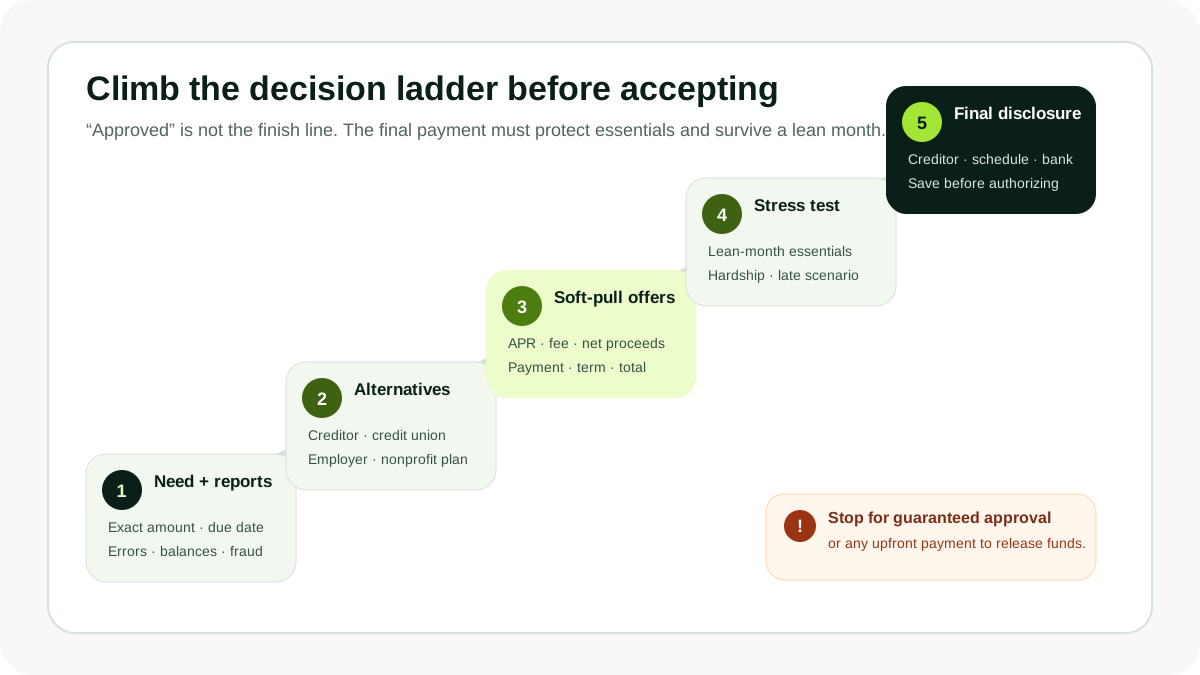
Borrow in order, not under pressure: verify the need and credit data, test lower-risk alternatives, compare written offers, and accept only a payment that survives a lean month.
1. Upstart — best broader-underwriting comparison quote
Upstart ranks first because its partner-lender platform can evaluate more than a marketing credit-score label. It says the process considers credit, income, and other application information and does not require a minimum level of educational attainment. That broader input set can make Upstart a useful quote for someone with a thin file, recent credit damage, or a profile that a conventional lender prices poorly. It does not mean approval is guaranteed or that alternative underwriting produces a low rate for every applicant.
The current unsecured personal-loan page advertises $1,000 to $75,000, with state minimums of $3,100 in Georgia, $1,500 in Hawaii, and $7,000 in Massachusetts and possible state-specific maximums. Terms are generally three or five years. Published fixed APRs are 6.2% to 35.99%, based on five-year offers made through the platform in March 2026.
The representative disclosure shows why the fee deserves equal attention with the rate: a $10,000, 60-month loan at 17.50% interest with a 7.25% origination fee has 21.23% APR and provides only $9,275 in net proceeds. The borrower still owes principal based on the $10,000 issued amount. Fees and creditors vary by offer, so the example is neither a promise nor a maximum.
Upstart discloses a soft credit inquiry for the initial rate check and a hard inquiry after an applicant accepts an offer and proceeds. Use the soft-check stage to record amount, creditor, origination fee in dollars, net proceeds, APR, term, monthly payment, total of payments, first due date, and offer expiration. Do not assume the displayed amount survives identity, income, employment, bank, or final credit verification.
Funding can be fast, but the wording matters. Upstart reports that 69% of customers in March 2026 had transfer initiated within 24 hours after approval and signing. Bank processing, verification, weekends, holidays, and loan purpose can change availability. “Transfer initiated” does not mean guaranteed cash in the account that day.
Upstart ranks first only within this two-company set. Its main disadvantages are a potentially substantial deducted fee, only two common unsecured terms, partner-specific servicing, state minimums, and a 35.99% maximum APR. It is a comparison quote, not a recommendation to accept a high-cost offer.
2. Happen Bank — best joint application and term flexibility
Happen Bank is the current name of the former LendingClub banking business. Its disclosures state personal loans from $1,000 to $75,000, fixed terms from 24 to 84 months, and 5.96% to 35.99% APR under the offer stated as current from June 1, 2026. The individual result can reflect credit history, income, debt-to-income ratio, term, requested amount, state, and other underwriting information.
Most loans have a 0% to 8% origination fee, deducted from proceeds and included in APR. Happen states there is no application, brokerage, or prepayment fee. A late fee may apply after the published 15-day grace period, and interest begins when the loan is issued even if bank availability follows later. Those operational details matter when cash flow is already tight.
Happen's strongest differentiator is the joint-application path. A qualified co-borrower can combine information with the primary applicant, but both people become responsible for the debt. Before applying jointly, document who receives the funds, who pays, how account access works, and what happens after unemployment, separation, illness, or death. A co-borrower should never be added merely to make an unaffordable payment pass underwriting.
Direct Pay can send eligible consolidation funds to qualifying credit cards or personal loans. It may reduce the risk of diverting cash from the intended payoff, but the borrower still needs to verify posting, trailing interest, pending transactions, and any residual statement balance. Continue required payments until the old creditor confirms the account is current and the intended balance is gone.
The $1,000 minimum and 24-to-84-month range can fit a smaller repair or produce more payment choices than Upstart. A longer term is not automatically more affordable: it can lower the required monthly amount while increasing total interest and keeping the obligation open longer.
Happen ranks second because a fee up to 8%, possible late fee, and 35.99% upper APR can make a marginal approval expensive. It can rank first for an individual who receives the lower actual APR, needs a joint application, wants Direct Pay, or benefits from a term unavailable through Upstart. Compare the current Happen documents rather than relying on old LendingClub rates or reviews.
Offer comparison
Provider
Published amount
Published APR context
Fee structure
Term menu
Main reason to quote
Upstart
$1,000–$75,000, with state minimums
6.2%–35.99%; Mar. 2026 five-year offer data
Partner-specific; 7.25% in representative example
3 or 5 years
Broader underwriting inputs and soft initial rate check
Happen Bank
$1,000–$75,000
5.96%–35.99% fixed; stated current Jun. 1, 2026
0%–8% for most loans
24–84 months
Joint application, Direct Pay, or term flexibility
Advertised minimum APRs describe selected prior or qualifying offers, not what a bad-credit applicant will receive. At 35.99%, a hypothetical no-fee $5,000 loan amortized over 36 months costs about $229 per month and about $8,244 across scheduled payments—roughly $3,244 above principal. A deducted fee or longer term changes the result. This example is arithmetic, not a quote and not a forecast of either provider's offer.
Step 1: verify the amount and urgency
Write the exact expense, due date, and amount. Ask whether the need can be reduced, delayed, divided, negotiated, or paid directly. A $1,200 repair estimate does not justify taking $5,000 because the platform approves it. Borrowing extra produces extra interest and may leave cash available for unplanned spending.
For medical bills, request an itemized statement, insurance review, financial assistance, prompt-pay discount, and interest-free plan before borrowing. For utilities, rent, or taxes, contact the provider or agency about a written payment arrangement. For existing debt, request hardship options from the creditor before replacing it with a new obligation.
An emergency can still require borrowing. The purpose of this step is to size the smallest viable loan and distinguish a true deadline from sales pressure.
Step 2: inspect all three credit reports
Use AnnualCreditReport.com, the federally authorized source linked by the CFPB, rather than a look-alike site. Reviewing your own reports does not hurt a score. Check names, addresses, accounts, balances, payment status, duplicate entries, unfamiliar inquiries, and collections.
Dispute inaccurate information with both the reporting company and the business that supplied it, following the CFPB's documentation guidance. Accurate negative information generally cannot be removed merely because a credit-repair company charges a fee. Correcting an error may take time, but it can prevent an unnecessarily poor offer.
Do not buy a score and assume it is the one a lender uses. The CFPB explains that consumers can have multiple scores because products, formulas, and data sources differ. The practical input is the lender's written offer, not a label from a monitoring app.
Step 3: test lower-risk alternatives
Start with the institution that already knows your deposit or payroll history. Ask a bank or credit union for the APR, fee, term, collateral, and membership rules of its smallest loan. An employer emergency program, payroll advance without a recurring fee, secured savings loan, family agreement, or community assistance may solve the need without a high unsecured APR. Each option has privacy, relationship, or asset risks that should be documented.
If the problem is existing unsecured debt, a reputable nonprofit credit counselor can review the full budget and discuss a debt-management plan. That is different from debt settlement. A settlement company may instruct a customer to stop paying, which can add fees and interest, harm credit, and invite collection or litigation. The CFPB recommends understanding those distinctions before enrolling.
A secured loan may offer a lower rate but changes the consequence of default: a car, savings balance, or other pledged asset can be at risk. Do not secure routine consumption with an essential asset merely to make the APR look smaller.
Step 4: compare soft-pull offers in a controlled session
Navigate directly to the official provider domain. Confirm that the initial rate check is soft before submitting. Use the same requested cash amount and compare offers within a short period so income, balances, and market conditions are as consistent as possible.
Create one row per offer with these fields:
Issuing creditor and loan servicer.
Issued principal and cash actually received.
Origination fee in dollars and every recurring or late fee.
Interest rate, APR, fixed or variable status.
Monthly payment, number of payments, and total of payments.
Funding estimate, first due date, and AutoPay effect.
Prepayment, extra-principal, due-date, and hardship rules.
Hard-inquiry timing and offer expiration.
Net proceeds equal issued principal minus any deducted origination fee. A $5,000 issued loan with an 8% deducted fee delivers $4,600, not $5,000. Increasing principal to receive the missing cash also increases the obligation. APR helps incorporate relevant financing charges, but the dollar worksheet makes the tradeoff visible.
Step 5: stress-test the payment
Build the payment into a lean-month budget, not an average or optimistic one. Include rent or mortgage, food, utilities, transport, insurance, medicine, taxes, existing minimums, irregular annual bills, and a small emergency margin. If one reduced shift or ordinary repair causes a missed payment, the loan is too tight.
Compare equal terms. A five-year payment may look better than a three-year payment while costing more overall. If only the longest term fits, record the dollar premium and confirm that extra payments reduce principal without penalty. Do not count uncertain overtime, a tax refund, or a future refinance as required repayment income.
Ask what happens after a missed payment, when a late fee begins, whether delinquency is reported, how partial payments are handled, and whether hardship relief can extend the term or allow interest to accrue. Support programs are discretionary and agreement-specific, not guaranteed forgiveness.
Step 6: verify the final disclosure before signing
Final approval can differ from prequalification. Read the Truth in Lending disclosure and note before authorizing. Confirm legal creditor, amount financed, finance charge, APR, payment schedule, total of payments, fee deduction, bank account, and first due date. Save copies outside the provider portal.
Stop if the final terms change materially, the lender pressures immediate acceptance, or the receiving account is unfamiliar. Never provide a one-time password to an inbound caller. If a loan text refers to an application you did not make, the FTC recommends not replying or clicking; report and delete it.
After funding, verify the deposit and set a payment reminder independent of AutoPay. Review the first statement, confirm extra payments are applied as intended, and request a payoff quote before the last payment. Keep closure confirmation and check later credit reports for accurate reporting.
Red flags that end the comparison
Guaranteed approval regardless of history.
A demand to pay before loan funds are delivered, especially by gift card, wire, crypto, or payment app.
A lender or broker that cannot identify the actual creditor, APR, fee, term, and state licensing information.
An unexpected text or call requesting Social Security, bank, or verification credentials.
A prechecked add-on product or fee not reflected in the amount expected.
Instructions to falsify income, employment, purpose, address, or identity information.
Pressure to borrow more, refinance immediately, or skip reading the agreement.
The FTC advises checking whether a lender is registered in the state and independently searching the company and contact information. Use a state banking or financial-services regulator and official domain; a polished ad is not verification.
Frequently asked questions
What credit score is required for these loans?
Neither reviewed provider publishes one universal approval score for every applicant and partner. Credit reports, income, debt, amount, state, verification, and other factors matter. Avoid a publisher that invents a guaranteed cutoff.
Which provider is easier to qualify for?
Public pages cannot answer that for an individual. Upstart emphasizes broader inputs; Happen supports joint applications. Use soft initial checks where disclosed, then compare actual terms without treating prequalification as approval.
Is 35.99% APR too high?
It is expensive and deserves a full alternatives review. Whether any loan prevents a worse consequence depends on the amount, term, fee, essential need, and realistic repayment plan. Do not accept it merely because another product could cost more.
Can an origination fee improve the offer?
A fee can accompany a different interest rate, so compare APR and total payments. But a deducted fee also reduces usable cash. Normalize offers to the same net proceeds before deciding.
Will applying hurt my credit?
An initial soft inquiry does not affect a score. Upstart discloses a later hard inquiry after offer acceptance. Confirm Happen's current inquiry sequence during the application and do not submit a final application until the offer is worth pursuing.
Can a co-borrower help?
A qualified co-borrower may change eligibility or pricing, but both borrowers become responsible. It is a shared debt with credit and relationship consequences, not a harmless application technique.
Should I use the loan to build credit?
Do not pay high interest solely to create payment history. On-time repayment can be reported, but late payments, fees, and added debt can make the profile worse. A lower-risk credit-building product or simply paying existing obligations on time may be more appropriate.
Our methodology
How we scored every product on this list
Weighted Affordable Actual Offer 30%, Eligibility Transparency 20%, Fee and Net Proceeds 20%, Payment and Hardship Fit 15%, and Safeguards and Alternatives 15%. We reviewed current documents but did not prequalify, apply, receive offers, fund loans, make payments, or contact support.
This review cycle used official product documentation, published methodology, current plan terms, and regulatory sources. Any hands-on or support-response testing is stated explicitly when performed. Read our fullmethodologyfor the complete scoring rubric.
DollarScout uses a privacy-friendly, cookie-less analytics script (Ahrefs) to understand traffic in aggregate. We don't sell your personal information and don't run ad trackers. You can review our Privacy Policy or opt out of data sharing any time.