How to Get a Personal Loan
By Sophie Brown, Senior Finance Editor · Updated Jul 2026 · Fact-checked Jul 18, 2026
A personal loan usually provides a fixed amount repaid in installments, but approval, pricing, fees, and protections vary widely. The safest process begins by proving the amount and payment are necessary and affordable, then checking credit data, prequalifying where possible, and comparing written offers on identical terms. This guide covers documents, APR, origination fees, underwriting, scams, funding, and the first payment.
Key takeaways
- Borrow the smallest amount that solves the documented need and choose the shortest term with a payment the budget can sustain.
- Compare APR, origination fee, net proceeds, total payments, rate type, late terms, and prepayment rules.
- Review all three credit reports and correct supported errors before a time-sensitive application.
- Prequalification is not final approval; verify the final disclosure after the lender completes underwriting.
- A guaranteed loan that requires gift cards, cryptocurrency, or an upfront release payment is a scam warning.
Decide whether borrowing improves the situation
Write the exact use, amount, timing, and alternative. A loan can spread a necessary expense or replace higher-cost debt, but it also commits future income. It is a poor substitute for a recurring budget deficit.
Before applying, compare delaying the purchase, negotiating the bill, using a payment plan, drawing from savings above the emergency floor, or borrowing less. Do not borrow extra merely because a lender offers it.
Set the payment ceiling first
Build the ceiling from after-tax income, essential expenses, debt payments, irregular bills, and a reserve contribution. Stress-test it after a plausible income dip or large renewal. The lender’s approval amount measures underwriting, not household comfort.
For each candidate amount and term, record monthly payment, total interest, fees, and payoff date. A longer term lowers the payment but often increases total cost.
Review credit reports and identity data
Use AnnualCreditReport.com, the federally authorized source, to request reports from Equifax, Experian, and TransUnion. Check names, addresses, accounts, balances, limits, payment status, collections, and inquiries. Dispute supported inaccuracies with both the reporting company and the furnisher, keeping evidence.
A credit score is not one universal number. CFPB notes that lenders can use different models and report data. Improving a consumer score shown by an app does not guarantee the same change in a lender’s score.
Avoid applying repeatedly while correcting an error. Ask whether prequalification uses a soft inquiry and whether moving to a full application creates a hard inquiry.
Compare legitimate lender types
Banks, credit unions, and licensed online lenders can offer installment loans. Verify the exact legal entity, website, state license where applicable, physical contact information, and complaint history. Do not trust a sponsored search result or caller ID alone.
Ask whether the company is the lender or a lead generator that sends data to multiple firms. Read privacy terms before submitting a Social Security number or bank credentials.
The FTC warns that legitimate lenders do not guarantee credit regardless of history and demand money first to release it. Application or appraisal fees can exist, but a promise that a payment guarantees approval is a red flag.
Prequalify in a controlled window
Where available, prequalification can estimate rate and payment using a soft inquiry. Submit the same requested amount and term to several verified lenders during a short comparison period. Save the date and assumptions.
Prequalification can change after income verification, credit review, collateral review, or fraud checks. It is not a commitment. Do not compare a two-year offer with a five-year offer by payment alone.
Read every number in the offer
| Term | Question |
|---|---|
| Principal | What amount will legally be owed? |
| Origination fee | Is it paid separately or deducted from proceeds? |
| Net proceeds | How much cash actually reaches the borrower or creditors? |
| Interest rate | Is it fixed for the full term or variable? |
| APR | Which interest and fees are reflected in the yearly cost measure? |
| Payment and term | How many payments, on which dates, and for what amount? |
| Total of payments | What is repaid if the schedule is followed? |
| Late/default terms | What fees, reporting, acceleration, or collection can occur? |
| Prepayment | Is there a penalty, and how is extra principal applied? |
If a 6% fee is deducted from a $10,000 loan, net proceeds may be $9,400 while repayment is based on $10,000. Compare the amount needed with net proceeds.
APR helps compare financing cost, but also compare total dollars and the same term. Optional insurance, memberships, or add-ons should not be included without explicit value and consent.
Prepare accurate documents
A lender may request government identification, Social Security number, address history, income evidence, employment, tax forms, bank statements, housing cost, debts, loan purpose, and funding account. Self-employed applicants may need longer income history.
Never alter a document or inflate income. Provide data through the verified encrypted portal, not an unsolicited email or chat. Ask why credentials are needed before connecting a bank through a third party.
Evaluate a co-signer or secured offer carefully
A co-signer becomes legally responsible according to the contract; missed payments can damage both parties. Agree in writing on access to statements and a contingency plan, but understand a private agreement does not release the co-signer from the lender’s rights.
A secured personal loan can offer different terms because property backs repayment. Identify the collateral, lien, valuation, repossession rights, insurance duties, and release process. Do not pledge essential transportation or savings without comparing the loss scenario.
Inspect the final disclosure before accepting
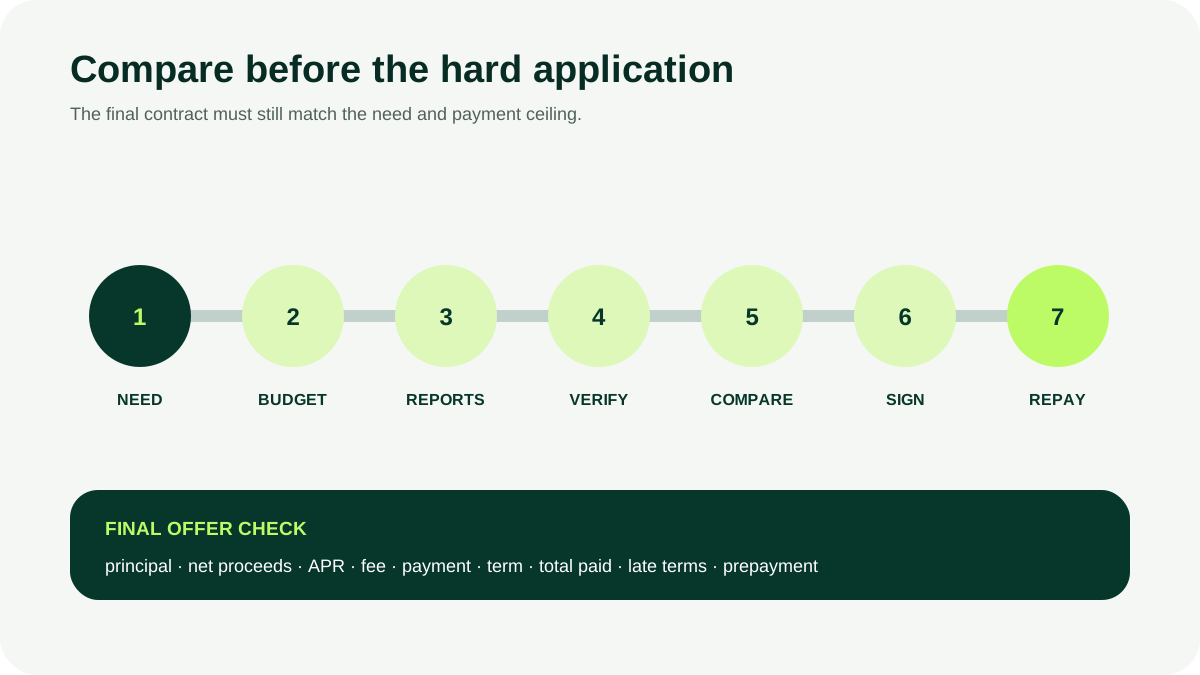
Compare final principal, APR, fee, payment, term, net proceeds, and lender with the saved quote. Ask why any field changed. Read the promissory note, arbitration clause, authorization for automatic debit, privacy notice, and optional-product elections.
Confirm whether accepting happens by electronic signature, clicking a button, or receiving funds. Do not assume there is a general right to cancel after funding; rights depend on the product and law.
Verify funding and the first payment
Confirm funds only in the borrower’s verified bank portal, not from a screenshot. For consolidation, track every creditor payoff and residual balance. Do not stop old payments until payoff posts.
Then:
- Save the signed agreement and disclosure.
- Confirm servicer, account number, payment amount, due date, and grace terms.
- Set autopay with a cash buffer and enable alerts.
- Make a small manual check if the first automatic debit is unclear.
- Review the first statement and credit reports for accuracy.
- Direct extra payments to principal and retain confirmation.
Contact the servicer before a missed payment if income changes. A written hardship option is better than ignoring the account.
Respond to an approval, counteroffer, or denial
An approval is useful only if the final amount and payment still solve the need. A lender may approve less than requested, require a co-signer, shorten the term, or charge more than the preliminary quote. Treat each change as a new offer and rerun the budget and total-cost comparison.
If credit is denied or offered on materially less favorable terms because of consumer-report information, read the adverse-action or risk-based-pricing notice. It can identify the reporting company, score information, and principal factors used. Request the relevant report, check the cited data, and dispute supported errors; the reporting company does not make the lending decision.
Do not immediately submit many new applications. First determine whether the problem is an error, insufficient income, high monthly debt, short credit history, recent delinquencies, lender policy, or an amount the budget should not support anyway. A smaller loan is not a solution if the expense still cannot be funded.
Keep a comparison record even after declining. Record lender, date, amount, term, APR, fee, and reason. This makes a later application evidence-based and prevents returning to the same unsuitable structure.
Refinancing later is never guaranteed. Market rates, income, credit, and lender policies can worsen. Accept the current loan only if it is sustainable without depending on a future refinance.
Bottom line
Getting a personal loan safely is a comparison and verification exercise. Define the smallest useful amount, cap the payment from the household budget, inspect credit data, verify every lender, and compare identical written offers by APR, fees, net proceeds, total cost, and payoff date. Accept only after the final contract still matches the plan.
Frequently asked questions
Sources
Related content
More from DollarScout on this topic.
