Many products on this page are from partners who compensate us. This doesn't influence our ratings. Our opinions are our own.
Loans · Rankings
Best Debt Consolidation Loans of 2026
By Sophie Brown, Senior Finance Editor
Updated Jul 19, 2026
Fact-checked Jul 19, 2026
13 min read
SoFi ranks first among the four debt-consolidation lenders in DollarScout's 2026 comparison because it combines $5,000 to $100,000 loans, two- to seven-year fixed terms, a no-origination-fee offer path, optional Direct Pay to credit cards, and no stated late or prepayment fee. Happen Bank—formerly LendingClub—ranks second for a $1,000 entry point, joint applications, Direct Pay, and terms up to 84 months. LightStream is third for strong-credit borrowers who want no origination fee and a published maximum APR below the other lenders, but it does not provide the same creditor-payment workflow. Upstart is fourth for broader underwriting and small starting amounts, with the largest concern being a potentially material origination fee deducted from proceeds.
This ranking covers the four lenders attached to DollarScout's current debt-consolidation page, not every available bank, credit union, online lender, balance-transfer card, nonprofit debt-management plan, or hardship program. Exclusion is not a negative recommendation. DollarScout reviewed official lender rates, terms, fees, underwriting, funding, Direct Pay, and support documents plus CFPB and FTC guidance on July 19, 2026. We did not prequalify, submit applications, receive offers, fund loans, contact support, pay creditors, or measure credit-score changes.
6.99% to 35.49% fixed APR with the 0.25% AutoPay and 0.25% member discounts, current July 6, 2026; the actual offer depends on term, creditworthiness, income, fees, and other factors
5.96% to 35.99% fixed APR under the offer disclosed as current from June 1, 2026; the actual rate depends on credit, amount, term, and other underwriting factors
Personalized fixed APR varies by loan purpose, amount, term, credit profile, and payment method; the published example is 7.24% APR and the stated maximum across purposes is 25.39%, subject to change
6.2% to 35.99% fixed APR for unsecured personal loans with three- or five-year terms, based on five-year rates offered in March 2026; actual range, approval, and terms vary by state and profile
Origination Fee
0% to 7% optional origination fee reflected in APR and deducted from proceeds when selected; a no-origination-fee option is available, and SoFi states no prepayment or late fee
0% to 8% of the loan amount on most personal loans, deducted from proceeds and incorporated into APR; no application, brokerage, or prepayment fee
No LightStream origination, application, or prepayment fee; Florida documentary stamp tax and a receiving bank wire fee can apply in the disclosed circumstances
Partner-specific and included in APR; the current representative $10,000, 60-month example uses a 7.25% fee deducted from proceeds, and no prepayment penalty is advertised
Loan Amounts
$5,000 to $100,000 with two- to seven-year terms, subject to underwriting, state minimums, partner-bank exclusions, and availability
$1,000 to $75,000 with terms from 24 to 84 months; amounts and terms vary by state, channel, credit, and product availability
$5,000 to $100,000, with fixed terms from 24 to 240 months depending on loan purpose and approved amount
$1,000 to $75,000; state minimums include $3,100 in Georgia, $1,500 in Hawaii, and $7,000 in Massachusetts, and maximums can vary by state
Standout feature
Direct Pay to eligible credit cards
$1,000 entry point and Direct Pay to eligible creditors
No origination, application, or prepayment fee
Broader model considers credit, income, and other application information
Detailed reviews
In-depth look at every product on our list.
Best Overall · Editor's Choice
1
Ranked #1
SoFi Personal Loans
★★★★⯨4.5/54.5
DollarScout rating
SP
SoFi Personal Loans
Best complete consolidation workflow
SoFi combines $5,000 to $100,000 fixed loans, two- to seven-year terms, a no-origination-fee offer path, optional fee-rate tradeoffs, and Direct Pay to eligible cards. It ranks first when the actual APR beats the debts and net proceeds cover every payoff. The $5,000 minimum is too high for small balances, and a long term can raise total repayment despite lowering the payment.
6.99% to 35.49% fixed APR with the 0.25% AutoPay and 0.25% member discounts, current July 6, 2026; the actual offer depends on term, creditworthiness, income, fees, and other factors
Origination Fee
0% to 7% optional origination fee reflected in APR and deducted from proceeds when selected; a no-origination-fee option is available, and SoFi states no prepayment or late fee
Loan Amounts
$5,000 to $100,000 with two- to seven-year terms, subject to underwriting, state minimums, partner-bank exclusions, and availability
Standout features
Direct Pay to eligible credit cards
No-origination-fee option and no stated late or prepayment fee
Broad $5,000 to $100,000 amount and two- to seven-year term range
DollarScout's take
SoFi combines $5,000 to $100,000 fixed loans, two- to seven-year terms, a no-origination-fee offer path, optional fee-rate tradeoffs, and Direct Pay to eligible cards. It ranks first when the actual APR beats the debts and net proceeds cover every payoff. The $5,000 minimum is too high for small balances, and a long term can raise total repayment despite lowering the payment.
Pros
✓Direct Pay to eligible credit cards
✓No-origination-fee option and no stated late or prepayment fee
✓Broad $5,000 to $100,000 amount and two- to seven-year term range
Cons
✗$5,000 minimum can encourage overborrowing for smaller debts
✗Optional fee and discount combinations require offer-by-offer comparison
Our pick for best direct pay and joint flexibility
2
Ranked #2
Happen Bank (formerly LendingClub)
★★★★☆4.1/54.1
DollarScout rating
HB
Happen Bank (formerly LendingClub)
Best Direct Pay and joint flexibility
Happen Bank, formerly LendingClub, supports $1,000 to $75,000 loans, Direct Pay to eligible cards and personal loans, joint applications, and terms up to 84 months. A 0% to 8% origination fee is deducted on most loans, and late charges can apply after the grace period. It is useful for smaller consolidations or a qualified co-borrower, but only a favorable individual APR justifies the new debt.
5.96% to 35.99% fixed APR under the offer disclosed as current from June 1, 2026; the actual rate depends on credit, amount, term, and other underwriting factors
Origination Fee
0% to 8% of the loan amount on most personal loans, deducted from proceeds and incorporated into APR; no application, brokerage, or prepayment fee
Loan Amounts
$1,000 to $75,000 with terms from 24 to 84 months; amounts and terms vary by state, channel, credit, and product availability
Standout features
$1,000 entry point and Direct Pay to eligible creditors
Joint application path where a co-borrower improves the offer
No application, brokerage, or prepayment fee
DollarScout's take
Happen Bank, formerly LendingClub, supports $1,000 to $75,000 loans, Direct Pay to eligible cards and personal loans, joint applications, and terms up to 84 months. A 0% to 8% origination fee is deducted on most loans, and late charges can apply after the grace period. It is useful for smaller consolidations or a qualified co-borrower, but only a favorable individual APR justifies the new debt.
Pros
✓$1,000 entry point and Direct Pay to eligible creditors
✓Joint application path where a co-borrower improves the offer
✓No application, brokerage, or prepayment fee
Cons
✗Origination fee can reach 8% and reduce payoff proceeds
✗Late fees can apply and long terms can increase total interest
LightStream can be the lowest-cost actual offer for a strong-credit borrower: it publishes no origination, application, or prepayment fee, $5,000 to $100,000 amounts, and a 25.39% maximum APR. AutoPay affects pricing and disclosed tax or bank-wire exceptions remain. It ranks third because the borrower generally manages creditor payoffs rather than using the integrated Direct Pay workflow available from SoFi and Happen.
Personalized fixed APR varies by loan purpose, amount, term, credit profile, and payment method; the published example is 7.24% APR and the stated maximum across purposes is 25.39%, subject to change
Origination Fee
No LightStream origination, application, or prepayment fee; Florida documentary stamp tax and a receiving bank wire fee can apply in the disclosed circumstances
Loan Amounts
$5,000 to $100,000, with fixed terms from 24 to 240 months depending on loan purpose and approved amount
Standout features
No origination, application, or prepayment fee
Published maximum APR below the other lenders in this set
Broad amounts and purpose-dependent fixed terms
DollarScout's take
LightStream can be the lowest-cost actual offer for a strong-credit borrower: it publishes no origination, application, or prepayment fee, $5,000 to $100,000 amounts, and a 25.39% maximum APR. AutoPay affects pricing and disclosed tax or bank-wire exceptions remain. It ranks third because the borrower generally manages creditor payoffs rather than using the integrated Direct Pay workflow available from SoFi and Happen.
Pros
✓No origination, application, or prepayment fee
✓Published maximum APR below the other lenders in this set
✓Broad amounts and purpose-dependent fixed terms
Cons
✗Lowest pricing requires excellent credit and AutoPay setup before funding
✗Borrower generally must execute and verify creditor payoffs
Upstart is a worthwhile comparison quote for borrowers who may not fit conventional score-first underwriting. Current unsecured offers span $1,000 to $75,000 with state minimums, three- or five-year terms, and fixed APRs up to 35.99%. A partner-specific origination fee—7.25% in the representative example—can create a payoff shortfall, making net proceeds and total repayment more important than fast funding.
6.2% to 35.99% fixed APR for unsecured personal loans with three- or five-year terms, based on five-year rates offered in March 2026; actual range, approval, and terms vary by state and profile
Origination Fee
Partner-specific and included in APR; the current representative $10,000, 60-month example uses a 7.25% fee deducted from proceeds, and no prepayment penalty is advertised
Loan Amounts
$1,000 to $75,000; state minimums include $3,100 in Georgia, $1,500 in Hawaii, and $7,000 in Massachusetts, and maximums can vary by state
Standout features
Broader model considers credit, income, and other application information
Small starting amount outside higher-minimum states
Soft rate check before the hard inquiry disclosed at acceptance stage
DollarScout's take
Upstart is a worthwhile comparison quote for borrowers who may not fit conventional score-first underwriting. Current unsecured offers span $1,000 to $75,000 with state minimums, three- or five-year terms, and fixed APRs up to 35.99%. A partner-specific origination fee—7.25% in the representative example—can create a payoff shortfall, making net proceeds and total repayment more important than fast funding.
Pros
✓Broader model considers credit, income, and other application information
✓Small starting amount outside higher-minimum states
✓Soft rate check before the hard inquiry disclosed at acceptance stage
Cons
✗Potentially large origination fee is deducted from proceeds
✗Three- or five-year terms offer less payment flexibility than rivals
Prices, methodology, tradeoffs, and the workflow each service actually supports.
How we ranked debt-consolidation loans
The model weights Verified Savings and All-In Cost at 30%, Creditor-Payoff Workflow at 20%, Amount and Term Fit at 15%, Eligibility and Offer Comparison at 15%, Payment Flexibility and Support at 10%, and Transparency and Consumer Safeguards at 10%. A lower monthly payment earns no credit by itself if it comes from a longer term that raises total cost.
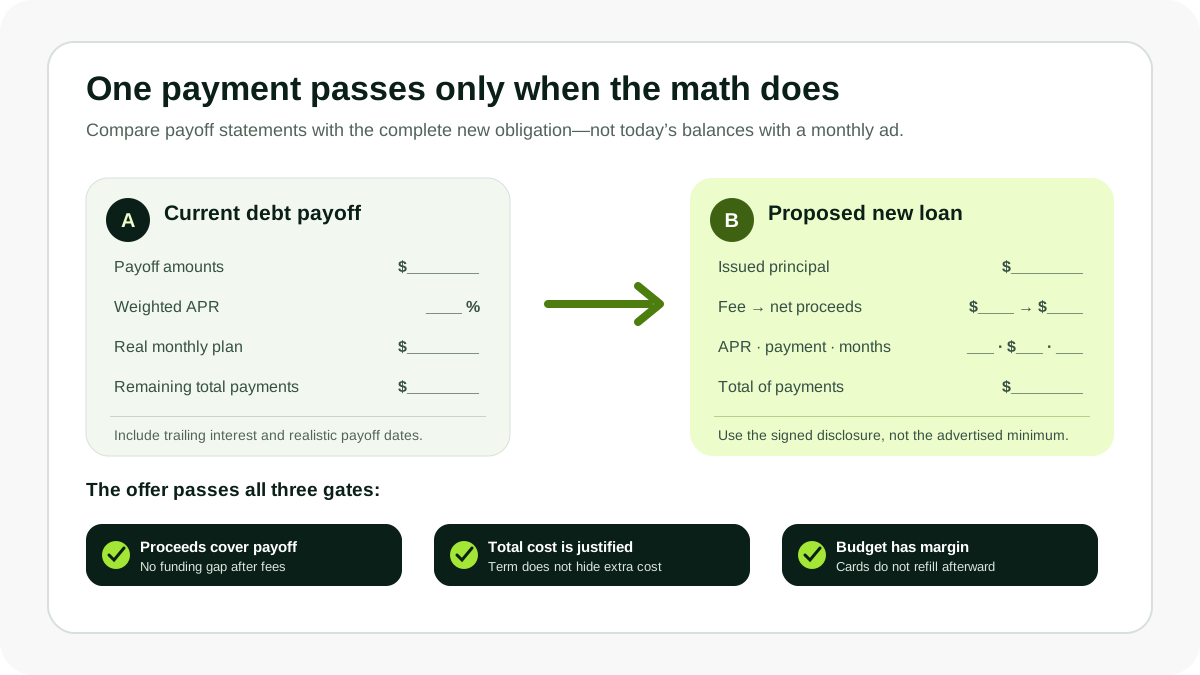
We compare only actual prequalified offers received on the same day and for the same amount. Advertised APR ranges are not personal quotes. The best consolidation loan must produce a lower APR or a clearly justified operational benefit, enough net proceeds after any fee to pay the intended balances, and a payment that fits the budget without reopening the cards.
One payment is not automatically cheaper. Compare payoff amounts, net proceeds, APR, term, total repayment, and the spending change needed to prevent new balances.
1. SoFi — best complete consolidation workflow
SoFi ranks first because its current product can handle both a large payoff and the operational work of sending funds to eligible credit cards. The published personal-loan range is $5,000 to $100,000, with fixed terms from two to seven years. As of July 6, 2026, SoFi advertises 6.99% to 35.49% fixed APR after a 0.25-percentage-point AutoPay discount and a 0.25-point member discount. The actual offer depends on credit, income, term, discounts, fees, and state availability.
The fee structure needs careful reading. SoFi offers a 0% to 7% optional origination fee path: selecting a fee can change the interest rate and APR, and the fee is deducted from proceeds. A no-origination-fee option is available. Compare APR, net proceeds, monthly payment, and total payments across both versions; “optional” does not mean the fee version is always worse. SoFi states that personal loans have no prepayment or late fee, although a missed payment can still produce delinquency, credit reporting, collection, and interest consequences.
For credit-card consolidation, SoFi can send approved Direct Pay funds to eligible creditors and deposit any applicable remainder. This reduces the chance that a borrower receives cash but delays the payoff. It does not guarantee a zero card balance: trailing interest, pending purchases, recurring charges, or a payment posted after statement calculation can leave an amount due. Confirm every creditor's payoff and keep making required payments until the old account shows zero.
The $5,000 minimum is SoFi's main weakness. Someone consolidating $2,500 should not borrow extra merely to qualify. The broad $100,000 maximum can also tempt a borrower to combine debts that should be handled differently, such as federal student loans with protections, secured debt, or a low-rate loan already close to payoff.
SoFi is best for a borrower who qualifies for a meaningfully lower fixed APR, needs at least $5,000, and values Direct Pay. It is not a solution when the offer is near 35%, the fee leaves insufficient proceeds, or the new seven-year total exceeds the existing payoff plan.
2. Happen Bank — best Direct Pay and joint application flexibility
Happen Bank, the current name of the former LendingClub banking business, ranks second. Its current personal-loan disclosures show $1,000 to $75,000, terms from 24 to 84 months, and 5.96% to 35.99% fixed APR under the offer stated as current from June 1, 2026. State, channel, amount, term, credit, debt-to-income ratio, and product availability affect the actual offer.
Most personal loans carry a 0% to 8% origination fee based on the borrower profile. The fee is deducted from proceeds and incorporated into APR. Happen says there is no application, brokerage, or prepayment fee, but it may assess late charges after a 15-day grace period. Its published refinance product can use a separate 1% processing fee, so applicants must distinguish a new loan, Direct Pay loan, and refinance offer.
Happen's Direct Pay loan can pay eligible credit cards and personal loans directly, then send remaining approved proceeds to the linked bank account. Joint applications can add a co-borrower where available. That can improve qualification or pricing, but the co-borrower becomes fully responsible for the obligation; it is not merely a reference or income helper.
The $1,000 minimum is more practical than SoFi or LightStream for a small consolidation. Terms up to seven years can lower the payment, but a longer term may increase total interest. Happen also says interest begins when the loan is issued even if bank availability takes several days, making the funding and first-payment timeline worth confirming.
Happen ranks below SoFi because its maximum origination fee is higher, late fees are possible, and the lowest balance is not enough to outweigh an expensive individual offer. It ranks above LightStream because Direct Pay, joint application support, and a lower minimum directly serve the consolidation use case.
3. LightStream — best no-fee offer for strong credit
LightStream ranks third and can be the cheapest actual offer for a strong-credit borrower. It advertises $5,000 to $100,000 and fixed terms from 24 to 240 months depending on loan purpose and amount. For ordinary debt consolidation, the available maximum term can be shorter than the longest purpose-specific term, so the offer—not the global range—controls.
The current consumer-loan page uses a 7.24% APR example and states a 25.39% maximum APR. Rates vary by purpose, amount, term, credit profile, and payment method. AutoPay must be selected before funding to receive the quoted discount; invoicing is 0.50 percentage points higher. The lowest rates require excellent credit.
LightStream says it charges no origination, application, or prepayment fee. Florida documentary stamp tax and a receiving-bank wire fee can apply in disclosed cases. Net proceeds therefore usually equal the approved principal outside those exceptions, which makes comparison cleaner than a deducted fee.
The limitation for consolidation is workflow. LightStream generally deposits proceeds into the borrower's account rather than presenting the same named Direct Pay feature as SoFi and Happen. The borrower must obtain payoff amounts, send funds promptly, confirm posting, address trailing interest, and avoid spending the cash elsewhere. A lender's same-day funding claim does not mean every creditor is paid the same day.
LightStream is the best candidate here for a borrower with strong credit who qualifies below the card APR, needs at least $5,000, wants no origination fee, and can manage payoff execution. It ranks third because the comparison is about consolidation, not general personal-loan quality.
4. Upstart — best broader-underwriting fallback
Upstart ranks fourth for applicants who may not fit conventional score-first underwriting. Loans are originated by lending partners, and the current product advertises $1,000 to $75,000, subject to state minimums including $3,100 in Georgia, $1,500 in Hawaii, and $7,000 in Massachusetts. Unsecured personal-loan terms are generally three or five years.
The published range is 6.2% to 35.99% fixed APR, based on five-year rates offered in March 2026. The representative $10,000, 60-month example uses a 17.50% interest rate and 7.25% origination fee, producing 21.23% APR and $9,275 in proceeds. Upstart says there is no prepayment penalty. The actual partner, fee, APR, amount, and underwriting result vary.
Upstart's model considers credit, income, and other application information and says no minimum educational attainment is required. That does not establish approval, a low rate, or fairness for an individual borrower. A high origination fee is especially important in consolidation because the borrower needs enough net cash to pay exact balances. To receive $10,000 after a 7.25% fee, the issued principal would need to exceed $10,000, increasing payment and interest.
Funding can be fast: Upstart reports that 69% of March 2026 customers had transfer initiated within 24 hours after approval and signing. The receiving bank controls availability. Speed should not shorten comparison; an emergency caused by unaffordable debt rarely improves when a high-cost offer is accepted in minutes.
Upstart is a useful fourth quote for a borrower with limited history or an unconventional profile. Reject it when the APR does not beat the debts, the fee creates a payoff gap, or the payment leaves no margin for essential expenses.
Debt-consolidation loan comparison
Lender
Published amount
Published APR context
Origination fee
Direct creditor payment
Main fit
SoFi
$5,000–$100,000
6.99%–35.49% with stated discounts, current Jul. 6, 2026
0%–7% optional; no-fee path available
Yes, eligible credit cards
Larger consolidation needing an integrated payoff workflow
Happen Bank
$1,000–$75,000
5.96%–35.99% fixed, stated current Jun. 1, 2026
0%–8% most loans
Yes, eligible cards and personal loans
Smaller balances, joint option, or Direct Pay flexibility
LightStream
$5,000–$100,000
7.24% example; 25.39% stated maximum
None; disclosed exceptions apply
Borrower generally manages payoff
Strong-credit borrower seeking a clean no-fee offer
Upstart
$1,000–$75,000 with state minimums
6.2%–35.99%, based on Mar. 2026 five-year offers
Partner-specific; 7.25% in representative example
Verify offer and funding path
Broader-underwriting comparison quote
Run the savings test with payoff statements
Collect each creditor's current balance, APR, minimum, payoff amount, trailing-interest rule, and expected payoff date. Add the remaining payments under a realistic accelerated plan—not merely today's balance. For the new loan, record issued principal, deducted fee, cash received, APR, payment, number of payments, and total of payments.
The new loan passes only if net proceeds cover the intended payoffs and its total cost is lower or a documented operational benefit justifies the difference. A $400 monthly payment for 60 months costs $24,000. A $330 payment for 84 months costs $27,720; the lower payment is $3,720 more before comparing old debt.
Do not compare advertised ranges
Prequalify with several lenders in a short, organized window when soft inquiries are available. Save the full offers. Compare the same amount and a similar term. One lender's 36-month offer cannot be ranked against another's 84-month offer using payment alone.
Confirm whether accepting triggers a hard inquiry, who originates and services the loan, whether the rate is fixed, and when the offer expires. Never pay an upfront fee to “unlock” a personal loan; origination fees on legitimate offers are disclosed in the agreement and typically deducted or financed as described.
Close the payoff loop
Direct Pay reduces work but does not remove responsibility. Keep minimum payments active until each creditor confirms receipt. Check for residual interest after the next statement. Move recurring subscriptions and inspect refunds or chargebacks that could reopen a balance.
Decide whether to keep cards open based on fees, temptation, utilization, age, and the written spending plan. Closing every card may affect utilization and available credit; keeping every card at hand may recreate the debt. The right answer is behavioral and credit-specific.
Fix the cash-flow cause
List take-home income, essentials, irregular expenses, minimums, and true annual costs. Create a small emergency buffer so the next car repair or medical bill does not return to a card. If the budget remains negative after reasonable cuts and income options, a new loan only delays the problem.
The CFPB recommends contacting creditors and considering reputable nonprofit counseling. A hardship plan may reduce rate or payment without a new origination fee. A debt-management plan is not the same as debt settlement, and a consolidation loan is not loan forgiveness.
Avoid settlement and consolidation confusion
Debt settlement companies may tell customers to stop paying while money accumulates in a separate account. That can add interest and fees, damage credit, trigger collection or lawsuits, and create tax consequences. The FTC says telemarketed for-profit debt-relief providers cannot charge before they actually settle or reduce a debt and must make required disclosures.
An unexpected call promising guaranteed forgiveness, asking for an upfront fee, or requesting account credentials is a red flag. Navigate to the lender or counselor independently and verify the organization.
Frequently asked questions
Which lender is cheapest for debt consolidation?
Only the personal offers can answer that. LightStream has no origination fee and a lower stated maximum APR, but it targets stronger credit. SoFi and Happen provide Direct Pay. Upstart may approve a different profile but can deduct a material fee. Compare APR, net proceeds, term, total repayment, and payoff workflow.
Will consolidation improve my credit score?
It may change utilization and account mix, but the application, new account, closed cards, payment history, and future balances all matter. No lender can guarantee a score increase. The main goal should be affordable, on-time repayment at lower cost.
Should I consolidate federal student loans with a personal loan?
Generally do not refinance federal loans into a private personal loan without understanding the permanent loss of federal repayment, deferment, discharge, and forgiveness protections. The lenders here also restrict certain education uses. Evaluate student debt separately.
Is Direct Pay safer than receiving cash?
It reduces diversion and administrative error, but the borrower must still confirm creditor details, payoff timing, trailing interest, and residual balances. Continue required payments until every payoff posts.
What if every offer is above 30% APR?
Pause before borrowing. Contact creditors about hardship options, review a nonprofit debt-management plan, reduce the amount, add an eligible co-borrower only with informed consent, or build credit and cash flow before reapplying. Avoid payday and title loans and anyone promising guaranteed debt elimination.
Our methodology
How we scored every product on this list
Weighted Savings and Cost 30%, Direct Pay 20%, Amount and Term Fit 15%, Eligibility 15%, Support 10%, and Safeguards 10%. We reviewed current documents but did not prequalify, apply, receive offers, fund loans, contact support, or pay creditors.
This review cycle used official product documentation, published methodology, current plan terms, and regulatory sources. Any hands-on or support-response testing is stated explicitly when performed. Read our fullmethodologyfor the complete scoring rubric.
DollarScout uses a privacy-friendly, cookie-less analytics script (Ahrefs) to understand traffic in aggregate. We don't sell your personal information and don't run ad trackers. You can review our Privacy Policy or opt out of data sharing any time.