
SoFi Personal Loans at a glance
SoFi Bank offers fixed-rate unsecured personal loans from $5,000 to $100,000 with terms from two to seven years. The product supports debt consolidation, home improvement, large purchases, medical expenses, relocation, and other permitted personal uses. It is not a revolving line of credit and is not secured by a home or vehicle.
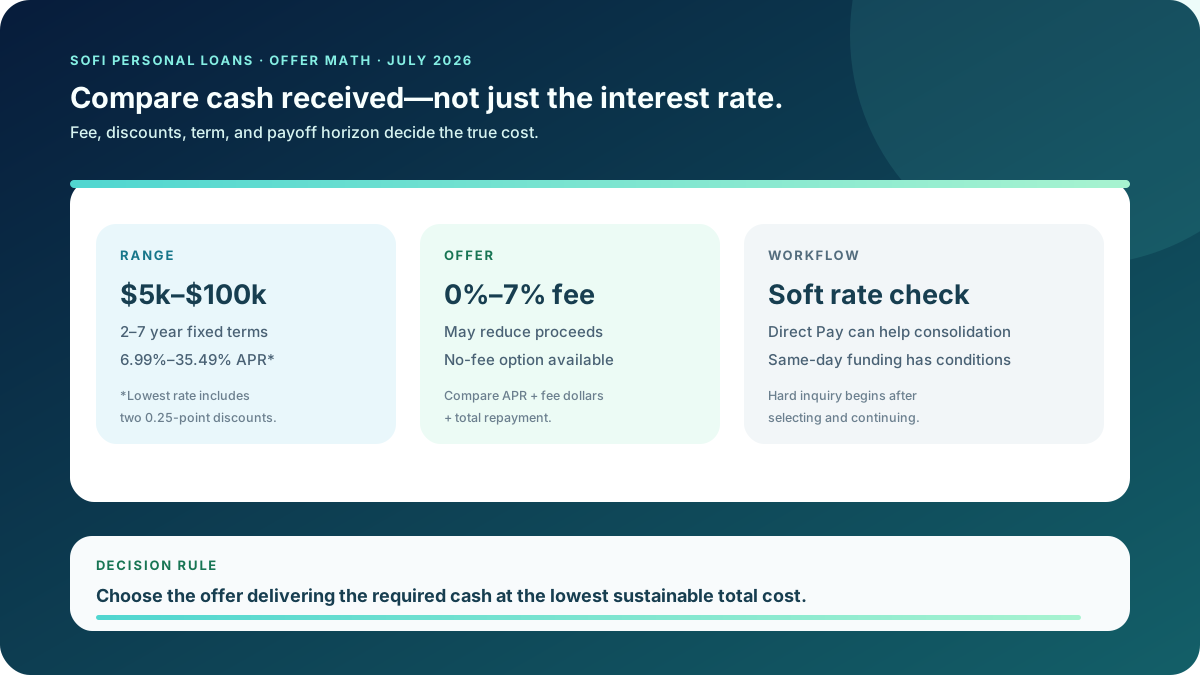
The current headline range is 6.99% to 35.49% fixed APR after a 0.25-percentage-point AutoPay discount and a separate 0.25-point member discount. SoFi can present a no-origination-fee option and offers with a 0% to 7% fee that is deducted from proceeds. A fee-bearing offer may use a lower interest rate, so “no fee” is not automatically the lowest total cost.
| Review question | DollarScout finding |
|---|---|
| Best for | Qualified borrowers seeking $5,000 to $100,000 and several pricing structures |
| Rate check | Soft inquiry; continuing the application triggers a hard inquiry |
| Terms | Two to seven years |
| Funding | Most eligible borrowers can receive funds the same day after approval and timely signing |
| Main risk | Comparing interest rate instead of APR, net proceeds, and total repayment |
APR and personalized pricing
APR scores 4.5/5. SoFi's range is competitive at the low end and broad enough to serve many credit profiles, but 35.49% is expensive debt. The final fixed APR depends on creditworthiness, income, monthly obligations, term, amount, fee structure, discounts, and state rules.
The advertised 6.99% floor assumes both AutoPay and member discounts. A borrower who does not qualify for one or later loses it can have a different rate and payment. The main page reports that the average funded APR for borrowers selecting a seven-year term between March 15, 2025 and March 15, 2026 was 15.89%. That historical average is more informative than the floor, but it is not a forecast for a new applicant.
Use APR rather than nominal interest rate to compare offers with different origination fees. Then check total repayment because two loans with similar APRs can have different terms. A seven-year loan can lower the monthly bill while materially increasing interest paid.
Optional origination-fee structures
Fees scores 4.4/5. SoFi says no origination fee is required and does not charge a prepayment or late fee. It can also display a structure with a 0% to 7% origination fee in exchange for different pricing. When charged, the fee is reflected in APR and deducted from the funds delivered.
Suppose the approved loan is $20,000 with a 5% fee. The borrower receives $19,000 but repays principal and interest based on the $20,000 obligation. If exactly $20,000 is needed for creditors or a contractor, the requested face amount must be higher, which changes the payment and total cost.
Compare every option on four lines: face amount, fee dollars, net proceeds, and total of payments. A no-fee offer preserves proceeds. A fee-bearing offer can still win if its lower rate saves more than the fee over the planned payoff period. Early payoff often favors the no-fee structure because an upfront fee has less time to be offset by interest savings.
AutoPay, member, and Direct Pay discounts
AutoPay reduces the interest rate by 0.25 percentage points while automatic deduction remains enabled. It is optional for approval. Keep a payment buffer and confirm whether an extra payment changes the next scheduled debit.
The separate 0.25-point member discount requires, within 31 days after funding, a SoFi Plus subscription, an eligible direct deposit into SoFi Checking and Savings, or at least $5,000 in qualifying deposits. The condition must continue to be met during each stated review period. Losing or regaining eligibility can change the rate and re-amortized payment.
Direct Pay is designed for eligible credit-card and personal-loan consolidation. At least 50% of proceeds must go directly to eligible creditors for the published rate discount. Mortgages, auto loans, and student loans are excluded. Creditor posting is not instantaneous, so keep making required payments until every old account shows the transfer.
Discounts should not drive an unwanted banking relationship. Compare the undiscounted loan and the operational burden of keeping each condition active.
Amounts and terms
Loan Amounts scores 4.8/5. The $100,000 ceiling is one of the largest mainstream unsecured ranges. That can consolidate several balances or fund a significant renovation without pledging a home. The $5,000 minimum, which can be higher in some states, is inefficient for a $1,200 repair.
Terms run from two to seven years, subject to the options actually offered. Choose the shortest payment the budget can sustain through a realistic income interruption. Extending a discretionary purchase over seven years can leave the borrower paying after the benefit is gone.
Borrow only the amount needed after accounting for any deducted fee. A higher approval is not a spending target. For debt consolidation, close the loop by confirming each creditor payoff and avoiding new balances on the cleared cards.
Eligibility and credit inquiries
Basic eligibility includes the age of majority, residence where SoFi is authorized to lend, eligible U.S. citizenship or immigration status, and employment, sufficient other income, or an employment offer starting within 90 days. Approval also considers financial history, credit, income, expenses, and existing SoFi obligations.
Checking a rate uses a soft credit inquiry and does not affect the score. Selecting an option and continuing the full application triggers a hard inquiry. The final approval remains subject to verification.
Use the soft stage to compare amount, term, APR, fee, discounts, proceeds, payment, and total repayment. Do not submit a full application merely to reveal terms already available through prequalification.
Application and funding speed
Funding Speed scores 4.5/5. SoFi describes three steps: prequalify, select terms and complete the application, then sign and receive funds. Most eligible borrowers can receive money the same business day when approval is complete and the agreement is signed before 5:30 p.m. Eastern.
Same-day funding is not guaranteed. Inaccurate information, verification, a partner-bank loan, the receiving institution, weekends, holidays, and signing after the cutoff can delay delivery. Direct Pay also requires creditor processing after disbursement.
Do not schedule a purchase or stop paying an old creditor until funds post. Save the approval, Truth in Lending disclosure, signed note, disbursement confirmation, and creditor-payment evidence.
Customer service and hardship
Customer Service scores 4.5/5. SoFi publishes phone hours seven days a week, authenticated chat and account support, product help pages, and a broad member platform. Its eligibility and Direct Pay documentation answer important pre-application questions.
Marketing and older SoFi material discuss unemployment support, but a borrower should rely only on the hardship terms in the final current agreement and authenticated account. Payment relief can extend a payoff date or allow interest to accrue. Contact the servicer before a payment is missed and request the effect on interest, payment, term, and credit reporting in writing.
DollarScout did not time a support contact or test a hardship request. The score reflects documented access and product support, not a promised resolution time.
Keep requests and responses in the authenticated message center when possible, and download any written modification before relying on it. Ask whether relief changes accrued interest, the next due date, monthly payment, maturity date, or credit reporting. A temporary payment reduction can improve cash flow without reducing the total obligation.
Debt-consolidation controls
Consolidation works only when the new APR and total repayment improve the old debt and the paid-off balances do not return. List each creditor's balance, APR, minimum payment, payoff amount, and promotional expiration. Compare those totals with the SoFi offer after fees.
Direct Pay reduces transfer work but does not verify that every account reaches zero. Interest can accrue between the quoted payoff and posting. Check each account after payment, resolve residual cents, and preserve statements.
A lower monthly payment can come from a longer term rather than a lower cost. Compare the payoff date and total of payments alongside monthly cash flow.
After funding, save each creditor's zero-balance statement and check all three credit reports after normal reporting cycles. Direct Pay is a transfer mechanism, not proof that every residual dollar was cleared or that an old card will remain unused.
SoFi versus alternatives
Choose LightStream when credit is strong, a hard inquiry is acceptable, and a no-origination-fee offer with full proceeds is the priority. Choose Upstart when broader underwriting inputs may improve access and its APR remains competitive after the fee.
Happen Bank can be useful for a lower minimum, Direct Pay, and joint applications, while a local credit union may provide relationship pricing or a secured alternative. Check at least three soft-pull offers where possible.
SoFi stands out when a borrower needs more than $5,000, values several term and pricing choices, and will actively manage the discount conditions.
Who SoFi is best for
SoFi fits borrowers who:
- Need $5,000 to $100,000 for a permitted personal use.
- Can qualify near the stronger end of the range.
- Want a soft-pull comparison before a hard inquiry.
- Will compare no-fee and fee-bearing structures precisely.
- Can maintain only the discounts that are operationally sensible.
It is weaker for a small emergency, an applicant near the maximum APR, anyone treating a seven-year term as permission to overspend, or a borrower who does not want to monitor ongoing discount conditions.
Bottom line
SoFi earns 4.5/5. The amount range, soft rate check, fixed terms, flexible fee structures, Direct Pay, potential same-day funding, and documented service make it one of the most complete personal-loan products.
Its flexibility creates the main risk: headline rate, interest rate, APR, fee, proceeds, discount, and term are different variables. Compare every final disclosure on equal proceeds and an equal payoff horizon before signing.


