Upstart at a glance
Upstart Network is a technology marketplace, not the lender. Banks and credit unions originate the loans shown through the platform. Upstart collects application information, uses its underwriting model and partner criteria to surface possible terms, and can support servicing after origination.
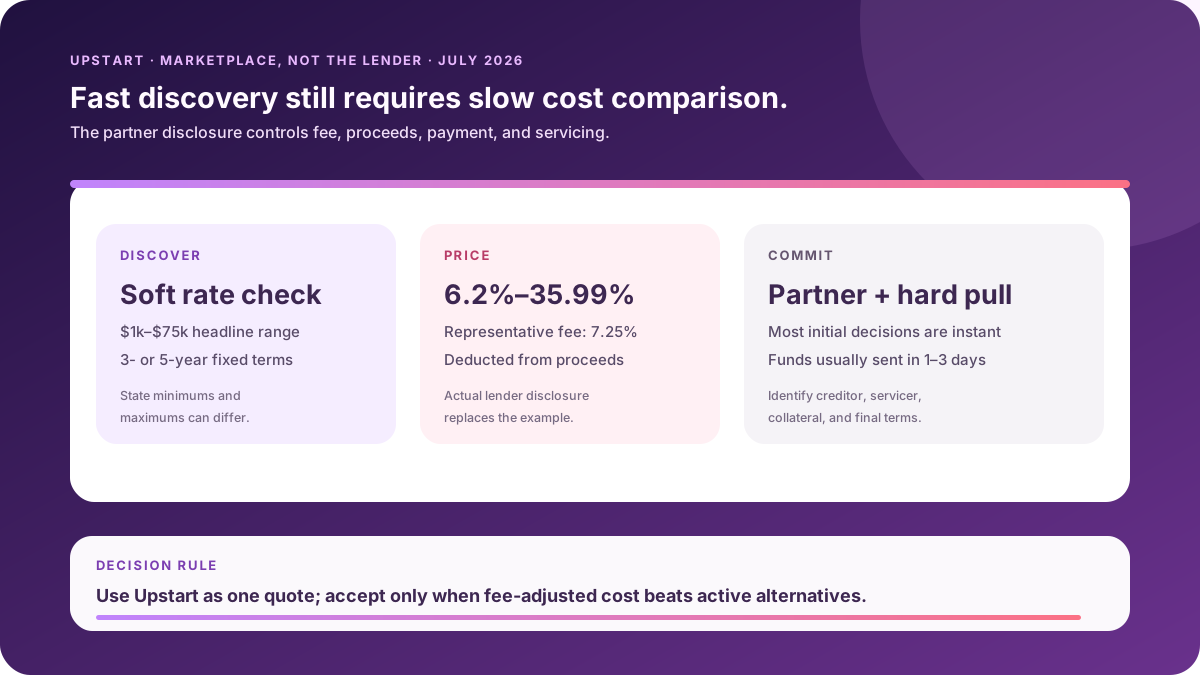
Current unsecured personal-loan disclosures show $1,000 to $75,000, fixed APRs from 6.2% to 35.99%, and three- or five-year terms. State minimums and maximums differ. The rate check uses a soft inquiry; accepting an option and proceeding triggers a hard inquiry.
| Review question | DollarScout finding |
|---|---|
| Best for | Applicants who may benefit from broader underwriting inputs and fast comparison |
| Platform role | Marketplace; regulated banks and credit unions make the loans |
| Amount | $1,000 to $75,000, subject to state limits |
| Funding | Transfer can be initiated in as fast as 24 hours after approval and signing |
| Main risk | A deducted origination fee can make proceeds much lower than face amount |
APR and representative cost
APR scores 3.8/5. The current fixed range is 6.2% to 35.99% for unsecured personal loans. The lowest rate is reserved for the strongest profiles and the available range varies by state.
Upstart's representative example uses a $10,000, 60-month loan with a 17.50% interest rate and a 7.25% origination fee, producing 21.23% APR. The borrower receives $9,275 and makes 60 payments of about $252. That example is based on five-year rates offered in March 2026; it is not a typical or guaranteed offer.
APR is the right first comparison because it incorporates the interest rate and certain finance charges. Total repayment is the second. A three-year loan can carry a higher payment and lower total interest; a five-year term can ease monthly cash flow while extending cost.
At the high end, 35.99% is expensive and can be difficult to justify for a discretionary purchase. Compare a credit union, no-fee lender, secured option, payment plan, and the cost of postponing the expense.
Origination fees and net proceeds
Fees scores 3.4/5. The fee is partner- and offer-specific. Upstart's platform agreement says a creditor can charge a nonrefundable origination fee, disclose it in the note, and deduct it from unsecured-loan proceeds. Late and returned-payment fees can also apply under the final agreement. Upstart advertises no prepayment penalty.
A 7.25% fee on $20,000 removes $1,450, leaving $18,550. The borrower still repays the face principal plus interest. If the goal is to deliver $20,000 to creditors, requesting only $20,000 creates a shortfall.
Record five values for every offer: face amount, fee dollars, net deposit, monthly payment, and total of payments. A lower interest rate does not compensate for a high fee automatically. An early payoff can make an upfront fee especially costly because it has less time to be offset by lower interest.
Amounts, terms, and state limits
Loan Amounts scores 4.5/5. A $1,000 national starting point serves smaller needs better than lenders with a $5,000 minimum, while $75,000 covers large consolidation and improvement projects. State rules override the headline range: current disclosures list minimums of $3,100 in Georgia, $1,500 in Hawaii, and $7,000 in Massachusetts, and maximums can vary.
Unsecured personal loans ordinarily use three- or five-year terms. Not every applicant sees both. Most offers are unsecured, but Upstart warns that certain partner institutions can place a lien on other accounts held with that institution, and the platform may show an auto-secured personal-loan option. Read the collateral section instead of assuming every product is identical.
Use proceeds only for permitted personal, family, or household purposes. The agreement and lender note govern restrictions. Post-secondary education, illegal activity, or a use requiring a different regulated product can be prohibited.
Broader underwriting is not guaranteed approval
Upstart markets a model that considers credit, income, employment, education, and other submitted information. Neither Upstart nor its partners require a minimum educational attainment merely to be eligible, and education should be understood as one possible input rather than a credential gate.
The approach can help a borrower whose conventional score does not capture a stable job or improving profile. It can also return no offer or an expensive one. Income, existing debt, delinquencies, identity verification, state availability, and each partner's credit policy still matter.
Provide accurate information and upload documents only through the authenticated workflow. A request to pay an outside “agent” or send credentials by message is not part of the documented application.
Soft rate check and hard application
Checking a rate takes about five minutes and uses a soft credit inquiry. It can appear on the consumer's own report without lowering the score. Selecting an offer and moving to final approval triggers a hard inquiry that can affect credit.
The soft stage is the right point to compare Upstart with SoFi, Happen, a credit union, and other lenders. Personal-loan hard inquiries are not always grouped for scoring in the same way as mortgage or auto rate shopping, so do not submit several full applications casually.
An instant initial decision can still be conditioned on the hard pull, income, identity, bank account, or document verification. “Approved instantly” does not mean unconditional funding.
Decision and funding speed
Funding Speed scores 4.7/5. Upstart says the majority of unsecured-loan applicants receive an instant decision after a completed application without additional paperwork. In March 2026, 69% of customers had the transfer initiated within 24 hours after approval and signing.
The help center gives a broader expectation of one to three business days for funds to be sent. Partner cutoff times differ, and completing documents before about 11:50 a.m. Eastern can improve the chance of same-day initiation. Bank holidays and the receiving institution affect arrival.
Funds ordinarily go to a verified personal account at a U.S. financial institution. Business accounts are not accepted for ordinary personal-loan disbursement. Do not promise a creditor or contractor money until the bank makes it available.
Payments, servicing, and support
Customer Service scores 4.0/5. Upstart maintains a borrower help center covering applications, identity checks, funding, fees, due dates, payments, payoff, and credit reporting. The final lender and any servicer named in the note remain important because not every loan has identical policies.
Eligible borrowers may be able to change a due date through the account, but exceptions apply. A late fee can be assessed after the grace period stated in the agreement, and an account 30 or more days past due can be reported. Interest can continue even before a fee appears.
Contact support before a missed payment and ask for any relief terms in writing. Save the application, creditor identity, Truth in Lending disclosure, promissory note, fee, funding record, payment history, and payoff confirmation.
DollarScout did not time support or test a servicing dispute. The score reflects documented resources and access rather than a measured outcome.
Preserve the note, payment confirmations, messages, and any written modification. The marketplace can facilitate origination, but the named creditor and servicer control the live account. If a payment or balance is wrong, direct the documented dispute to the entity shown on the statement rather than assuming Upstart itself owns the debt.
Debt-consolidation discipline
Debt consolidation was the stated use for a majority of Upstart rate checks in March 2026. The loan helps only when it reduces cost or creates a workable payoff plan without re-accumulating balances.
List each old balance, payoff quote, APR, minimum, and promotional expiration. Compare their weighted cost with the new APR and total repayment. If an origination fee causes proceeds to fall short, decide how the residual creditor balance will be paid.
After disbursement, verify every payoff and continue old minimums until accounts post correctly. A fixed installment payment creates an end date, but clearing credit-card limits can invite new debt unless spending and emergency savings also change.
Upstart versus alternatives
Choose SoFi for a larger $100,000 ceiling, two- to seven-year terms, Direct Pay, and the ability to compare no-fee and fee-bearing structures. Choose LightStream when credit is strong and full proceeds with no origination fee outweigh the absence of soft prequalification.
Happen Bank can provide Direct Pay and joint applications with its own fee range. A local credit union can offer a smaller amount, relationship underwriting, or a secured loan at a lower APR.
Upstart is most useful as an additional soft-pull quote for an applicant whose broader profile may matter. It should not become the default merely because the decision is fast.
Who Upstart is best for
Upstart fits borrowers who:
- Want to check a personalized range without score impact.
- Have a thin or nontraditional credit profile with verifiable income.
- Need between $1,000 and $75,000, subject to state rules.
- Value a fast decision and can wait through verification.
- Will compare the partner offer on net proceeds and total cost.
It is weaker for a borrower receiving a high fee or near-maximum APR, someone needing more than $75,000, or anyone unwilling to identify the actual creditor and servicing terms.
Bottom line
Upstart earns 4.0/5. Its soft rate check, wider underwriting inputs, useful amount range, mostly instant initial decisions, and fast transfer process make it a credible marketplace.
Fees and high-end APR prevent a stronger score. Treat Upstart as a comparison channel, not a lender promise: identify the institution, normalize proceeds, read the complete disclosure, and choose the shortest affordable offer that improves the existing alternative.