Lili at a glance
Lili combines online business checking and savings with cards, domestic and international wires, employee access, invoices, expense management, tax reserves, accounting reports, and credit-related add-ons. The platform serves sole proprietors and registered entities and is designed to replace several administrative tools with one login.
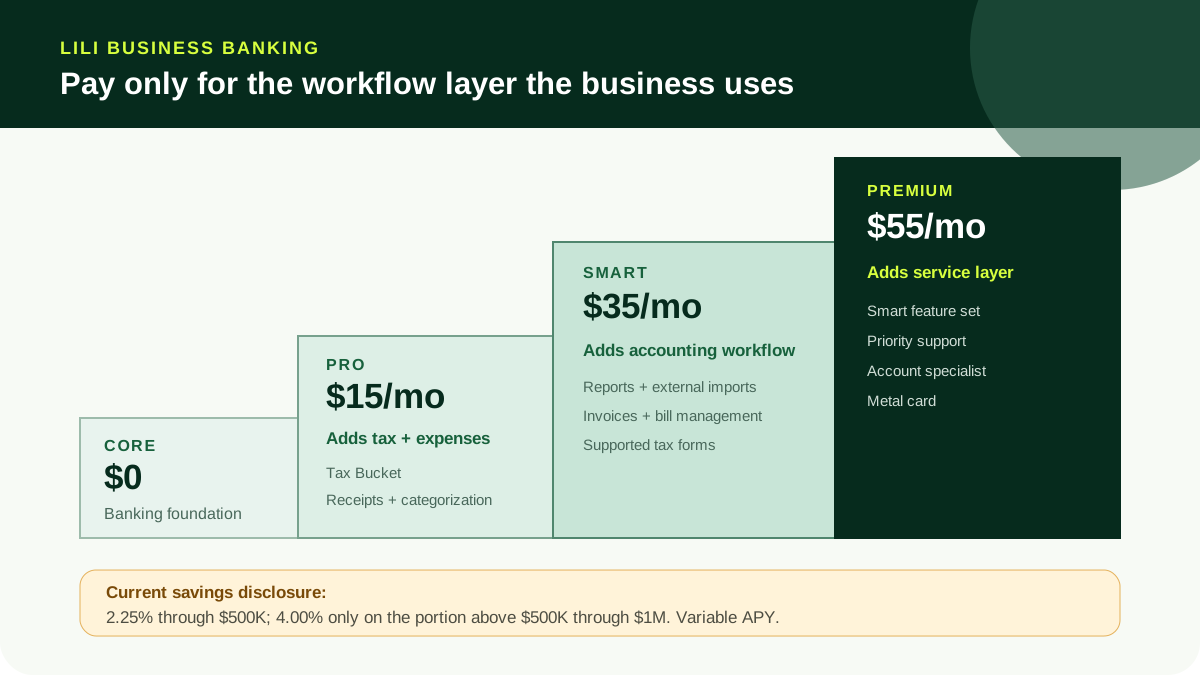
Its breadth creates a more difficult buying decision than a simple free account. Core covers banking basics. Pro adds tax and expense tools. Smart adds fuller accounting, invoices, external transaction imports, and reports. Premium adds higher-touch service and a metal card. Savings yield is described separately from the checking plan and is subject to current disclosure terms.
| Review question | DollarScout finding |
|---|---|
| Best for | Small businesses wanting banking plus selectable tax, accounting, and team features |
| Monthly plans | Core $0; Pro $15; Smart $35; Premium $55 |
| Current savings APY | 2.25% through $500,000; 4.00% on the portion above $500,000 through $1 million |
| Deposit protection | Up to $3 million through Sunrise Banks and sweep-program banks, subject to conditions |
| Main limitation | Four plans, transaction fees, partner services, and feature eligibility require careful comparison |
:::note Lili’s savings APY is variable. The current product page says the disclosed rate is effective January 13, 2026. Older help articles can display prior rates, so users should rely on the disclosure shown during enrollment and in the current account terms. :::
Plan pricing
Fees score 4.1/5. Lili Core has no monthly or annual plan fee and no required minimum balance. It includes checking, a Visa debit card, savings, early eligible ACH availability, wires, business-tool connections, statements, and core money movement. Optional transaction and add-on fees still apply.
Lili Pro costs $15 monthly or $144 annually. Annual billing saves $36 versus twelve monthly charges. Pro adds eligible cash-back rewards, automatic tax savings, expense categorization and splitting, receipt capture, income and expense insights, an expense report, and access to Lili’s discretionary BalanceUp program when approved.
Lili Smart costs $35 monthly or $336 annually. It adds categorization for income and expenses, multiple accounting reports, pre-filled business tax forms for supported classifications, invoices, bill management, external bank and card transaction imports, and Accountant AI. Annual billing saves $84.
Lili Premium costs $55 monthly or $528 annually. It includes Smart features plus a metal card, a dedicated account specialist, and priority support. Annual billing saves $132 versus twelve monthly payments.
Plan fees are charged in advance after any applicable trial or discount. Lili’s help center says annual customers have ten business days from payment to request a full refund; after that the annual fee is not refunded merely because the user downgrades. Promotional onboarding prices do not change the ongoing list price.
Current savings APY
Yield receives 4.7/5. Lili’s current business-banking disclosure lists 2.25% APY on savings balances up to and including $500,000 and 4.00% APY on the portion above $500,000 through $1 million. Any portion over $1 million earns no interest under that disclosure. At least $0.01 must be in savings.
The tiering is marginal. A $600,000 savings balance does not earn 4.00% on every dollar; the first $500,000 earns the lower rate and the next $100,000 earns the higher rate. The blended rate is therefore lower than 4.00%.
Lili’s current page says savings is available across plans, while some older support pages still describe earlier plan eligibility and rates. The legally applicable rate and access are the ones shown in the current account disclosure and the user’s account. DollarScout treats the January 2026 product disclosure as current and flags the documentation difference rather than silently mixing periods.
Checking and savings are different balances. Money must be placed in the interest-bearing savings account, and transfers should preserve enough checking liquidity for bills, cards, payroll, and pending withdrawals. APY is variable and fees can reduce earnings.
FDIC insurance and partner structure
Lili is a financial technology company, not a bank. Core banking services are provided by Sunrise Banks, N.A., Member FDIC. Lili advertises up to $3 million in FDIC coverage through Sunrise and a sweep network of program banks.
The standard $250,000 limit applies per depositor, per insured bank, per ownership category. Sweep coverage depends on pass-through conditions, correct account records, the current bank network, and any other deposits the business holds at those banks. Customers with large balances should check program-bank placement rather than assuming $3 million is automatic.
Wire services use Column Bank, N.A. and can be subject to acceptance and risk review. The optional BusinessBuild card involves CapitalOS and First Internet Bank of Indiana. A feature’s provider determines the relevant agreement, insurance, credit treatment, and dispute path.
FDIC insurance covers an insured bank’s failure. It does not cover tax categorization, software errors, a declined wire, fraud outside applicable protections, or credit-product loss.
Banking and payment fees
Core’s no-fee claim concerns the plan, not every transaction. Lili’s fee schedule lists free standard ACH and incoming domestic wires, $15 outgoing domestic wires, $15 incoming international wires, and $25 outgoing international wires, with a 1% commission for certain currency-converted transfers. Mailed checks cost $3.
MoneyPass ATM withdrawals are free from Lili, while out-of-network and international ATM charges can apply. Cash deposits use participating retail locations and can involve merchant fees up to $4.95 and app-specific limits. This suits occasional cash more than a high-volume register operation.
International wires are limited to eligible legal entities and supported countries. A sole proprietor or a business in an unsupported corridor should not subscribe based on international-payment marketing before confirming access inside the app.
Tax and bookkeeping tools
Integrations score 4.3/5. Pro can automatically set a chosen percentage of eligible business income aside in a Tax Bucket. Expense categorization, receipts, and reports help organize deductions. Smart and Premium add more complete income and expense categorization, profit-and-loss and cash-flow reports, supported pre-filled tax forms, external account imports, invoices, bills, and AI-assisted accounting workflows.
These tools assist accounting; they do not make Lili a tax preparer. Lili states that final categorization is the user’s responsibility and that its reports are not tax, legal, or accounting advice. An AI suggestion can accelerate review but should not post an unusual transaction without evidence.
External imports improve completeness when spending occurs on another card or account. They also create reconciliation work: duplicates, missing pending transactions, transfers, owner contributions, loan principal, and reimbursements need correct treatment. The source statement controls.
Smart’s reports include income and expense, profit and loss, cash flow, and Schedule C-related output. A business with inventory, payroll, depreciation, accruals, multiple entities, or formal financial statements can require a dedicated accounting ledger even if Lili remains the bank.
Team access and cards
Lili supports multiple users and describes role-based permissions for partners, administrators, and accountants, along with approval thresholds. Plan fees are charged per account rather than per user according to the help center.
Delegated access is valuable only when roles are configured narrowly. Accountants generally need records, not payment authority. Staff cards need merchant or amount limits. Large transfers can require a second approver. Permissions should be reviewed when responsibilities change and removed immediately during offboarding.
The optional BusinessBuild program is a separate paid add-on, currently described as $30 per month after introductory pricing. It reports certain payments to Dun & Bradstreet and may affect a business credit profile. It is not available to every entity or owner, and positive score movement is not guaranteed.
Onboarding and eligibility
Onboarding scores 4.5/5. Lili advertises a digital application using business information and identity verification, with no branch visit. It supports sole proprietors, LLCs, corporations, partnerships, and certain international founders operating a registered U.S. business.
Eligibility and features still vary by entity, residency, verification, and risk review. Prepare formation documents, EIN or tax information, beneficial-owner details, physical address, expected activity, and identification. International founders should confirm which wires, cards, and add-ons are available before moving core cash.
Test the operating workflow in stages: fund a small amount, verify routing details, create user roles, send one ACH, receive one customer payment, connect accounting, and reconcile the first statement. Keep another payment path until the process is stable.
Customer support
Customer Service scores 4.2/5. Lili advertises live support seven days per week and 24/7 assistance, while Premium adds priority service and a dedicated account specialist. It also publishes a detailed help center.
DollarScout did not submit timed support cases. The score reflects available channels and plan differentiation, not a guaranteed response time. Partner-bank and wire issues can require coordination beyond Lili, so retain transaction identifiers, confirmation emails, dates, and the provider named in the relevant disclosure.
Do not pay $55 monthly solely for the expectation of faster help. Premium should earn its cost through the combined reports, payments, team operations, and support actually used.
Alternatives
Choose Found for an especially strong free workflow around Pockets, invoices, contractor records, and sole-proprietor tax estimates. Choose Relay for many checking accounts, unlimited users, approval automation, and a clear Profit First fit. Choose Bluevine for checking APY, payment tools, and paid tiers whose fees can be waived through substantial balance and card activity.
Choose Mercury for a digital startup prioritizing global USD wires, advanced permissions, startup integrations, and Treasury for eligible large balances. A traditional bank is more appropriate when branches, frequent cash deposits, merchant services, or local relationship underwriting are central.
Who should use Lili
Lili is a strong candidate for businesses that:
- Want free core banking with the option to add tax or accounting features.
- Will use the savings account and understand marginal APY tiers.
- Need team permissions, cards, wires, and multiple administrative tools.
- Can select one tier based on actual features rather than upgrading by default.
- Operate mostly digitally with occasional cash.
It is easier to skip when the business needs a simple one-plan product, branch cash service, full accounting, guaranteed credit access, or international features that are not confirmed for its entity.
Bottom line
Lili earns 4.3/5. Core is a credible free business account, and the paid ladder can consolidate tax reserves, bookkeeping, invoices, reports, teams, and higher-touch service. Current savings disclosures are competitive, especially for large eligible balances, and the conditional sweep network expands stated deposit protection.
The product requires disciplined selection. Rates and older help pages can differ, four plans obscure the minimum needed tier, and partner services have separate terms. Start with Core or the lowest plan that completes a defined job, confirm the current savings disclosure inside the account, reconcile one full month, and upgrade only when a paid feature replaces measurable cost or work.