Many products on this page are from partners who compensate us. This doesn't influence our ratings. Our opinions are our own.
Lili vs Found: 2026 Business Banking Comparison
By Sophie Brown, Senior Finance Editor · Updated Jul 2026 · Fact-checked Jul 18, 2026
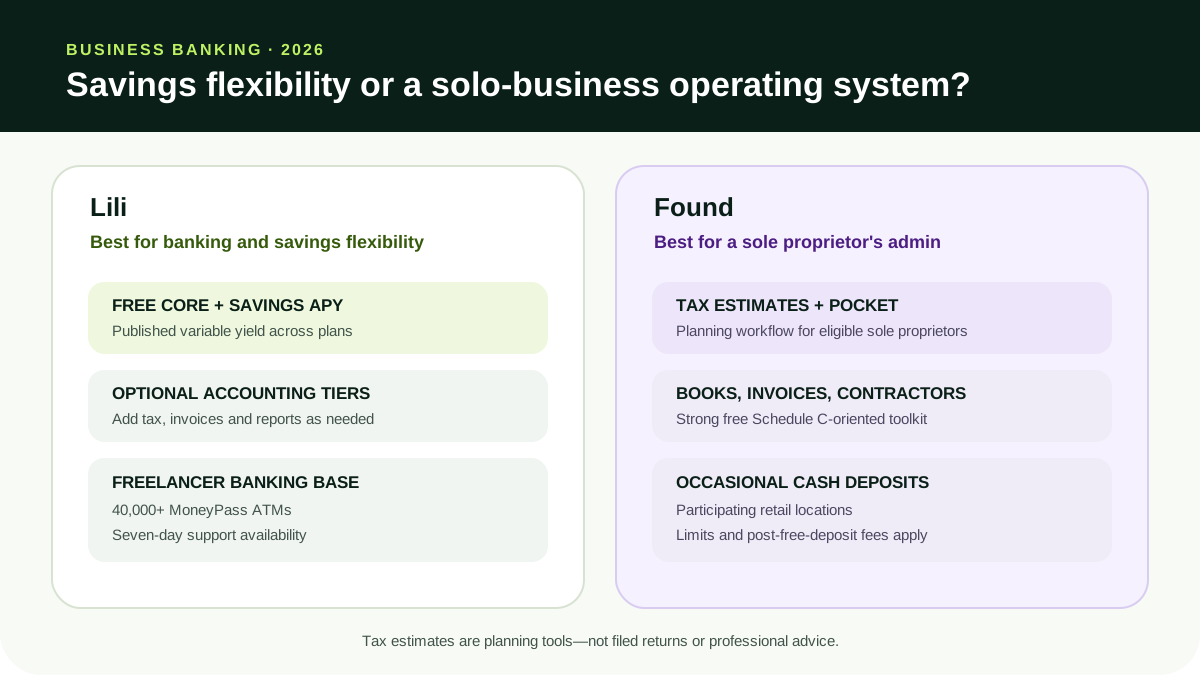
Lili and Found both earn 4.3/5 overall, but they solve different problems. Lili is the better fit for an owner who wants a free operating account, savings yield without buying a premium plan, broader support availability, and optional accounting upgrades. Found is stronger for a U.S. sole proprietor who wants transaction categorization, tax estimates, tax pockets, invoicing, contractor tools, and Schedule C-oriented records in one workflow. Choose Lili for banking and savings flexibility; choose Found for the more cohesive solo-business bookkeeping and tax-planning system.
Head-to-head
| Feature | Lili | Found |
|---|---|---|
| DollarScout Rating | 4.3/5 ★ | 4.3/5 ★ |
| Monthly Fee | Core $0; Pro $15/month or $144/year; Smart $35/month or $336/year; Premium $55/month or $528/year | Found $0; Found Plus $35/month or $315/year; Found Pro $80/month or $720/year; one 30-day paid-plan trial for eligible users |
| Yield | Current savings disclosure: 2.25% on balances through $500,000 and 4.00% on the portion over $500,000 through $1 million; no yield above $1 million | Free plan pays no APY; Plus pays 1.50% on balances up to $20,000; Pro pays 2.50% on all balances with no stated cap |
| Deposit Insurance | Up to $3 million through Sunrise Banks and sweep-program banks, subject to pass-through conditions and deposits held at participating banks | Up to $250,000 per depositor for each ownership category through Lead Bank, Member FDIC |


Category-by-category breakdown
Fees
Yield
Integrations
Onboarding
Customer Service
Detailed analysis
The short answer
Choose Lili for banking flexibility and savings; choose Found for integrated solo-business administration. DollarScout rates both products 4.3/5 overall, so the right answer is determined by the work you need the account to perform rather than a rounded headline score.
Lili Core has no monthly subscription, and Lili publishes a variable savings APY for eligible balances across its plans. Paid Lili tiers add bookkeeping, tax, invoicing, and business-management features. Found also has a free plan, but its clearest advantage is that categorization, receipts, profit-and-loss reporting, tax estimates, contractor records, and unlimited invoicing already form a connected workflow for a sole proprietor.
| Decision factor | Lili | Found |
|---|---|---|
| Free plan | Core: $0 monthly subscription | Found: $0 monthly subscription |
| Paid plans | Pro $15/month; Smart $35/month before temporary promotions | Plus $35/month or $315/year; Pro $80/month or $720/year |
| Published savings proposition | Variable tiered APY available across plans | Plus publishes 1.50% APY up to $20,000; Pro publishes 2.50% with no stated balance cap |
| Tax workflow | Tax bucket and enhanced tools vary by plan | Real-time estimates and a tax Pocket are central to the product |
| Best fit | Freelancer or small owner wanting banking plus optional accounting | Sole proprietor wanting banking, bookkeeping, invoices, and tax planning together |
Monthly fees and plan value
Lili Core advertises no monthly fee, no minimum balance, and no overdraft fees. Its paid plans are currently listed at $15 per month for Pro and $35 per month for Smart, with temporary introductory discounts displayed on the plan page. A promotional price should not be used as the long-run cost: compare the ordinary subscription price over 12 months with the separate bookkeeping, invoicing, or tax software it could replace.
Found's free plan also has no monthly fee or minimum balance. Found Plus is $35 monthly or $315 annually, while Found Pro is $80 monthly or $720 annually under the current published pricing. The annual price lowers the effective monthly cost but also creates a larger upfront commitment. Found's fee schedule says the core account does not charge to open or use the account and lists ordinary transfers, invoices, and payments as free, while faster movement methods can carry separate charges.
Neither product wins simply because both have a $0 entry point. Lili is more economical when its free savings and banking workflow is enough. Found is more valuable when its free bookkeeping and tax organization prevent a solo owner from paying for another system or reconstructing records at year-end.
Savings yield: compare the whole balance
Lili publishes a tiered variable savings APY effective January 13, 2026: 2.25% on the portion of an eligible balance up to $500,000, 4.00% on the portion above $500,000 through $1 million, and no yield on the portion above $1 million. The wording matters. A $600,000 balance does not earn 4.00% on every dollar; only the applicable upper tier receives that rate. Lili says savings is available across its plans.
Found ties its published yield to paid subscriptions. Plus publishes 1.50% APY on balances up to $20,000. Pro publishes 2.50% APY on eligible balances with no advertised cap. The free plan should not be assumed to earn those rates. For a modest business reserve, subtract the subscription cost before concluding that the higher-tier account improves total return.
For example, a $10,000 balance at 1.50% would generate about $150 over a year if the rate remained unchanged, before tax. That does not by itself offset a $315 annual Plus subscription. The plan may still be worthwhile for its operational tools, but yield alone is not the case. APYs are variable, and actual interest depends on balances and timing.
Bookkeeping and expense organization
Found is more cohesive for a sole proprietor who wants the account to act as a lightweight ledger. The free plan includes transaction categorization, receipt capture, profit-and-loss reporting, real-time tax estimates for supported sole-proprietor profiles, contractor management, W-9 and 1099 tools, and unlimited invoices. Because the banking activity begins inside the same system, less information has to be copied between disconnected apps.
Lili also categorizes expenses and supports receipts, invoices, reports, and tax-related tools, but the advanced accounting feature set depends more heavily on the selected paid plan. That is not inherently worse: an owner who already uses QuickBooks or another ledger may prefer a free operating account and avoid paying twice for overlapping bookkeeping.
Neither platform eliminates reconciliation. Owners should review merchant categories, split mixed purchases, attach receipts, reconcile transfers, and keep supporting documents. Software can propose a category; it cannot determine the business purpose of a questionable expense.
Tax estimates are planning tools, not tax advice
Found's tax estimate is one of its most useful differentiators, but it needs a precise interpretation. Found says the estimate uses income, expenses, profile information, mileage, and home-office inputs for eligible sole proprietors. Its tax Pocket can automatically allocate a selected percentage of deposits so that tax cash is separated from operating money.
An estimate is not a filed federal or state return, a payment to the IRS, or professional tax advice. It can be incomplete when a household has wages, another business, investment income, credits, entity-level elections, employees, multi-state obligations, or unusual deductions. The owner remains responsible for verifying estimated payments and deadlines.
Lili also offers tax buckets and tax-management tools, with availability depending on the plan. The same caution applies. Treat any suggested amount as a planning signal, compare it with actual prior-year liability and current income, and consult a qualified professional when the business or household is more complex than a straightforward Schedule C.
Invoicing and getting paid
Both products let a small business issue invoices and receive customer payments without building a separate accounts-receivable stack. Found includes unlimited invoicing in its free feature set and connects paid invoices to the same categorization and tax workflow. That is especially useful for a consultant, designer, cleaner, photographer, or other service operator who sends relatively simple invoices.
Lili includes invoicing capabilities and promotes customer-payment tools within its broader business platform. Plan limits, payment methods, processing times, chargeback handling, and instant-access fees should be checked before replacing a dedicated payment processor.
An invoice tool is not a complete accounting control. Number invoices consistently, preserve customer and service details, reconcile partial payments, record processor fees separately, and maintain a second copy of important records. Businesses with inventory, purchase orders, complex sales tax, revenue recognition, or approval chains will usually outgrow both native invoice systems.
Pockets, buckets, and cash-flow discipline
Found provides a Primary Pocket, a tax Pocket, and up to eight custom Pockets under its current guidance, for a total of as many as 10. Pockets can receive automatic allocations and can have distinct account details or card assignments under applicable rules. This makes a simple “tax, payroll, owner pay, operating expense” allocation visible without opening accounts at several institutions.
Lili supports a tax bucket and savings-oriented organization, with the precise automation and accounting features determined by the plan. Its savings account is the stronger option when the priority is earning yield on a reserve rather than building a detailed envelope system inside the checking workflow.
Automation should begin conservatively. A percentage that diverts too much revenue can leave the operating account short before payroll or rent. Start with a small allocation, monitor two cash cycles, and keep a documented minimum operating buffer.
Cash deposits and ATM access
Found supports cash deposits at participating retail locations through an in-app barcode rather than an ATM. Its help center currently says one cash deposit per month is free and later deposits cost $2, with published rolling limits. Store availability and cashier procedures can vary, so a cash-heavy business should test a nearby location before moving its primary account.
Lili advertises access to more than 40,000 MoneyPass ATMs without a Lili fee. Retail cash deposits can carry a third-party fee of up to $4.95 under the published banking information. A fee on every deposit can become material for a food vendor, barber, market seller, or other cash-intensive operator.
Neither is equivalent to a branch bank with a night depository, coin service, change orders, and teller support. A business that regularly handles cash may need a local bank or credit union as its deposit account even if Lili or Found remains useful for digital operating expenses.
Transfers, faster access, and less-obvious fees
Found's current fee schedule lists ordinary transfers and account use as free, but instant payments can cost the greater of 1.75% or $0.50, subject to the published cap, and express transfers can cost 1%, subject to their minimum and cap. A business that routinely pays to accelerate customer funds should include those charges in its monthly account cost.
Lili publishes standard ACH and incoming domestic wires without a Lili fee on its business-banking page, while foreign card transactions, outgoing wires, expedited services, or third-party cash networks can follow different terms. Always distinguish a provider fee from a fee charged by an intermediary bank, ATM operator, retail location, or recipient.
Run a small inbound and outbound transfer before closing an old account. Confirm cutoff times, weekend treatment, initial holds, daily limits, recipient verification, and whether a new account has lower limits during its first weeks.
Team access and business complexity
Neither account is the default choice for a company with sophisticated treasury controls, several legal entities, or layered approval requirements. Lili is primarily oriented toward freelancers and small operators. Found is explicitly strongest for solo businesses and sole proprietors, although it offers team cards and contractor tools.
Found's tax calculations are not a substitute for entity-level accounting for an S corporation, partnership, or C corporation. A growing company may need separate approval roles, dual control for payments, audit logs, multiple entities, payroll integrations, and a full general ledger. Mercury or Relay can be more appropriate when governance matters more than embedded Schedule C tools.
For a solo owner who occasionally gives an employee or contractor a card, review spending limits, card-lock controls, receipt collection, and the legal responsibility for transactions before issuing access.
Customer support
Lili advertises support seven days a week and 24/7 assistance for urgent needs. DollarScout gives Lili 4.1/5 and Found 4.0/5 for Customer Service, a narrow edge rather than a decisive gap. A published schedule does not guarantee that every issue will be resolved immediately.
Test support with a realistic question before depending on the account: an ACH return, a card dispute, a check hold, a beneficiary detail, or an account-access problem. Save secure-message records and case numbers. For time-sensitive payroll or vendor payments, maintain a backup payment rail at another institution.
Deposit insurance and fintech structure
Lili and Found are financial-technology companies, not FDIC-chartered banks. Banking services are provided through partner-bank arrangements. Found identifies Lead Bank, Member FDIC, for its current deposit account. Lili explains that eligible deposits can receive pass-through coverage through its program banks and advertises expanded sweep coverage subject to program terms.
Pass-through insurance depends on legal and recordkeeping conditions. The standard FDIC limit is generally $250,000 per depositor, per insured bank, per ownership category. A sweep program can distribute eligible funds among multiple banks, but coverage is not multiplied merely because an app displays several Pockets or buckets.
Ask for the current partner-bank and sweep disclosures, identify any program bank where the business already holds money, and confirm how funds are titled. A properly formed business account can have an insurance category separate from an owner's personal deposits, subject to FDIC rules.
Which account is better by use case?
Choose Lili when you want a $0 core account, published savings yield without a paid bookkeeping subscription, a freelancer-oriented debit and expense workflow, broader stated support coverage, or optional accounting upgrades as the business develops.
Choose Found when you are a U.S. sole proprietor who wants free bookkeeping basics, transaction categories, receipts, invoices, contractor records, tax estimates, and automatic tax allocations in one place. It is also more practical of the two for occasional retail cash deposits under its current fee structure.
Choose another business bank when the company needs branches, frequent cash service, international treasury, advanced team approvals, complex entity accounting, or a conventional bank relationship for lending. A two-account setup can preserve local cash and backup access while using Lili or Found for digital administration.
Final verdict
This is a genuine tie at the overall-score level, not a reason to invent a winner. Lili is the better banking-and-savings platform: its free core account, plan-independent savings proposition, and support availability create a flexible base. Found is the better solo-business operating system: its free categorization, tax estimates, tax Pocket, contractor tools, and invoicing keep more of a sole proprietor's administrative work in one workflow.
Which one is right for you?
- Best for Savings yield without purchasing a bookkeeping subscription: LiliOpen a Business Account
- Best for Freelancer banking with optional accounting upgrades: LiliOpen a Business Account
- Best for Integrated tax estimates and automatic tax allocations: FoundOpen a Business Account
- Best for Free Schedule C-oriented bookkeeping and invoicing: FoundOpen a Business Account
Final verdict
Lili and Found tie at 4.3/5 overall. Lili wins for owners who prioritize a free banking base, savings yield, and optional accounting upgrades. Found wins for sole proprietors who want banking, categorization, tax estimates, tax allocations, contractor records, and invoicing to work together. Neither replaces professional tax advice or a full accounting system for a complex entity.
Frequently asked questions
Sources and verification
Scores and product facts come from the underlying DollarScout reviews and were checked against these primary sources.
- Lili business banking
- Lili plans and current subscription pricing
- Lili legal agreements and disclosures
- Lili business banking home and savings disclosures
- Found pricing and plan features
- Found current fee schedule
- Found Lead Bank account terms
- Found FDIC insurance explanation
- Found cash deposit limits and fees
- Found tax estimate methodology
- Found tax Pocket guide
- Found Pockets guide
- FDIC understanding deposit insurance
Related content
More from DollarScout on this topic.
