
Mercury at a glance
Mercury is a financial technology company whose business platform combines checking and savings, debit and charge cards, domestic and international payments, bill pay, invoices, employee expenses, approvals, accounting automations, an API, and optional cash management and credit products. Banking services are provided through Choice Financial Group and Column N.A., Members FDIC.
The platform is designed for technology companies, ecommerce businesses, agencies, investors, and other firms that operate digitally. It can serve U.S. entities with founders in several supported countries, subject to verification. It does not accept cash deposits and does not provide branches.
| Review question | DollarScout finding |
|---|---|
| Best for | Digital U.S. companies needing global payments, permissions, integrations, and startup finance tools |
| Core monthly fee | $0; optional paid workflow plans available |
| Bank yield | No promoted checking APY |
| Treasury | Investment portfolios for eligible businesses with $250,000+ across Mercury |
| Deposit protection | Up to $5 million through partner banks and sweep networks, subject to conditions |
| Main limitation | No cash deposits; Treasury is an investment and paid-plan pricing needs careful reading |
Core banking and paid plans
Fees score 4.7/5. Mercury’s core business checking and savings carry no required monthly fee, account-opening fee, minimum balance, or overdraft fee. The free platform includes ACH, domestic wires, USD international wires, cards, bill pay, invoices, basic expense management, QuickBooks and Xero automations, and team permissions. Certain optional services still cost money.
Mercury also sells Plus and Pro workflow plans. With the annual-pricing view selected in July 2026, the pricing page displays Plus at a $29.90 monthly equivalent and Pro at $299 monthly equivalent. Mercury’s FAQ says paid plans start at $35 per month under monthly billing. Buyers should switch the billing toggle and confirm the charge and commitment before subscribing.
Plus adds recurring invoices, an invoicing API allowance, more reimbursed users, and other workflow benefits. Pro adds a relationship manager, higher allowances, and more complex operations support. These plans do not make the underlying checking account “more insured,” nor are they required to send normal payments.
The correct comparison is incremental. Count the users who submit reimbursable expenses, invoices requiring ACH debit, tax filings, and NetSuite workflows. If the business only needs banking, cards, ACH, wires, bills, and ordinary accounting feeds, the free tier is unusually complete.
Transfers and international costs
Standard ACH, domestic wires, and many USD international wires are free from Mercury. A free international USD wire can be sent with shared charges, meaning intermediary fees may reduce what the recipient receives. Mercury offers an optional $15 OUR instruction intended to cover intermediary charges, although the receiving bank can still assess its own fee.
Non-USD international wires carry a 1% currency-conversion fee at the published standard rate. Mercury says businesses exchanging more than $200,000 can contact it about pricing. Non-USD card activity also carries an international transaction fee.
Payments cross several systems. Mercury’s international terms identify Column and Wise among service providers and explain that correspondent networks may be involved. Cutoff times, supported countries, compliance checks, recipient details, and intermediary banks affect delivery. Free initiation does not mean an international transfer is instantaneous, guaranteed, or costless to the beneficiary.
Mercury does not support cash deposits. It also does not issue customer checkbooks, although users can request mailed checks and deposit eligible checks remotely. Businesses that collect physical currency or need teller-certified instruments should keep a branch bank.
Deposit insurance
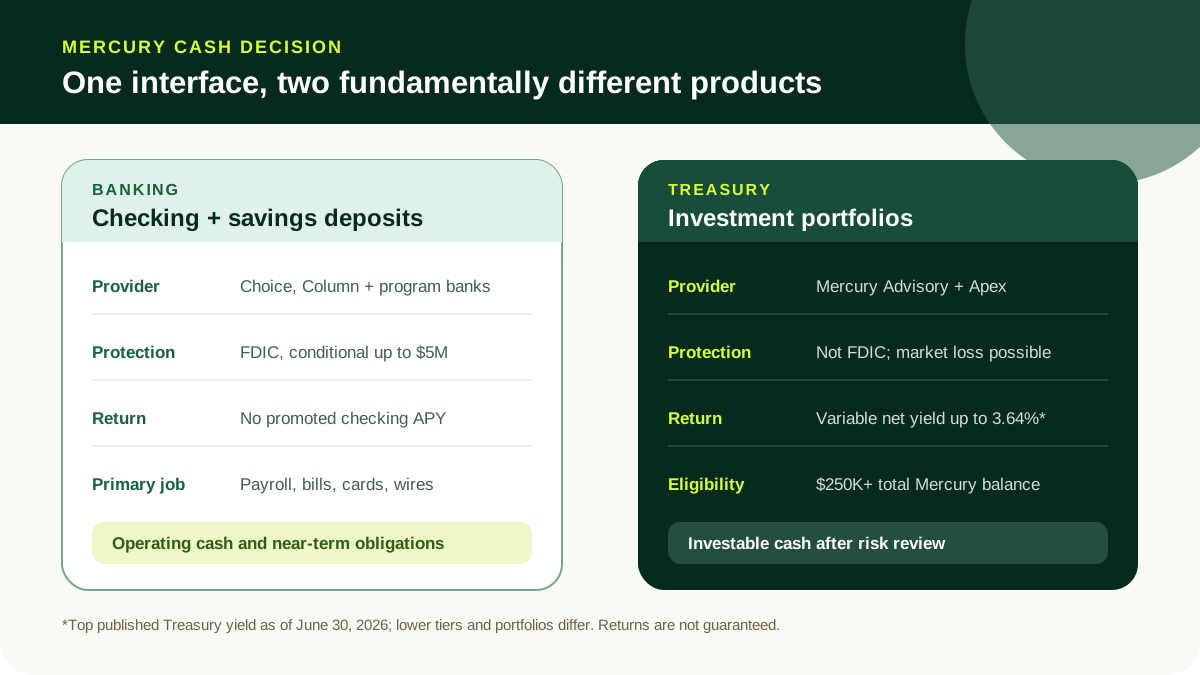
Mercury is not an FDIC-insured bank. Eligible checking and savings deposits are held through Choice Financial Group, Column N.A., and program banks. Mercury advertises up to $5 million in FDIC insurance through partner sweep networks.
The standard insurance limit remains $250,000 per depositor, per insured bank, per ownership category. Higher potential coverage depends on funds being placed across participating banks, pass-through eligibility, accurate records, and the customer’s other deposits at the same banks. Sweep disclosures warn that excess funds can be placed at a designated excess bank without full insurance after network capacity is reached.
A company with a large balance should review its current bank allocation, program-bank list, and any deposits held directly or through another intermediary. The $5 million statement is a program maximum, not a promise that every dollar is always insured.
FDIC coverage applies to eligible deposit loss if an insured bank fails. It does not cover transfer fraud, card disputes, platform downtime, Treasury investments, or the failure of a nonbank service provider.
Treasury: yield with investment risk
Yield scores 3.8/5. Mercury does not promote a conventional checking APY. Instead, eligible businesses with at least $250,000 across Mercury accounts can apply for Mercury Treasury, offered by Mercury Advisory LLC, an SEC-registered investment adviser.
The current Treasury page lists net yields ranging by total Mercury deposits and portfolio. As of June 30, 2026, the published table reaches 3.42% for a Treasury money-market portfolio and 3.64% for an ultra-short bond portfolio at more than $20 million. The $250,000-to-$2 million tier shows lower yields. Rates and returns change.
Treasury can allocate to a Treasury money-market fund or an ultra-short bond fund. Mercury describes same-day liquidity for the money-market option and one-to-two-day liquidity for the ultra-short option, but settlement, cutoffs, market conditions, and account review matter.
Securities are held through Apex Clearing. Brokerage protection, where applicable, is governed by SIPC rather than FDIC rules and does not protect against a decline in market value. Mutual funds can lose principal. Mercury’s advisory fee varies by portfolio and deposit level; published net yield already reflects the stated advisory fee but is not guaranteed.
Eligibility excludes or limits certain entity types and businesses. The current page requires a U.S. entity, a supported physical country, and the balance threshold; it also lists exclusions. Approval for banking does not guarantee Treasury access.
Integrations, cards, and controls
Integrations score 4.8/5. Mercury supports QuickBooks, Xero, NetSuite feeds, Stripe, bill workflows, invoices, expense reports, team cards, reimbursements, and a developer API. Its startup ecosystem includes investor and SAFE tools plus partner offers.
Administrators can create users, cards, spend policies, approval rules, and account permissions. That makes Mercury more operational than a basic account. It also creates governance work. A finance lead should separate account administration, payment creation, and approval; require multifactor authentication; restrict API credentials; and remove access during offboarding.
Accounting automation reduces entry but does not replace reconciliation. Invoice status is not the same as settled cash, card receipts need documentation, and cross-account transfers should not be recorded as revenue or expense. NetSuite-specific benefits should be compared with the paid plan price.
The IO charge card is a separate product with its own eligibility and repayment terms. A card offer, venture debt, or working-capital loan is not guaranteed merely because the business has a Mercury deposit account.
Onboarding and eligibility
Onboarding scores 4.5/5. Mercury’s application is digital and built around U.S.-registered companies. It can accept founders physically located in a published group of countries, but prohibited jurisdictions, industries, entity types, and risk profiles remain ineligible.
Prepare formation documents, EIN confirmation, ownership and control information, government identification, a physical operating address, business description, funding sources, and expected transaction activity. A registered agent or virtual address by itself may not satisfy the information requested.
Approval is not immediate for every applicant. Payments, mobile deposits, cards, credit, and Treasury can have separate limits or reviews. Start with a small transfer, validate routing instructions, create permissions, connect the ledger, test one domestic and one international workflow, and retain a secondary account during migration.
Customer support
Customer Service scores 4.2/5. Mercury provides a help center and authenticated support, while Pro includes a relationship manager. DollarScout did not submit or time support tickets, so the score reflects the documented channels, product complexity, and escalation paths rather than a promised response time.
Banking and payment issues can involve Mercury, Choice, Column, Wise, Apex, a correspondent, or a recipient bank. Save wire references, timestamps, beneficiary instructions, bank allocation records, screenshots, and correspondence. Identify whether the issue concerns a deposit, card, payment, investment, or credit provider before escalating.
Alternatives
Choose Bluevine when interest-bearing checking and small-business payment acceptance matter more than startup tooling. Choose Relay for many accounts, Profit First allocation, unlimited collaborators, and explicit approval automation. Choose Novo for a simple free account centered on more than 40 small-business integrations and Reserves.
Choose Lili or Found when built-in tax organization and bookkeeping are more valuable than sophisticated global payments. A traditional bank is preferable for cash deposits, branches, cashier services, or local relationship lending.
Who should use Mercury
Mercury is a strong candidate for businesses that:
- Operate digitally and rarely or never deposit cash.
- Send domestic and international USD payments.
- Need granular users, cards, approvals, invoices, and accounting connections.
- Are U.S.-registered with owners in supported locations.
- Can distinguish FDIC-insured deposits from Treasury investments.
It is easier to skip when branch access, routine cash deposits, guaranteed interest, simple one-provider responsibility, or local underwriting is essential.
Bottom line
Mercury earns 4.4/5. Its free banking platform is unusually capable, its permissions and integrations suit growing digital companies, and its payment reach is a real advantage. Conditional sweep coverage can protect larger operating balances when placement is understood.
The product demands precise boundaries. Paid plans are workflow subscriptions, international wires can create recipient costs, and Treasury is an investment account with market risk—not high-yield savings. Use core banking first, model any subscription from actual volume, inspect sweep allocation, and move only investable cash into Treasury after reviewing risk and liquidity.