
Bluevine at a glance
Bluevine Business Checking combines an online checking account with variable interest, sub-accounts, cards, bill pay, invoicing, payment acceptance, domestic and international transfers, and accounting connections. The product is aimed at small businesses that operate digitally but still need more payment and cash-handling options than a startup-only account.
The central decision is not simply whether Bluevine is free. The Standard plan has no monthly fee, but its 1.30% APY requires activity every calendar month. Plus and Premier charge monthly fees unless their separate waiver requirements are satisfied. A business should compare the interest and payment-fee savings with the plan charge using its own average balance and transaction mix.
| Review question | DollarScout finding |
|---|---|
| Best for | Small businesses keeping operating cash in checking and meeting recurring activity rules |
| Standard plan | $0 monthly; 1.30% APY on up to $250,000 only in qualifying months |
| Paid plans | Plus $30 monthly; Premier $95 monthly; each has published waiver conditions |
| Deposit protection | Up to $3 million through Coastal Community Bank and sweep-program banks, subject to conditions |
| Main limitation | Plan economics, cash-deposit fees, and APY eligibility require active monitoring |
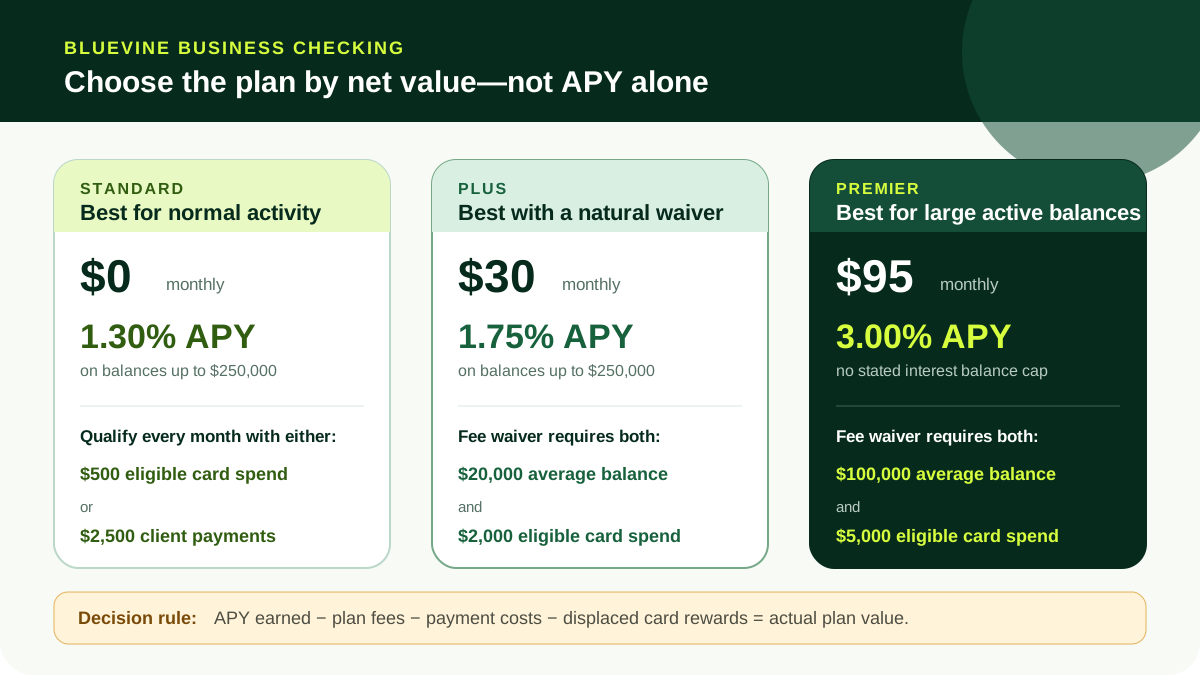
Plans and monthly fees
Fees score 4.4/5. Standard has no monthly service fee, no minimum opening deposit, no overdraft fee, unlimited transactions, free standard ACH, and free incoming ACH and wires. Those terms make it a credible primary account for a low-volume business without forcing a subscription.
Plus costs $30 per month. Bluevine’s current fee guidance says the charge is waived for a billing period when the business both maintains at least a $20,000 average daily balance and spends at least $2,000 with eligible Bluevine business cards. Plus discounts several payment fees, includes more sub-accounts and mailed checks, and earns its stated APY without a monthly activity test.
Premier costs $95 per month. The published waiver requires both a $100,000 average daily balance and $5,000 of eligible card spend during the billing period. Premier adds the highest APY, deeper payment discounts, more sub-accounts, more mailed checks, and priority support. A large balance alone is not enough to waive either paid plan if the card-spend condition is missed.
The waiver design matters. Keeping $100,000 idle solely to avoid a $95 fee can have a larger opportunity cost than the charge, while routing card purchases solely to satisfy a threshold can displace a more valuable rewards or credit workflow. Compare total dollars, not the word “waivable.”
Current APY and qualification rules
Yield earns 4.8/5 because interest is available directly on operating balances and the Premier cap is unusually broad. Bluevine’s terms effective March 12, 2026 list:
- Standard: 1.30% APY on total checking and sub-account balances up to $250,000, but only after meeting one monthly activity requirement.
- Plus: 1.75% APY on balances up to $250,000, with no separate activity test for interest.
- Premier: 3.00% APY on total balances with no stated interest-accrual cap and no separate activity test.
Standard qualifies by either spending at least $500 on eligible Bluevine business cards during the monthly eligibility period or receiving at least $2,500 in client payments through eligible ACH, wire, mobile deposit, or merchant-processor transfers. Transfers from an owner’s outside account, cash deposits, and checks drawn on the owner’s own accounts do not satisfy the client-payment test.
Posting dates control qualification. A transaction initiated at month-end but settled after the eligibility period counts in the next period. Reversed card transactions can invalidate the test. A business near the threshold should not budget interest until the dashboard confirms qualification.
APY is variable. For comparison, calculate interest after the monthly plan fee and any payment charges. At $20,000, a 0.45-percentage-point difference between Standard and Plus is roughly $90 annually before tax—far below twelve $30 fees—unless the Plus fee is waived or its operational discounts create additional value.
FDIC coverage and the fintech structure
Bluevine is a financial technology company, not an FDIC-insured bank. Banking services are provided by Coastal Community Bank, Member FDIC. Bluevine says eligible checking deposits can receive up to $3 million in FDIC insurance by spreading funds across Coastal and program banks.
That number is not a new $3 million limit at one bank. The standard limit remains $250,000 per depositor, per insured bank, per ownership category. Sweep coverage depends on pass-through requirements, the program-bank list, and other deposits the business already holds at those banks in the same ownership capacity. A company carrying more than $250,000 should review its Bluevine coverage dashboard, legal ownership details, and program-bank exclusions rather than relying on a headline.
FDIC insurance covers the failure of an insured depository institution, not fraud, merchant disputes, investment loss, operational downtime, or a payment sent to the wrong recipient. Bluevine lending and Treasury or advisory products have separate providers and protections.
Payments, sub-accounts, and integrations
Integrations score 4.4/5. Bluevine supports free standard ACH, bill pay, mobile check deposit, mailed checks, domestic wires, international payments, cards, payment links, invoicing, Tap to Pay, and automated accounts-payable workflows. Sub-accounts can separate tax, payroll, reserves, or project cash while remaining inside the Bluevine relationship.
The Standard fee schedule still includes transaction charges. Mailed checks cost $1.50, same-day ACH can cost $10, outgoing domestic wires can cost up to $15, and international payments can add fixed charges and foreign-currency conversion cost. Plus and Premier discount many of these items but do not make every payment free.
Bluevine documents connections with accounting and business tools and supports external-account linking. Integrations reduce duplicate entry, but the bank statement remains authoritative. Test whether payee data, memo fields, sub-account activity, and cleared dates map correctly into the business’s ledger before automating reconciliation.
Approval rules, team cards, and accountant collaboration can improve control. Permissions should follow job responsibilities, card limits should be specific, and payment approvals should not all depend on one unavailable owner. A software permission is an operational control, not a substitute for written authority and periodic review.
Cash and check deposits
Bluevine supports mobile check deposit and cash deposits through participating Allpoint+ ATMs and the Green Dot retail network. It is more cash-capable than several online-only competitors, but it does not behave like a branch teller network.
The current Allpoint+ fee is $1 plus 0.5% of the deposited amount. Green Dot locations can charge a retail service fee. Location limits, daily limits, barcode or card procedures, and availability timing can make recurring cash handling expensive. A cash-heavy restaurant or retailer should model the monthly dollar cost and staff time before replacing a local deposit account.
Mobile deposits are subject to eligibility, limits, holds, and review. Keep original checks until the deposit is final and follow the endorsement instructions shown in the app. A dashboard credit is not always the same as irrevocably available funds.
Application and onboarding
Onboarding receives 4.4/5. Bluevine accepts applications from eligible U.S.-registered businesses and supports some owners outside the United States. Applicants must be at least 18, represent a qualifying business, provide identity and ownership information, and pass verification and industry checks.
Prepare the legal name, EIN or tax information, formation records, physical business address, beneficial-owner details, source of funds, expected activity, and identification before applying. Marketing references a short application, not guaranteed approval or immediate unrestricted access. Limits and feature availability can depend on risk review, country, industry, and account history.
The cleanest onboarding sequence is to open the account, verify the routing details, make a small test deposit, configure roles, connect accounting, test one inbound and outbound payment, and only then redirect major receivables or payroll. Retain an alternative payment path during the transition.
Customer support
Customer Service scores 4.0/5. Bluevine publishes a help center and contact channels, while Premier includes priority support. DollarScout did not submit timed cases, so the score does not promise response speed or resolution quality.
Support boundaries matter in a partner-bank model. A transfer can involve Bluevine, Coastal Community Bank, a correspondent, a recipient bank, a card network, or a third-party payment provider. A useful escalation record includes the transaction ID, amount, dates, counterparty, status, screenshots, and the exact outcome requested.
Do not make priority support the only reason to pay $95 monthly. The plan should first work economically on yield, fee discounts, sub-account capacity, and operations. Support is valuable, but its benefit is difficult to quantify before a real incident.
Alternatives
Choose Mercury for a software startup or international digital business that values free USD wires, polished permissions, and startup integrations more than cash deposits. Choose Relay for Profit First-style account partitioning, many users, approval workflows, and savings accounts tied to a subscription tier. Choose Novo for a lightweight no-monthly-fee account centered on ecommerce and accounting integrations without checking yield.
Choose Found when sole-proprietor bookkeeping, tax estimates, contractor administration, and invoicing are more important than the maximum checking APY. A local bank or credit union remains a better primary option when cash, cashier services, branch verification, or in-person problem resolution dominates.
Who should use Bluevine
Bluevine is a strong fit for businesses that:
- Keep enough operating cash for checking yield to matter.
- Naturally satisfy Standard activity or a paid-plan waiver.
- Need sub-accounts, bill pay, cards, invoices, and accounting connections.
- Deposit checks digitally and handle only moderate cash.
- Understand how sweep insurance interacts with deposits at program banks.
It is easier to skip when card spend is low, client payments arrive irregularly, cash is deposited daily, branch service is essential, or paid-plan qualification would require artificial behavior.
Bottom line
Bluevine earns 4.4/5. Standard is a capable no-monthly-fee business account, and the current 1.30%–3.00% APY range can make operating cash productive. Payment tools, sub-accounts, cash options, and up to $3 million in conditional sweep coverage give it broader utility than many fintech checking products.
The best headline is not automatically the best plan. Standard can earn zero in a missed month, Plus and Premier require both balance and spend to waive their fees, and cash and accelerated payments carry charges. Use three months of actual balances and transactions to model interest, subscription cost, payment fees, and lost card rewards. Bluevine is compelling when the business qualifies through normal activity—not when the workflow must be distorted to fit the plan.