Relay at a glance
Relay is a financial technology platform that combines business checking and savings with debit and credit cards, team permissions, bills, approvals, expenses, invoices, cash-flow tools, and accounting integrations. Banking services are provided by Thread Bank, Member FDIC.
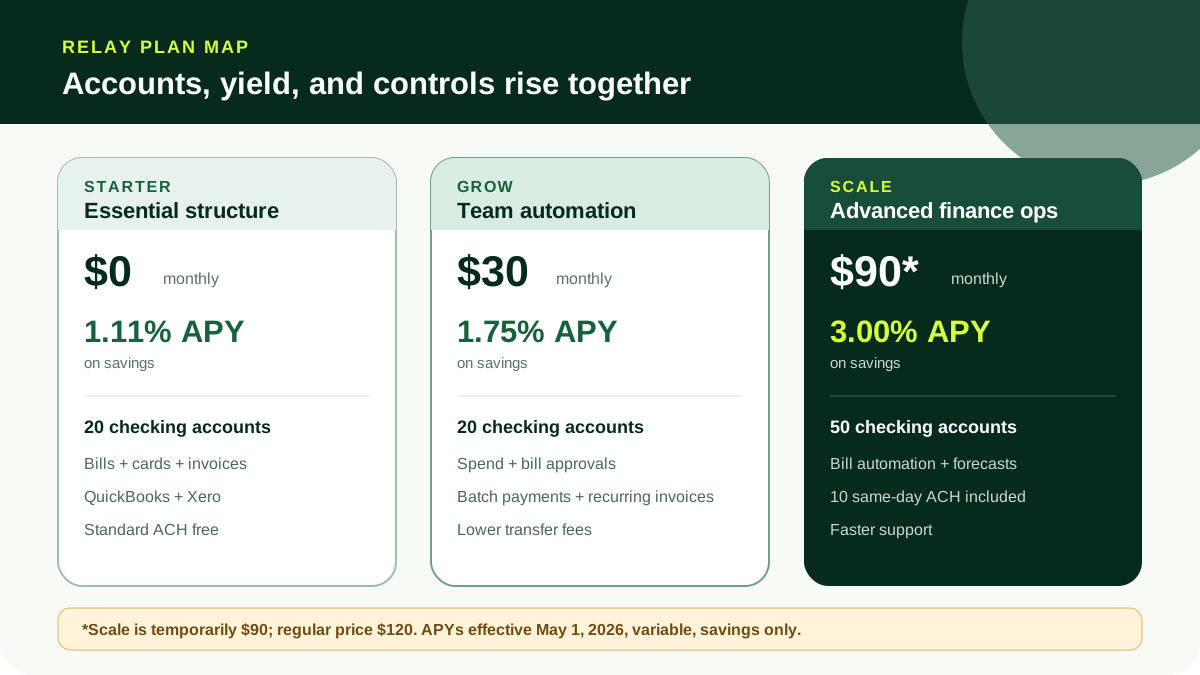
The platform is unusually focused on separating cash. Starter and Grow can provide up to 20 checking accounts; Scale can provide up to 50. Businesses can also use savings accounts, automatic transfer rules, and a Profit First structure. This works for agencies, contractors, property operators, ecommerce businesses, and teams whose accounting improves when payroll, taxes, profit, projects, and operating expense stay visibly separated.
| Review question | DollarScout finding |
|---|---|
| Best for | Teams and owners using multiple accounts, approvals, cards, and cash-allocation rules |
| Monthly plans | Starter $0; Grow $30; Scale currently $90, regularly $120 |
| Savings APY | 1.11%, 1.75%, or 3.00% by plan as of May 1, 2026 |
| Account capacity | Up to 20 checking accounts on Starter/Grow; 50 on Scale |
| Deposit protection | Up to $3 million through Thread Bank’s sweep network, subject to conditions |
| Main limitation | Best automation and yield require a paid plan; transaction fees vary by tier |
:::note Relay’s current pricing page dates the savings rates to May 1, 2026. Older support articles can show prior APYs. DollarScout uses the newer dated pricing disclosure and recommends confirming the rate in the application and account agreement. :::
Plans and monthly pricing
Fees score 4.2/5. Starter costs $0 and includes core banking, savings, cards, bill intake and management, multistep bill rules, receipts, invoices, payment links, automatic follow-ups, and QuickBooks and Xero connections.
Grow costs $30 per month and has a 14-day trial. It adds payment-fee discounts, configurable bookkeeping automation, spend approval requests, batch vendor payments, recurring invoices, card-on-file charging, and the ability to surcharge eligible card payments subject to applicable restrictions.
Scale is currently advertised at $90 per month for a limited time, down from a regular $120. It also has a 14-day trial. Scale raises checking capacity to 50, includes ten same-day ACH transfers monthly, adds bill-payment automation, cash-flow forecasts, higher savings APY and card cash back, partner offers, and faster phone and email support.
The temporary Scale price should not be modeled as permanent. A business should calculate value at $120, read the billing notice, and treat any discount as upside. Upgrading for a higher APY only works if additional interest, rewards, and fee savings exceed the subscription and tax effect.
Savings APY
Yield scores 4.4/5. Relay’s pricing footnote says rates are accurate as of May 1, 2026 and variable with the target federal-funds range. Starter savings earns 1.11% APY, Grow 1.75%, and Scale 3.00%. Fees may reduce earnings.
The rates apply to interest-bearing savings accounts, not every Relay checking balance. A business must move appropriate surplus cash into savings while leaving enough in checking for cards, bills, ACH, wires, checks, and unsettled transactions.
At a $50,000 average savings balance, the gross annual difference between 1.11% and 1.75% is about $320 before compounding and tax—less than Grow’s $360 annual subscription. Grow therefore needs workflow or payment savings as well. Between 1.11% and 3.00%, the gross difference is about $945, still below Scale’s regular $1,440 annual price. The break-even changes with balances and other benefits.
APY is not the only cash decision. Account separation can reduce errors, but money in many checking accounts earns no advertised savings APY. Auto-transfer rules should preserve payroll and payment liquidity and be reviewed after unusual revenue or expenses.
Payment and invoice fees
Standard ACH payments are free across the three plans. Same-day ACH costs $5 on Starter, $3 on Grow, and Scale includes ten per month before a $1 charge. Domestic outgoing wires cost $8 on Starter and $5 on Grow or Scale under the current plan table.
Local-network international wires cost $5, $3, or $1.50 by tier. SWIFT wires cost $25, $22, or $20, and currency exchange begins as low as 1%. Availability, supported currency, intermediary banks, compliance review, and recipient-bank fees still affect final delivery.
Relay invoices can accept cards at 2.9% plus $0.30. Pay-by-bank costs 1.00% on Starter, 0.75% on Grow, and 0.50% on Scale, capped at $10. A manual customer ACH push is free. Incoming wire payment requests cost $5. Grow and Scale can surcharge eligible card payments, but businesses must follow network and state rules and disclose the surcharge correctly.
Plan selection should use actual monthly counts. A business sending five domestic wires saves $15 monthly on Grow versus Starter—only half the subscription. Batch payments, recurring invoices, approvals, and bookkeeping automation must create the remaining value.
FDIC insurance and partner structure
Relay is not an FDIC-insured bank. Thread Bank provides deposit accounts and uses an IntraFi network to spread eligible balances. Relay advertises up to $3 million in FDIC coverage per business through this sweep program.
The standard limit is $250,000 per depositor, per insured bank, per ownership category. Coverage above that amount depends on funds being placed across network banks, pass-through requirements, and the business’s other deposits at those banks. Relay says customers are enrolled automatically and can opt out of the program or a bank by contacting support.
Its support article says amounts over the $3 million program maximum can be placed at an excess bank. Such excess placement may not be fully insured. Large depositors should inspect the current bank list and allocation, not infer that every balance is protected without limit.
Thread provides banking, while Unit is described as a technology layer. International payments can involve Community Federal Savings Bank, Nium, and Visa Global Services. Invoice cards and other functions use additional networks. The responsible provider and agreement vary by transaction.
Accounts, Profit First, and controls
Integrations score 4.7/5. Starter and Grow support up to 20 checking accounts and Scale up to 50, plus savings. Users can name accounts for income, operating expense, owner pay, taxes, profit, payroll, locations, clients, or properties. Automatic transfers can allocate a percentage or fixed amount.
Relay is the official banking platform promoted for the Profit First method. The software can implement the buckets, but the method is a management framework rather than a guarantee of profitability. Allocation percentages should reflect actual margins, tax obligations, debt covenants, and working-capital cycles.
Relay supports collaboration with employees, bookkeepers, and accountants, cards with spend policies, receipt collection, and approval workflows. Grow and Scale can create custom bill approvals based on vendor or amount. Relay notes that payments initiated outside the Bills section may not follow those bill-approval rules, so teams must choose the controlled path consistently.
QuickBooks, Xero, Gusto, Plaid, and Yodlee connections can reduce entry and improve account-level visibility. Multiple bank accounts still increase reconciliation count. Account transfers must be coded as transfers, and every statement should reconcile to the ledger.
Cash deposits
Relay supports cash in two networks. Allpoint+ ATMs can accept up to $1,000 per transaction without a Relay surcharge. Green Dot participating retailers can charge up to $4.95, often limit transactions to $500 and daily deposits to $1,500, with higher per-transaction capacity at Walmart.
This is more useful than a no-cash fintech but is not equivalent to commercial branch service. Availability, clearing time, denomination handling, receipts, and location limits matter. A cash-heavy retailer should compare the total time and per-deposit cost with a local bank’s monthly package.
Keep receipts until the deposit appears and reconciles. Staff who carry cash need written custody, limit, and exception procedures.
Onboarding and eligibility
Onboarding scores 4.4/5. Relay offers a digital application and does not require branch paperwork or a minimum balance. Eligible business types and owners must complete identity, beneficial-ownership, address, industry, and activity review.
Prepare formation documents, EIN or tax information, government identification, ownership percentages, operating address, business description, and expected flows. An online interface does not guarantee instant approval, a particular limit, credit eligibility, or immediate international access.
After opening, create a small account structure first. Test one ACH, card, invoice, bill approval, savings transfer, and accounting sync. Adding 20 or 50 accounts before naming conventions and ledger mapping are agreed can create more confusion than control.
Customer support
Customer Service scores 4.2/5. Relay provides a help center and customer-experience team, while Scale advertises faster phone and email support. DollarScout did not submit timed cases, so the score reflects documented access and the complexity of partner escalation rather than guaranteed response speed.
Save ACH trace numbers, wire references, invoice IDs, cash receipts, account statements, and approval records. State whether an issue concerns Thread deposits, a Relay workflow, Unit, an international provider, a card network, or an accounting connector.
Alternatives
Choose Bluevine when interest-bearing checking and payment acceptance outweigh the need for many accounts. Choose Mercury for startup-oriented global payments, APIs, advanced finance operations, and optional Treasury investments. Choose Novo for a simple free account centered on more than 40 small-business integrations and Reserve labels.
Choose Found or Lili when tax estimates, bookkeeping, or integrated tax workflows matter more than multi-account control. A branch bank is better for high-volume cash, teller services, or local relationship lending.
Who should use Relay
Relay is a strong candidate for businesses that:
- Benefit from many real checking accounts and named savings buckets.
- Delegate cards, bills, expenses, or accounting to a team.
- Use Profit First or another formal cash-allocation method.
- Can justify Grow or Scale with combined yield and workflow value.
- Want cash-deposit access without relying on branches.
It is easier to skip when one simple account is enough, paid automation would go unused, or full commercial cash and branch service is required.
Bottom line
Relay earns 4.4/5. It combines strong account structure, collaboration, approvals, invoices, accounting connections, competitive plan-based savings APY, and conditional sweep coverage. Starter is a credible free product, while Grow and Scale can replace operational software for the right team.
The decision is arithmetic and governance. Model the regular Scale price, keep checking and savings yield separate, include every payment fee, and document the route subject to approvals. Relay is most valuable when its many accounts clarify cash rather than merely multiplying balances and reconciliations.