Many products on this page are from partners who compensate us. This doesn't influence our ratings. Our opinions are our own.
Business Banking vs. Personal Banking
By Sophie Brown, Senior Finance Editor · Updated Jul 2026 · Fact-checked Jul 18, 2026
Business and personal bank accounts can use similar payment rails, but they represent different owners, records, permissions, and operating risks. A dedicated business account creates a clean boundary for revenue, expenses, taxes, and authorized users. The correct setup depends on the legal entity, transaction profile, account agreement, and deposit-insurance category—not simply the label printed on the account.
Key takeaways
- Route business receipts and expenses through an account titled and documented for the business activity.
- A separate account improves bookkeeping but does not by itself create an LLC, tax election, deduction, or liability shield.
- Business accounts commonly add user roles, payment controls, cash-management tools, and fee structures not designed for consumers.
- Sole-proprietorship deposits are generally aggregated with the owner’s single accounts for FDIC insurance, while qualifying legal entities can have separate business-category coverage.
- Reconcile the account monthly and document every owner contribution, draw, reimbursement, and transfer.
The important difference is ownership and purpose
A personal checking account records the financial activity of an individual or household. A business account records activity conducted for a trade, sole proprietorship, partnership, LLC, corporation, or other organization. Both may support ACH transfers, cards, checks, mobile deposits, and bill pay, but the account title and agreement identify who owns the deposit and which uses the institution permits.
The SBA recommends opening a business bank account when a business is ready to accept or spend money. IRS Publication 583 goes further on recordkeeping: it says a new business should open a business checking account, keep it separate from personal checking, use it for business purposes, identify deposit sources, and reconcile it monthly.
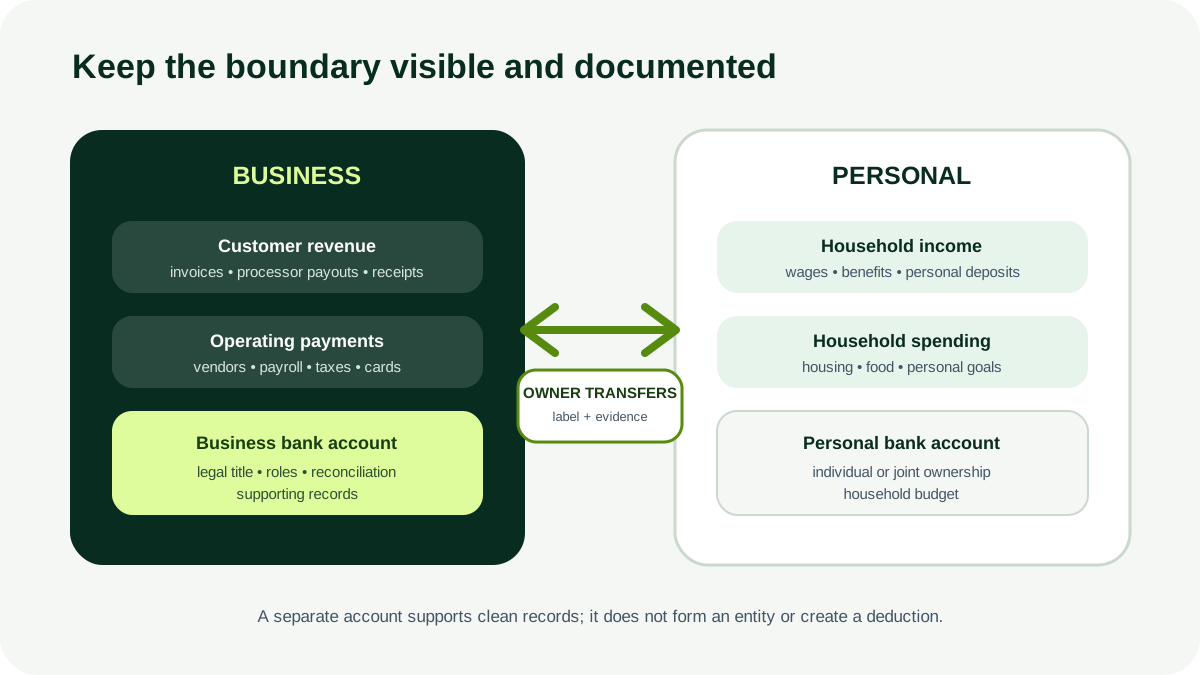
Side-by-side: what changes in practice
| Area | Personal banking | Business banking |
|---|---|---|
| Account owner | Individual or joint consumers | Sole proprietor, LLC, corporation, partnership, or organization |
| Main purpose | Household income, bills, saving, and spending | Customer receipts, vendor payments, payroll, taxes, and operating cash |
| Opening records | Personal identity and taxpayer information | Identity plus entity, ownership, license, and tax-ID documents as required |
| Access | Owner and joint owner | Owners plus role-based users, bookkeepers, or employees where supported |
| Controls | Alerts, card locks, transfers | Approval limits, dual control, user permissions, payment templates, positive pay where available |
| Pricing | Often monthly fee or waiver | May add transaction, cash-deposit, ACH, wire, and treasury-management fees |
| Insurance calculation | Based on personal ownership category | Depends on entity form and FDIC ownership category |
The word “business” does not guarantee every feature in the table. A basic online business account may have no branches, no cash deposits, and simple single-user access. A sophisticated treasury account may charge separately for ACH batches, wires, fraud controls, and information reporting. The current fee schedule and service agreement define the product.
Separation improves records, not the legal structure itself
Opening a business account does not form an LLC or corporation. Formation happens under applicable state law, and federal tax classification follows separate rules. Likewise, using a personal account for a business transaction does not automatically decide whether an expense is deductible. The underlying business purpose and supporting evidence matter.
The account is nevertheless an important operational boundary. It reduces the number of mixed transactions a bookkeeper must classify, makes gross receipts easier to trace, produces clearer financial statements, and helps explain owner cash movements. For a legal entity, consistent separation also supports the broader practice of treating the entity as distinct from its owners. State-law consequences vary, so owners should obtain entity-specific legal advice instead of treating a bank account as a complete liability-protection plan.
Use explicit transfer labels:
| Movement | Business books | Personal books |
|---|---|---|
| Owner funds startup costs | Owner contribution or loan, based on facts | Transfer to business, not personal consumption |
| Sole proprietor takes cash | Owner draw | Transfer received, not wage expense |
| LLC reimburses documented expense | Reimbursement under applicable policy | Repayment of supported business cost |
| Business pays personal bill | Owner distribution/draw or other proper classification | Personal expense; not disguised as business expense |
Ask a tax professional how a specific entity and election should classify compensation and distributions. An S corporation, partnership, single-member LLC, and sole proprietorship do not use identical owner-payment rules.
Opening documents reflect who the customer is
The SBA lists common documents such as an EIN—or an SSN for some sole proprietorships—formation documents, ownership agreements, and a business license. A bank may request more to satisfy identification, ownership, industry, address, and risk requirements.
For an LLC or corporation, form the entity with the state before applying for an EIN. The IRS provides EINs free and says an entity name on the application should match formation records. Keep the IRS confirmation, state filing, operating agreement or bylaws, assumed-name registration, licenses, and ownership information in one secure file.
Do not pay an unofficial site merely to obtain an EIN. Do not alter the entity name to fit an application without checking the formation record. Name mismatches across the secretary of state, IRS, bank, processor, and invoices can delay onboarding and tax forms.
Consumer and business protections are not interchangeable
Some federal consumer-account rules apply differently—or may not apply—to accounts established primarily for business purposes. Do not assume that a business debit card, unauthorized transfer, ACH return, check fraud, or payment dispute will receive the exact timing and liability treatment familiar from a consumer account.
Read the business deposit agreement and funds-availability policy. Establish internal deadlines for reporting suspicious activity that are stricter than the contractual deadline. Turn on alerts, restrict administrator rights, and review transactions daily when payment volume is material.
If multiple people can move money, use the least privilege needed. A bookkeeper who downloads statements may not need wire authority. A cardholder may need a low purchase limit but no ability to add users. When supported, require a second approval for new wire recipients or high-value ACH batches.
Fees should be modeled from actual activity
A no-monthly-fee account may still be expensive for a cash-heavy business. Another account with a monthly fee may include enough cash deposits, checks, ACH entries, and wires to be cheaper overall. Build a monthly model:
- Count expected incoming ACH credits and outgoing ACH debits.
- Estimate cash deposits by dollar amount and visit frequency.
- Count domestic and international wires in each direction.
- Add checks, bill-pay items, card users, and ATM usage.
- Include required minimum balances and the opportunity cost of idle cash.
- Price fraud controls, accounting feeds, payroll integrations, and extra users.
Run a normal month and a peak month. Seasonal volume can cross an included-transaction threshold even when the annual average looks low.
Deposit insurance differs by entity form
FDIC coverage is generally $250,000 per depositor, per insured bank, for each ownership category, subject to the rules and account records. A sole proprietorship has no separate legal identity for FDIC purposes: its deposits are insured in the owner's single-account category and aggregated with the owner's other single deposits at that bank.
A valid corporation, partnership, or unincorporated association engaged in an independent activity can qualify for the business/organization ownership category. The FDIC states that the category limit is not multiplied by the number of owners, members, partners, or account signers. Multiple operating, payroll, tax, and savings accounts owned by the same entity at one bank are combined within that category.
This distinction is easy to miss when a bank app shows personal and business accounts separately. Use BankFind to verify the legal insured bank and EDIE or direct FDIC guidance for material balances.
A clean operating routine
Deposit all customer receipts into the business account. Pay vendors and business cards from it. Avoid cash withdrawals without a receipt and written purpose. Store invoices, receipts, contracts, deposit records, and payment confirmations with the bookkeeping entry; a bank statement proves money moved but does not by itself prove a tax deduction.
At month-end:
- Reconcile the bank statement to the ledger.
- Investigate duplicate, missing, pending, or uncleared items.
- Classify owner contributions, draws, reimbursements, and loans.
- Match processor payouts to gross sales, fees, refunds, and chargebacks.
- Review user access, card limits, alerts, and unused payment templates.
- Compare operating cash with upcoming payroll, tax, debt, and vendor obligations.
For each business, keep a separate complete set of records. If one owner operates unrelated businesses, funneling all activity through a single account can defeat the clarity the account was meant to create.
When a personal account is not enough
Move to a business account before accepting customer payments under an entity name, adding employees or bookkeepers, processing meaningful cash or wire volume, connecting merchant services, or relying on an LLC or corporation as the contracting party. Also check the personal account agreement: many consumer accounts prohibit or restrict business use.
A new freelancer with one client and low volume may see little functional difference at first. The separation becomes more valuable as transactions, tax obligations, collaborators, and audit needs grow. Opening it early avoids a later migration of payment instructions and historical records.
Bottom line
Business banking is not a prestige upgrade to personal banking. It is an ownership, recordkeeping, permissions, and cash-control system. Use the correct legal title, keep business flows separate, document every boundary-crossing transfer, model fees from real activity, and calculate deposit insurance under the correct entity category. The result should make the books easier to prove and the money harder to misuse.
Related content
Frequently asked questions
Sources
Related content
More from DollarScout on this topic.
