Found at a glance
Found combines a business checking account with transaction categorization, receipt capture, profit-and-loss reporting, invoices, contractor management, tax estimates, automated allocations, and sub-accounts called Pockets. The combination is designed to reduce the number of systems a self-employed person maintains between getting paid and preparing records for taxes.
The product is broader than a free checking account and narrower than full accounting software. Found can organize activity and produce useful reports, but its accuracy depends on the income, expenses, classifications, adjustments, and outside transactions supplied by the owner. Complex inventory, accrual accounting, payroll, multi-entity consolidation, or tax filing can still require specialized tools and professional review.
| Review question | DollarScout finding |
|---|---|
| Best for | Sole proprietors and small businesses combining banking, bookkeeping, and tax planning |
| Current plans | Free $0; Plus $35 monthly or $315 annually; Pro $80 monthly or $720 annually |
| Current yield | None on Free; Plus 1.50% up to $20,000; Pro 2.50% with no stated cap |
| Deposit protection | Up to $250,000 through Lead Bank, Member FDIC |
| Main limitation | Tax and bookkeeping outputs are only as complete as the data and classifications entered |
Pricing and plan differences
Fees score 4.4/5. The core Found plan costs $0 per month with no required minimum balance. It includes business checking, physical and virtual debit cards, team cards with controls, up to ten Pockets, unlimited ACH, invoices, expense categorization, receipt scanning, tax estimates, contractor management, and core reports.
Found Plus costs $35 monthly or $315 annually. The annual option saves $105 against twelve monthly charges. Plus adds 1.50% APY on balances up to $20,000, external transaction imports, unlimited categorization rules and custom tags, more advanced bookkeeping and tax tools, and priority phone support.
Found Pro costs $80 monthly or $720 annually. It adds 2.50% APY on all balances with no stated cap, 1% eligible debit-card cash back, a dedicated account manager, a metal debit card after the trial and first successful billing, free mailed checks, and discounted outgoing wires.
Eligible users can take one 30-day trial of Plus or Pro. It auto-renews to the chosen subscription unless canceled. Found’s pricing page says cancellation returns the user to the free plan, which is preferable to losing basic account access, but export records and verify downgraded features before relying on that transition.
Other transaction charges still exist. Current pricing shows $15 outgoing domestic wires for Free and Plus, $10 for Pro, $1 mailed checks on Free and Plus, and free mailed checks on Pro. Instant transfers, ATMs, cash deposits, and other optional services can carry separate fees.
APY and plan economics
Yield receives 3.8/5. The free plan pays no APY. Plus pays 1.50% APY on balances up to $20,000, producing at most about $300 per year before tax if the rate and balance remain constant. That does not by itself recover the $315 annual subscription.
Pro pays 2.50% APY on all balances with no stated cap. At a constant $30,000 balance, that is about $750 annually before tax—close to the $720 annual price before considering cash back or operational features. At lower balances, a customer needs meaningful value from bookkeeping, support, checks, wires, or rewards to justify Pro.
Rates are variable, and fees reduce net earnings. The useful calculation is subscription cost minus interest, eligible cash back, displaced software cost, and time saved. Do not hold excess operating cash in a higher-tier account solely to make the subscription look economical; liquidity policy should follow business needs.
Found’s APY applies to the account under the current plan terms. Pockets organize balances but do not create independent coverage at a new bank. Interest does not replace a cash-reserve policy or investment decision.
Pockets and cash-flow controls
Pockets are sub-accounts inside Found. Every account starts with Primary and Taxes, and users can create up to eight more. Each Pocket has an account number and can receive allocations or direct deposits. Cards and bank payments can be associated with particular Pockets.
Percentage-based deposit allocations can divide incoming revenue among taxes, owner pay, payroll, operating expenses, projects, or a reserve. This is useful because the allocation happens when income arrives instead of waiting for month-end. The total remains part of the Found relationship and can be moved internally.
Pockets create visibility, not legal restrictions. A transfer or flexible-spending setting can make those funds available. Owners should still document which balances are restricted by contract, tax obligation, payroll timing, or internal policy.
The feature works best with a simple structure. Ten poorly maintained Pockets can obscure cash just as easily as one account. Define a purpose, funding rule, target, and review owner for each one.
Bookkeeping and integrations
Integrations score 4.4/5. Found categorizes transactions, captures receipts, identifies potential write-offs, supports rules, tags clients or projects, splits transactions, and produces profit-and-loss, income, expense, balance-sheet, and cash-flow information. Invoices and contractor payments bring receivables and 1099 workflows into the same activity record.
Free customers can use core categories, reports, and a limited number of custom rules. Ongoing imports from outside bank accounts, cards, and financial apps require Plus or Pro. That distinction matters when most business spending occurs on a separate rewards card: the free plan can leave Found’s books incomplete unless activity is added manually.
Accountant access allows a professional to view and edit activity, categorize expenses, create rules and tags, import transactions, export activity, and download reports. Accountants cannot send money, change the subscription, or alter account-level credentials. That permission model is more useful than sharing an owner login.
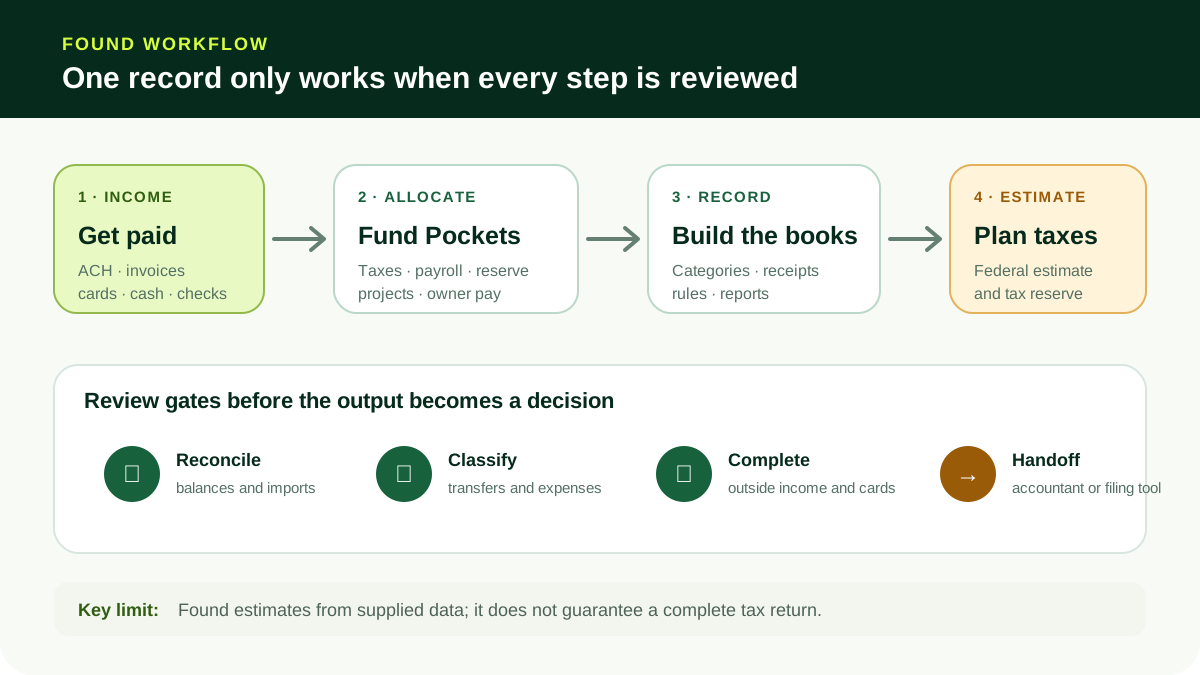
Reconciliation remains necessary. A rule can consistently apply the wrong category. An imported transaction can duplicate manually entered activity. Review uncategorized items, transfers, personal spending, owner contributions, reimbursements, and opening balances before trusting reports.
Tax estimates and payments
Found’s tax workflow is a differentiator. For eligible sole proprietors and single-member LLCs, it estimates federal income and self-employment taxes using the tax profile, recorded income, categorized deductions, adjustments, credits, filing status, and other information. The estimate updates as transactions change.
The Taxes Pocket can automatically reserve Found’s smart percentage or a fixed percentage of incoming business income. Plus and Pro subscribers taxed as sole proprietors can submit eligible quarterly federal estimated tax payments during Found’s published payment window. State tax payments are not supported through that workflow.
Entity limits matter. Found says the automated estimate is currently for sole proprietors; S corporations and other classifications can still save a chosen percentage but do not receive the same estimate. Payroll tax, sales tax, excise tax, multi-state filings, estimated-payment safe harbors, and entity-level returns can require separate work.
Found can generate tax records such as Schedule C information from entered data and can route users toward TurboTax or an accountant. It does not mean Found files every return or guarantees classification. The company repeatedly advises consulting a tax professional before tax decisions.
Invoicing and contractor management
Unlimited customized invoices are available on the free plan. Clients can pay through supported methods, and income received into Found can flow through deposit allocations. The app can also collect contractor W-9 information, track payments, and prepare 1099-related records.
That workflow reduces handoffs, but payment acceptance is not automatically free. Review processing fees, settlement time, dispute handling, refund procedures, and whether the client-facing options match the contract. A paid invoice should be reconciled to the actual deposit and processing deduction.
Contractor tools do not decide worker classification. A business remains responsible for determining whether a worker is properly treated as a contractor or employee, collecting accurate information, and meeting federal and state deadlines.
Cash deposits, cards, and payments
Found supports cash deposits at more than 79,000 participating retail locations through an app-generated barcode. The first cash deposit each month is free; later deposits cost $2 each. Current limits are up to $2,000 per rolling seven days and $4,000 per rolling 30 days, with merchant-level limits possible. ATM cash deposits are not supported.
This can handle occasional cash but is not a substitute for commercial cash management. A business approaching the rolling limit needs another deposit path. Keep the retail receipt until the balance is confirmed.
The account includes a Mastercard business debit card and supports team cards with spending controls. Physical and virtual cards can be linked to Pockets. Card limits reduce exposure but do not replace receipt policy, merchant review, and prompt offboarding.
FDIC insurance and account structure
Found is a financial technology company, not a bank. Banking services are provided by Lead Bank, Member FDIC. Found states that funds are FDIC-insured up to $250,000 per depositor for each account ownership category.
That is the standard insurance framework, not a multi-million-dollar sweep claim. The limit includes other qualifying deposits the same business may hold directly at Lead Bank in the same ownership category. Pockets do not multiply coverage because they are compartments within the Found account.
FDIC insurance covers insured-bank failure. It does not cover tax-estimate errors, card fraud outside applicable protections, a disputed invoice, or software availability. Users should enable available security controls and keep downloadable records.
Onboarding and support
Onboarding scores 4.7/5. Found supports sole proprietors and several registered entity types, including LLCs, S corporations, C corporations, and partnerships. The digital process asks for identity and business information and remains subject to verification and approval.
Set up the tax profile carefully, connect only relevant accounts, confirm opening balances, test one invoice and payment, define Pockets, and review classifications before importing a full history. Fast setup is valuable only when the starting data is correct.
Customer Service scores 4.2/5. Found provides app-based and email support, a detailed public help center, priority phone support on Plus, and a dedicated account manager on Pro. DollarScout did not time cases, so these are channel and plan differences rather than promised service levels.
Alternatives
Choose Lili for a broader plan ladder, savings APY, international wires for eligible entities, and role-based team access. Choose Bluevine when checking yield, sub-accounts, payment methods, and a larger sweep-insurance program matter more than integrated tax estimates. Choose Relay for many checking accounts, unlimited users, approvals, and Profit First-style structures.
Choose Novo for a free ecommerce- and integration-oriented account without a tax platform. An accountant plus a traditional bank can be the better arrangement when entity accounting, payroll, inventory, or tax complexity exceeds Found’s intended scope.
Who should use Found
Found is strongest for owners who:
- Receive 1099 or small-business income and want bookkeeping attached to banking.
- Will keep outside activity complete and reconciled.
- Need invoices, contractor records, Pockets, and estimated-tax reserves.
- Can justify a paid plan with workflow value, not APY alone.
- Deposit cash only within the retail limits.
It is easier to skip when the business needs branch service, cash deposits above the rolling limit, complex accrual accounting, payroll-led tax compliance, or multi-entity consolidation.
Bottom line
Found earns 4.3/5. The free plan is unusually complete, bringing banking, books, invoices, contractor administration, Pockets, and basic tax planning into one interface. Plus and Pro add real capability, support, and yield, while annual prices are transparent.
The system should be judged by record quality. If all business activity is captured, categories are reviewed, and the tax profile is accurate, Found can remove substantial administrative work. If outside cards, income, payroll, or entity obligations remain invisible, polished reports create false confidence. Start with one full month, reconcile it against source records, and ask an accountant whether the outputs are complete before making Found the operating source of truth.